How Long Each Loan Type Actually Takes to Close
Hard money closes in 5 to 10 business days. DSCR takes 21 to 30. New construction closes quickly but draws over 6 to 18 months. A real comparison table across all seven investment loan types, with the specific bottleneck at each stage.
Hard money and fix-and-flip loans close fastest, typically 5 to 10 business days when the file is clean. These are business-purpose loans for real estate investors, not for homeowners buying or refinancing a primary residence. DSCR rental loans take longer, usually 21 to 30 business days, because they require an appraisal with a rent schedule. New construction closes in a similar initial window but then draws against the budget over 6 to 18 months, so the total project cycle is much longer than a single closing date suggests. If your deal has a hard contract deadline, the loan type you choose is partly a timing decision.
This guide covers business-purpose investment loans only. It is not for a homeowner buying or refinancing a primary residence. Owner-occupied financing closes under a different regulatory framework and on a different clock. If that is your situation, this page does not apply to you.
Closing timeline by loan type
The table below covers all seven programs. The typical column assumes a clean file submitted with no missing documents. The stretched column reflects what actually happens when something slips.
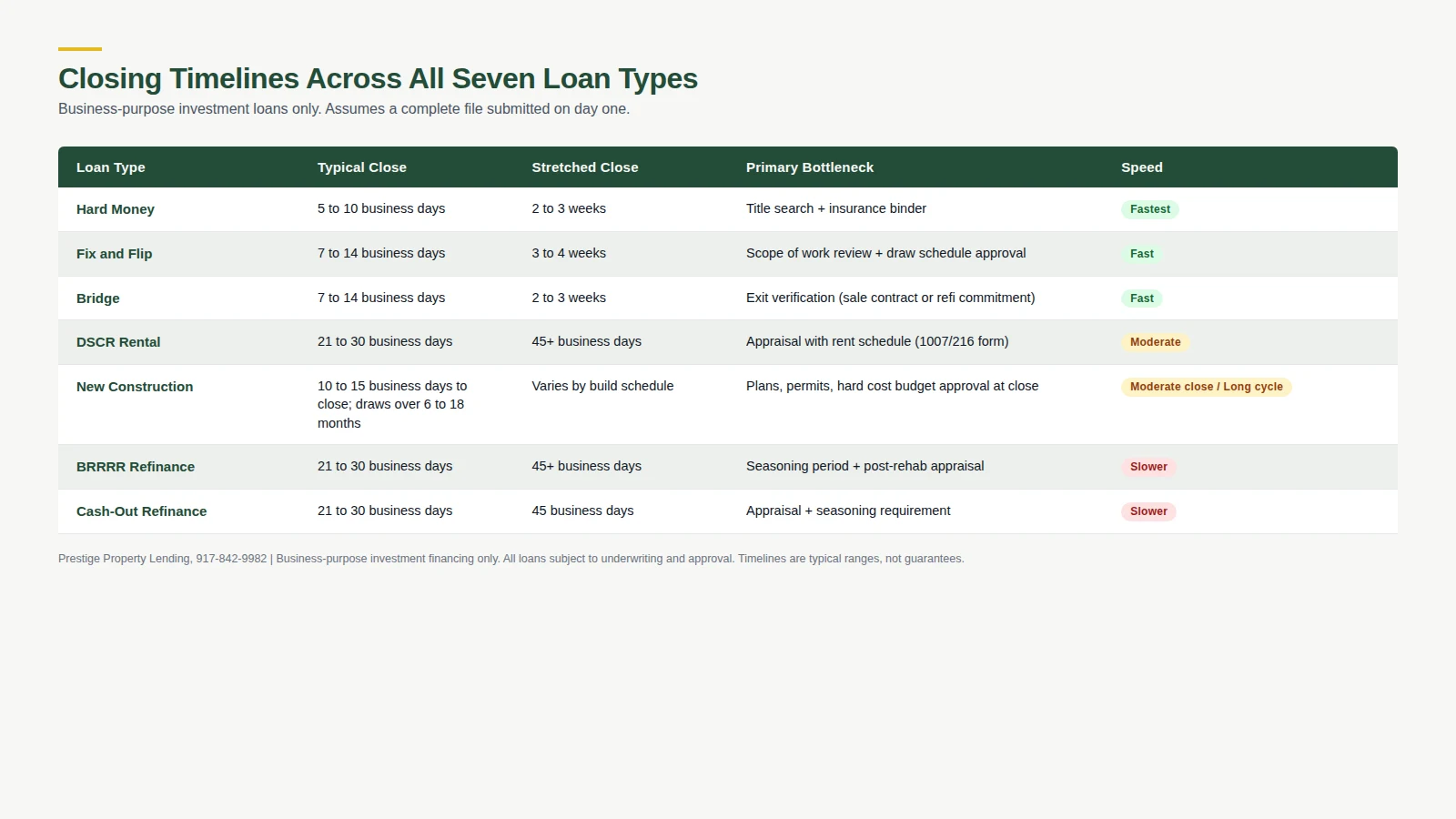
| Loan type | Typical close | Stretched close | Primary bottleneck |
|---|---|---|---|
| Hard money | 5 to 10 business days | 2 to 3 weeks | Title search and insurance binder |
| Fix and flip | 7 to 14 business days | 3 to 4 weeks | Scope of work review and draw schedule approval |
| Bridge | 7 to 14 business days | 2 to 3 weeks | Exit verification (sale contract or refi commitment) |
| DSCR rental | 21 to 30 business days | 45+ business days | Appraisal with rent schedule addendum |
| New construction | 10 to 15 business days to close; draws over 6 to 18 months | Varies by build schedule | Plans, permits, and hard cost budget approval at close |
| BRRRR refinance | 21 to 30 business days | 45+ business days | Seasoning period and post-rehab appraisal |
| Cash-out refinance | 21 to 30 business days | 45 business days | Appraisal and seasoning requirement |
Hard money: why it closes in a week
Hard money underwrites the asset, not the borrower’s income history. The lender needs three things: a clear picture of the property’s value, a title report with no clouds, and proof the borrower has the cash to close and carry. There are no tax returns to process, no income calculation, and no wait for a debt-to-income review.
The limiting factor is almost always the title search. In a county where the title plant is current, that takes two to three days. In a rural county where title must be searched manually from older records, it can take a week. The other variable is the insurance binder: getting a landlord or builder policy bound on short notice takes one to three days if your insurance agent is responsive and longer if they are not. These two steps run in parallel, but they both need to land before the closing can be scheduled.
A fix-and-flip loan is essentially hard money with a draw schedule attached. The initial close mirrors hard money speed. The lender also needs to review your scope of work and budget before they will release draws, but that review happens before closing, not after. A complete, itemized scope submitted at application shaves time off the review stage. See hard money loans for a full breakdown of what the underwrite looks at.
Want terms on a specific deal?Answer seven questions and get a decision in 72 hours.
Get FundingBridge loans: fast close, but the exit drives the real risk
A bridge loan for an investor closes in the same 7 to 14 business day window as hard money, because the underwriting logic is similar: asset value, clear title, borrower liquidity. What the lender also wants to see is a credible exit. If you are bridging to a sale, they want the purchase contract. If you are bridging to a refinance, they want evidence that the refinance is achievable at your target number.
The timeline risk on a bridge loan is not the closing, it is the extension. Most bridge loans carry a 12-month term. If the exit slips and you need a six-month extension, you are paying another 1 to 2 points on the full loan balance plus an elevated rate on the extended period. The all-in cost on a $500,000 bridge loan that extends six months beyond the initial term can add $12,000 to $18,000 in carry. Our post on what happens when a bridge loan exit slips walks through the full number set.
DSCR loans: the appraisal is the whole timeline
A DSCR loan is approved on the property’s rental income, not your tax returns. That eliminates much of the document-gathering that slows a conventional loan, but it introduces one firm dependency: the appraisal must include a rent schedule, sometimes called a 1007 or 216 form, that an appraiser physically completes after inspecting the property. You cannot compress that step by having a clean file.
In most markets, getting an appraiser scheduled takes 5 to 10 business days. The appraisal report itself takes another 3 to 5 days to complete. Underwriting then reviews the rent schedule against the proposed payment to confirm the DSCR calculation. On a clean single-family rental, that full sequence runs 21 to 30 business days from application. A rural or unusual property where qualified appraisers are scarce can push it past 45 days.
The two things that delay DSCR closings most often: an insurance binder that comes back with the wrong occupancy classification, and LLC paperwork that is incomplete when the file goes to underwriting. Both are fixable, but each adds 5 to 7 business days. Use the DSCR calculator to confirm your ratio before you order the appraisal. If the number is borderline, running it first saves you the appraisal fee on a deal that will not qualify. Full program details at DSCR rental loans.
New construction: two timelines, not one
When investors ask how long a construction loan takes to close, they usually mean the initial funding event. That is 10 to 15 business days for a straightforward ground-up spec build with complete plans, a fixed-price contract, and permits already pulled. The lender is underwriting a future value, so the appraisal comes back as a subject-to-completion figure and that is the main moving part at close.
But the construction loan is not paid out at close. It is disbursed in draws over the life of the project, typically 6 to 8 draws spread across 6 to 18 months. Each draw requires a site inspection to confirm the work is done before the next draw can be requested. The total time from application to fully drawn is the real timeline, and it has as much to do with your build schedule as with the lender.
Interest during construction accrues only on what has been drawn, not on the full loan amount. A $600,000 construction loan that is 40 percent drawn in month four carries interest on $240,000, not $600,000. If you miscalculate your draw timing, you can run short between inspections because the reimbursement model means you fund the work first and get paid back afterward. Our post on interest reserves on construction loans explains the cash-flow math in detail. Program overview at new construction loans.

BRRRR and cash-out refinances: the seasoning wait
Both of these sit in the 21 to 30 business day range for the same reason as DSCR: they require an appraisal, and the appraisal cannot be ordered until the property is in a condition the appraiser can evaluate. For a BRRRR refinance, that means the rehab must be substantially complete before you submit the application. Trying to rush the refinance before the work is done usually produces an appraisal that comes in below the ARV, which defeats the purpose of the whole strategy.
The seasoning requirement adds a separate clock. Most lenders want to see 3 to 6 months of ownership before they will do a cash-out refinance on an investment property. If your BRRRR plan calls for a refinance in month two, confirm the lender’s seasoning policy before you commit to that exit. Our post on BRRRR refinance seasoning requirements covers which lenders use which thresholds and why it varies.
Three things that add two weeks to any file
Across all loan types, three factors account for most of the avoidable delays we see.
An incomplete document package at submission. The underwriter can only work with what is in the file. Missing bank statements, a missing operating agreement, or a scope of work that lists labor but not materials sends the file into a back-and-forth cycle that adds a week per round. Get everything in on the first submission. Our post on what lenders check before they issue a term sheet has the full list by loan type.
Title issues discovered mid-process. An IRS lien, an unrecorded easement, or a prior owner’s mortgage that was never discharged can stop a closing cold. A preliminary title report takes one to two business days and surfaces any of these before you have a hard closing date. Order it at application, not a week before close.
A change to the deal after term sheet. If the purchase price drops post-inspection, the lender has to re-underwrite the loan amount. If the scope of work expands, the construction budget has to be re-approved. Mid-stream changes are legitimate, but they restart part of the clock. If you know the scope is likely to change, say so at application rather than delivering the news after approval.
When the timeline is wrong for your deal
These loans are not for everyone, and not for every timeline. If you have a contract with a 10-day close and no extension option, a DSCR loan will not get there. Hard money can close in that window with a clean file, but the rate and points will be higher than a DSCR loan. That cost difference is the premium for speed, and it is real: on a $400,000 purchase, the financing cost gap between a hard money close and a DSCR close is typically $8,000 to $15,000 over a 12-month hold, depending on the rate environment when you borrow.
If you are refinancing an existing rental and the deal is not time-sensitive, rushing into a hard money bridge to avoid the 30-day DSCR window usually costs more than waiting. Run the numbers on both options before committing to one.
If you are an owner-occupant looking to buy or refinance your primary residence, none of these programs apply to your situation. Business-purpose investment financing operates outside the consumer mortgage framework, and that includes the timeline. These loans close faster because they skip the regulatory steps that consumer loans require, not because lenders are cutting corners.
For a deal with a hard close date, call 917-842-9982 and describe the situation. The fastest realistic path to funding depends on the specific property, the file you have ready, and the contract terms. A five-minute call before you sign the contract is worth more than a two-week scramble after.
Common questions
Can a hard money loan really close in 5 days?
Yes, on a straightforward purchase with no title issues, an existing insurance agent, and a complete document package submitted on day one. The main variables are the title search (faster in metro counties with current title plants, slower in rural counties) and the insurance binder. Five days is achievable but requires everything to move without any back-and-forth. Ten business days is a more reliable target to build a contract around.
What is the fastest way to close a DSCR loan?
Order the appraisal the day you submit the application, submit a complete LLC document package upfront, and get your insurance binder issued with the correct non-owner-occupied occupancy classification before underwriting reviews the file. Clean files from experienced investors can close a DSCR loan in 14 to 18 business days. The appraisal is the one step you cannot compress, so the earlier it is ordered the better.
How does a construction loan closing differ from a regular loan closing?
The initial close looks like a standard purchase closing: you sign loan documents, title records the deed of trust, and the lender funds the initial deposit or land acquisition. The difference is what happens next. The bulk of the loan is held in a construction escrow and released in draws as work progresses, each draw requiring a site inspection. You are not receiving the full loan amount at close.
What happens if I cannot close by my contract deadline?
Most purchase contracts allow the buyer to request an extension, though sellers are not required to grant one. If the delay is on the lender side, ask your loan officer for a specific reason and a revised timeline in writing. If the seller will not extend and you cannot close, you may lose your earnest money deposit unless the contract has a financing contingency that covers the delay. Always include a financing contingency on any purchase where the close date is aggressive relative to the loan type.
Does a bridge loan close faster than a DSCR loan?
Yes, significantly. A bridge loan closes in 7 to 14 business days because it underwrites asset value and exit plan, not rental income. A DSCR loan closes in 21 to 30 business days because it requires an appraisal with a rent schedule addendum that cannot be rushed. If you have a hard deadline under three weeks, a bridge loan is the only product that can reliably meet it.
Ready to fund your next deal?
Approval within 72 hours. Close in 5 to 10 business days.
Get Funding Now