Interest Reserve on a Construction Loan: How It Works and What Happens When It Runs Out
An interest reserve is the line item in your construction budget that pays your monthly interest during the build. Here is how lenders calculate it, what it adds to your loan, and what happens when it runs out before the certificate of occupancy arrives.
An interest reserve is the line item in your construction budget that pays your monthly interest during the build. The lender holds the money, draws from it monthly against your loan balance, and you do not write a check for those payments while the property is under construction. If the reserve runs out before the certificate of occupancy arrives, you write the check anyway, or you are in default.
This post is for real estate investors financing a ground up build or a major renovation through a business-purpose construction loan. If you are building a home you intend to live in, this is not the right loan type and this is not the right post.
What an interest reserve actually is
When you close a construction loan, you do not receive the full loan amount on day one. Money is released in draws as work is completed and inspections pass. That draw-by-draw structure creates a problem: interest is accruing on your outstanding balance every month, but you have no rental income coming in to pay it because the property is not yet finished.
An interest reserve solves that problem by budgeting the expected interest cost into the loan itself. The lender holds a reserve account funded from loan proceeds, and each month the interest payment is swept from that reserve rather than from your operating account. You still owe the interest. It is still adding to your loan balance. But you are not sending a wire every 30 days while your GC is framing walls.
Not every lender requires one. Some prefer that borrowers pay interest out of pocket monthly, which keeps the loan smaller but demands more liquidity on your end. Whether a reserve is required, optional, or unavailable depends on the lender and the loan structure. Call 917-842-9982 to talk through how it applies to a specific deal.
How the calculation works
The reserve is sized on two inputs: the expected interest you will owe over the construction term, and a buffer for overruns.
The formula lenders use:
Interest Reserve = Loan Amount x Average Percent Outstanding x Annual Rate x (Months / 12)
The “average percent outstanding” is where most borrowers get confused. On day one you have drawn nothing. By the end of the build you have drawn most of the loan. The average across the full term is roughly 50 percent, which is where the common rule of thumb comes from: use half the loan amount as your average balance for sizing purposes.
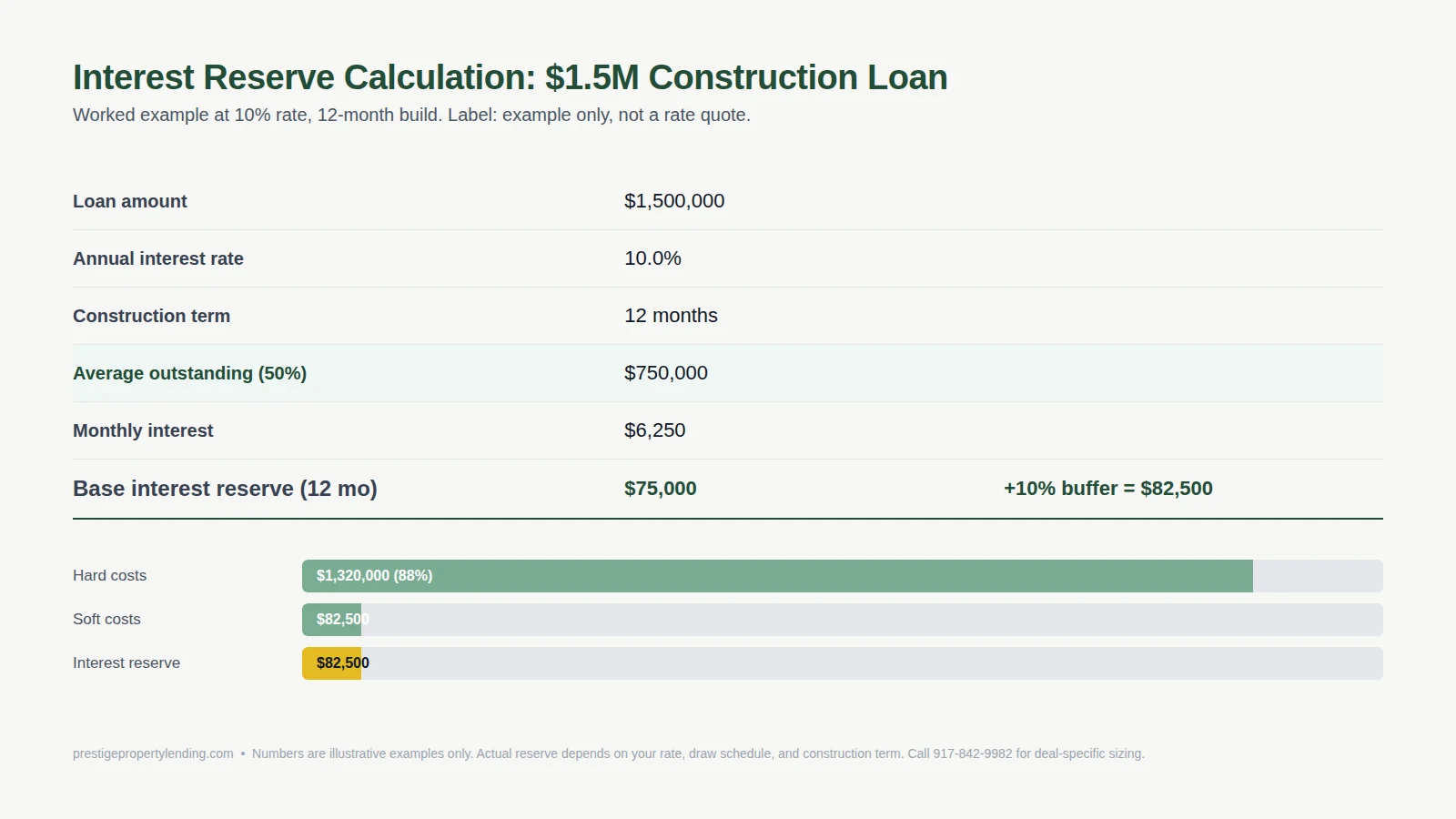
Worked example, labelled as such. A $1.5 million construction loan at 10 percent over a 12-month build:
- Average outstanding balance: $1,500,000 x 50% = $750,000
- Monthly interest: $750,000 x 10% / 12 = $6,250
- 12-month reserve: $6,250 x 12 = $75,000
Most lenders pad that estimate by 10 to 15 percent to account for draws running ahead of schedule or rates moving on a floating-rate loan. On the example above, a 10 percent buffer takes the reserve line to $82,500.
That $82,500 is part of your total loan amount. You are borrowing the money that pays the interest on the money you are borrowing. It increases your LTC and your total cost of the project. If you fund that $82,500 out of pocket instead, your loan is smaller, your total interest basis is smaller, and your carry cost over the life of the project is lower. Most investors take the reserve anyway because it protects liquidity during a build, when surprises are expensive.
Use the hard money loan calculator to model how the reserve line changes your total loan amount and points paid at different rate assumptions.
Want terms on a specific deal?Answer seven questions and get a decision in 72 hours.
Get FundingWhat actually moves the reserve size
| Variable | Effect on reserve |
|---|---|
| Loan amount | Directly proportional: a larger loan means a larger reserve at the same rate and term |
| Interest rate | Directly proportional; floating-rate loans add basis risk if SOFR moves during the build |
| Construction term | Each extra month adds roughly one month of interest at the average outstanding balance |
| Draw schedule shape | Front-loaded draws raise the average outstanding balance above 50%, increasing the reserve |
The draw schedule shape is the variable most investors underestimate. A ground up build where site prep and foundation work consume 40 percent of the budget in the first two months will carry a higher average outstanding balance than the simple 50 percent rule assumes. If your GC’s budget is weighted heavily toward early phases, your lender may size the reserve at 55 or 60 percent of the loan rather than 50.
Floating-rate loans add another dimension. If your loan is priced at SOFR plus 400 basis points and SOFR moves 75 basis points over the build, your reserve can go short without any fault in the construction schedule. Lenders typically build a rate buffer into the padding percentage, but verify it when you review the loan budget line by line.

When the reserve runs out before the project finishes
This is the failure mode nobody prints, so here it is plainly.
An interest reserve is sized at underwriting on an assumed schedule and rate. If the build runs three months over, a reserve designed for a 12-month project may be exhausted by month 12 with three months of payments still to go. When the reserve is depleted, monthly interest reverts to you. The lender does not extend the reserve automatically, and they are not required to.
The typical sequence: the build runs long, the reserve runs dry, the lender calls for current interest payments, and the borrower must pay out of pocket or negotiate a loan modification. Modifications on construction loans carry fees, typically 0.5 to 1.5 percent of the loan amount per extension period, plus the additional interest expense on the now-larger loan balance.
A three-month extension on a $1.5 million loan at those fee ranges adds $7,500 to $22,500 in modification fees. On top of that, you are now paying the monthly interest out of pocket for the duration of the extension, because the reserve is gone. On the worked example above, that is another $18,750 in interest across three months. Total extension cost in this scenario: $26,250 to $41,250, before any hard cost overruns on the project itself.
The risk is not abstract. Construction timelines extend for reasons outside your control: permitting delays, weather, subcontractor defaults, supply chain issues. Size the reserve for the schedule you expect plus a realistic buffer, not the optimistic one. And read the modification process in the loan documents before you close, so you know what the process looks like before you need it.
For more on what drives draw timing and inspection delays, see how a ground up construction loan works for an investor.
How the reserve interacts with your loan budget
The reserve is a soft cost line item in your sources and uses table. It counts toward your total project cost, which affects your LTC calculation.
If your total project cost is $2 million and your lender is at 80 percent LTC, the maximum loan is $1.6 million. If the interest reserve is $82,500, that amount is available for the interest payments but not for framing and drywall. Your effective hard cost coverage from the loan is $1.6 million minus the reserve, minus other soft costs.
Run this before you finalize the budget. A reserve that is sized too large can squeeze hard cost coverage and force additional equity into the deal at closing. The new construction loan program page covers how LTC tiers typically work and what the reserve structure looks like at different loan sizes.
One more interaction worth noting: if your hard cost contingency and your interest reserve are both underfunded, you have two correlated risks. A schedule overrun costs money in carry (reserve) and often costs money in hard costs (contingency), because delays frequently come with additional labor or material costs. Both lines should reflect the risk in the project, not the number that makes the budget work on paper.
When to pay interest out of pocket instead
An interest reserve increases your loan balance and your total carry cost. On a short build with a lower loan amount, paying interest out of pocket each month can cost less overall and keeps your LTC lower, which may get you better pricing. If you have the liquidity and the build is projected at six months or under, model both options before you decide.
If you are a first-time builder with a thin contingency, a reserve sized on the optimistic schedule is a specific trap. Three months of unexpected delays on a $1.5 million loan at current market rates carries roughly $18,750 in interest beyond the original reserve estimate. If that money is not sitting in a separate account, you will need to negotiate a modification under time pressure, which is the worst position in any real estate lending conversation.
Presold projects where an end buyer is waiting for the certificate of occupancy carry a different risk: the buyer’s rate lock has a deadline. If your interest reserve runs short and the project extends, you may be absorbing carry costs while the buyer renegotiates their purchase financing or walks. Plan the schedule conservatively when a buyer is on the other end of the timeline.
For a full picture of what it costs when a construction deal slips, read the post on what moves construction loan rates for investors in 2026 alongside this one. Rate and term interact with reserve size in ways that are easier to see when the rate mechanics are clear.
Common questions
Is the interest reserve part of the loan amount or separate from it?
It is part of the loan amount. The lender includes it in the total loan at underwriting, which means you pay interest on the reserve itself, and it counts toward your loan-to-cost ratio. This is why some borrowers with strong liquidity choose to fund the reserve out of pocket rather than borrowing it.
What happens to unspent interest reserve at the end of construction?
It depends on the loan structure. Most construction loans reduce the outstanding loan balance by any unspent reserve, which lowers the amount you convert or refinance. Some lenders allow you to apply it as a credit toward closing costs on the permanent loan. Read the modification agreement before you assume either treatment.
Can you increase the interest reserve after closing if the build goes long?
Yes, through a loan modification. The lender will require an updated budget, a revised schedule, and usually an appraisal update confirming the project still pencils at the new loan amount. Modification fees typically run 0.5 to 1.5 percent of the loan amount. The process takes weeks, not days, so do not wait until the reserve is exhausted to start the conversation.
Does a DSCR loan have an interest reserve?
No. A DSCR loan is a stabilized rental loan where the property is already producing income to service the debt. The interest reserve concept applies to construction and heavy rehab loans where the property is not yet income-producing. If you are building a rental and want to hold it on a DSCR loan after completion, the construction lender handles the interest reserve during the build; the DSCR lender that refinances you out does not.
What is the difference between an interest reserve and a contingency reserve?
They cover different risks. The contingency covers unexpected hard cost overruns: bad substrate, hidden mechanical issues, material price spikes. The interest reserve covers the cost of time: as long as the project is active, interest is accruing. A project can be perfectly on budget for hard costs and still exhaust its interest reserve if the schedule runs long. Budget both separately, because both can be needed at once.
Ready to fund your next deal?
Approval within 72 hours. Close in 5 to 10 business days.
Get Funding Now