How a Ground Up Construction Loan Works for an Investor
Ground up construction money is released backwards: you pay the subs, an inspector verifies the work, then the lender reimburses you. Here is the draw schedule, the cash float it creates, and the ratio that actually sets your down payment.
A ground up construction loan funds a build you do not yet own the finished version of, and it funds it backwards. You pay the subs, an inspector verifies the work, and only then does the lender reimburse you. Expect 80 to 90 percent of total cost, interest charged on the drawn balance only, and a 12 to 18 month term with a hard maturity date.
This is a business purpose loan for investors building spec homes, small multifamily, or a rental they intend to hold. If you are building the house you plan to live in, this is the wrong article and we are the wrong lender. Owner occupied construction is a consumer mortgage governed by TILA and RESPA, and it works differently in almost every respect that matters.
The draw schedule is the product
Everything else about a construction loan is a detail attached to the draw schedule. It is the part that decides whether the deal works, and it is the part first time builders consistently misread.
A conventional loan hands you the money at closing. A construction loan approves a maximum and then releases it in tranches tied to completed milestones. Here is a real shaped example on a $420,000 project at 85 percent loan to cost.
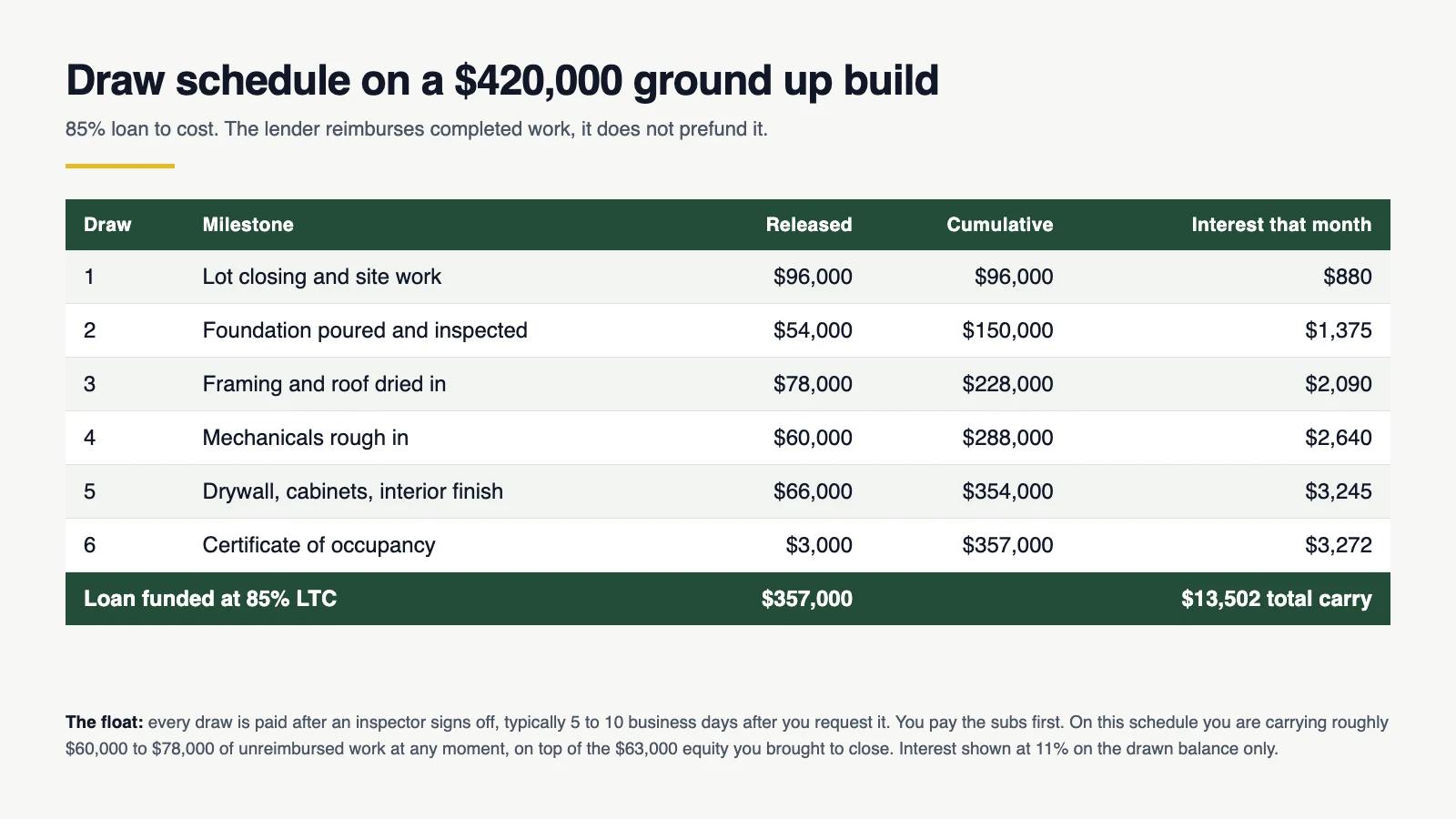
Read the last column. Interest accrues only on what has actually been released, so month one costs $880 and month five costs $3,245. That is why the total carry on a $357,000 loan comes to roughly $13,500 rather than the $39,000 you would pay on a fully funded balance for a year. It is the single most misunderstood favourable feature of the product.
Now read the note underneath it, because that is the part that hurts.
Reimbursement, not prefunding, and the float it creates
The lender does not send money to the jobsite in advance. You or your builder pay for the framing package, then you request a draw, then an inspector visits, then the funds release. Five to ten business days is normal. Two weeks is common at the end of a quarter.
So at any point on the schedule above you are carrying somewhere between $60,000 and $78,000 of work you have paid for and not yet been reimbursed for. That is on top of the $63,000 of equity you brought to the closing table. Budget for the float, or you will stall at the mechanicals draw with a framer who will not come back.
Two things reduce the pain and both are worth negotiating for before you sign:
- More, smaller draws. Six draws on a $420,000 build is reasonable. Four is a cash flow problem. Ask for the schedule in writing with the milestone definitions spelled out, not just the dollar amounts.
- An interest reserve. Some lenders will hold back part of the loan to make your own interest payments during construction. It increases your loan and your total cost, and it means a bad month does not turn into a default.
Want terms on a specific deal?Answer seven questions and get a decision in 72 hours.
Get FundingHow much cash you actually bring
This is where term sheets get read wrong. Three different ratios describe the same deal and they do not produce the same number.
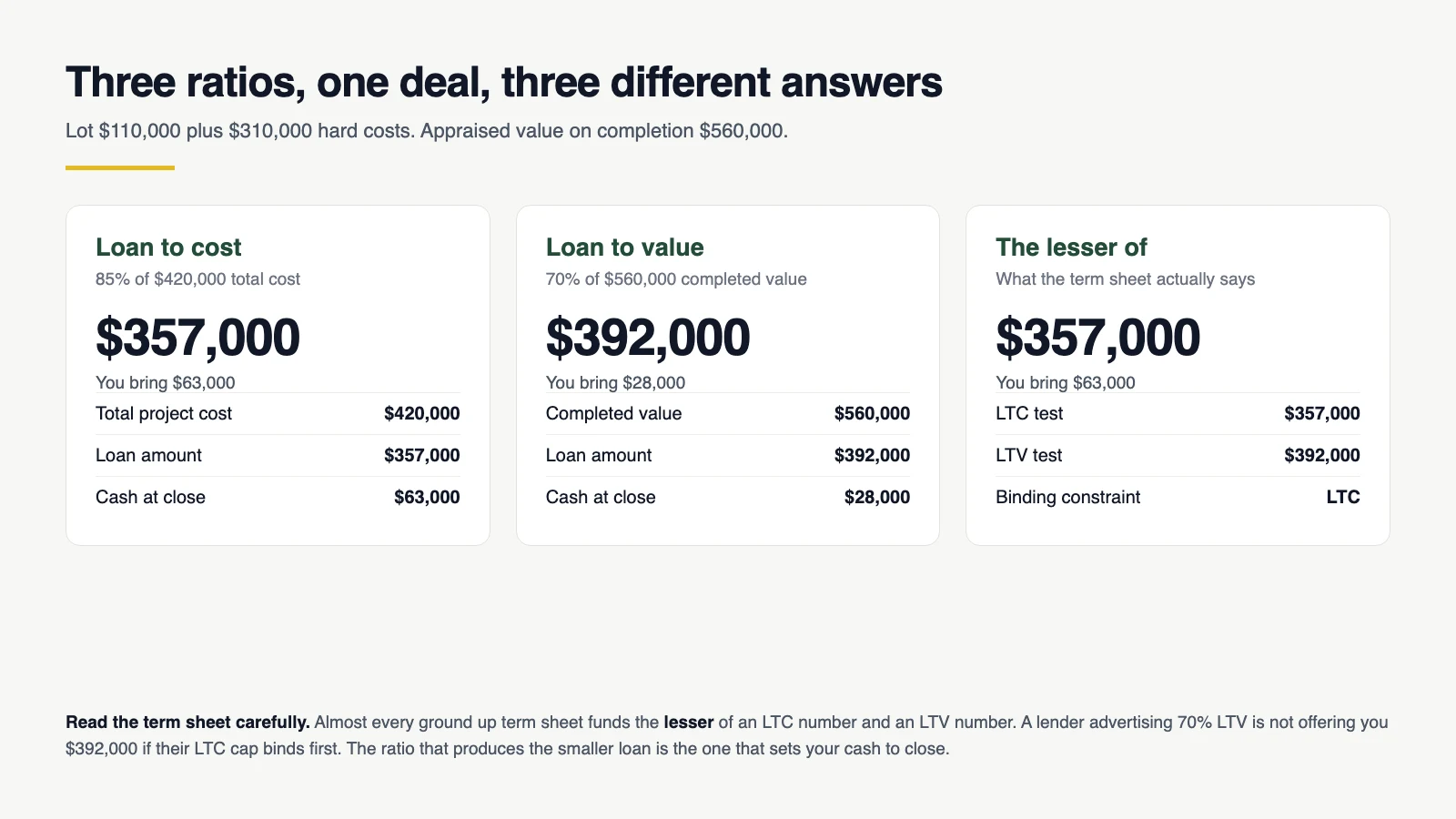
Almost every ground up term sheet funds the lesser of a loan to cost number and a loan to value number. A lender advertising 70 percent LTV is not offering you $392,000 on this deal if their 85 percent LTC cap binds first. The ratio that produces the smaller loan sets your cash to close, and it is usually LTC on a ground up build because the profit is not built yet.
Where the lot came from also changes the arithmetic. If you bought the land two years ago for $70,000 and it now appraises at $110,000, most lenders will count the appraised value toward cost, which means your $40,000 of appreciation counts as equity you never have to write a check for. Say so early in the conversation. It is the cheapest $40,000 you will ever find.
What underwriting actually looks at
A ground up file is underwritten on four things, roughly in this order.
| What | What a strong file looks like | What gets a file declined |
|---|---|---|
| Builder experience | Three or more completed projects of similar scope in the last three years, with addresses | First build, no licensed GC under contract, or a GC with no comparable work |
| The budget | Line item hard costs from the GC, a 10 percent contingency, permits already pulled or in process | A one page estimate, no contingency, soft costs missing entirely |
| The appraisal | Subject to completion value supported by finished comps within a mile | No comparable new construction, or a value that only works if the market moves |
| Liquidity | Cash to close plus the float plus six months of carry, verifiable | Exactly the down payment and nothing behind it |
The liquidity test is the one that surprises people. A lender is not asking whether you can close. They are asking whether you can survive a two month delay on the certificate of occupancy, because that delay happens on a meaningful share of builds and it is the difference between a project that finishes and a project that becomes their problem.
The exit is underwritten before the loan is
A construction loan has a maturity date and no amortisation. On day 400 the whole balance is due. There are two honest exits.
Sell it. A spec build is priced against the appraisal and the market at the time you finish, not the market when you broke ground. Build a decline into the model. If the deal only works at the top of the comp range, it is not a deal.
Refinance it. If you are building a rental, the exit is a long term loan, usually a DSCR loan underwritten on the completed property’s rent. Run that math before you break ground, not after. A build that costs $420,000 and rents for $2,900 against a $3,150 payment at the take out rate does not refinance, and no amount of construction going well will fix it. Our DSCR calculator will tell you in about thirty seconds whether the take out exists.
Order of operations that saves deals: price the exit loan first, then set the maximum build budget the exit can support, then decide whether the lot works. Most failed spec builds were failed on the day the lot was bought.
What it costs, and what moves the number
Ground up construction prices above a stabilised rental loan and usually above a straightforward fix and flip, because the collateral does not exist yet. Expect the rate to sit in the low double digits and origination in the one to three point range, with the exact number driven by four levers.
- Experience. The single biggest lever. A builder on their eighth spec home and a builder on their first are not priced within two points of each other.
- Leverage. Every ten points of LTC you give back moves the rate. Bringing 25 percent instead of 15 percent is often worth more than shopping three lenders.
- Presold or spec. A signed contract on the finished house removes the market risk from the lender’s model.
- Complexity. A single family on a flat serviced lot prices better than a four unit on a slope with a variance pending.
Rates and terms move with the market and every file is subject to underwriting and lender approval, so treat any range you read online, including this one, as a starting point rather than a quote.
Who should not take a ground up loan
This is the section most lender blogs leave out, and it is the one that saves people money.
- First time builders with no GC. If you have never run a build and you are acting as your own general contractor, the loan is available in theory and expensive in practice. Do one project alongside an experienced GC first. A fix and flip is a much cheaper place to learn where budgets go wrong.
- Anyone whose cash to close is exactly the down payment. See the float. See the liquidity test. This ends badly and it ends predictably.
- Deals that only work at the top of the comp range. Construction takes 12 to 18 months. You are underwriting a market you cannot see.
- Owner occupants. Business purpose lending is not available for the home you will live in, and the consumer product you actually want has protections this one does not.
What to do next
If you have a lot under contract or already owned, the fastest path to a real answer is a line item budget from your GC, the last three projects you or your builder completed, and a rough completed value from the comps. That is enough for a term sheet in a few days. If you are earlier than that, price the exit first.
Worth reading alongside this: how much cash you actually need to flip a house covers the same reimbursement lag on a shorter timeline, and the gap between the budget people plan and the cash they need is nearly identical. Full program details are on our new construction lending page.
Common questions
How much do you have to put down on a ground up construction loan?
Typically 15 to 20 percent of total project cost, because most lenders fund 80 to 90 percent of loan to cost. On a $420,000 build at 85 percent LTC that is $63,000. Land you already own at an appraised value above what you paid can count toward that equity, which reduces the cash you write a check for.
Do you make payments during construction?
Yes, interest only, and only on the balance actually drawn. Early months are cheap and later months are not. On the schedule above the payment runs from about $880 in month one to about $3,272 in month six. Some lenders will fund an interest reserve so the loan makes those payments for you, at the cost of a larger loan.
How long does a construction draw take to fund?
Five to ten business days from request to funding is normal, because an inspection sits in the middle. Plan your cash on ten. The gap between paying a subcontractor and being reimbursed is the working capital most first time builders fail to budget for.
What happens if the build runs past the maturity date?
You ask for an extension, which usually costs a fee expressed in points and sometimes a rate increase. If no extension is granted and the loan is not paid off, it goes into default at the default rate, which is materially higher. This is why lenders test liquidity for six months of carry rather than one.
Can you get a construction loan with no experience?
Sometimes, at worse pricing and lower leverage, and usually only with a licensed general contractor with a real track record under contract. The builder’s resume substitutes for yours. Without either, most lenders will decline rather than price the risk.
Is a construction loan the same as a construction to permanent loan?
No. A construction only loan matures and must be paid off or refinanced. A construction to permanent loan converts into long term financing at completion in a single closing. On the investor side the equivalent is building with a construction loan and taking out with a DSCR loan, which is two closings but keeps the long term terms negotiable at the point you actually know what the property rents for.
Ready to fund your next deal?
Approval within 72 hours. Close in 5 to 10 business days.
Get Funding Now