Construction Loan Down Payment: How Much Cash You Actually Bring
On a ground-up construction loan, your down payment is set by LTC and an ARV cap, not a simple percentage of a purchase price. Here is how the three measures work together and why the same deal gives different answers at different LTC tiers.
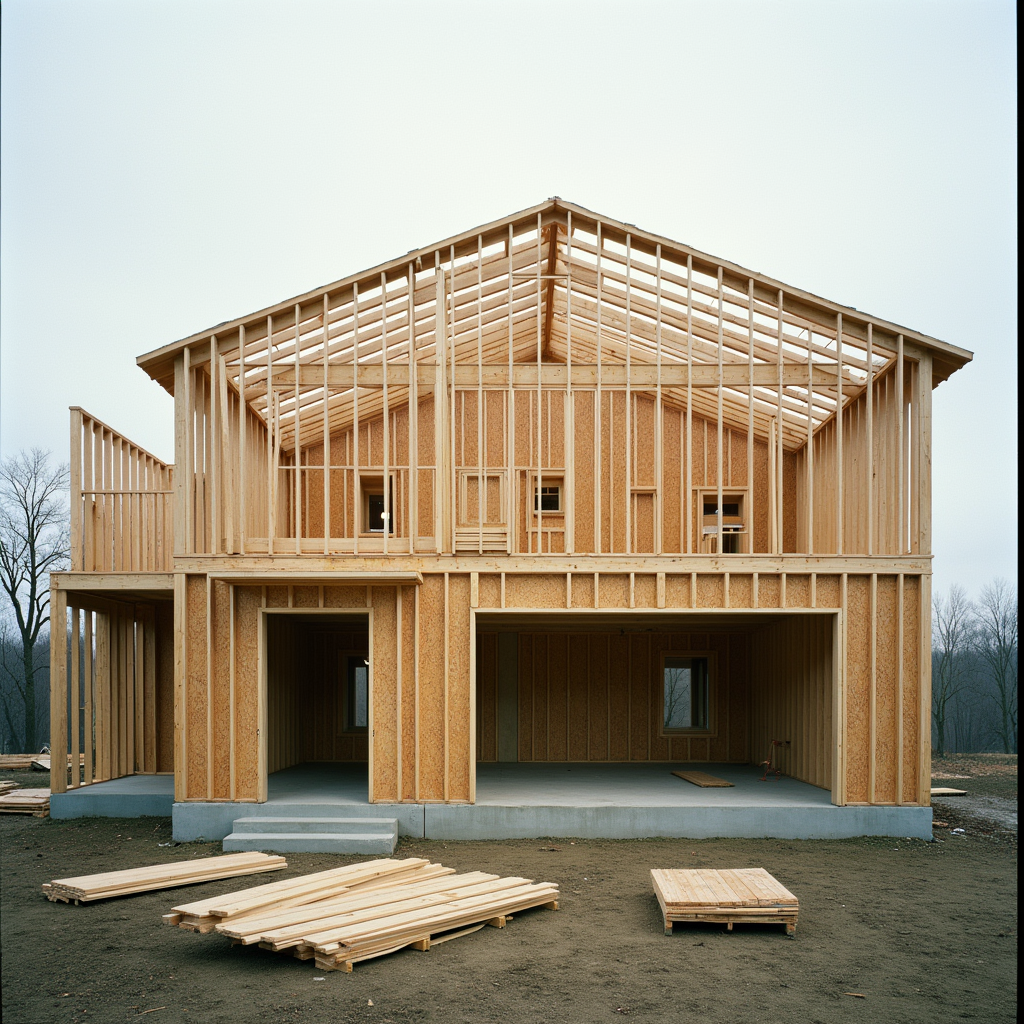
The down payment on a construction loan for an investor is not a percentage of a purchase price. There is no purchase price on a ground-up build. Lenders use loan-to-cost (LTC) and an ARV cap, and those two measures can give very different cash-in requirements on the same deal. If you are building the home you plan to live in as a primary residence, this is not your loan. Business-purpose construction financing is for investors only, and that distinction matters legally and practically.
How investor construction lenders measure the down payment
Consumer construction lenders anchor to a down payment percentage because they are financing someone buying a home. Investor construction lenders anchor to LTC: the loan divided by the total project cost. Total project cost includes land, hard costs (the actual construction budget), soft costs (permits, architecture, contingency), and sometimes an interest reserve built into the loan commitment. That is the denominator. The loan is the numerator.
At 80% LTC, a $550,000 total project cost produces a $440,000 loan and requires $110,000 in equity. That equity can be cash, land you already own free and clear, or a combination of both. The practical question is how much of that $110,000 you need to bring in cash on closing day versus how much land equity covers it.
The second governor is the ARV cap. Most investor lenders also run a loan-to-value check against the as-completed appraisal: the property’s estimated value once the build is finished. A lender might offer 80% LTC but also impose a 70% ARV ceiling. On a deal where 80% LTC would produce a $440,000 loan but 70% ARV caps it at $420,000, the ARV becomes the binding constraint and you bring more cash. Understanding the full draw structure of a ground-up construction loan gives you the context for how lenders price that exit risk into the deal.
The same deal at four LTC tiers
Here is a worked example. Ground-up spec build in a suburban market:
- Land (owned free and clear): $100,000
- Hard costs (construction budget): $400,000
- Soft costs (permits, design, 10% contingency): $50,000
- Total project cost: $550,000
- ARV (subject-to-completion appraisal): $780,000
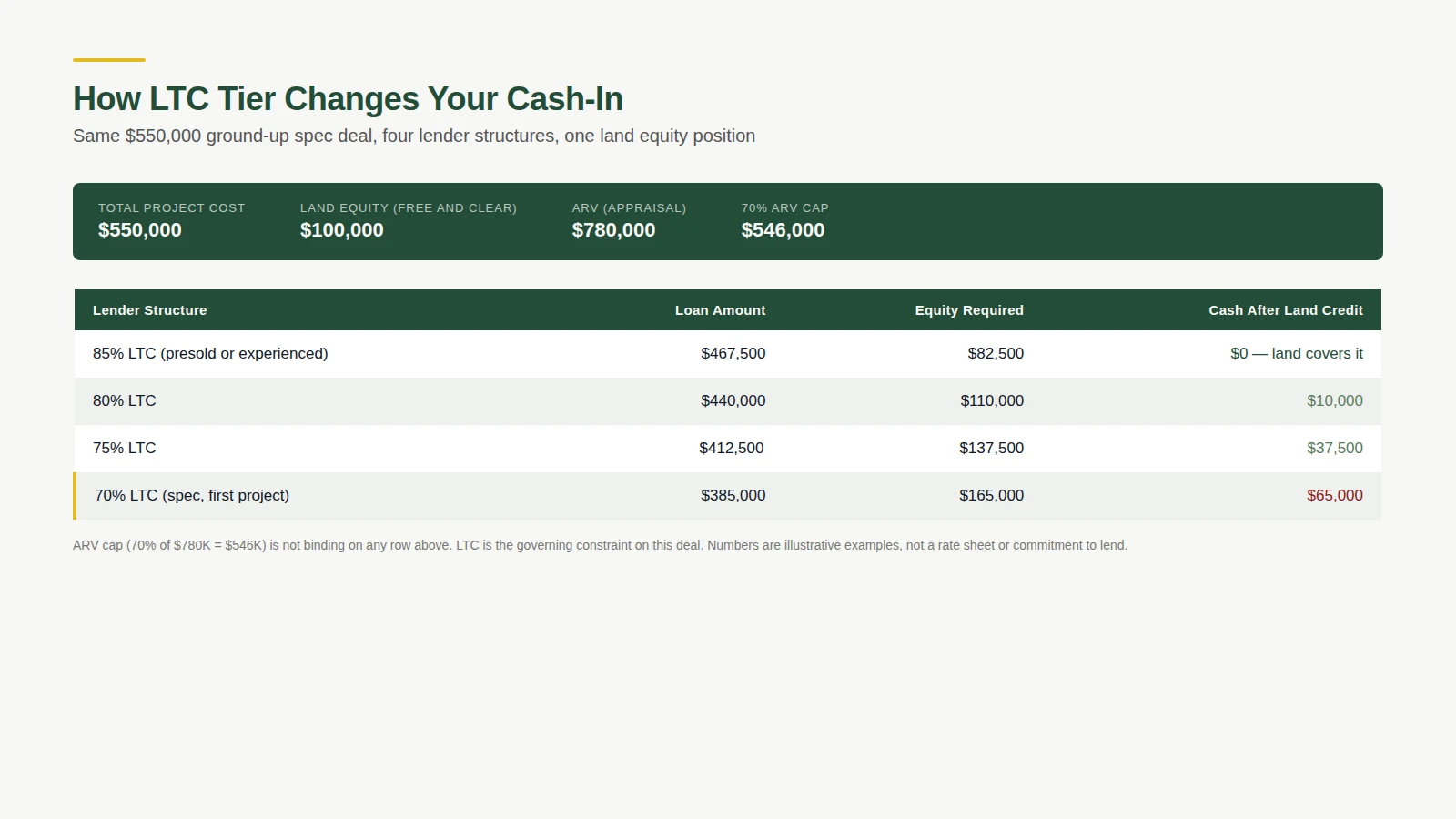
At 70% ARV, a $780,000 completed value produces a $546,000 cap. Every LTC tier in the table produces a smaller loan than that, so LTC is the binding constraint on this particular deal. Now change the ARV: if the appraisal comes in at $620,000, the 70% ARV cap drops to $434,000, which falls below the 80% LTC loan of $440,000. At that point, the ARV governs and you bring more cash regardless of which LTC tier the lender offers.
The cash column in the table assumes the lender gives full credit for the $100,000 in land equity. Not all lenders do, and the conditions that determine whether they do matter more than most borrowers expect.
Want terms on a specific deal?Answer seven questions and get a decision in 72 hours.
Get FundingWhat land equity actually counts for
Free-and-clear land is the cleanest form of equity in a construction deal. If you paid $100,000 for a lot two years ago and it appraised at $115,000 today, most investor lenders will credit you $115,000 in equity against the total project cost. That is $115,000 you do not bring in cash on closing day.
Encumbered land changes the arithmetic. If you have a $60,000 note on the lot, the lender nets that out. You have $55,000 in usable equity, not $115,000. The construction loan proceeds can pay off the lot note at closing, but run the numbers using the net equity figure when you model your cash position.
Land acquired recently can trigger a seasoning discount with some lenders: they credit you the purchase price, not the current appraised value, if the lot was acquired in the last six to twelve months. A lot bought for $80,000 that is now worth $110,000 gets credited at $80,000 with those lenders. The $30,000 appreciation is real on paper but does not reduce your cash-in at this closing.
What moves your LTC tier
The LTC a lender offers you is not fixed. Four variables move it in practice.
Builder or investor experience. How many ground-up projects have you completed and closed, with documentation? A borrower with five completed specs is a different risk profile than someone on their first project. First-timers typically land at 65% to 70% LTC. Three or more completed projects gets you into the 75% to 80% range on a well-structured deal. Experience is not a soft credential here: lenders ask you to document it with a project list, photos, and closing statements.
Spec versus presold. A presold project, one where a buyer is already under contract before the first draw, is materially lower risk than a spec build. Some lenders will go to 85% LTC on a presold build they would underwrite at 75% LTC as a spec. On the $550,000 deal above, that ten-percentage-point difference is $55,000 in additional loan proceeds. If you have a buyer lined up before you break ground, bring that contract to the term sheet conversation from the start.
The cost-to-ARV relationship. A wide margin between total cost and ARV means the ARV cap is not binding and the LTC governs. A deal where cost is $550,000 and ARV is $620,000 has less cushion than one where ARV is $780,000. A lender offering 80% LTC with a 65% ARV floor on the thin-margin deal is effectively delivering a 65% ARV loan ($403,000), not an 80% LTC loan ($440,000). Run both calculations before you model your cash position.
Loan size. Some lenders have minimum loan floors below which the standard terms do not apply. A $150,000 construction loan on a small infill project may face different LTC constraints than a $600,000 loan. Check the minimum loan amount before assuming the rate sheet applies to your deal size.
What happens when the ARV appraisal comes in low
The subject-to-completion appraisal happens before closing, not after the build. An appraiser estimates what the finished property will be worth based on the plans, the location, and comparable sales in the market. If the appraisal comes in lower than your projection, the ARV cap drops with it.
On the deal above: if the appraisal delivers $700,000 instead of $780,000, the 70% ARV cap falls from $546,000 to $490,000. At 80% LTC, the $440,000 loan still fits under $490,000, so the LTC still governs. But if the appraisal comes in at $620,000, the 70% ARV cap drops to $434,000. The 80% LTC loan of $440,000 now exceeds that cap by $6,000. You either bring more cash or accept a smaller loan. On a deal where you modeled $440,000 in debt and your land equity covered the equity requirement, a $60,000 appraisal shortfall turns into a funding gap on closing day.
The fix is running the numbers at multiple ARV scenarios before you commit. Stress-test at 90% and 85% of your projected ARV. If the deal breaks at 90%, you are one unfavorable comp set away from a problem. Use the ARV calculator to model different comp scenarios before the appraisal is ordered. For how rate ranges interact with LTC tiers on construction deals, see the construction loan rate breakdown for investors in 2026.
Who this loan is not right for
These are business-purpose loans for investors. They are not subject to TILA, RESPA, or the consumer protection statutes that govern residential mortgages, which is why they can close in days rather than months. That also means we cannot fund an owner-occupied build. If you are building the home you plan to live in as your primary residence, a conventional construction loan or an FHA construction program is the correct path. We do not work in that lane.
This financing is also not right for a borrower whose equity position depends on an optimistic ARV. If the difference between a working deal and an underfunded one is whether the appraisal hits a specific number, that is a thin margin to carry into a 12-month build. Construction costs routinely run 5% to 10% over the original budget. An appraisal that comes in 8% below projection is not an unusual outcome, particularly on spec builds in markets where comparable sales are sparse. Stress-test both variables before you commit.
The carry cost also grows as draws accumulate. Interest accrues on the drawn balance, not the full loan commitment. Early in the build, the monthly number is modest. By month nine on a twelve-month draw schedule, you may be carrying interest on $380,000 or more of outstanding balance. A project that runs two months over schedule adds two months of near-full-balance carry. That buffer needs to be in your cash reserve at closing, not in your ARV.
Running the numbers
Before pricing a deal, model it through the fix and flip calculator at your base case and at 10% cost overrun and 8% below ARV projection. That gives you the floor on your equity requirement before you sit down with a lender.
The new construction loan program covers ground-up builds from $100,000 to $25 million, lending in all 50 states. Approval runs within 72 hours and closing in 5 to 10 business days. Call 917-842-9982 with the project summary: lot address, total project cost, construction budget, ARV from comps, and your completed project history.
Common questions
Do I need to own the land before applying for a construction loan?
Not always, but owning it free and clear gives you the strongest equity position at closing. If you are purchasing the land simultaneously with the construction loan, the land acquisition is typically rolled into the total project cost and financed as part of the deal. The lender will credit the land at its appraised value or purchase price, whichever is lower, and your equity requirement comes from the combined deal.
What is the difference between LTC and LTV on a construction loan?
LTC (loan-to-cost) divides the loan by the total project cost: land plus hard costs plus soft costs. LTV on a construction loan is usually loan-to-ARV: the loan divided by the subject-to-completion appraised value. Both caps apply to every deal, and the one that produces the smaller loan is the binding constraint. On deals with a wide margin between cost and ARV, LTC governs. On thin-margin deals, the ARV cap typically takes over.
Can equity from a joint venture partner count toward the down payment?
Yes, equity from a documented JV or equity partner can generally satisfy the down payment requirement. The lender will want to see the operating agreement, confirm that the equity contribution is real and unencumbered, and verify that the partner’s capital is not structured as a second loan disguised as equity. A mezzanine note behind the construction loan covering the equity contribution is one of the most common reasons a construction file gets flagged at underwriting.
What happens if construction costs go over budget?
Cost overruns above the loan commitment come from the borrower, not the lender. Most lenders require a 10% contingency built into the budget, which sits inside the loan commitment and covers modest overruns without additional cash. Overruns beyond the contingency require you to fund the difference directly before the lender releases the next draw. Your cash reserve at closing should account for this: a $380,000 hard cost budget with a 10% contingency gives $418,000 in cushion. A $450,000 final cost means you cover $32,000 out of reserve.
Does a presold contract improve the construction loan terms?
Yes, having a buyer under contract before the build starts is one of the most reliable ways to improve your LTC tier. A presold project removes the exit risk that drives a lender to a conservative spec LTC. The improvement is typically five to ten percentage points. On a $550,000 project, the difference between 75% LTC and 85% LTC is $55,000 in additional loan proceeds, which reduces your cash requirement by the same amount. Bring the executed purchase contract to the initial conversation, not after the term sheet is issued.
Ready to fund your next deal?
Approval within 72 hours. Close in 5 to 10 business days.
Get Funding Now