Construction Loan Requirements for a Ground Up Spec Build
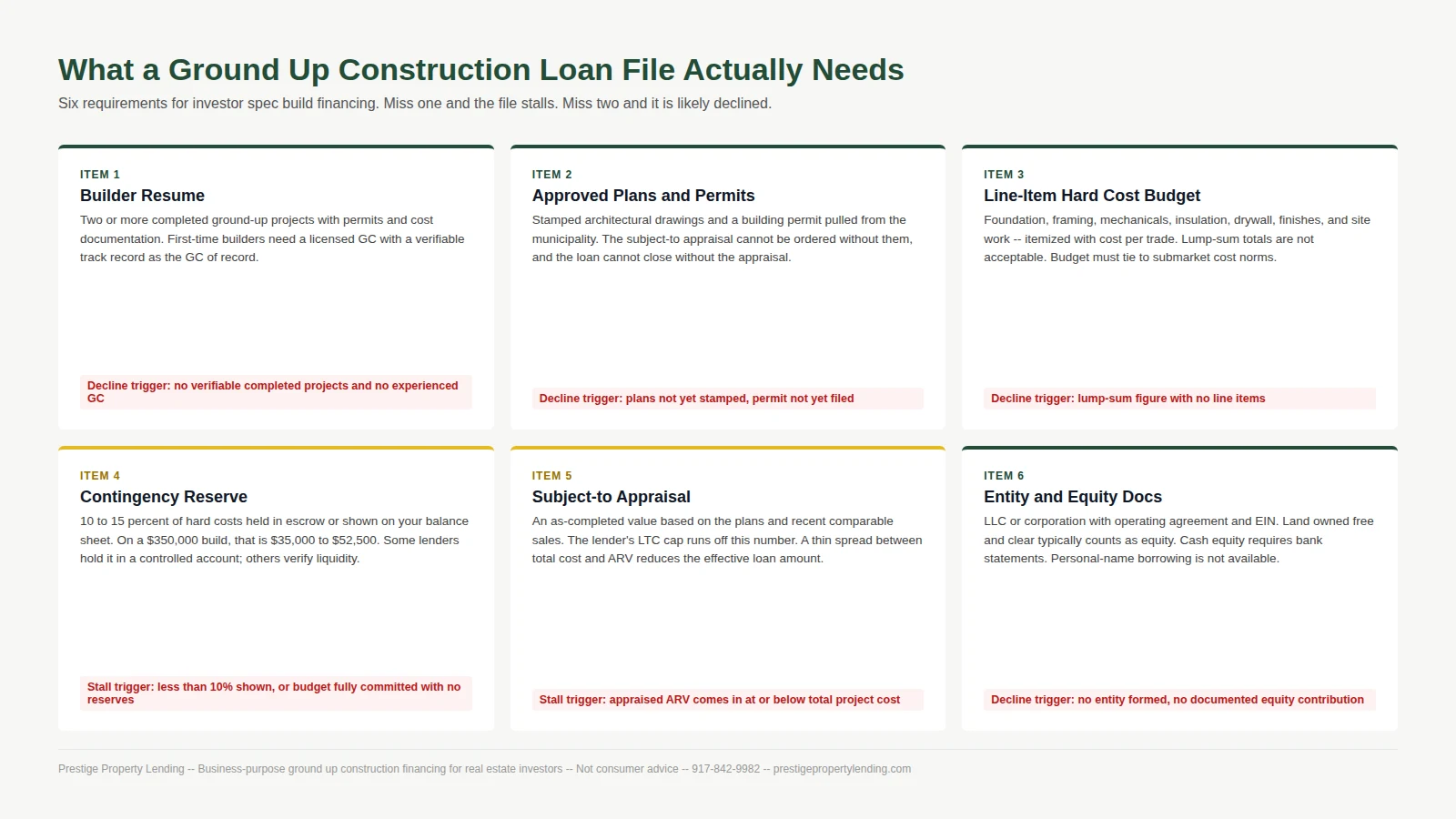
A ground up construction loan for an investor is underwritten on the project, not on personal income. Six things go into the file: builder resume, approved plans, a line-item hard cost budget, contingency reserve, subject-to appraisal, and documented equity. Miss one and the file stalls.
A ground up construction loan for an investor is underwritten on the project, not on your personal income. What gets it approved or declined comes down to six items: the builder’s track record, approved plans and permits, a hard cost budget that holds together under review, a subject-to appraisal, documented equity, and proof of contingency. Miss one and the file stalls. Miss two and it is likely declined.
This post covers what each of those requirements actually means, why it matters to the lender, and what gets files killed after a verbal approval. One thing it is not: a guide for someone building their own home. Consumer construction loans, including FHA and conventional construction-to-permanent products, are designed for owner-occupants buying or building a primary residence. Business-purpose construction financing is a different product with different underwriting, and it is not available for personal use.
The six requirements and why each one exists
1. Builder resume
The lender is funding work that has not happened yet. The as-completed appraisal assumes the building gets built to spec, on something resembling the stated budget, within the loan term. If the builder has never completed a ground-up project, that assumption has no supporting evidence.
For a spec build, most private lenders want at least two completed comparable ground-up projects with cost documentation. “Comparable” means similar scope: a 2,000-square-foot new construction that came in close to budget is better evidence than a 1,000-square-foot addition. The key word is “verifiable”: permits pulled, certificates of occupancy issued, before-and-after photos help.
First-time builders are not automatically disqualified. If you have no ground-up track record yourself, a licensed general contractor with documented project completions can serve as the GC of record. The lender is vetting experience in the project, not exclusively in you. What kills a file is a borrower with no track record who also has no experienced GC in place.
2. Approved plans and permits
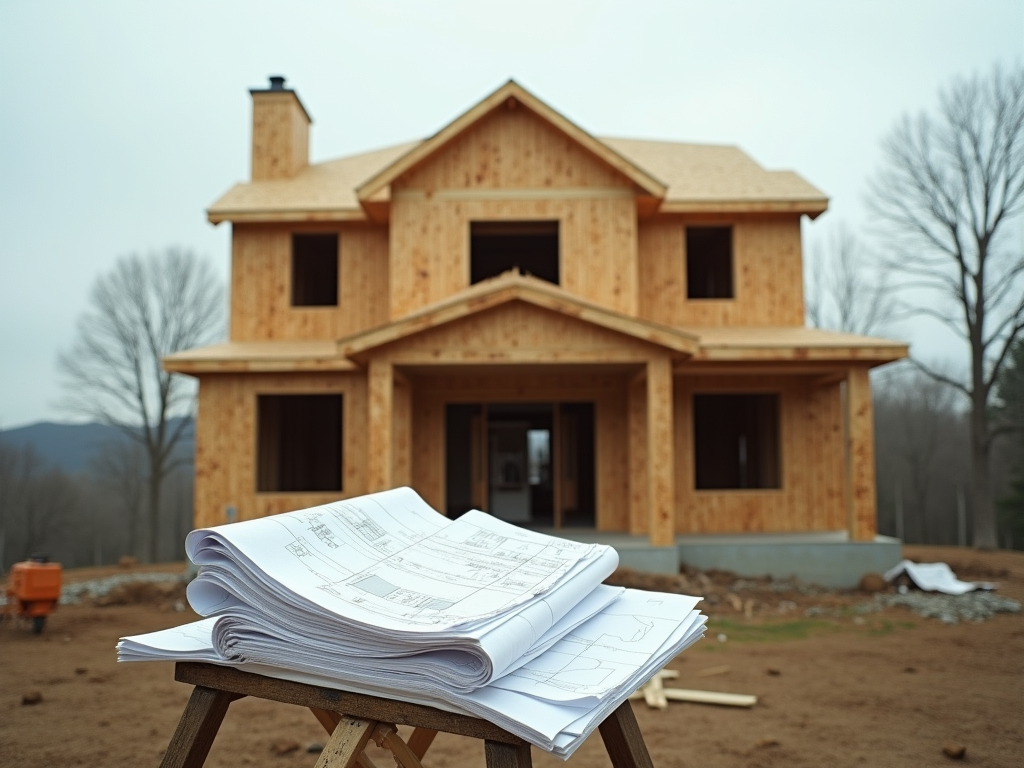
An appraisal of what a house will look like when it is finished cannot be ordered until there are plans to appraise. Stamped architectural drawings, prepared by a licensed architect or engineer, give the appraiser something to value against comparable completed sales. Without them, there is no ARV. Without an ARV, there is no loan amount.
The permit matters for a different reason: it confirms the project is legal in the jurisdiction where it sits. A permit application in process is usually enough to open a file. A project where zoning is uncertain, or where permits have been denied and are under appeal, does not move forward until that is resolved.
3. Line-item hard cost budget
A lump-sum construction cost tells a lender nothing useful. What they need is a line-item breakdown covering at minimum: site preparation, foundation, framing and sheathing, roofing, windows and exterior doors, rough mechanicals (HVAC, plumbing, electrical), insulation, drywall, finish work, flooring, and final fixtures. For a spec build, landscaping and driveway should be included, because an appraiser will account for them in the as-completed value.
The budget needs to align with comparable costs for the submarket. If your budget shows $65 per square foot for framing in a market where the going rate is $90 to $110, the lender will notice and require an explanation. A budget that looks too low signals either an amateur estimate or an intent to cut corners mid-project, both of which increase the lender’s exposure in the back half of the draw schedule.
4. Contingency reserve
Construction goes over budget. Not always, not catastrophically, but often enough that a lender who funds a project with zero contingency is funding a problem they will eventually have to solve. Standard private lender requirement is a contingency of 10 to 15 percent of hard costs held in reserve. On a $350,000 build, that is $35,000 to $52,500.
Some lenders hold the contingency in a separate escrow account, releasing it only when documentation supports a genuine cost overrun. Others verify the cash exists on your balance sheet without the escrow structure. Either way, the funds need to exist before the loan closes. A borrower whose budget is fully committed and whose balance sheet shows no reserve is telling the lender that any deviation from plan becomes the lender’s problem.
5. The subject-to appraisal
This is the piece most investors misunderstand, and the one that most often produces a surprise at closing.
The appraisal is ordered on an “as completed” or “subject to completion” basis. The appraiser reviews the plans and specifications, selects comparable sales of similar completed properties in the same submarket, and produces an opinion of value assuming the project is finished as designed. That number is the ARV the lender uses to set the maximum loan.
The issue is that what you expect the house to be worth and what the appraiser concludes are often different numbers. Appraisers use closed sales, not asking prices, and a submarket with few recent comps produces a conservative ARV. If your total cost is $500,000 and the appraiser returns $565,000, the spread is only $65,000. At 75 percent LTC, your loan is $375,000. That works mathematically, but it is a thin cushion if anything goes wrong. Use the ARV calculator to run this before you order the appraisal, so the number is not a surprise.
6. Entity and equity documentation
Business-purpose construction financing is extended to entities, not to individuals. Before a file opens, you need an LLC or corporation with an operating agreement and an EIN. The borrowing entity should be in good standing in its state of formation.
On equity: the most common form in a ground-up deal is owned land. If you own the lot free and clear, its appraised value generally counts toward your equity contribution. If the lot carries a mortgage, the lender nets the lien against the lot value and counts only the net equity. Cash equity can supplement or replace land equity, but the lender needs to see bank statements, not just a representation that the money exists.
The LTC math on a real deal
Here is a worked example using round figures. Assume a lot owned free and clear at $150,000, hard construction cost of $350,000, and total project cost of $500,000. The subject-to appraisal comes back at $720,000.
At 75 percent LTC, the maximum loan is $375,000 (75 percent of $500,000). The land equity of $150,000 covers the $125,000 gap between the loan and the total project cost, so no additional cash is needed at close beyond fees and the contingency reserve. The LTC-to-ARV ratio is 52 percent, which is conservative and unlikely to trigger a value-based cap.
Change one variable: the appraisal returns $510,000 instead of $720,000. The LTC loan of $375,000 would represent 73 percent of the appraised value. If the lender’s maximum LTV is 70 percent, the loan caps at $357,000. You now need to bring $143,000 in equity to close instead of $125,000. This is why the spread between total project cost and ARV matters more than the ARV number alone.
Want terms on a specific deal?Answer seven questions and get a decision in 72 hours.
Get FundingWhat gets a file declined after a verbal yes
A verbal approval or a term sheet is not a commitment to lend. Files get declined or repriced at underwriting for these specific reasons:
The appraisal comes in low. This is the most common. An appraiser in a thin comp market produces a conservative number. If that number squeezes the effective LTC below 60 percent coverage, you may need to bring in additional cash or restructure the deal.
Builder history does not hold up in verification. Verbal representations about past projects that cannot be documented with permits, certificates of occupancy, or inspectable records get flagged. An experienced GC brought in late in the process, after the file opened, is viewed differently than one who has been on the project from the start.
The budget review catches omissions. A file submitted without soft costs will be restructured at underwriting: permits, architecture fees, engineering, insurance during construction, and draw inspection fees all need to be accounted for. Adding those costs raises total project cost, which reduces the effective LTC and may require additional equity.
Title issues on the land. Mechanics liens, unpaid property tax, or ownership ambiguity on the lot can delay or kill the close. Run a title search early, before you invest time in plans and permits.
Insurance and reserve requirements. Lenders typically require builder’s risk insurance in place at closing. Many also require three to six months of projected interest reserves on the balance sheet in addition to the contingency. A borrower who arrives at closing having spent most of their liquidity on the lot is in a difficult position.
Who this loan is wrong for, and what it costs when a deal slips
This loan is wrong for you if: you are building the home you plan to live in (we do not fund owner-occupied construction); your builder has no documented track record and you have not engaged an experienced GC; your budget has no contingency and no additional capital on your balance sheet; or the submarket has no recent comparable sales, which means the appraisal will be either delayed or conservative.
On costs: beyond the principal, a ground up construction loan carries origination points, draw inspection fees (typically $100 to $300 per inspection), interest on the drawn balance (which grows with each advance), and potentially an extension fee if the project runs past the initial term. A project that stalls in month five for 90 days while an inspection dispute is resolved is carrying real interest cost with no corresponding progress toward sale. Know those numbers before you sign the term sheet.
If the contingency is exhausted and the project is not complete, additional advance requests are negotiated, not automatic. The lender will look at the percentage of completion versus the percentage of the budget spent. A project that is 70 percent complete but has spent 95 percent of the budget is in a materially different position than one that is 95 percent complete at 95 percent spent.
Getting your file ready
The new construction loan program covers the full underwriting approach and what a term sheet looks like for an investor spec build or build-to-rent project. Run the ARV calculator before you order the appraisal to see where your total cost sits relative to likely value. If you want the draw schedule mechanics specifically, the post on how a ground up construction loan works covers the six-draw timeline and what a missed inspection actually costs.
Call 917-842-9982 to discuss a specific project. All loans are subject to underwriting and approval.
Common questions
Do I need to own the land before I can apply for a construction loan?
Most lenders prefer the land is already owned or closing simultaneously. Some will fund a combined lot purchase and construction, but the land value counts toward your total project cost and affects the LTC calculation. Buying the land first, even a few weeks before the construction loan closes, simplifies the file considerably.
What credit score do investor construction loans require?
Business-purpose construction lenders use credit score as one input, not the primary one. A file with a strong builder resume, clean title, and well-documented budget can close with scores in the 620 to 660 range that a bank would decline. Score matters most at the pricing level: a score under 640 typically adds a point or more compared to a file at 700 or above. What gets a file declined is not a weak score in isolation. It is a weak score combined with no verifiable liquidity and a first-time builder with no experienced GC.
How many draws does a typical ground up construction loan have?
Six draws over a 12 to 18 month term is common on a standard spec build. Each draw is tied to an inspection: you schedule a site visit, the inspector confirms the work claimed matches the work completed, and then the advance is released. The post on how a ground up construction loan works covers the draw schedule mechanics in detail, including what a delayed inspection costs in carry.
Can I use a construction loan to build a rental property I plan to hold?
Yes. A construction-to-permanent structure rolls the construction loan into a DSCR rental loan at project completion rather than requiring a separate takeout refinance. The underwriting still requires the same builder documentation, but the exit is underwritten on projected rent rather than a sale price. That path is covered under the new construction loan program.
What happens if construction costs more than the budget?
Overruns beyond the contingency reserve are the borrower’s responsibility. The lender will not automatically advance additional funds. If the project is ahead of schedule and the appraised value supports it, additional draws can sometimes be negotiated. If the overrun threatens project completion, the lender has remedies including stopping draws, requiring additional equity, or accelerating the note. This is the scenario the contingency reserve exists to prevent. That is why 10 to 15 percent is a real requirement, not a guideline.
Ready to fund your next deal?
Approval within 72 hours. Close in 5 to 10 business days.
Get Funding Now