Construction Loan Rates for Investors in 2026: What Moves Yours
Private construction loan rates for real estate investors run roughly 10% to 14% in 2026, interest-only on drawn balances. The consumer rates Google shows you are a different product for a different borrower. This post covers the investor version: the four levers that move your rate and how to model carry cost correctly.
Private construction loan rates for real estate investors in 2026 run from roughly 10% to 14% annually, interest-only on the drawn balance, with 1 to 3 origination points depending on the deal and the borrower. If you found this post through a search for “construction loan rates,” the rate sheets Google surfaced are for homeowners building a primary residence: credit union and bank products subject to consumer mortgage law. Those are a different product, and this post does not cover them. What follows is the investor version: what drives your rate, how the carry math actually works, and what you can do to move the number before you submit a file.
Why investor construction rates look nothing like bank rates
Consumer construction lenders, the ones on page one of Google, price a fundamentally different risk. They have a homeowner who has agreed to occupy the finished property, a long-term mortgage as an exit, federal consumer protection law setting the floor, and often a government guarantee behind the loan. Their rate sits in the 6% to 7% range as of mid-2026 because they are pricing a different risk stack entirely.
Private construction lenders for investors price something harder: a project that does not exist yet, being built by someone who might have done this one time or five times or never, with an exit that depends on a sale or refinance that has not happened. The rate compensates for that uncertainty. It is not a premium tacked on top of a consumer rate; it is a different product priced from the ground up.
This distinction matters because your carry cost analysis has to start from the right baseline. A borrower who compares a 6.5% credit union rate to an 11.5% private rate and concludes they are paying 500 extra basis points has done the math on the wrong denominator. The consumer lender would not fund their deal at any rate. All loans are subject to underwriting and lender approval, and the qualification criteria across the two product types are not comparable.
The four levers that move your rate
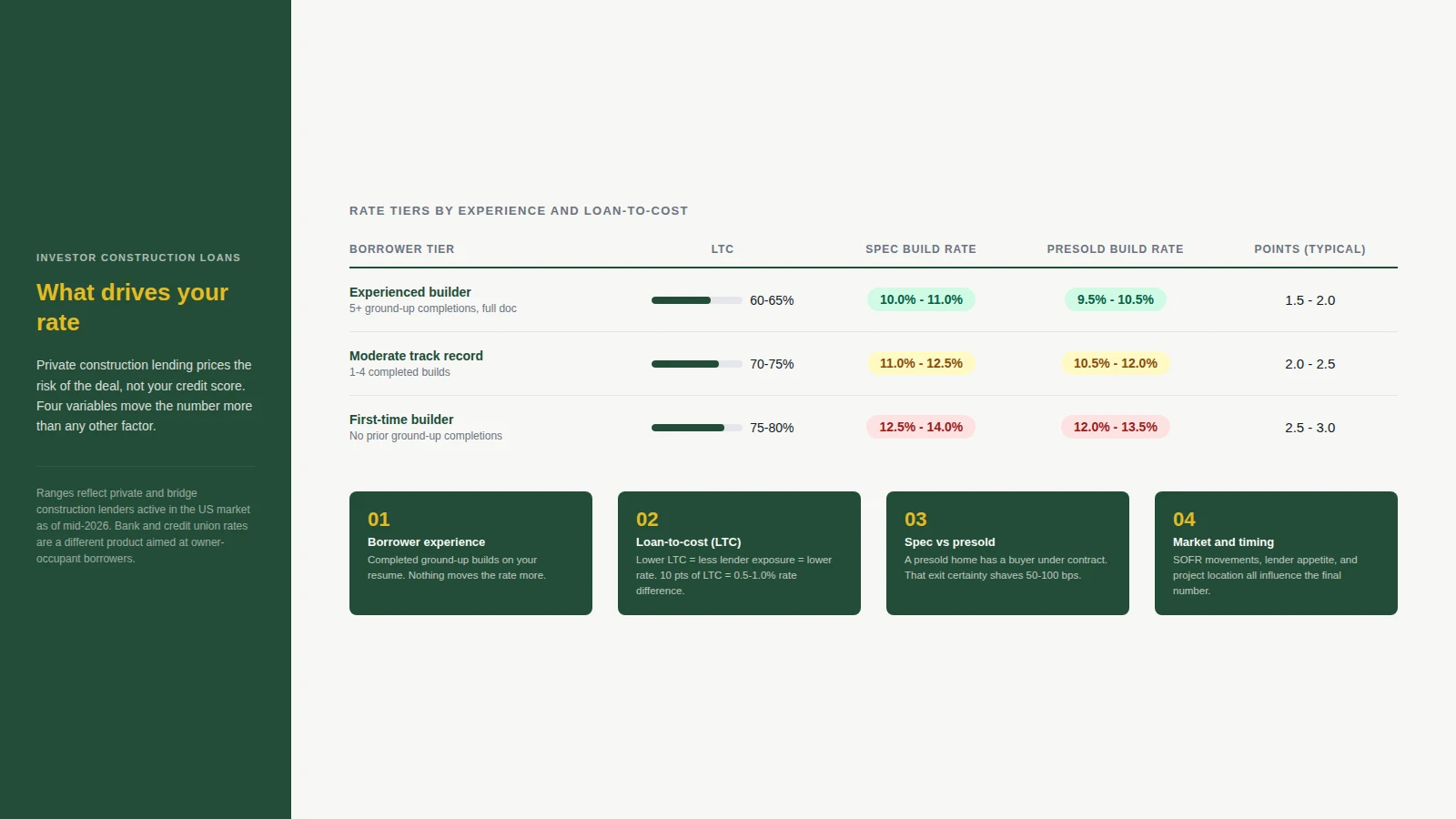
Every file a private construction lender underwrites lands in a rate tier based on four variables, in roughly this order of importance.
Borrower experience
The biggest single factor is your completed ground-up build history. A borrower who has taken a spec home from permit to certificate of occupancy five times represents a measurably smaller probability of a construction default, cost overrun, or abandoned project than someone on their first build. That difference shows up directly in the rate. In practice, the spread between an experienced builder and a first-time builder on an otherwise identical file runs 200 to 350 basis points. Your completed project list, your contractor relationships, and your ability to show finished comparables all feed into this assessment.
If you are early in your building career, the fastest path to a lower rate on the next deal is to complete the current one on time and within budget, and to document it thoroughly. Lenders who see you return with a clean close behind you price you differently than they did on draw one.
Loan-to-cost
Loan-to-cost is the ratio of what you are borrowing to the total project cost: land, hard costs, soft costs, contingency, and any interest reserve you are financing. A $1.2 million project with a $900,000 loan is 75% LTC. The lower your LTC, the less of the lender’s capital is exposed if the project stalls or the exit comes in below projections.
As a rule of thumb, each 10-point reduction in LTC from the top of the range, say from 80% down to 70%, is worth roughly 50 to 100 basis points on the rate. Bringing more equity to the deal does more than reduce your debt load: it directly lowers the cost of the debt you do take. Private construction lenders in 2026 are generally willing to go to 70% to 80% LTC on investment property ground-up builds, with the ceiling depending on the lender’s current appetite, your experience tier, and the project market. Loan sizes typically run from $100,000 to $25 million, and approval timelines on a complete file are often within 72 hours, subject to underwriting.
Spec build vs presold
A presold build is one where you have a purchase contract in hand before you break ground. The buyer is committed, the exit is defined, and the lender is pricing a project with a known endpoint. A spec build has none of that: you are betting the market wants what you are building, at the price you need, by the time you are done.
Presold projects routinely price 50 to 100 basis points below comparable spec builds at the same LTC and experience tier. If you can secure a buyer, or even a strong letter of intent, before you draw your first advance, it changes the underwriting conversation in your favor.
Market conditions and lender appetite
Private construction lending rates move with short-term benchmarks, particularly SOFR, and with lender portfolio dynamics that are not publicly reported. A lender who is full on construction exposure in a given market will reprice upward or stop writing new loans. A lender who has just raised a new fund may sharpen the pencil to deploy. These factors create rate variance of 50 to 150 basis points on similar deals underwritten at different times or through different sources, which is part of the reason understanding the current market before you commit to a rate matters.
Want terms on a specific deal?Answer seven questions and get a decision in 72 hours.
Get FundingHow carry cost actually works
Construction loan interest accrues on the drawn balance, not the full commitment. That distinction is significant and often misunderstood in pro forma modeling.
If you have a $900,000 construction commitment and you draw $180,000 on the first advance, your interest clock starts on $180,000. At 11.5%, that is $1,725 per month. After the third draw, when you have drawn $540,000, your monthly carry is $5,175. You do not owe interest on the full $900,000 until you have drawn all of it, which happens at or near the end of construction.
On a 14-month build with a front-loaded draw schedule, your total interest carry across the project might be $68,000 to $80,000, not the $103,500 you would calculate by annualizing the rate on the full loan amount from day one. That gap matters for your margin. Model the draw schedule, not the commitment size, when you are projecting carry. The walk-through on how ground-up construction loans work covers the draw mechanics in detail, including what happens when an inspection is delayed and the carry clock keeps running.
A worked example: $1.2M spec build, first-time builder
The numbers below are an example with round figures, not a rate quote or commitment to lend.
Total project cost: $1,200,000. Loan at 75% LTC: $900,000. Rate: 12.5% interest-only. Origination: 2.5 points, or $22,500. Term: 14 months.
Draw schedule: six draws over 14 months. Average drawn balance across the project: approximately $540,000. Monthly interest on that average: $5,625. Total estimated carry: $78,750. Add origination of $22,500 and you have roughly $101,250 in financing cost before the exit. That is 8.4% of the total project cost, and it is the number to model into your margin.
The same deal for an experienced builder with five prior completions at 65% LTC would look different: loan at $780,000, rate at 10.5%, origination at 1.75 points ($13,650). Average drawn balance perhaps $450,000, monthly carry $3,938, total estimated carry $55,125. Financing cost before exit: $68,775, or 5.7% of project cost. Experience and equity together cut the cost of capital by roughly $32,000 on a deal this size. Use the hard money loan calculator to run these figures on your own project numbers before you commit.
Who this loan is wrong for
Private construction financing for investors is the wrong product if your project is a primary residence you plan to occupy. Consumer construction lenders offer lower rates, longer terms, and the consumer protection infrastructure that comes with regulated mortgage lending. The rate advantage a consumer lender offers on owner-occupied construction is real and should be used. We do not fund primary residences.
It is also the wrong product if your timeline cannot absorb a construction delay. Most private construction loans have a term of 12 to 24 months. Extension fees run 1% or more per month after the initial term expires. If your pro forma has no schedule contingency and a contractor issue or permitting delay hits at month 11, the extension cost can eliminate margins that looked comfortable at closing. Build the worst-case extension scenario into your budget before you sign.
And it is the wrong product if your exit is a refinance into a long-term rental loan before you have tenants in place. Most DSCR lenders want a property with a rent history, not one that just passed its final inspection. Seasoning requirements on the back-end refinance vary, but six months of rent receipts is a common threshold. Understand what your DSCR exit requires before you commit to the construction loan on the front end. Our new construction loan program page covers the typical structure and what the file needs to look like at submission.
What to do before you call
Before you submit a file, have your builder resume ready: a list of prior completed ground-up projects with addresses, square footage, cost, and close date. Have a hard cost budget broken into line items, with a 10% contingency line included. Have your land or lot already in contract or owned. And know your LTC: total project cost on one side, requested loan on the other.
A file that comes in with those four elements in order closes faster and prices better than one that arrives as a concept with a phone number attached. The approval process on a complete file typically runs within 72 hours, subject to underwriting, and closings happen in 5 to 10 business days from there. Call 917-842-9982 to discuss your project before you commit to land.
Common questions
Are investor construction loan rates fixed or variable?
Most private construction loans for investors carry a fixed interest-only rate for the term of the loan, typically 12 to 24 months. When you see references to variable construction rates, that language usually applies to bank construction-to-permanent products for homeowners, where the rate adjusts as the loan converts to a long-term mortgage. Those are a different product entirely.
Can I lock a construction loan rate before I own the land?
Not with most private lenders. The rate is issued as part of the term sheet, which is tied to a specific project: address, plans, hard cost budget, borrower file. A rate quote without those inputs is a marketing number, not a commitment. Most lenders issue a term sheet within 72 hours of a complete file submission, so the gap between going under contract on land and getting a rate in writing is usually short if your file is ready.
What is the difference between LTC and LTV on a construction loan?
Loan-to-cost compares the loan to what it costs to build the project. Loan-to-value compares the loan to what the finished project will be worth. On a ground-up build, the LTV based on the appraiser’s subject-to-completion value is often lower than the LTC, because a completed home in a strong market is worth more than the raw cost to build it. Lenders typically underwrite to LTC for the initial approval, because cost is a known input and value is a projection. Both numbers appear on the term sheet, and both have caps.
Does having a general contractor under contract improve my rate?
Yes, meaningfully. A signed contract with a licensed, insured general contractor with a track record in the relevant jurisdiction reduces one of the larger risk variables in construction underwriting. An owner-builder situation, where you act as your own GC, is treated differently: typically higher rates and lower LTC limits, because the lender is pricing the construction execution risk directly rather than through a third party with their own license and liability at stake.
How does a construction loan rate compare to a bridge loan rate?
Bridge loans and construction loans price similarly in the private lending market, because both are short-term, interest-only instruments with an event-based exit. Bridge loans for stabilized properties or light value-add sometimes price at the lower end of the range, because the collateral exists and is already valued. Ground-up construction sits at the higher end because the collateral is unbuilt. The spread between a clean bridge on a stabilized rental and a ground-up spec build might run 100 to 200 basis points at comparable LTV and experience levels.
Ready to fund your next deal?
Approval within 72 hours. Close in 5 to 10 business days.
Get Funding Now