Seasoning Requirements on a BRRRR Refinance: The 3, 6, and 12 Month Rules
The BRRRR refinance stalls when investors misjudge the seasoning clock. Most DSCR lenders require six months from the title date. Conventional lenders require twelve. Here is which rule applies when, what ownership and rental seasoning each measure, and how to model the carry cost so a slow appraisal does not kill the deal.
Most DSCR lenders require six months from the title date before they will fund a BRRRR refinance. Conventional lenders require twelve. A handful of short-term private lenders will move at three months, but the cost is high and the exit is still twelve months away if you want conventional pricing. The clock starts when you take title, not when rehab finishes, not when the tenant moves in.
This is the single most common reason a BRRRR deal stalls mid-strategy. The investor completes the rehab in eight weeks, places a tenant, and expects to refinance immediately. The lender says six months. The carry cost on the hard money loan, the bridge, or even cash, has another four months to run.
Two separate clocks: ownership seasoning and rental seasoning
Most investors talk about seasoning as one thing. It is actually two, and lenders may require one or both.
Ownership seasoning measures the time from the date on the deed. It answers one question: is this a title-seasoned sale or a chain of quick transfers? Lenders use it to screen out speculative flips and to ensure the appraiser’s stabilized value has time to be tested against a real market.
Rental seasoning measures the time from the date of first occupancy or lease execution. It answers a different question: does the income the appraiser used actually exist? A property that closed its first lease two weeks before the refinance application has rental seasoning of two weeks, regardless of how long you have owned it.
DSCR lenders care most about rental seasoning because they underwrite to the income, and income that is two months old is not the same as income that is six months old with a rent roll to back it up. Some lenders require both six months of ownership and three to six months of rental history. Others accept ownership seasoning alone if the lease is fully executed and the first payment has cleared. Know which clock your lender is counting before you plan the rehab timeline.
The three tiers and what they cost you
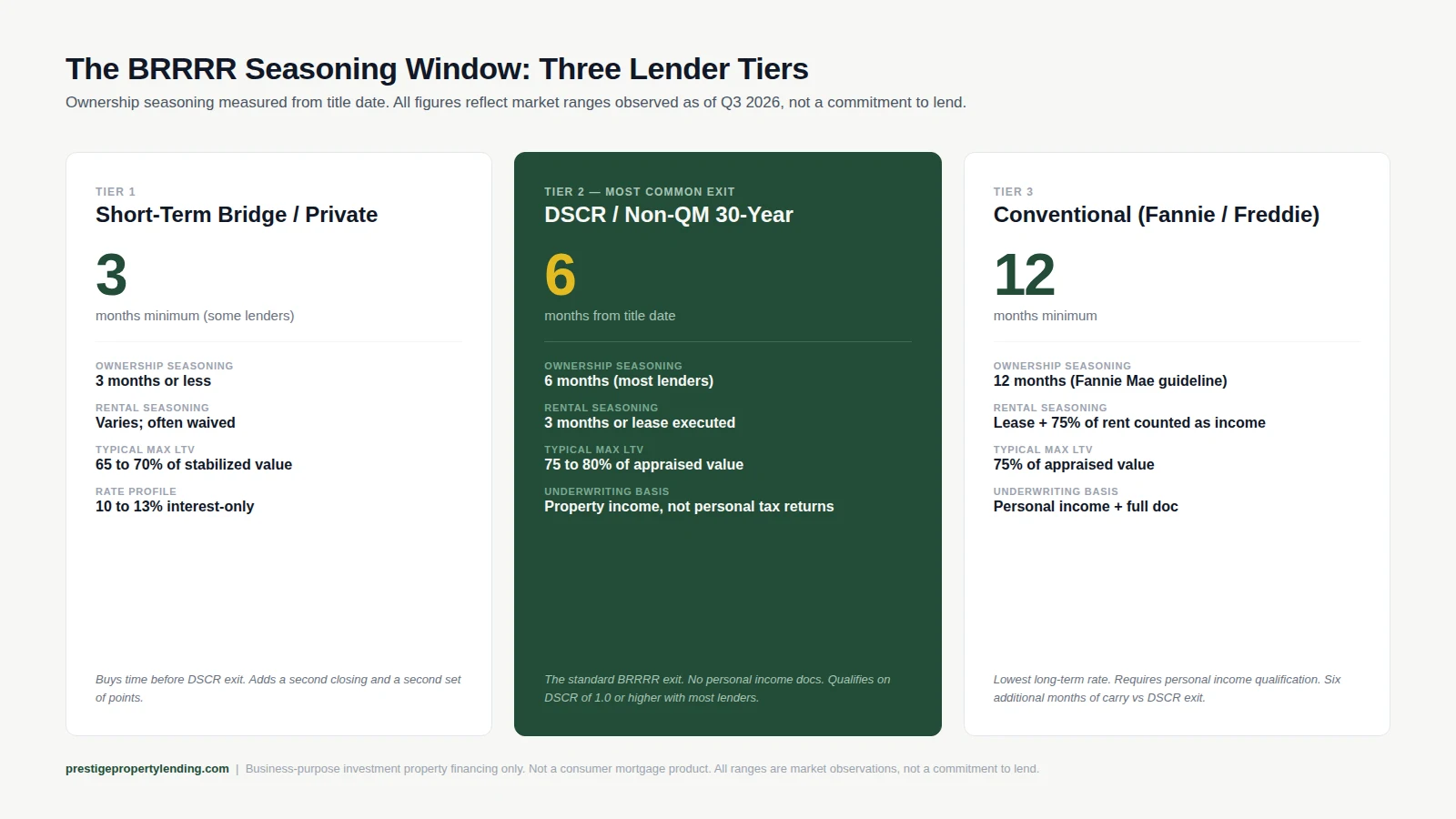
The seasoning requirement is set by the lender, and it tracks directly with the type of financing and its rate.
Three months or less is available from some bridge or private lenders who will refinance your initial acquisition or hard money loan into a slightly longer term before the DSCR exit. These loans price at hard money rates, typically 10 to 13 percent interest-only with two to three points, and they have their own exit: you still need to refinance into a DSCR or conventional loan at month six or twelve. They solve a specific problem, getting out of an expensive short-term loan before you qualify for permanent financing, but they add a second closing and a second set of fees.
Six months is the standard floor for DSCR and non-QM investment property refinances. Most lenders in this space, including nearly every private lender offering 30-year DSCR notes, require six months of ownership seasoning from the title date. Some layer on a three-month rental seasoning requirement, which means the effective timeline is: take title, finish rehab, place tenant, wait three months, then close the refinance. If rehab takes eight weeks and tenant placement takes two weeks, you are at month three when the lease starts. The refinance closes at month six, assuming the lender counts from title and not from lease execution.
Twelve months is required by Fannie Mae and Freddie Mac guidelines for a cash-out refinance on an investment property. This is the conventional mortgage exit that produces the lowest long-term rate, but it costs six additional months of carry compared to the DSCR option. Some investors use DSCR financing as the six-month exit and then consider a rate-and-term refinance to conventional at month twelve or later, if rates have moved in their favor.
Want terms on a specific deal?Answer seven questions and get a decision in 72 hours.
Get FundingWhat the appraiser actually measures at the six-month mark
The appraisal that supports a BRRRR refinance is not the same as the ARV you used to underwrite the purchase. At the purchase stage, you are projecting value subject to repairs. At the refinance stage, the appraiser is measuring the current stabilized value of a property that now has a tenant, a completed rehab, and a rent roll behind it.
Those two numbers should be close. They are not always the same, and the gap is one of the most reliable ways a BRRRR deal falls short of the capital recycling it was supposed to achieve.
The appraiser uses recently sold comparables, ideally within half a mile and within the last six months. If the market has softened since you purchased, the stabilized value may come in below your original ARV. If your rehab standard exceeded what the neighborhood supports, the appraiser adjusts down to what the area sustains. A $15,000 kitchen remodel that would appraise well in a gentrifying block may be credited at $5,000 in a rental-heavy zip code where tenants do not pay a premium for granite countertops.
The carry math: what six months actually costs
Here is a worked example. You purchase a duplex for $80,000 cash. Rehab costs $38,000 over seven weeks. All-in cost: $118,000. The stabilized rent across both units is $2,600 per month. The appraiser’s six-month stabilized value is $165,000.
At month six, a DSCR lender funds you at 75 percent of $165,000, which is $123,750. You pull out $123,750 against your $118,000 cost, leaving $5,750 in your pocket and a rented duplex with equity. The DSCR against the new payment qualifies at the base tier. Capital is recycled.
Now change one number: the appraiser comes in at $148,000 instead of $165,000. Your refinance at 75 percent is $111,000. You get back $111,000 against $118,000 invested. You leave $7,000 in the deal. That is not a failed BRRRR: you own a rented duplex with equity and a small remaining position. But the capital you planned to redeploy does not exist, and you need $7,000 set aside for exactly this outcome before the deal starts. Use the BRRRR calculator to model the capital recovery at different appraisal scenarios before you commit.
The carry cost runs regardless of whether the appraiser agrees with your projections. Six months of holding a property with no hard money loan and full rent coverage is low carry. Six months at 12 percent interest-only on a $118,000 balance is $7,080 in interest alone, paid out before the refinance closes.

How to plan around the seasoning window
Count from title, not from stabilization. The day you sign the deed is day one. Not the day rehab ends. Not the day you place the tenant. A lot of investors start the clock from when the property is ready to rent, which puts their refinance timeline off by two to four months and leaves them scrambling at the hard money maturity date.
Plan the rehab duration against the seasoning floor, not independently of it. If your lender requires six months and your rehab takes ten weeks, you have fourteen weeks after rehab ends before the refinance can close. Budget carry for those fourteen weeks, not just the rehab period.
Place the tenant as fast as the lender’s rental seasoning requirement allows. If the lender wants three months of rental seasoning and you reach month three of ownership, a delayed tenant means you are not closing at month six, you are closing at month nine. An empty property during the seasoning window extends both your carry and your exposure to a second appraisal cycle if the market moves.
For a full breakdown of how the financing works across all five stages of the strategy, see our BRRRR loan program page. And if you are still working through whether the BRRRR method fits your deal at all, our overview of where the BRRRR strategy breaks covers the refinance step alongside the other failure modes.
When BRRRR seasoning requirements are wrong for your deal
The BRRRR method works for patient capital. The seasoning window is not a flaw in the strategy. It is the price of converting a short-term acquisition into a long-term rental with permanent financing. But it is the wrong structure for several common situations.
If you need the capital back in ninety days to fund a second acquisition, the six-month DSCR window means BRRRR is not the right vehicle. A fix and flip that returns capital on the sale is the cleaner move for fast recyclers.
If the rental market in your target area has softened since you purchased, the stabilized appraisal may support a much lower loan than your all-in cost. Seasoning requirements exist to protect lenders against speculative value inflation. They also expose investors to market corrections between purchase and refinance. In a market where rents have declined, the appraised stabilized value could fall below your cost regardless of how long you wait.
The most common execution failure: the investor buys with a six-month hard money loan, finishes rehab in two months, places a tenant, and expects to refinance at month three. The DSCR lender says six months. The hard money loan matures at month six, exactly when the refinance should close. There is no buffer. If the appraisal takes three weeks, or the DSCR lender’s processing runs long, the hard money note is past maturity and the investor faces extension fees. Those extension fees run one to two percent of the loan balance per month. On a $100,000 loan, a two-month extension costs $2,000 to $4,000 before any modification fees. That comes out of the capital recycling the strategy was supposed to produce.
If you are planning a conventional exit at month twelve, budget eighteen months of total timeline: the six-month DSCR window, six months of DSCR payment history if the conventional lender requires it, and the conventional refinance at month twelve or later. Each step has its own closing costs. Model all three sets of fees as part of the total cost of capital before you commit to the deal.
Call 917-842-9982 with questions about how seasoning windows affect a specific deal.
Common questions
Does the seasoning clock start from purchase or from when rehab is complete?
Ownership seasoning starts from the date you take title, which is the deed transfer date. Rehab completion does not reset or start the clock. If you took title on January 1 and finished rehab on March 15, you reached six months of ownership seasoning on July 1, regardless of when rehab ended.
Can you do a BRRRR with no seasoning if you paid cash?
Some lenders offer delayed financing, which allows a cash-out refinance shortly after an all-cash purchase, but Fannie Mae’s delayed financing exception requires the purchase to have been arm’s length, with no junior financing, and cash proceeds verified. Most DSCR and non-QM lenders still impose a three-to-six-month minimum even for cash purchases. The exception is not a bypass of seasoning requirements, it is a narrow carve-out with its own conditions.
What happens if the appraisal comes in lower than your ARV?
You refinance at the lender’s LTV against the actual appraised value, not your projection. If your DSCR lender funds at 75 percent and the appraiser comes in $20,000 below your target, your loan is $15,000 smaller than you planned. You either leave that amount in the deal or bring cash to close, depending on how the numbers line up. This is why a conservative ARV estimate is worth more than an optimistic one.
Is rental seasoning the same as ownership seasoning?
No. Rental seasoning measures how long the property has had an active, paying tenant. Ownership seasoning measures how long you have held title. On a BRRRR deal where you took title in January, finished rehab in March, and placed a tenant in April, you have six months of ownership seasoning in July but only three months of rental seasoning. Some lenders require both. Read the lender’s guidelines before you build your timeline.
Can you skip DSCR and go straight to conventional at 12 months?
Yes, if the deal supports it and you have the income documentation that conventional underwriting requires. A DSCR loan does not require personal income verification. A conventional cash-out refinance on an investment property does. If your tax returns show low adjusted gross income, as many investors’ do, the conventional exit at month twelve may not be available regardless of the appraised value or the rental income.
Ready to fund your next deal?
Approval within 72 hours. Close in 5 to 10 business days.
Get Funding Now