Should You Borrow in an LLC? What Business-Purpose Lenders Actually Require
Business-purpose lenders prefer LLC borrowers. Consumer lenders cannot make the loan at all. Here is what lenders need from your entity, why the personal guarantee still puts you on the hook, and what happens if you transfer title after close.

Business-purpose lenders close loans in LLCs every day. Consumer mortgage lenders cannot. If you are financing a rental, a flip, or a ground-up build, the question is not really whether to borrow in an LLC; it is what the lender needs from that entity before a term sheet goes out. This post is for investors using business-purpose financing. If you are buying the home you plan to live in, a consumer mortgage is what you need, and an LLC as borrower is not an option there.
Why consumer lenders and business-purpose lenders treat entities differently
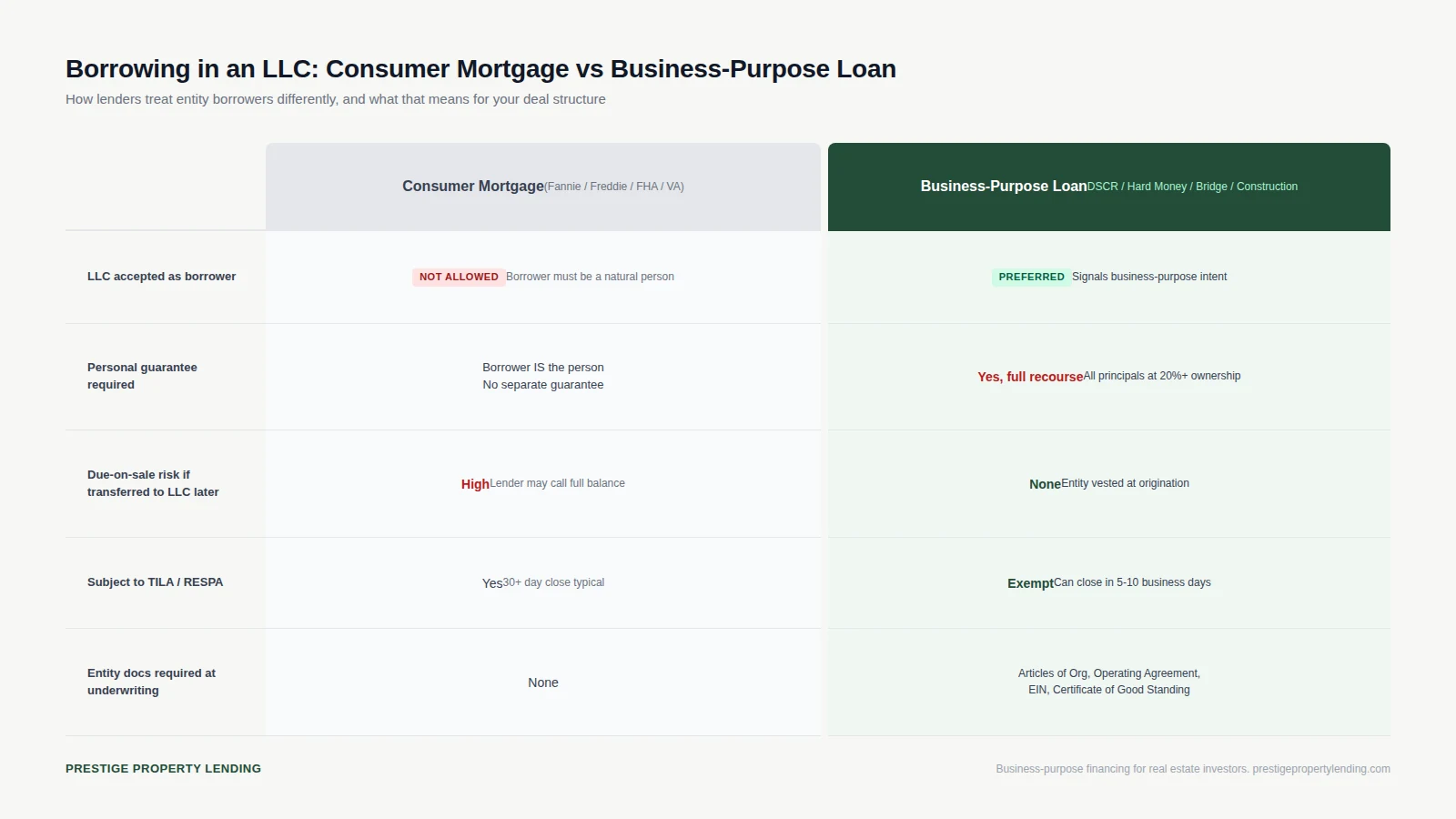
Fannie Mae, Freddie Mac, FHA, and VA all require that the borrower be a natural person. The guidelines are explicit. If you take title in an LLC and try to finance it with a conventional mortgage, the transaction is declined at the underwriting stage. That is not a policy preference; it is a guideline constraint that lenders selling into those markets cannot waive.
Business-purpose loans are different. A hard money, DSCR rental, bridge, or construction loan is not sold into a government-backed secondary market. It is funded by a private capital source with its own credit guidelines. Most of them are not only willing to lend to an LLC; they prefer it. A borrower who has taken the time to form an entity is signaling that this is a commercial transaction, not a housing decision. That separation is one of the things that makes the loan business-purpose in the first place.
The legal distinction matters. Business-purpose loans are exempt from the Truth in Lending Act and RESPA, which is exactly why they can close in five to ten business days instead of thirty. That exemption depends partly on the nature of the borrower and the stated purpose of the loan. An entity borrowing to invest is the profile these statutes were written around.
The personal guarantee: what the LLC does not protect you from
Most borrowers assume that borrowing in an LLC removes their personal exposure on the debt. It does not, and most business-purpose lenders will not allow it. Standard practice requires a full recourse personal guarantee from every principal with 20 percent or more ownership in the borrowing entity. You sign the note personally. The LLC is the title holder; you are the guarantor.
Here is what that looks like on a deal. Your LLC takes title to a $475,000 rental. The loan is $380,000. The LLC is listed as borrower. You sign a personal guarantee. If the property value drops to $310,000 and the loan goes into default, the lender can foreclose, sell the property for $310,000, and pursue you personally for the $70,000 deficiency. The entity did not protect you from the lender in that scenario.
What the LLC does protect you from is a tenant judgment or a liability claim at the property. If someone sues and wins, that judgment is against the entity, not against you personally, as long as you have maintained the entity correctly: separate bank account, no commingling of personal and business funds, operating agreement in place. Those are different risks from the lender risk, and both matter to an investor with multiple properties.
Want terms on a specific deal?Answer seven questions and get a decision in 72 hours.
Get FundingThe due-on-sale trap when you transfer title later
Investors sometimes buy a property in their personal name and transfer title to an LLC after close. The reasoning is usually that they wanted conventional financing at the outset, or they are reorganizing an existing portfolio into entities. The problem is the due-on-sale clause, which appears in almost every mortgage.
A due-on-sale clause gives the lender the right to call the full balance due immediately when title is transferred to a new entity, even a wholly owned one. Most lenders do not exercise that right when they discover the transfer, but they have it. If rates have risen significantly since your loan originated, a lender holding a below-market note has more incentive to act. If you refinance later, the title search will surface the transfer and the new lender will need to address it.
The practical answer is to vest in the entity from day one. If you are using business-purpose financing, the lender will accept it and often prefer it. If you are using a consumer loan because you need the rate or the down payment, you cannot vest in an entity at origination, which means any future transfer carries the risk above. Some investors carry that risk intentionally and accept it as a cost of the structure. Know what you are deciding before you sign the deed.
What lenders actually need from your entity at underwriting
Underwriting a loan to an LLC takes a few more documents than a personal-name deal. The list is short but nothing on it can be missing. You will need: the Articles of Organization from the state where the entity was formed, the Operating Agreement showing ownership percentages and who has authority to bind the entity, an EIN from the IRS, and a certificate of good standing dated within 60 to 90 days of closing.
If the entity is a series LLC, confirm the lender’s policy before you start the application. Series LLCs are recognized in Delaware, Texas, and a handful of other states, but not all jurisdictions treat each series as a distinct legal person. Some lenders require each series to file its own articles; others accept the parent filing with a series designation. Getting this wrong adds weeks to a close. Have the entity set up before you start shopping the deal, not during it.
For a new LLC formed specifically for this deal, formation takes days in most states, but the business bank account may take longer. Most lenders require loan proceeds to be disbursed to a business account held in the entity’s name. Open that account early in the process, before you need it at closing.
Multi-property investors: one LLC per deal or a single umbrella
Investors with several properties often ask whether a single LLC can hold all of them or whether each property needs its own entity. The standard guidance from asset protection attorneys is one entity per property: if a judgment enters against one property, it cannot reach the others. Lenders generally agree with that structure and may prefer it because each deal has clean title with no cross-collateralization from other holdings.
The cost is real. Each LLC in most states carries annual fees, a registered agent requirement, and a separate tax filing if it has more than one member. At scale, the administrative load is not trivial. Run the numbers with your attorney and CPA before the portfolio grows past the point where restructuring is painful.
Use the DSCR calculator to confirm the rent-to-payment ratio on each property before you structure the entities, because a deal that barely qualifies on its own numbers is a different risk profile than one with strong coverage. Entity structure affects the administrative cost of the portfolio; the DSCR determines whether each asset actually holds up.

When borrowing in your own name is actually correct
There are deals where a personal name is the right call. A short hold where you intend to sell quickly and the title work is simpler without an entity. A first deal where you want the thinnest possible documentation overhead while you learn the process. A state with punishing annual LLC fees: California’s $800 minimum franchise tax applies to every LLC formed or operating there, every year. If the deal generates $200 a month in net cash flow after expenses, that fee is almost four months of earnings.
The protection benefit matters most when the asset is substantial and the liability exposure is real. On a single small rental with good landlord insurance, the incremental protection from an LLC may not justify the added cost and complexity. On a portfolio of twelve properties, it almost certainly does. This is a judgment call for your attorney, not a lender or a blog post.
Also read: DSCR loan requirements: what real estate investors need to qualify covers the qualifying criteria in detail, including how entity structure affects the file.
When this structure is the wrong fit
Business-purpose LLC financing is the wrong tool if the property is going to be your primary residence. Full stop. Borrowing as an LLC with the intention of occupying the property personally is an occupancy misrepresentation on the loan application. That is not a gray area.
It is also the wrong fit if you are asking the lender to treat a brand-new, undercapitalized entity as having business history it does not have. A lender can underwrite to the individual guarantor’s experience and liquidity; they do not need the LLC to have a track record. But an empty shell with no bank account, no operating history, and an operating agreement signed the week before the term sheet request is a slower close and occasionally a declined file.
And the structure does not protect you from the carrying cost when the deal slips. Every month past your underwritten exit date is a month of interest on the full balance, in some cases at a default rate. The LLC does not absorb those costs. You do, through the personal guarantee. On a hard money loan at 11 to 14 percent annualized, a three-month delay on a $400,000 loan adds roughly $13,000 to $17,000 in interest alone, before any extension fees. Plan the exit as carefully as the entry.
To talk through entity structure on a specific deal, call 917-842-9982.
Common questions
Can I get a DSCR loan in an LLC?
Yes. Most DSCR lenders prefer entity borrowers. You will need your LLC’s Articles of Organization, Operating Agreement, EIN, and a certificate of good standing. A personal guarantee from principals with 20 percent or more ownership is standard on most business-purpose loans. See the DSCR rental loan program for what qualifies on those deals.
Does borrowing in an LLC eliminate my personal liability to the lender?
No. Business-purpose lenders require a full recourse personal guarantee from the principals. The LLC holds title; you remain personally liable on the debt. The entity protects you from tenant judgments and third-party claims against the property, not from the lender if the loan defaults.
What happens if I transfer a personal-name property to an LLC after close?
The transfer triggers the due-on-sale clause in your existing mortgage. Most lenders do not call the loan in practice, but they have the right to demand full repayment immediately. If you refinance later, the title search will surface the transfer and you will need to address it. Vest in the entity from day one if you know you want entity ownership.
Does the LLC have its own credit score for loan underwriting?
No. Lenders underwrite to the personal guarantors, not the entity. Your personal credit, liquidity, and investment experience drive the approval. A two-week-old LLC with a clean operating agreement is treated the same as a five-year-old one, because the entity itself has no loan history to evaluate.
Can I borrow in a trust instead of an LLC?
Land trusts and revocable living trusts are accepted by many business-purpose lenders, but requirements vary. Irrevocable trusts and complex estate planning structures can slow a close significantly because both the title company and the lender need to review them carefully. If you are using an unusual entity type, disclose it early rather than at the title review stage.
Ready to fund your next deal?
Approval within 72 hours. Close in 5 to 10 business days.
Get Funding Now