Draw Schedules on a Fix and Flip: How to Not Run Out of Cash in Month Two
A fix and flip draw schedule is a reimbursement system. You pay your contractors, pass an inspection, and then the wire arrives. That gap between payment out and reimbursement in is what runs first-time flippers short by month two.
A fix and flip draw schedule is a reimbursement system, not a credit line. This post is for investors financing a rehab project, not homeowners using a consumer renovation loan. The lender holds your rehab funds in reserve at closing. You pay your contractors, complete a stage of work, request the draw, pass an inspection, and the wire arrives. That gap between payment out and reimbursement in is the cash position that catches first-time flippers short by month two.
How the money actually moves
At closing on a fix and flip loan, two pools of money are established. The first covers the purchase. The second is your rehab holdback, which sits in reserve until you earn it back through completed work.
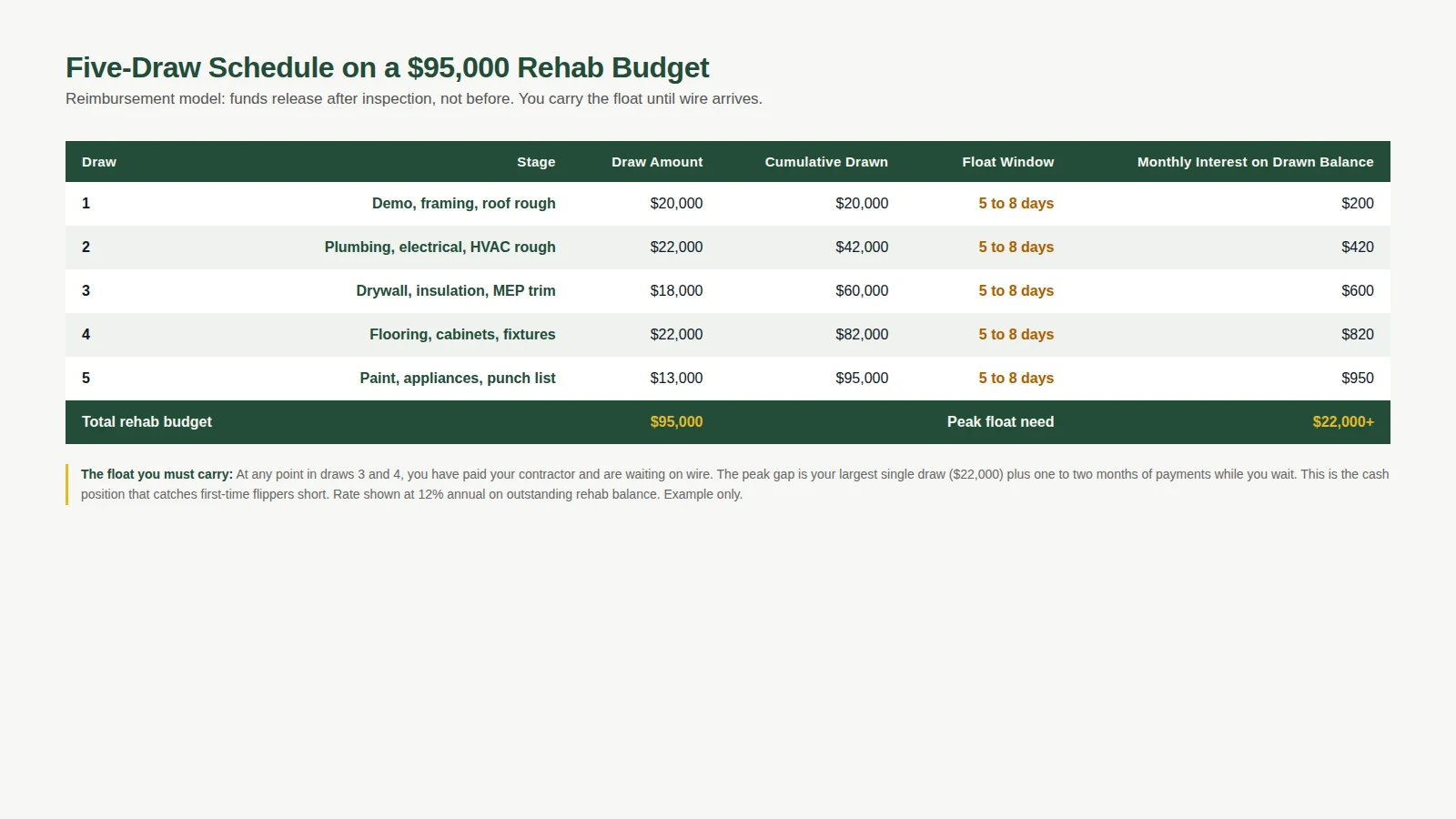
Most lenders break the holdback into four to six draws. A typical $95,000 rehab budget on a single-family project might look like this:
- Draw 1 (demo, framing, roof rough): $20,000
- Draw 2 (plumbing, electrical, HVAC rough): $22,000
- Draw 3 (drywall, insulation, MEP trim): $18,000
- Draw 4 (flooring, cabinets, fixtures): $22,000
- Draw 5 (paint, appliances, punch list): $13,000
The percentages are agreed in your scope of work at closing. You cannot renegotiate draw amounts mid-project without a formal change order, which adds time and paperwork. Cost overruns come out of your pocket, not the holdback.
The inspection lag: where the float actually comes from
After you submit a draw request, the lender orders a third-party inspection. The inspector typically arrives within two to five business days. After the inspection report clears, the wire takes another one to three days.
That is five to eight calendar days between when your contractor expects payment and when the money lands in your account.
On a $20,000 draw, five days of float is manageable if you have $25,000 liquid at closing. On a $22,000 draw in month three, while you are also paying interest on $60,000 already drawn, the math tightens considerably. Run the fix and flip calculator against your actual deal before you close. The field most investors leave blank is reserves.
Want terms on a specific deal?Answer seven questions and get a decision in 72 hours.
Get FundingThe carried interest compounds as you draw
Interest on a fix and flip loan is charged on the outstanding balance, not the total loan amount. The good news is that the early draws are cheap. The later draws are not.
After draw 1, you pay interest on $20,000 of rehab plus the full purchase balance. After draw 3, that rehab balance is $60,000. After draw 5, the full $95,000 is outstanding. At 12 percent annual in this example, the rehab portion alone adds roughly $200 per month after draw 1 and roughly $950 per month after draw 5. The interest is not the danger. The float is.
What an inspection actually checks
The inspector is verifying that the work billed in your draw request is actually complete. They are not your general contractor and they are not doing a code inspection. They are checking whether the scope of work for this draw is visibly finished, whether there are obvious defects or incomplete items, and whether the work matches the photos you submitted.
If the inspector finds the drywall is half hung when you called it done, the draw is denied. You reschedule, finish the work, and request again. That adds another full inspection cycle, another five to eight days of float, to a stage you thought was closed.
First-time flippers routinely underestimate how literal the inspection criteria is. Ninety percent done does not release ninety percent of the draw. It releases zero.
Why month two is where cash runs short
The pattern is consistent. Month one is manageable because your contractor often floats early work on relationships and you still have liquidity from closing. Month two is where the pinch arrives.
You have drawn once. Your contractor is into draw 2 scope, which requires materials deposits up front. The inspection for draw 2 is pending. Your lender is charging interest on everything already drawn. Carry costs, loan interest, utilities, insurance, and property taxes are accumulating against a project that is not yet generating any income.
The float you need to survive month two is roughly: your largest single draw amount, plus two months of carry costs, plus a ten percent budget contingency. On the $95,000 example above, that is $22,000 (your largest draw) plus roughly $3,500 in carry costs plus $9,500 contingency. Call it $35,000 in liquid reserves, separate from your down payment and equity contribution.
The post on how much cash you actually need to flip a house walks through the full stack, including holding costs most first-time investors leave off the spreadsheet.
How to compress the float
Discuss draw timing with your lender before closing. Some lenders will pre-schedule inspections at fixed intervals, every three weeks for example, rather than waiting for a draw request. The inspector is booked before you finish a stage, which shaves two to three days off each cycle.
Build a scope of work that matches the draw schedule, not the other way around. If your lender structures five draws, design your sub-phases so a complete, inspection-ready stage finishes at each of those five points. Stages that straddle a draw boundary cause partial completions and failed inspections.
Pay your contractors on a schedule that aligns to expected inspection dates, not to your own cash position. A contractor who knows an inspection is booked for Tuesday will not expect payment until Thursday.
When this structure does not suit your project
Draw schedule financing is not the right structure for every rehab, and saying so plainly is worth the space.
If your contractor requires significant materials deposits before starting, and you cannot float those amounts out of pocket, a standard reimbursement draw creates friction at every stage. Some lenders offer partial pre-funding or materials draws for experienced borrowers with a documented track record. First deals rarely qualify for those concessions.
If your renovation scope is small, under $30,000, and your contractor can complete the work before expecting full payment, a bridge loan without a rehab holdback may be simpler to manage. The draw administration disappears. Whether the rate difference justifies the simplicity depends on your deal math.
If your project runs long and you approach the loan maturity date, extension fees apply. Most lenders charge one to two percent of the outstanding loan balance per extension period. On a $275,000 total loan, that is $2,750 to $5,500 for time you did not budget. How a bridge loan works when the exit slips covers what happens when a project runs past the original term and what that delay actually costs in total carry.
Common questions
Do I get the full rehab budget at closing?
No. The rehab portion is held in reserve by the lender and released in draws as work is completed and inspected. Only the purchase funds arrive at closing. The holdback is yours to earn back, stage by stage, as the project progresses.
How long does a draw request take?
Plan for five to eight business days from submission to wire. The inspector typically arrives within two to five business days of your request. The wire follows one to three days after the inspection clears. Lenders vary. Ask yours for the exact timeline before you commit to a contractor payment schedule.
What happens if the inspector fails a draw?
The draw is denied for that stage. You complete the outstanding items, resubmit photos, and request a re-inspection. That adds another full inspection cycle to your timeline. There is no partial draw for ninety percent completion. The stage either passes or it does not.
Can I change the scope of work after closing?
Yes, but it requires a formal change order signed by the lender. Minor line-item swaps within the same draw may not need a change order. Material changes to scope almost always do, and they take time and sometimes require a revised appraisal or updated budget review.
Do I pay interest on the full rehab holdback from day one?
No. Interest accrues only on the drawn balance, not the total holdback. If you close with a $95,000 rehab reserve and pull $20,000 in draw 1, you pay interest on $20,000 only. The remaining $75,000 does not accrue interest until drawn. This makes the early months cheaper than the headline loan amount suggests.
How many draws can I request?
Most fix and flip lenders structure four to six draws, defined at closing based on your scope of work. Some allow additional draws for large projects but charge an inspection fee per draw. Design your project scope to fit the draw structure from the start rather than trying to add draws mid-project.
Next steps
If you have a deal in hand, the fix and flip loan program page covers the full program: loan sizes from $100K to $25M, all 50 states, approval within 72 hours.
Run your numbers before you call. The fix and flip calculator handles purchase price, rehab budget, ARV, and holding costs in one pass. Having those inputs ready makes the first conversation faster and more useful.
Direct line: 917-842-9982.
Ready to fund your next deal?
Approval within 72 hours. Close in 5 to 10 business days.
Get Funding Now