ARV: How Appraisers Actually Set It, and Why Yours Is Lower
ARV is the number your lender's appraiser produces, not the number you estimated. The two frequently disagree by $20,000 or more on a mid-range flip, and the difference comes out of your loan proceeds. Here is how the appraiser builds the number.
ARV is the number your lender’s appraiser signs off on, not the number you estimated from a few Zillow comps. The two frequently disagree by $20,000 to $40,000 on a mid-range flip, and the difference does not split the deal: it comes out of your loan proceeds. Understanding how a licensed appraiser builds the number is the single best way to close the gap before the report arrives.
This post is for real estate investors using fix and flip financing. It is not for homeowners or anyone refinancing or purchasing a primary residence. If you are buying the house you plan to live in, you need a consumer lender, not the information here.
What ARV actually means for your loan
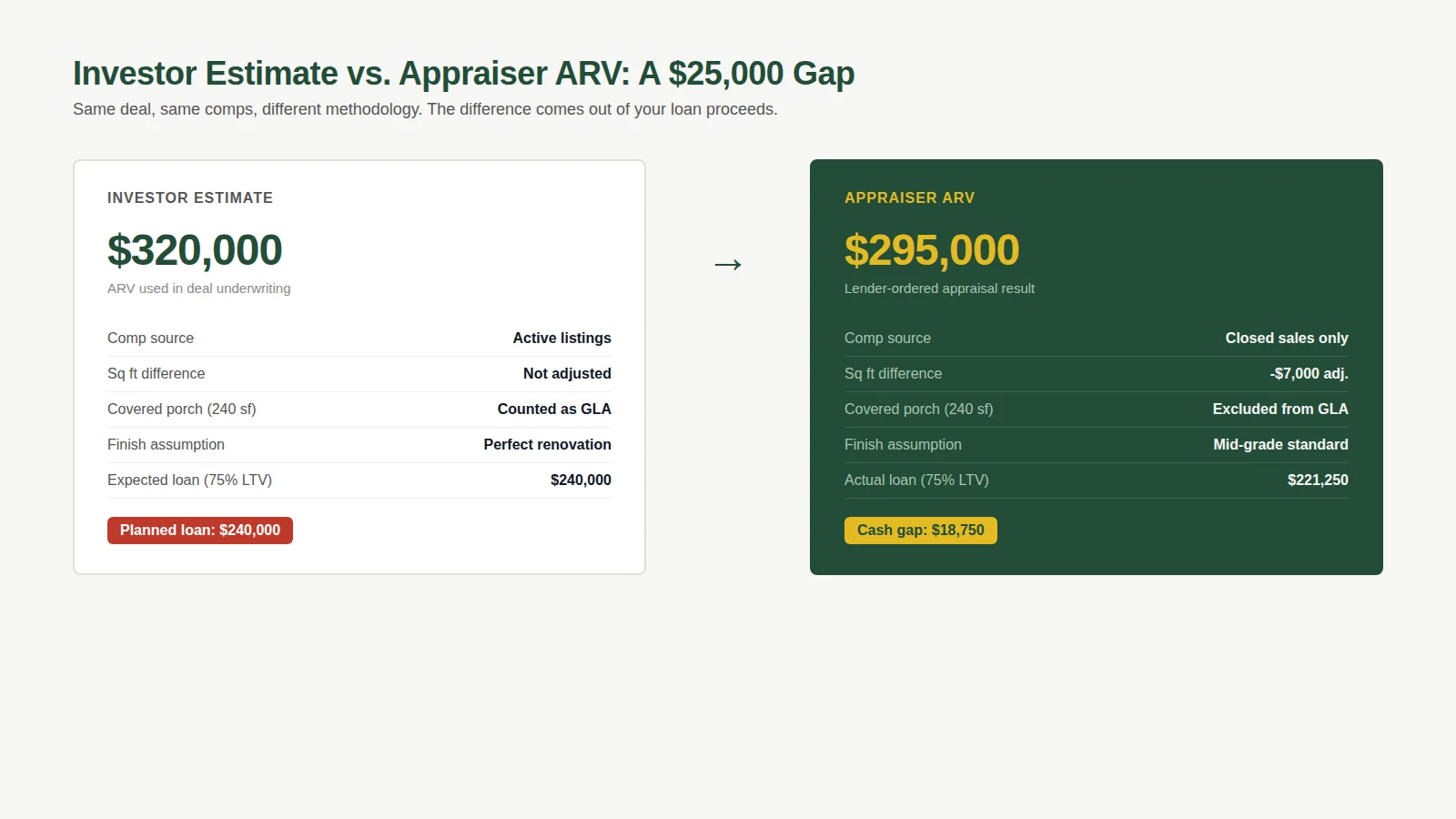
After repair value is the appraiser’s estimate of what your property will be worth once all planned improvements are complete. Your fix and flip lender uses it to calculate the maximum loan they will fund. A lender working at 75% of a $295,000 appraisal funds $221,250. If you underwrote the deal expecting $240,000 in loan proceeds based on a $320,000 ARV estimate, you need to find $18,750 from somewhere else before you close.
The ARV is not a number you set. You estimate it during due diligence. The lender orders an appraisal from an independent licensed appraiser, and that number controls the loan. Your estimate is a hypothesis. The appraiser’s figure is the binding one.
How the appraiser selects comparables
Most investors pull comps from Zillow, Realtor.com, or MLS access, and they include properties that went under contract recently. An appraiser uses only closed sales, constrained by established appraisal methodology because that is what every lender’s review desk recognizes and what can be defended in a file review.
The comp search criteria look roughly like this:
- Sold within the last 6 months, ideally the last 90 days in an active market
- Within 1 mile of the subject property, expanded to 2 to 3 miles if there are fewer than 3 closed sales in range
- Same property type: single family, not a condo or townhouse
- Within 20% of the subject’s gross living area
- Same or similar bedroom count, with an adjustment if different
Active listings do not qualify. Pending sales rarely qualify. If you ran your comps on properties from 10 months ago and the market moved up 7% since then, the appraiser may use a time adjustment, but it is conservative and documented, not optimistic.
Want terms on a specific deal?Answer seven questions and get a decision in 72 hours.
Get FundingThe adjustment grid: where the number is actually built
Once the appraiser has three to five comparable sales, they build an adjustment grid. Each comp is adjusted up or down to account for differences between that comp and your subject property. The goal is to answer one question: what would this comp have sold for if it had been identical to the subject?
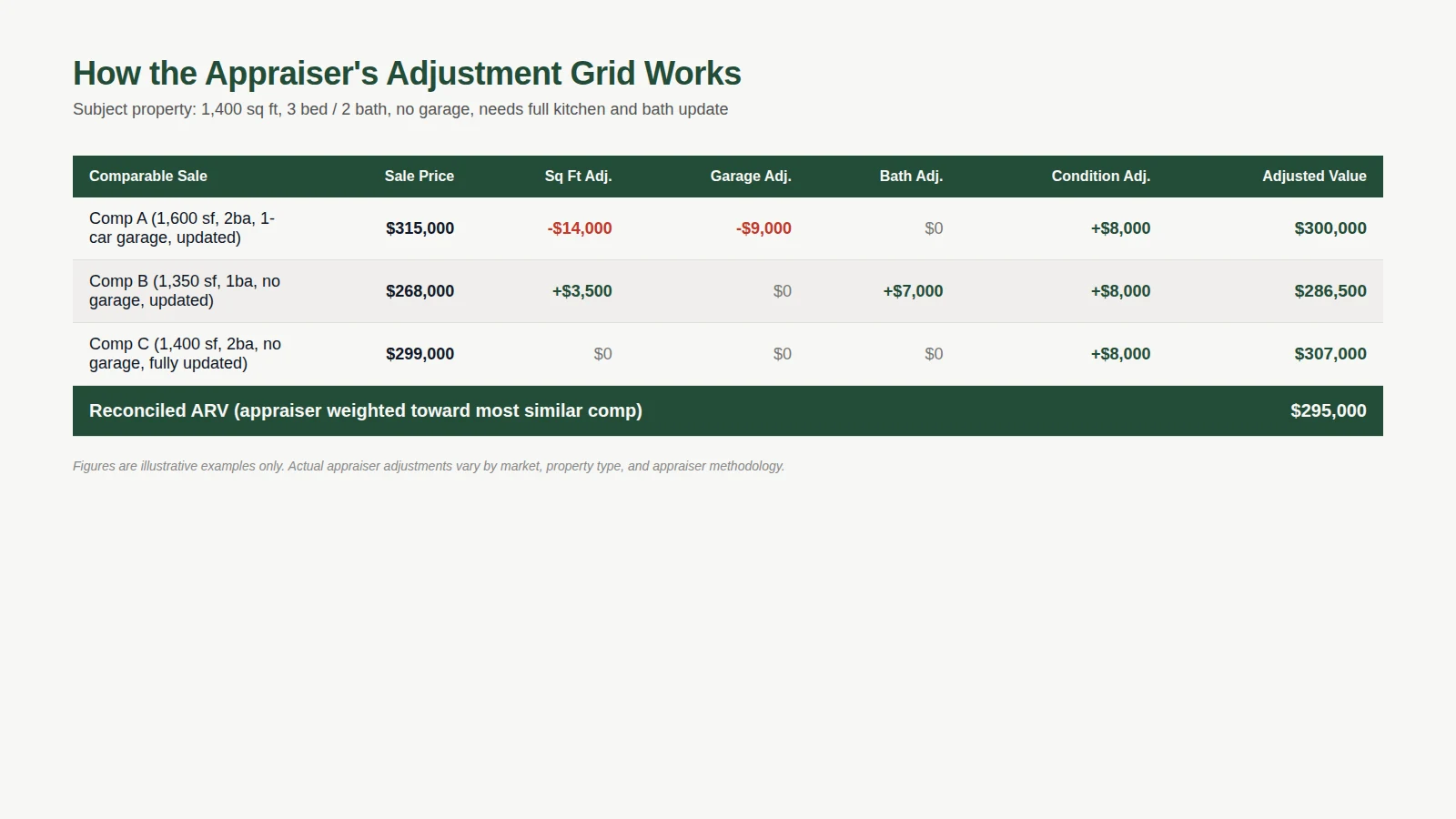
The adjustments are per-line and additive. A comp that is 200 square feet larger than your subject gets a downward adjustment for that square footage, at a market-derived rate, often $30 to $45 per square foot depending on the market. A comp with one fewer full bath gets an upward adjustment. A comp in better condition than your post-renovation subject gets a downward adjustment for condition.
The appraiser derives adjustment amounts from paired sales analysis: matching properties that sold close together in time and differed in only one feature. That is how they arrive at “a garage in this submarket is worth $9,000” rather than guessing. Those are real market-extracted numbers, not rules of thumb.
What a subject to completion appraisal actually reviews
Your lender does not order a standard as-is appraisal. They order a subject to completion appraisal, which means the appraiser is valuing the property as if all the work in your scope of work has been completed to the stated specification.
This is why your scope of work and renovation budget matter to the appraiser, not just to the lender. The appraiser reviews what you are proposing to do and makes a judgment about whether those improvements, if completed as described, would produce the condition they are assuming when they select comps. If your scope says “full kitchen remodel” but your budget is $14,000 in a market where a full kitchen remodel costs $30,000, the appraiser may adjust the condition assumption downward.
The appraiser also reviews the plans if they exist, inspects the subject property’s current condition, and verifies square footage against public records. That last step surfaces one of the most common ARV reduction errors: gross living area.
Gross living area and why your porch does not count
Gross living area is the above-grade, finished, heated and cooled interior space. Covered porches, sunrooms that are not fully conditioned, and attached garages do not count toward GLA. If you have a 240 square foot covered porch that you have been counting as interior space, you are estimating ARV on a larger property than the appraiser will measure.
The adjustment is concrete. If comps are selling at $180 per square foot of GLA and you are counting 240 square feet that the appraiser will exclude, that is a $43,200 reduction in effective size before any other variable. Most investors who make this mistake do not make it by 240 square feet, but a 120 square foot GLA error is common, and at $180 per foot that is $21,600.
Use the ARV calculator to model your deal at multiple ARV scenarios. Running the numbers at your base estimate, at 95% of that estimate, and at 90% takes about two minutes and shows you exactly how much cash each scenario requires at close.
Four reasons your estimate runs ahead of the appraiser’s number
These are the four patterns that consistently produce the investor estimate versus appraiser gap:
Active listings used as comps. A property listed at $330,000 is not a sale. It is a seller’s asking price. The market gives you the real number when it closes, and closings frequently come in below list. Appraisers do not use listing prices.
No square footage adjustment. If your three comps average 1,550 square feet and your subject is 1,350 square feet, you cannot apply their price per square foot directly. The appraiser applies a downward adjustment to each comp for the size premium, which reduces all three adjusted values.
Non-GLA space counted in the size estimate. Porches, garages, and unheated rooms that you include in your size estimate will be stripped out. This shifts the effective square footage by 100 to 300 square feet on older properties with additions or large covered porches.
Condition assumptions the budget does not support. Investors often assume a fully renovated, move-in-ready product and select comps that reflect that condition level. But the appraiser’s condition adjustment depends on what they believe the budget will actually produce. A tight renovation budget on a full gut job is a risk factor, not a footnote.
The 70% rule and how it connects to appraised ARV
The 70% rule says you should not pay more than 70% of ARV minus repair costs for a flip. If the appraised ARV is $295,000 and repairs are $65,000, the rule says maximum purchase price is ($295,000 x 0.70) minus $65,000, which equals $141,500.
The rule uses ARV, not your estimate of ARV. Running the 70% rule on an inflated ARV estimate produces a maximum offer price that the actual appraisal will not support. The discipline is to run the rule on the conservative case: take a 5% to 10% discount on your own ARV estimate before applying the formula. That buffer absorbs the methodological gap between what you estimate and what the appraiser delivers.
For details on how fix and flip financing structures the loan relative to ARV and the renovation draw schedule, see the fix and flip loan program page.
The most common mistake on a first flip is not the renovation budget or the purchase price. It is failing to account for the gap between what you think the ARV is and what the appraiser will produce. Stress test your deal at 90% of your own ARV estimate. If it still works, you have a margin for error. If it does not, the deal depends on optimism rather than arithmetic.
When ARV is not the right lens
ARV analysis is the right framework for a flip or a BRRRR refinance, but it does not apply to every real estate investment. A DSCR rental loan is underwritten on current appraised value and rent income, not a post-renovation ARV. If you are purchasing a stabilized rental that does not need significant work, the relevant tool is a DSCR calculator, not an ARV model.
If you are building a new property from the ground up rather than renovating an existing one, the relevant financing is a new construction loan. An as-completed appraisal still applies, but the appraisal process and draw structure differ substantially from a fix and flip. ARV for a new build is based on the plans and comparable new construction sales, not comparable renovated properties.
What it costs when the appraisal comes in low
Here is what most lending blogs will not write. When the appraisal comes in low, you have three options: bring more cash at close to cover the reduction in loan proceeds; renegotiate the purchase price downward by enough to restore your loan-to-ARV; or exit the deal before closing, subject to whatever your earnest money terms allow. None of those options is free or easy after you are already in contract.
A low appraisal can also trigger a condition on the loan: the lender may require the renovation to be completed to a specific scope before releasing certain draws. That slows the project and increases carry cost. On a $221,000 loan at a 10.5% annualized rate, one extra month of carry is roughly $1,930. Three extra months is $5,790 in interest you did not plan for.
The properties this financing structure does not work for: owner-occupied primary residences, properties with active title or environmental issues, and any deal where the required renovation cost exceeds what the post-renovation value can support at the lender’s LTV ceiling. If the deal needs $120,000 in rehab on a property with a $280,000 ARV, the math does not produce a viable loan at standard LTV parameters regardless of how strong the borrower is.
For a walkthrough of the financing mechanics on a first flip, including how draw timing and cash flow interact, see how to start flipping houses with borrowed money.
Questions about a specific deal: 917-842-9982.
Common questions
What is the difference between an investor ARV estimate and an appraiser ARV?
An investor estimate is a due diligence calculation based on the investor’s comp selection and condition assumptions. An appraiser’s ARV is a licensed professional opinion produced to USPAP standards, using only closed sales, documented adjustments, and a documented reconciliation process. Lenders use the appraiser’s number, not yours. The two figures often differ because investors use active listings, do not apply proper square footage adjustments, or count non-GLA space that the appraiser will exclude.
Can a lender use my ARV estimate, or do they always order their own appraisal?
For institutional bridge and fix and flip loans above roughly $150,000 to $200,000, lenders almost always order an independent appraisal. Some hard money lenders on smaller loans use a broker price opinion rather than a full appraisal, but that is still an independent evaluation, not your estimate. Treat the appraisal as the binding number and stress test your deal against a value 10% below what you expect before you commit to a purchase price.
What is a subject to appraisal and why does a fix and flip loan require one?
A subject to or as-completed appraisal values the property assuming all work in your scope of work has been completed to the stated standard. Your lender needs this number because the loan is made against a future value, not the current as-is value. The appraiser reviews your scope, compares it to similar renovated sales, and produces a value contingent on the work being done. If the work is not complete when the lender inspects before a draw, the draw may be withheld until it is.
Why did my ARV come in lower than I expected?
The four most common reasons: active listings used instead of closed sales; no adjustment for square footage differences between the subject and the comps; non-GLA space counted in the size estimate, such as a covered porch or unheated addition; or a condition adjustment because the scope and budget do not support the fully renovated assumption. The appraisal report shows every comp used and every adjustment applied, so you can identify exactly where the gap came from.
How close should my ARV estimate be to the appraiser’s number?
Within 5% is a reasonable target on a deal you have underwritten carefully with closed comps and proper adjustments. If your estimate is consistently 10% to 15% above what appraisers produce, the issue is usually comp selection or GLA measurement. Experienced flippers often apply a voluntary 5% to 8% discount to their own ARV estimate before running deal math, as a buffer against the methodological difference between an investor estimate and a formal appraisal.
What happens if the appraisal comes in below what I need to cover the deal?
You have three options: bring additional cash at closing to cover the gap in loan proceeds; renegotiate the purchase price downward by enough to restore your loan-to-ARV; or exit the deal before closing, subject to your earnest money terms. Reducing the renovation scope is a fourth option but it risks delivering a product that does not reach the ARV the loan requires. Most experienced investors build a 10% cash buffer into the deal structure specifically to absorb appraisal misses without forcing a renegotiation.
Ready to fund your next deal?
Approval within 72 hours. Close in 5 to 10 business days.
Get Funding Now