How a Bridge Loan Works When the Exit Slips
A bridge loan for real estate investors works as planned when the exit is on time. This post covers what extension fees, default rates, and a slipped sale actually cost on a worked $400,000 example.

A bridge loan for real estate investors is a short-term, interest-only loan secured against an investment property. If you are buying a primary residence or bridging the sale of your own home, this is not the right product. The mechanics of an investor bridge loan are straightforward. What most articles skip is what the loan costs when the property does not sell or refinance on schedule.
If the concept is new to you, start with what a bridge loan is for investors. This post focuses on what happens after you close, specifically on what a slipped exit actually costs in dollars and in options.
The basic mechanics
A bridge loan closes quickly, typically in 5 to 10 business days, and carries a term of 6 to 24 months. You pay interest only, monthly, on the outstanding balance. The principal comes due as a balloon at maturity. The loan is secured by the investment property, usually in first lien position.
The exit is the whole point. You plan to sell the property or refinance into a longer-term loan before the balloon is due. A bridge loan does not amortize. Every dollar of principal still exists on the day the loan matures.
Rates in the market for investor bridge loans observed in mid-2026 generally fall in a range from roughly 10% to 13%, depending on deal type, LTV, borrower experience, and whether the property is already income-producing. Origination ranges from 1 to 3 points. LTV is the primary lever: a 65% LTV deal prices better than a 75% LTV deal on the same property. See the bridge loan program page for the full range of variables.
The cost from day one: a worked example
Take a $400,000 bridge loan at 11.5%, with 2 points origination. The numbers look like this:
- Origination: $8,000 due at closing
- Monthly interest-only payment: $400,000 x 0.115 / 12 = $3,833
- Total interest over 12 months: $46,000
- Total cost of funds at a 12-month exit: $54,000
On a deal where the projected profit is $120,000, $54,000 in carry is significant but manageable. On a deal where the projected profit is $70,000, the math starts to look different if the exit slips at all. Use the hard money loan calculator to run your own deal before you commit.
Want terms on a specific deal?Answer seven questions and get a decision in 72 hours.
Get FundingWhat happens at month 12
The loan matures. If the sale has not closed or the refinance has not funded, you have three paths.
Request an extension. Most lenders will grant one if you have a credible exit in sight and your payments are current. Extensions typically come in 3-month increments, with a fee. Extension fees generally run 0.5% to 1.5% of the outstanding balance per extension period. On a $400,000 loan, a 1% extension fee is $4,000. You also continue paying interest at the note rate throughout the extension.
Pay the loan off. If you can sell or refinance, do it. Even a discounted sale that clears the balance and leaves something on the table beats the cost of a default.
Default. If you do not extend and do not pay, the loan enters default. The default interest rate kicks in, set higher than the note rate, typically 3 to 5 percentage points above it. On an 11.5% note, that range is 14.5% to 16.5%. At 16.5%, the same $400,000 loan costs $5,500 per month instead of $3,833. Over 90 days in default, that is $16,500 in interest instead of $11,500, plus the lender begins the enforcement process.
The full cost when the exit slips by 3 months
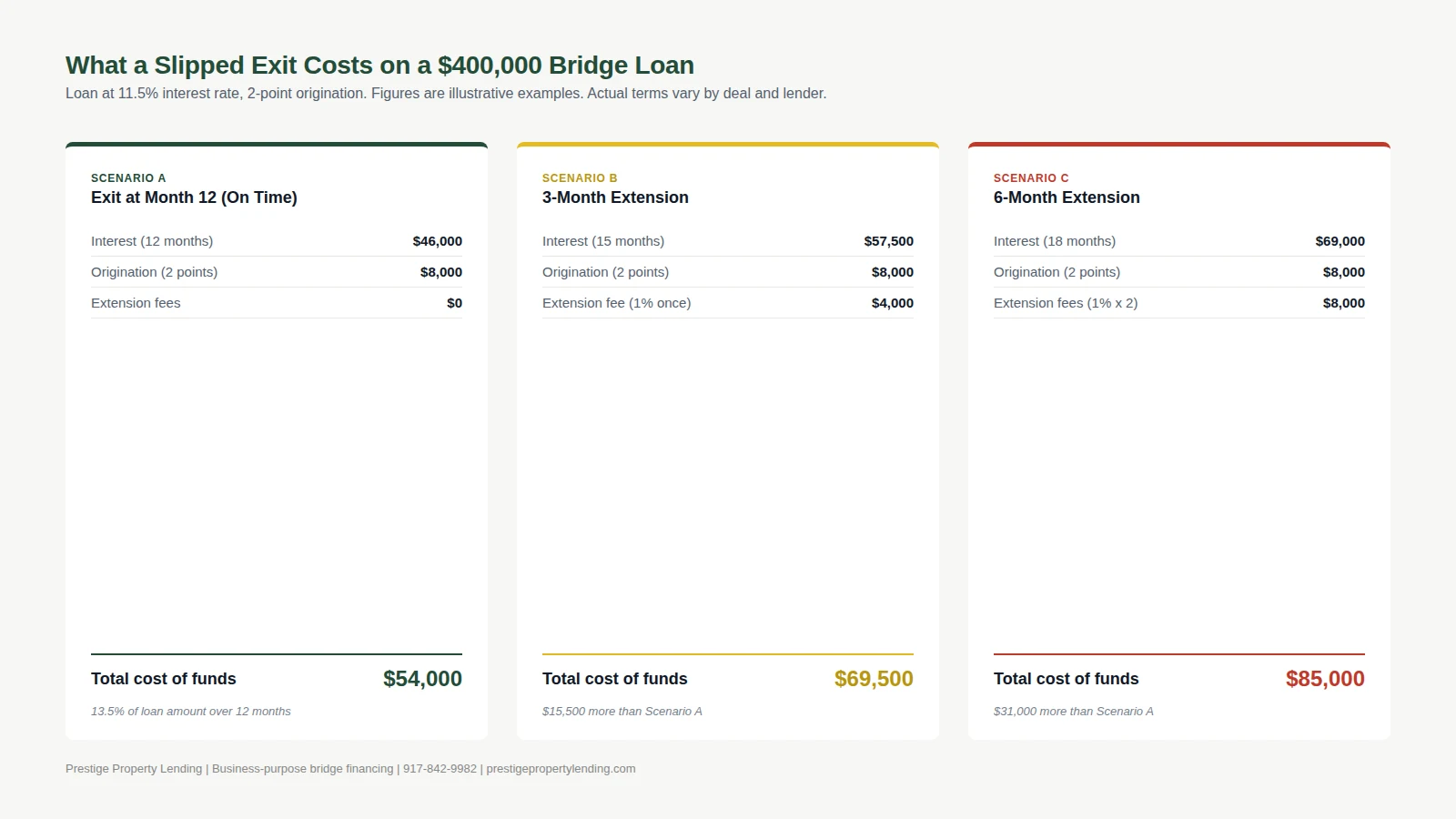
Back to the example. The sale is supposed to close at month 12. The buyer’s financing falls through at month 11. You return to market, get a new offer, and the deal closes at month 15.
- Interest, months 1 through 15: $57,500
- Origination: $8,000
- Extension fee, one 3-month extension at 1%: $4,000
- Total cost of funds: $69,500
That is $15,500 more than the plan. On a deal with tight margins, that is the difference between a good outcome and breaking even. The lesson is not to avoid bridge loans. It is to price the deal assuming the exit slips by at least one extension period, and ask whether the profit survives that assumption.
If the exit slips by 6 months instead of 3, the same loan costs $85,000: $69,000 in interest over 18 months, $8,000 in origination, and $8,000 in two extension fees at 1% each.
What month 13 looks like without an extension
Lenders do not want to foreclose. The process is expensive, slow, and the outcome is unpredictable. But they will begin it if you stop communicating and stop paying. What month 13 typically looks like, in order:
- The lender sends a formal maturity default notice. The default rate begins accruing from the maturity date.
- A workout call happens. The lender wants to understand your exit timeline and your remaining equity position.
- If the borrower has equity and a credible exit, most lenders will negotiate an extension, sometimes with tighter terms: a higher rate, fewer available extensions, or a partial paydown requirement.
- If the borrower is underwater or unresponsive, the lender moves to enforce. That means legal fees, servicer fees, and a formal foreclosure timeline that varies by state.
The pattern that repeats across most workout situations is that borrowers who call at month 10 get options. Borrowers who call at month 13 get fewer. If the exit is slipping, talk to your lender before the loan matures, not after.

When a bridge loan is the wrong tool
A bridge loan works when the exit is clear, near, and mostly within your control. It works against you when any of those three conditions fails.
Clear exit. A signed sale contract or a credible refinance path backed by current rent rolls qualifies. A plan to sell the property sometime after the renovation qualifies less well. Be specific: what is the listing price, what is the floor price that still clears the debt, and what happens if the market softens 10% before you close?
Near exit. The loan term should match the realistic timeline, not the optimistic one. A bridge loan on a 24-month gut renovation is borrowing at bridge rates for a timeline that calls for construction financing. Running a construction loan on the build phase and a bridge loan only on the lease-up or presale period is usually a better structure.
Exit mostly within your control. A sale depends on a buyer. A DSCR refinance depends on the property hitting its rent projections and the appraiser agreeing with your value estimate. Neither is fully in your control. Borrow with enough equity margin that a 15% miss on either one does not force a default.
A bridge loan is also the wrong tool if your intention from day one is to hold the property as a long-term rental. If you are buying a stabilized property and plan to hold, a DSCR rental loan is usually a lower-rate structure with no balloon date to manage. The bridge-and-refinance path makes sense when there is a value-add or repositioning play that needs to happen first.
The honest caveats
Bridge loans are expensive financing by design. The cost looks manageable on a 12-month flip with clean profit. It compounds fast on a hold that drifts to 18 months.
This is the wrong product if you do not have a realistic exit strategy with a fallback. A plan to sell and a fallback of refinancing into a rental loan is reasonable. A plan to sell with no fallback is a bet that the market cooperates and the buyer’s financing holds.
It is also the wrong product if the monthly interest payments would strain your cash position during the hold. Missing a payment while the property is vacant and under renovation is a compounding problem. The lender charges a late fee, your credit relationship with that lender gets damaged, and you are now trying to fix two problems instead of one.
The highest-risk scenario is holding several bridge-financed properties at once with exits all expected in a similar timeframe. One slipped sale at month 13 costs $15,000 to $20,000 in carry. Three simultaneous slips can compress a whole year of deal profit into a break-even, or worse.
If you want to talk through a specific deal before you borrow, call 917-842-9982.
Common questions
How is an investor bridge loan different from a homeowner bridge loan?
A homeowner bridge loan is secured by a primary residence and is subject to TILA and other consumer protections. An investor bridge loan is business-purpose financing secured by an investment property. Different lenders, different regulations, different underwriting criteria. The investor version typically closes faster and can go to higher LTVs because the compliance overhead is lower, but it also carries higher rates and shorter terms.
Can you extend a bridge loan if the exit slips?
Yes, in most cases, if you ask before the loan matures and your payments are current. Extension fees typically run 0.5% to 1.5% of the outstanding balance per extension period. Not all lenders offer extensions, and some cap the number of extensions available. Read the note before you close: the extension language is in there, and it matters before you borrow, not after.
What is the default rate on a bridge loan?
Default rates are set in the loan documents. They are typically 3 to 5 percentage points above the note rate. On a loan at 11.5%, a default rate of 16.5% adds about $1,700 per month in interest on a $400,000 balance compared to the normal rate. The default rate begins accruing when the loan matures without being paid off or extended, not when a payment is first missed, though missed payments have their own consequences.
What documents do you need to get a bridge loan?
At minimum: purchase contract or proof of ownership, rent rolls if the property has tenants, a scope of work and budget if you are renovating, your real estate experience summary, and proof of liquidity for reserves. A signed term sheet typically comes within 24 to 72 hours of submitting a complete package. Missing documents are the most common cause of delays at this stage, not underwriting complexity.
Is a bridge loan interest-only?
Yes. Investor bridge loans are structured as interest-only, with the full principal due as a balloon payment at maturity. You pay interest on the outstanding balance each month. The principal does not reduce during the loan term. That structure is what enables fast closings and flexible terms. It is also why the exit strategy matters: every dollar you borrowed is still owed on the last day of the loan.
Ready to fund your next deal?
Approval within 72 hours. Close in 5 to 10 business days.
Get Funding Now