Bridge Loan vs HELOC for Real Estate Investors: Four Differences That Actually Matter
A bridge loan and a HELOC both tap equity, but for a real estate investor they are not the same choice. Most lenders will not open a HELOC on a non-owner-occupied property, and the ones that will add seasoning and income requirements that kill a deal on a timeline. This post covers what the comparison actually looks like for investors.

A bridge loan and a HELOC are not interchangeable for a real estate investor. The quick summary: a bridge loan closes in days, costs more per month, and is available against investment properties without much resistance from most business-purpose lenders. A HELOC costs less per month but getting one against a property you do not occupy is genuinely hard, takes weeks when it is available at all, and requires seasoning you may not have. If you are reading this as a homeowner deciding how to fund a move between two primary residences, this is not your article. This post covers the investor version of this comparison, where the constraints differ at almost every point.
Why a HELOC on an investment property is harder than most articles admit
The majority of what you will read about bridge loans versus HELOCs assumes a homeowner trying to buy a new primary residence before the first one sells. In that scenario, opening a HELOC against a primary is often straightforward, and the rate comparison is the main question. For an investor, the analysis differs from the first sentence.
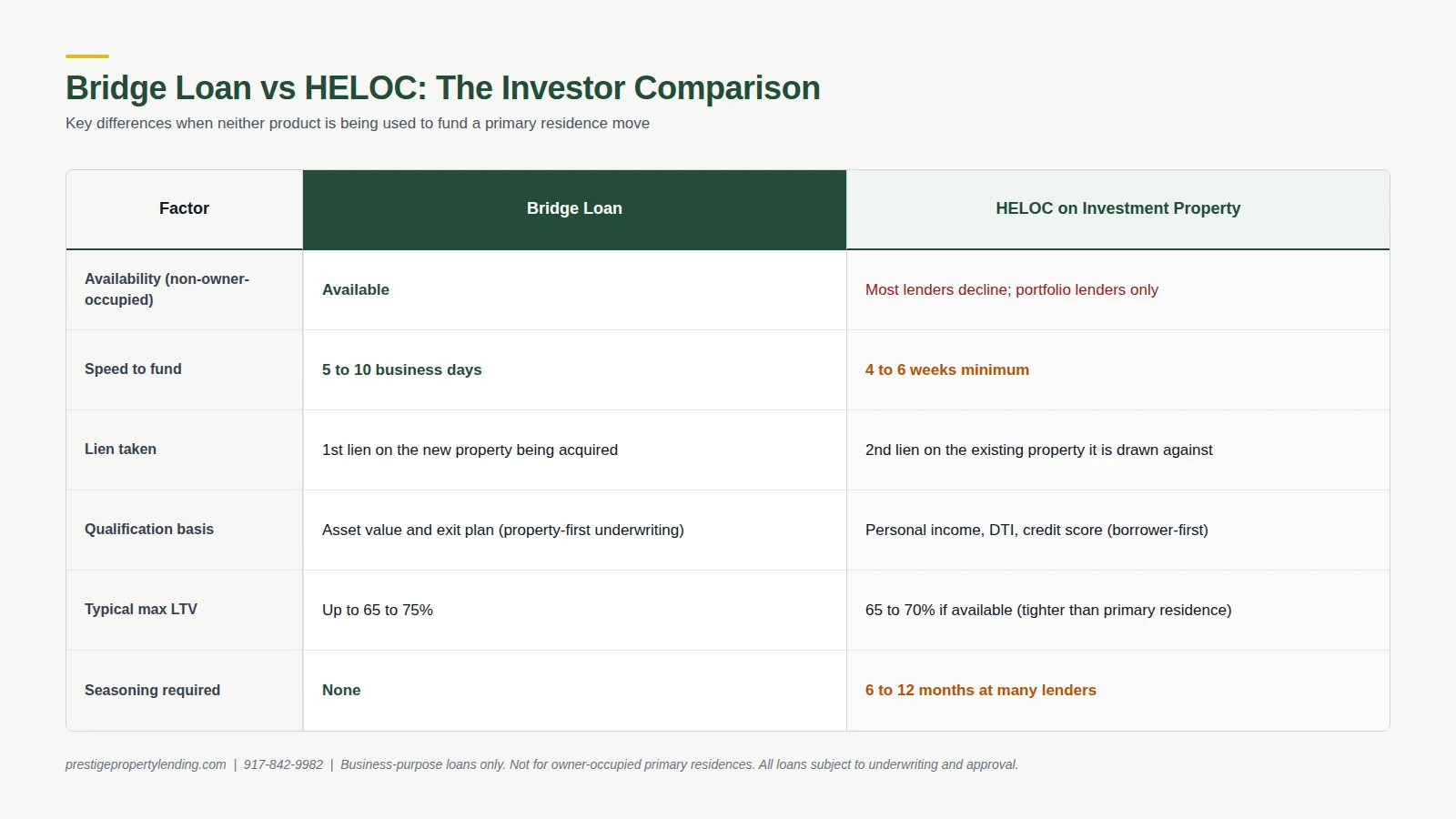
Most bank and credit union HELOC programs are built for owner-occupied primary residences. Some extend to second homes. Very few will open a revolving credit line against a non-owner-occupied rental or investment property, and the ones that will typically apply tighter terms: a loan-to-value cap around 65 to 70 percent (versus the 80 to 85 percent accessible against a primary), a credit score floor of 720 or higher, and full personal income documentation. Fannie Mae guidelines allow HELOCs on investment properties, but the overlay underwriting most retail banks apply closes most of those windows before an application is ever submitted.
Seasoning is the second obstacle. A lender placing a HELOC against a rental you recently acquired often wants six to twelve months of ownership history before approving the application. If you purchased the rental four months ago and need capital for the next acquisition, that HELOC is not available this month regardless of how strong your equity position is.
Lien position: what actually happens when you use both
A bridge loan on a new investment acquisition takes a first lien on the property being purchased. That is the standard structure. The situation that sometimes confuses borrowers is using equity in an existing property to fund a new acquisition: draw a HELOC on property A, use the proceeds toward property B, and take a bridge loan on property B for the remainder.
A HELOC on property A would sit in second lien position behind whatever first mortgage is on that property. The bridge lender on property B takes first position on property B. The two liens are on two different assets, so there is no structural conflict. What the bridge lender will want to confirm is that the HELOC draw is already funded and in your account before the bridge closes, and that the combined liabilities on your portfolio do not push the deal outside their comfort zone on leverage or reserves. Sequencing matters: the HELOC has to be open and drawn before you open the bridge loan file, not simultaneously.
Want terms on a specific deal?Answer seven questions and get a decision in 72 hours.
Get FundingSpeed: the gap that closes most deals
An investment bridge loan can close in five to ten business days once the file is complete, covering appraisal, title, and underwriting on an asset-based deal with a clean exit. That speed is a product of how the loan qualifies: the analysis centers on the property value and the repayment plan, not on months of personal income documentation and a draw-period setup.
A HELOC on a residential investment property, assuming you find a lender willing to offer one, runs four to six weeks from application to a funded draw: appraisal, title search, credit review, income documentation, and approval. A HELOC on a primary residence can move faster, sometimes three to four weeks, but still slower than a well-run bridge loan file. If a competing buyer can close in ten days and you are two weeks into a HELOC application, the deal does not wait.
Investors who successfully use a HELOC as deal capital typically maintain an open line as a standing resource, not something they open per deal. That means the HELOC was established months or years earlier against a primary residence or a seasoned rental, and the balance is available to draw today. For someone comparing these two products from scratch on a current acquisition, the practical choice is almost always the bridge loan.
Cost comparison: what the numbers look like on a nine-month hold
Bridge loans cost more per month than a HELOC. The question worth asking is total carry cost on the specific hold, not the annualized rate in isolation.
Consider a $350,000 acquisition held for nine months before sale or refinance. Using market ranges as of mid-2026, a business-purpose bridge loan might carry at a rate in the range of 10 to 12 percent annually, interest-only, with 1.5 to 2.5 points in origination. At 11 percent interest-only on a $350,000 balance, the monthly payment works out to $3,208. Over nine months that is $28,875 in interest. Add 1.75 points origination ($6,125) and the total carry cost on this example lands around $35,000.
A HELOC on a primary residence in the same period, carrying at a market rate in the 8 to 9 percent range with no origination points, on the same $350,000 drawn balance: monthly interest runs roughly $2,479 to $2,625. Over nine months that is $22,311 to $23,625. The difference versus the bridge is approximately $11,000 to $13,000 on this example. On a deal with a $50,000 projected return, that spread is worth examining carefully. On a deal with a $150,000 margin, the financing structure matters less than getting the deal closed.
Use the hard money loan calculator to model total carry cost on your specific loan amount, rate, and term before you commit to either structure. Rate is one input. Points, term, and extension fees all factor in.
Qualification: where the approaches diverge most
An investment bridge loan qualifies primarily on the asset being acquired and the exit plan. The underwriter wants to know the property value, the acquisition price, how you intend to repay the loan, and whether that exit is plausible given the property, the market, and your track record. Personal income and tax returns matter to some degree, particularly on larger loans or when the exit depends on qualifying for a DSCR refinance, but the primary analysis is property-level. This is why a borrower with substantial net worth and low W-2 income can often get a bridge loan where a conventional lender would decline.
A HELOC, even one extended to an investor on an investment property, qualifies more like a consumer product. The lender will pull credit, verify income, calculate a debt-to-income ratio, and apply underwriting standards built for a borrower who will be servicing the line from personal income. If your income runs through a schedule C or multiple K-1s, the HELOC lender’s income calculation may produce a lower figure than you expect, and that directly affects the line they will offer.

When the HELOC is the right answer
There are cases where the HELOC wins. If you own your primary residence with significant equity, have an open HELOC with available balance, and the acquisition timeline is not under pressure, drawing that line can be a cheaper source of short-term capital than opening a new bridge loan. Some investors with larger portfolios maintain HELOCs on multiple properties specifically for this purpose, treating the lines as a capital reserve rather than a deal-by-deal financing decision.
The HELOC also fits better when the capital need is staged rather than lump-sum: renovation draws on a property you already own outright, a cash buffer you want in place before a DSCR refinance, or working capital between closings. A revolving line that you can draw and repay matches those use cases in a way that a closed-end bridge loan does not.
The honest framing: for an investor who does not already have a HELOC open and funded, the comparison is rarely between two equally available options. The bridge loan is available. The HELOC may not be, and if it is, you probably needed to open it before you needed the capital.
Where this financing is the wrong choice
A bridge loan is the wrong tool if your exit is speculative. A bridge that funds an acquisition you plan to refinance out of in six months assumes that refinance happens. If interest rates move, the property does not appraise where you expected, or the rental market shifts and the DSCR loan you planned to use no longer qualifies the deal, you are in a bridge with no clear way out. Extension fees and default-rate provisions in a bridge agreement are not theoretical: they are a lender’s priced-in expectation that a portion of borrowers will encounter them. Understand what month thirteen costs you before you close month one. The post on how a bridge loan works when the exit slips covers the mechanics in detail.
A HELOC against a primary residence is the wrong structure if drawing it puts your housing stability at risk. Investors who draw primary HELOCs for deals that go wrong carry both the deal loss and a lien on the home they live in. Those risks do not cancel each other out.
Neither product is appropriate without a documented exit. All loans are subject to underwriting and lender approval, and the underwriting on an investment bridge loan assumes you have shown your work on how this loan gets repaid.
What to look at next
If you are working through a specific acquisition and want to understand what a bridge looks like on that deal, review the bridge loan program and then model your carry cost with the hard money loan calculator before you call. The calculator handles interest-only structures and produces a monthly and total cost figure you can set against your projected returns on the deal.
Call 917-842-9982 with deal-specific questions.
Common questions
Can you get a HELOC on a rental property you already own?
A small number of lenders, mostly portfolio banks and credit unions, will open a HELOC against a non-owner-occupied investment property. Most retail lenders will not. Those that will typically cap the loan-to-value at 65 to 70 percent, require a credit score of 720 or higher, verify personal income, and may require six to twelve months of ownership seasoning. Availability varies significantly by market and institution type. It is worth calling your existing bank first, but expect to hear no from the majority of them.
Which lien position does a bridge loan take on the new property?
A bridge loan for a new acquisition takes first lien position on the property being purchased. If you are also drawing a HELOC on a separate property you already own, those are two liens on two different assets and they do not conflict with each other. The bridge lender will want to confirm that the HELOC draw has already cleared and that the combined debt load does not create a leverage or reserve problem for the new deal.
How long does a bridge loan take to close versus a HELOC?
An investment bridge loan can close in five to ten business days once the file is complete. A HELOC on an investment property, where available, typically runs four to six weeks through appraisal, title, and underwriting. A HELOC on a primary residence can be faster, often three to four weeks, but still slower than a well-prepared bridge loan file. If the deal has a firm timeline, the bridge loan is the structure that fits.
Can I use a HELOC draw as my down payment for a new investment property?
Yes, but the timing matters. Drawing a HELOC on a primary residence or existing investment property and using those funds as equity in a new acquisition is an accepted structure. The bridge lender underwriting the new purchase will want to see that the HELOC was drawn before you opened the bridge file and that the funds are documented in your account. Drawing the HELOC and wiring to the new purchase in the same week can create a simultaneous-transaction issue that delays the close. Have the HELOC proceeds in your account for a few days before the bridge closes.
What happens if my bridge loan exit does not close on schedule?
Most bridge loans include an extension option of 30 to 90 days, typically at a fee in the range of 0.5 to 1.5 percent of the loan balance per extension period. If the exit fails entirely, the loan goes to default and the lender has the right to begin foreclosure proceedings. Default interest rates can run several points above the note rate. Plan your exit timeline with at least 60 days of buffer beyond your expected sale or refinance date, and read the extension clause before you sign.
Ready to fund your next deal?
Approval within 72 hours. Close in 5 to 10 business days.
Get Funding Now