What a Bridge Loan Is for Real Estate Investors
A bridge loan is short-term, asset-backed financing that lets a real estate investor acquire or reposition a property while the long-term exit is not yet in place. This guide covers how bridge loans work, what they cost all-in, and what happens when the exit slips.

A bridge loan is short-term, asset-backed financing that holds a real estate deal together while your long-term exit is not yet in place. It is not for homeowners moving between primary residences, and it is not subject to the consumer protections that govern a conventional mortgage. If you are buying or refinancing the home you live in, this is the wrong product and we cannot fund it. For investors acquiring, repositioning, or pulling equity from an investment property, a bridge loan is often the fastest path to close.
How a bridge loan works
The mechanics are straightforward. You borrow against the value of a property you are acquiring or already own, the lender takes a first-lien position, and you repay the full balance at the end of the term when you sell the property, refinance into permanent financing, or complete the value-add work that unlocks a long-term loan.
Terms typically run from 6 to 18 months. Interest accrues on the outstanding balance and is charged monthly; you pay as you go rather than rolling everything to the back end. On a $600,000 bridge at 10%, that is roughly $5,000 per month in interest carry. A six-month hold costs $30,000 in interest alone before you count origination.
The origination fee is paid at close. On investor bridge loans in 2026, market-observed origination ranges from 1 to 3 points depending on loan size, LTV, and borrower experience. One point on a $600,000 loan is $6,000. Two and a half points is $15,000. The range is wide because the risk profile of deals varies that much.
At the end of the term, the full balance is due. There is no gradual amortization working in your favor the way there is on a 30-year mortgage. You are paying for time and speed, and the clock runs from the day you close.
What investors use bridge loans for
Four situations account for most bridge loan volume on the investor side:
Acquisition with a repositioning plan. You are buying a vacant or underperforming asset that does not qualify for permanent financing in its current state. You close with the bridge, execute the rehab or lease-up, and refinance into a DSCR rental loan once the property is stabilized. The bridge covers the window when the asset is not yet financeable on a long-term basis.
Time-sensitive closes. Conventional and agency lenders take 30 to 60 days at minimum. When a seller needs 10 business days or the deal goes to the next buyer in line, speed is the product. A bridge loan can close within that window when the file is clean and the property is in acceptable condition.
Pulling equity before a sale closes. If you own a property with significant equity, a bridge cash-out lets you deploy that capital into a new acquisition before the existing property sells. The two transactions overlap. The bridge is repaid from the sale proceeds when they arrive.
Land purchase before construction financing is in place. You have identified a buildable lot but your ground-up construction loan is not yet arranged. A short bridge on the land acquisition keeps you in the deal while the construction financing is structured. This is also covered in detail in our bridge loans program page.
Want terms on a specific deal?Answer seven questions and get a decision in 72 hours.
Get FundingWhat a bridge loan actually costs
The number that matters is not the stated interest rate. It is the all-in cost of capital over your actual hold period.
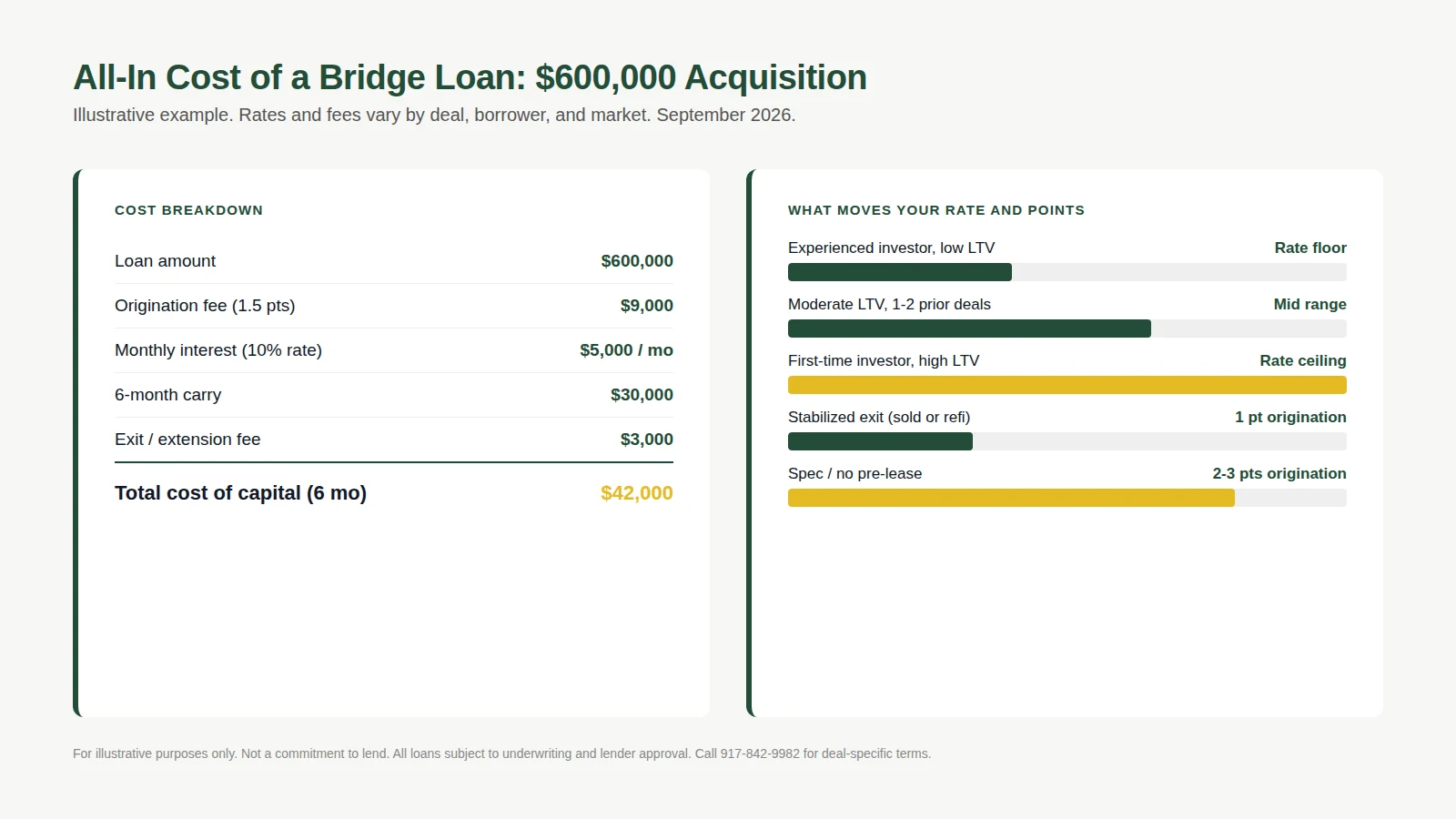
On that $600,000 acquisition: origination at 1.5 points is $9,000 at close. Monthly interest at 10% (a mid-range figure observed in the investor bridge market as of September 2026, at moderate LTV and with some borrower experience) is $5,000 per month. Six months of carry is $30,000. An exit or extension fee at 0.5 points adds $3,000. The total cost of capital for a six-month bridge comes to $42,000 on a $600,000 loan.
That is 7% of the loan amount. If your deal produces a $120,000 net profit, $42,000 is a real number but a manageable one. If the deal produces $35,000 before taxes and closing costs, the bridge loan has consumed most of it.
What moves the rate and points in your direction:
- Lower LTV relative to the as-is or appraised value
- Demonstrated experience on comparable deal types
- A credible, near-term exit already in motion (signed contract, signed lease, or completed rehab)
- Larger loan sizes, which often price more favorably per dollar borrowed
Borrowers at the lower end of the rate range typically have multiple completed transactions, LTVs below 65% of as-is value, and an exit that is not speculative. First-time investors or high-LTV requests price toward the upper end. The spread between the two can be 2 to 3 percentage points and several thousand dollars in total carry cost. Use the hard money loan calculator to run your specific deal: loan amount, rate, hold period, and points in gives you the total cost before you commit.
When a bridge loan goes wrong
The failure mode is predictable, and it is almost always the same: the exit does not happen on the timeline you planned.
You borrowed for six months. Month seven arrives and the property has not sold, the DSCR refinance fell through because the appraisal came in below the figure you needed, or the rehab hit a snag that pushed your timeline by 90 days. You need an extension. Most lenders will grant one, at an additional fee of 0.5 to 1 point and sometimes at an increased rate. On a $600,000 balance, that extension fee is another $3,000 to $6,000 before you count the additional monthly carry.
Month thirteen is the date you should mark on a calendar before you sign the term sheet. Many bridge loans carry a 12-month term with one six-month extension. If you are still not out by month thirteen, the lender has the right to begin enforcement. Because these are business-purpose loans outside the consumer protection framework, enforcement can move considerably faster than in a conventional mortgage default. A borrower in that position has very little negotiating leverage.
The deals that go badly share a few characteristics:
- The exit price assumed appreciation or comparable sales that did not materialize
- The refinance exit assumed an appraised value tied to work that ran over budget or timeline
- Cash reserves were thin enough that one unexpected repair or a slow lease-up put debt service at risk
- The borrower chose a 12-month term because that was the product on offer, not because they had a realistic 12-month plan
A bridge loan that funds a deal with a tested exit and adequate reserves is a clean, useful tool. A bridge loan used to buy time on a deal that is already uncertain turns a six-month problem into a 13-month problem at a higher cost.
See how this plays out alongside a fix and flip in how much cash you actually need to flip a house: the carry cost and reserve math apply to both, and running them together on one balance sheet changes how you size both deals.
Whether this loan fits your situation
A bridge loan fits when: you have an asset that does not currently qualify for long-term financing; speed is the deciding factor in whether you win the deal; or you have a specific, tested exit within a realistic timeline.
It does not fit when: your exit requires a sale price you have not tested in the market; the refinance exit depends on an appraisal tied to work you have not yet budgeted accurately; or your reserves are thin enough that a 90-day slip would put you in default. It also does not fit if the income from the property is what you need to service the loan, because most bridge lenders underwrite the exit, not the income stream.
For deal-specific terms, visit our bridge loan program page for loan sizes, advance rates, and how we structure the term. We can typically issue a term sheet within 72 hours of a complete application. All loans are subject to underwriting and lender approval.
To talk through a specific deal, call 917-842-9982.
Common questions
What is the difference between a bridge loan and a hard money loan?
The terms are often used interchangeably in investor lending. Where a distinction exists, bridge loans typically refer to a specific transition being financed (acquisition to sale, or acquisition to permanent financing), while hard money refers more broadly to asset-based lending outside the conventional system. In practice, most investor lenders apply the same underwriting criteria to both. You are borrowing against the property, not your income, in either case.
Can you get a bridge loan on a property you already own?
Yes. A cash-out bridge is a common use case for investors who own a free-and-clear asset or carry significant equity. The lender takes a first-lien position against the property, advances a percentage of its current value, and the loan is repaid from sale proceeds or a refinance. Qualification is asset-based: the property needs to support the requested loan amount at a manageable LTV.
What credit score do you need for a bridge loan?
Credit is a factor but not the primary one. Most bridge lenders underwrite the asset first and the borrower second. A solid property, a credible exit, and demonstrated deal experience can carry a file where credit is imperfect. Significant derogatory history, especially recent foreclosures or bankruptcies, narrows your options and tends to move pricing toward the upper end of available ranges. Ask the lender directly before spending time on a full application.
How long does a bridge loan take to close?
For a clean file with a clear title and a completed or drive-by appraisal, a bridge loan can close in 5 to 10 business days. What extends that timeline: title issues, delayed appraisal, incomplete borrower documentation, or a required inspection. The fastest closings happen when the borrower arrives with property documents, entity paperwork, and a complete financial package already assembled.
What happens if you cannot repay a bridge loan at maturity?
Failure to repay at maturity puts the loan in default. Most lenders will offer a short extension at an additional fee (typically 0.5 to 1 point) and sometimes at an increased rate. If you cannot repay and the lender does not extend, you are in the enforcement phase. Because these are business-purpose loans outside the consumer protection framework, the timelines for enforcement can move faster than in a conventional mortgage default. Your exit plan needs to be realistic, not optimistic, before you borrow.
Ready to fund your next deal?
Approval within 72 hours. Close in 5 to 10 business days.
Get Funding Now