Bridge Loan Rates and the Real Cost of a 12-Month Loan
What bridge loan rates actually look like for real estate investors in 2026, how origination points and exit fees stack on top of the rate, and the full all-in cost on a $400,000 bridge over 12 months.

Bridge loan rates for real estate investors run roughly 9% to 12% in the current market, depending on LTV, property type, and borrower track record. This post covers the investor version of bridge financing. If you are a homeowner looking to bridge between two primary residences, these loans are not available to you. Business-purpose bridge lending is a separate product class, and a conventional mortgage lender is the right starting point for an owner-occupant.
The rate is only part of what a bridge loan costs. By the time you add origination points, an exit fee, and 12 months of interest-only payments, the all-in number on a $400,000 bridge can reach $54,000. That is 13.5% of the loan amount, and it is the figure you need before you can run your deal numbers honestly.
What bridge loan rates look like for investors in 2026
Market rates observed among private and commercial bridge lenders in mid-2026 sit in a range from roughly 9% to 12% for investor-purpose loans. The spread is wide because bridge lenders price the whole deal, not just the borrower’s credit score.
A well-experienced investor taking 65% LTV on a stabilized multifamily property with a clear exit, whether a refinance into a DSCR loan or a signed purchase contract, will land near the bottom of that range. A first-time investor taking 75% LTV on a vacant single-family with a speculative exit will be at the top, or declined entirely.
| Scenario | Approximate rate range |
|---|---|
| Experienced investor, 65% LTV, clear exit | 9.0% to 10.0% |
| Experienced investor, 70% LTV, standard rehab exit | 10.0% to 10.75% |
| First deal, 70% LTV, sale exit | 10.5% to 11.5% |
| First deal, higher LTV, speculative exit | 11.5% to 12%+ |
These are ranges observed in the market as of mid-2026 and are not quotes or commitments. The rate on your specific deal will depend on your underwriting file. Call 917-842-9982 to discuss where a particular deal would land.
The four things that move your rate
LTV and exit clarity. A bridge lender is taking a position in your property at a point in time when the property may be underperforming or vacant. The lower the LTV and the clearer the exit, the less risk they carry, and the rate reflects that. A signed purchase agreement at a realistic price is the clearest exit there is. A plan to refinance into a DSCR loan in six months is a reasonable exit, but the lender will want to see that the property’s stabilized rent will support a DSCR loan at current rates. A hope that the market appreciates is not an exit.
Borrower experience. Bridge lenders look at your track record on similar deals. If you have completed two flips and are now doing a small multifamily value-add, that translates. If you have never borrowed for investment purposes before, the lender is taking on experience risk and the pricing will reflect it.
Property type and condition. A vacant property is harder to value and harder to sell quickly in a default scenario. Lenders price that risk. Mixed-use and land have more limited buyer pools. Single-family and two-to-four unit properties in established markets are the easiest to collateralize, which tends toward tighter pricing.
Loan size. Very small loans, under $150,000, sometimes price higher as a percentage because the fixed cost of origination and servicing does not compress proportionally. Loans above $1M often carry different underwriting standards and cost structures. The middle range, roughly $200,000 to $1.5M, is where most pricing falls in the ranges above.
Want terms on a specific deal?Answer seven questions and get a decision in 72 hours.
Get FundingThe real all-in cost: a $400,000 bridge over 12 months
Rate alone is a misleading number on a short-term loan. A 10.5% bridge loan does not cost 10.5% over 12 months. It costs more, because origination points and exit fees are charged on the principal and collected separately from the monthly interest.
Here is how the math works on a $400,000 bridge at 10.5%, with 2 points at origination and a 1-point exit fee:
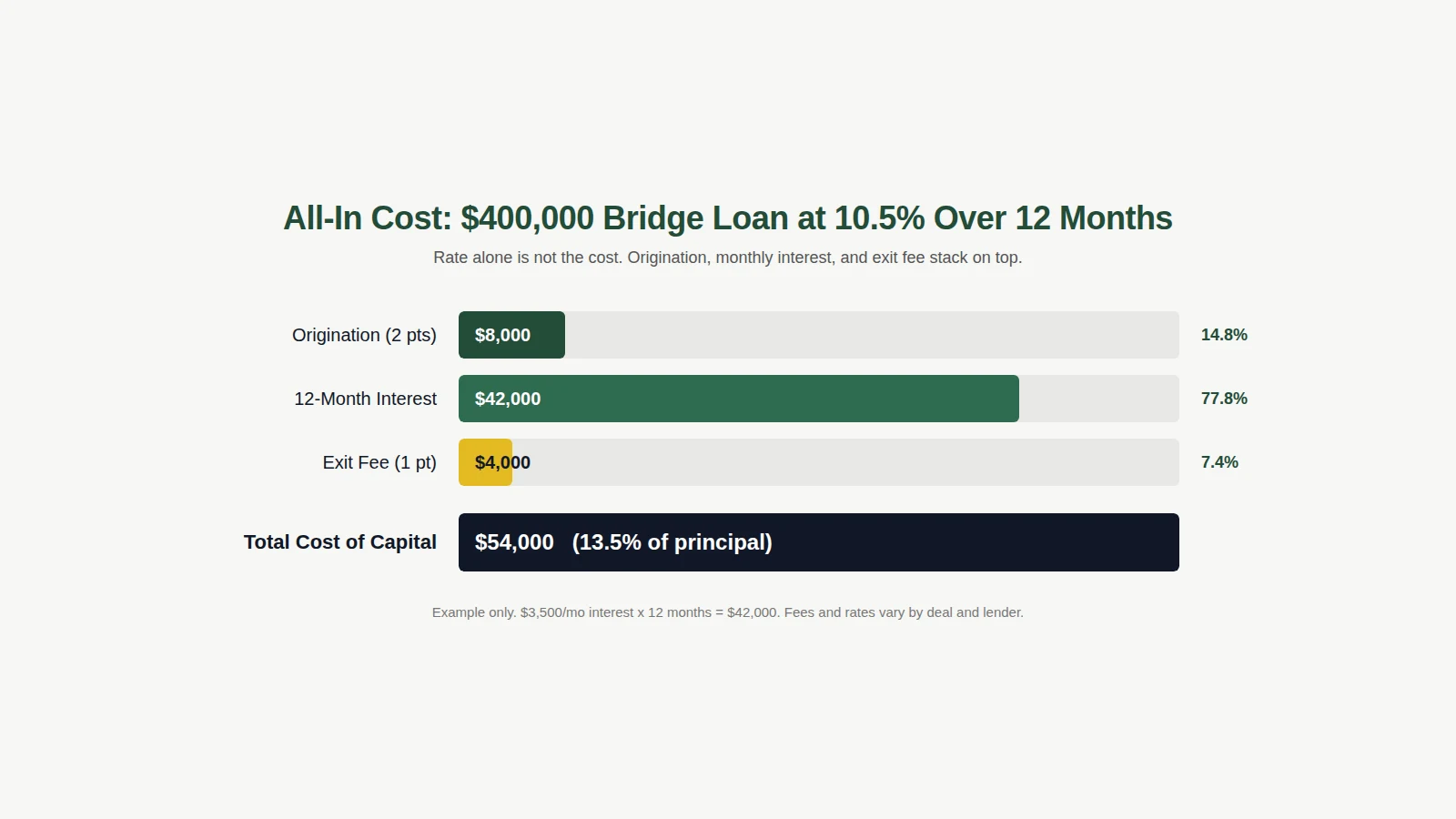
- Origination (2 points): $8,000
- Monthly interest at 10.5% annual: $400,000 x 0.00875 = $3,500 per month
- 12 months of interest: $42,000
- Exit fee (1 point): $4,000
- Total cost of capital: $54,000
That is 13.5% of the loan amount over 12 months. On an annualized effective rate basis, it is higher than the stated note rate. If you hold the loan for only 9 months, you pay 9 months of interest ($31,500) plus both fees, so $43,500, or about 10.9% of the principal. Paying off early saves real money, which is worth building into your deal timeline.
Not every lender charges an exit fee. Some fold it into the origination, some charge a prepayment penalty instead, and some charge neither. Read the term sheet carefully and add every fee to the total before comparing offers. The hard money loan calculator runs this math on any principal and rate combination, so you can model your specific deal before you enter a conversation with a lender.
How to use bridge loan costs in your deal underwriting
The cost of capital is a line item in your pro forma. A $54,000 financing cost on a $400,000 loan attached to a $550,000 property means your all-in basis is the purchase price plus rehab plus that $54,000. The ARV needs to support a sale or a refinance that clears all three layers, with enough margin left to absorb the unexpected.
If you are doing a value-add apartment building and the exit is a DSCR rental loan, the question is whether the stabilized net operating income will support a DSCR loan at the refinance amount, after 12 months of bridge payments have run through your operating account. Model the worst month, not the best month, and check whether the DSCR floor at the refi lender’s current rates actually works at the loan amount you need.

If you are doing a fix and flip and the exit is a sale, the bridge financing cost comes directly out of your profit margin. A deal that pencils at 15% return before financing may pencil at 5% after it. That is a different risk profile, and a different conversation with your lender about whether the exit is realistic. The bridge loan program page covers the typical terms and eligibility requirements we work with.
What a bridge loan costs when the deal slips
A 12-month bridge at 10.5% costs $3,500 a month in interest. If the project runs four months long, that is $14,000 in additional interest you did not budget. Add an extension fee, typically 0.5% to 1% of the principal, or $2,000 to $4,000 on a $400,000 loan, and a four-month slip adds $16,000 to $18,000 to your financing cost before you touch any other overrun.
If you miss the maturity date without arranging an extension and cannot refinance, the loan enters default. Default rates are typically 3% to 5% above the note rate. On the example above, that is 13.5% to 15.5%, or roughly $4,500 to $5,167 per month. That is a number that turns a thin deal into a loss quickly and a loss into a situation where the lender controls the timeline.
The piece on what happens when a bridge loan exit slips covers extension mechanics, default rate triggers, and what options are realistically available at month 12. Read it before you close, not after the timeline starts moving.
Who this loan is wrong for
A bridge loan is not the right tool for every situation where speed or flexibility matters. Be direct about whether any of these apply to your deal before you start the conversation with a lender.
Owner-occupants. These loans are business-purpose only. If you are buying or refinancing your primary residence, a bridge loan from a private lender is not available to you.
Investors with no clear exit. A bridge loan is a time-limited instrument. If you do not have a credible plan to refinance, sell, or otherwise generate the payoff within the loan term, the financing cost will compound against you. Lenders will ask for the exit plan. If you cannot answer it clearly, that is information about the deal, not just the paperwork.
Thin-margin deals that depend on the timeline holding. If your pro forma only works if rehab finishes in four months and the property sells at full ask within 60 days of completion, the financing structure is your highest-risk variable. Build in a realistic buffer, or price the deal to absorb a slip. The financing cost math above shows what a four-month overrun does to the numbers.
Investors who need long-term predictable financing from day one. A bridge loan is meant to be replaced. If you want to hold a rental for five years, start qualifying for a DSCR loan early and use the bridge period to build the occupancy that a DSCR loan requires. The bridge is the setup, not the finish line.
To discuss where a specific deal would land, call 917-842-9982. Every loan is subject to underwriting and lender approval. No approval or rate is guaranteed until a term sheet is issued and underwriting is complete.
Common questions
What are typical bridge loan rates for investors in 2026?
Investor bridge loan rates in mid-2026 run roughly 9% to 12%, depending on LTV, property type, borrower experience, and exit clarity. The lowest rates go to experienced investors at 65% LTV or below with a clear exit. First-deal borrowers at higher LTV tend to land in the 10.5% to 12% range. These are market observations as of mid-2026, not quotes or commitments.
What is the total cost of a bridge loan, including fees?
Add origination points, monthly interest, and an exit fee if the lender charges one. On a $400,000 bridge at 10.5% with 2 points origination and 1 point exit, the all-in cost over 12 months is $54,000. That is 13.5% of the principal. Use the hard money loan calculator to run your own numbers before entering a lender conversation.
Can I pay off a bridge loan early?
Often yes, and it saves money because interest accrues only on the outstanding balance for the period the loan is held. Some bridge loans carry a prepayment penalty, typically equal to a minimum number of months of interest, often 3 to 6 months. Read the prepayment clause in your term sheet before signing. Paying off a 12-month bridge at month 9 eliminates 3 months of interest payments, which on a $400,000 loan at 10.5% is $10,500.
What happens if I cannot pay off the bridge loan on time?
Most lenders offer an extension option at maturity, typically at 0.5% to 1% of the principal per extension period. If the extension request is denied or you miss the maturity date entirely, the loan defaults. Default rates run 3% to 5% above the note rate, which can add $4,500 to $5,000 per month on a $400,000 loan. Extensions are not guaranteed and should be treated as a contingency, not a plan.
Do bridge loan rates differ for fix and flip versus buy-and-hold investors?
They can. A flip with a sale exit is straightforward to price because the payoff comes from a transaction with a clear close date. A buy-and-hold bridge where the exit is a DSCR refinance adds a layer of uncertainty: the lender is pricing the risk that the DSCR loan does not come through at the right amount. Tell your lender the full exit plan upfront, not after they issue a term sheet.
Ready to fund your next deal?
Approval within 72 hours. Close in 5 to 10 business days.
Get Funding Now