Rental Property Loan Rates vs Primary Residence Rates: Why the Spread Exists
Rental property loans carry a rate premium over primary residence mortgages. The gap runs 0.50 to 1.75 percentage points depending on loan type. Here is why the spread exists and what moves it.

Rental property loans carry a rate premium over primary residence mortgages. The gap runs 0.50 to 1.75 percentage points in Q3 2026 depending on loan type, LTV, and how you document income. This post covers investment property financing for non-owner-occupied rentals. If you are purchasing the home you plan to live in, these products do not apply to your situation and a consumer mortgage lender is the right resource.
The spread is structural. It will not negotiate away entirely. But four specific variables move it, and understanding the mechanism behind the premium is what lets you do something about it rather than accepting the first rate you are quoted.
The spread in numbers
The graphic below shows how rental property loan rates stack against a primary residence baseline as of Q3 2026. These are market ranges, not a rate quote, and each row carries its own qualifying conditions.
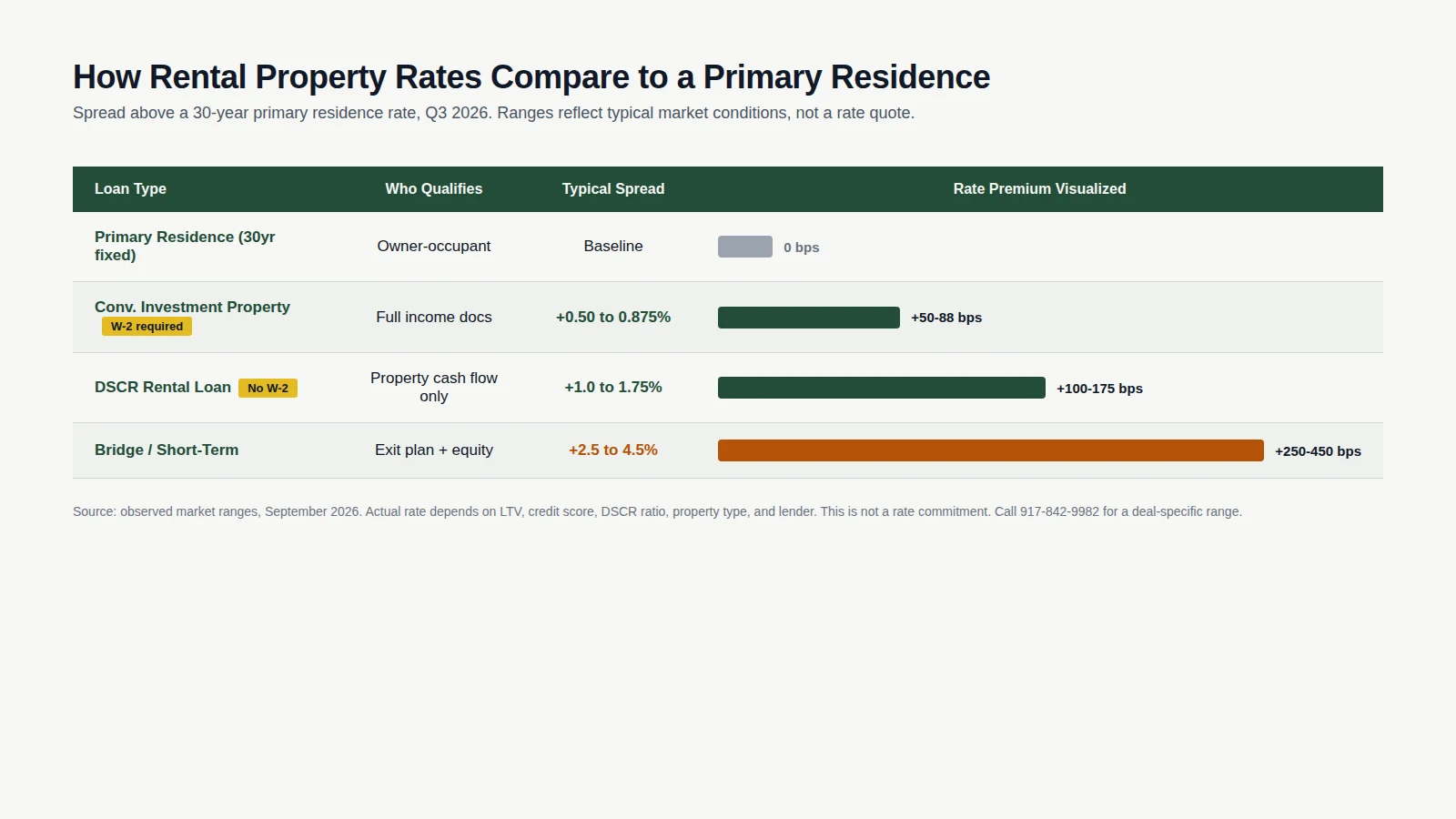
The spread widens as you move away from full income documentation. A conventional investment property loan still requires W-2s, tax returns, and a debt-to-income calculation. A DSCR loan skips the personal income step entirely and qualifies on the property’s rent. Bridge and short-term loans add duration risk on top of that. Each layer of documentation removed costs more in rate.
Three mechanisms that create the premium
The first is the Fannie Mae and Freddie Mac pricing grid. The agencies impose mandatory Loan Level Price Adjustments on investment property loans that do not apply to primary residences. At typical LTVs and credit scores, the surcharge on an investment property purchase can translate to 0.50 to 1.0 percentage points in rate compared to a primary residence at the same credit profile. Lenders pass this cost through directly.
The second mechanism is default priority. When a borrower’s income falls, primary residence mortgages are typically the last payment to stop. Rental mortgages sit further down that priority list. Lenders underwrite that behavior into their pricing because it is observable in default data: investment properties default at higher rates than primary residences across credit cycles.
The third mechanism is secondary market execution. Primary residence mortgages are the most liquid asset in the mortgage-backed securities market. Investment property paper, including DSCR loans, trades in a less liquid market with wider spreads. When credit markets tighten and liquidity leaves non-QM paper, DSCR spreads over primary rates widen. When credit is easy, the gap narrows. You are partly paying for where the market is at the time you lock.
Want terms on a specific deal?Answer seven questions and get a decision in 72 hours.
Get FundingWhere DSCR loans fit in this picture
A DSCR rental loan is underwritten on the property’s debt service coverage ratio: gross monthly rent divided by the full monthly payment including taxes, insurance, and any HOA. A $2,400 rent against a $1,950 PITIA is a 1.23 DSCR. That qualifies at most lenders and prices in the mid tier.
DSCR loans carry a larger spread over primary residence rates than conventional investment loans because there is no income documentation backstop. If the property sits vacant, there is no W-2 income supporting the payment. The lender’s only recovery path is the property itself. That single-source risk is priced into the rate.
There is also a feedback loop worth understanding before you shop: a higher DSCR loan rate means a higher monthly payment, which means a lower DSCR ratio. A property that produces a 1.28 DSCR at a conventional investment rate might produce a 1.18 DSCR at a DSCR loan rate on the same rent. That lower ratio can push you from a mid-tier price band into a higher-rate tier, which in turn compresses your DSCR further. Run the free DSCR calculator at the actual rate you are being quoted, not a ballpark, to see which tier your deal lands in before you lock.
Four variables that move your rate
Loan to value. Dropping from 75 percent LTV to 65 percent LTV can reduce a DSCR loan rate by 0.25 to 0.50 percentage points. On a $262,500 loan at 8.0 percent, the monthly P+I is $1,926. At 7.625 percent, it drops to $1,854. That $72 per month is the value of bringing an extra $35,000 to closing on a $350,000 property. The math holds because a lower LTV reduces the lender’s loss exposure in a default scenario.
DSCR ratio. Most lenders price in tiers. A 1.0 DSCR is break-even and prices at the top of the range. A 1.20 reaches the mid tier. Above 1.40 typically hits the best pricing available for that LTV and credit profile. The post on DSCR loan rate tiers shows how specific ratios map to specific pricing bands at different LTVs.
Credit score. DSCR loans are property-first underwriting, but the borrower still signs the note. Most programs require a minimum score of 620 to 640 and price noticeably better above 720. A borrower at 760 will typically see a rate 0.25 to 0.375 percentage points below a borrower at 680, all else equal on the same file.
Property type. Single-family and two-unit rentals price better than three- to four-unit properties or condos in most DSCR programs. Short-term rental properties qualified on projected revenue rather than a signed lease carry an additional premium because the income stream is harder to verify and less predictable. If your deal runs on Airbnb, build that rate premium into your model from the start rather than assuming lease-rate pricing.
A worked example on a $350,000 rental
Loan amount: $262,500 (25 percent down). Taxes and insurance: $450 per month. Gross rent: $2,600 per month.
At 7.375 percent, a rate consistent with a conventional investment property loan in Q3 2026, the P+I payment is roughly $1,813. Full PITIA: $2,263. DSCR: 1.15. That qualifies and prices in the mid tier.
At 8.125 percent, a rate consistent with a DSCR loan in the same market, P+I rises to roughly $1,949. Full PITIA: $2,399. DSCR falls to 1.08. The higher rate has pushed the deal from mid tier to the lowest qualifying tier, and lenders at that tier quote rates toward the top of the range. The rate is partly explaining itself.
The way out of that loop is not to find a lower rate at any cost. Run the deal at the rate you will actually receive and decide whether the numbers work at that rate. If they do not work at 8.125, they probably will not work at 7.875 either. The property’s rent is the constraint. The rate is just making that constraint visible.
When paying a higher rate is still the right call
DSCR loans are more expensive than conventional investment property loans. That is the actual cost of the product, not a negotiating problem.
The premium is worth paying in two situations. First, for self-employed investors, business owners, and anyone who shows limited W-2 income: a DSCR loan does not look at personal tax returns at all. If your income documents poorly enough that you cannot qualify conventionally, the DSCR spread is the price of accessing investment financing at all. Second, for investors with more than 10 financed properties: Fannie Mae and Freddie Mac cut off conventional investment lending at that count. DSCR loans have no such hard limit.
If you qualify for both products, the math should drive the decision. Run the DSCR on both rates. The one that produces a DSCR above 1.20 on realistic rent is the better deal. The one that requires optimistic rent assumptions to hit 1.10 is not a good deal regardless of how competitive the rate looks in isolation.
When this financing is the wrong fit

If you are buying the home you plan to live in, business-purpose lenders cannot fund that loan. This is a legal distinction, not a policy preference. These are commercial and investment-purpose loans only. Consumer mortgage lenders are the right resource for a primary residence purchase.
If your property needs significant renovation before it can generate rent, a DSCR loan is not the right starting point either. DSCR underwriting requires a signed lease or a market rent appraisal. A property that needs $200,000 in work before it generates income has no DSCR to underwrite against. A bridge loan or construction financing is the right product to reach stabilization; a DSCR refinance follows once the property is leased and income is documented.
A DSCR loan on a deal with a 1.02 coverage ratio is also a poor fit, regardless of whether it technically qualifies. A 1.02 DSCR means the rent covers the payment by $40 per month. One vacancy month, one insurance renewal, one property tax reassessment and the payment is uncovered. A working margin of safety starts around 1.20. All loans are subject to underwriting and lender approval. A calculator result is not a commitment to lend.
What to do next
Before you talk to any lender, run the specific deal through the DSCR calculator at the rate you expect to actually receive. Use a full PITIA, not just P+I. Properties that look good at a headline rate often look different when taxes and insurance are included.
For program parameters including minimum DSCR, LTV limits, and credit requirements, see the DSCR rental loan page. For a deal-specific conversation, call 917-842-9982.
Common questions
How much higher are rental property loan rates compared to a primary residence?
In Q3 2026, the premium runs 0.50 to 0.875 percentage points for a conventional investment property loan with full income documentation. For a DSCR loan, which qualifies on property cash flow rather than personal income, the premium runs 1.0 to 1.75 points. Short-term and bridge loans carry a larger spread still. All of these are market ranges, not a quote for any specific loan.
Can I get a rental property loan at the same rate as my primary residence?
No. The rate premium is structural. Mandatory pricing adjustments from Fannie Mae and Freddie Mac, higher default rates on investment properties, and less liquid secondary markets for investment paper all feed into the spread. You can narrow it by putting more down, improving your DSCR ratio, or improving your credit score, but the premium does not go away.
Does a DSCR loan always carry a higher rate than a conventional investment property loan?
In most market conditions, yes. A conventional investment property loan has a W-2 income backstop; a DSCR loan relies entirely on the property’s cash flow. That additional lender risk commands a premium. The trade-off is that a DSCR loan does not require personal income documentation, making it accessible to self-employed investors and those with more than 10 financed properties.
What DSCR do I need to get the best rate?
Most lenders tier their DSCR pricing. A 1.0 ratio is break-even and prices at the top of the range. A 1.20 reaches mid tier. Above 1.40 typically hits the best pricing for a given LTV and credit profile. Use the DSCR calculator to find out where your deal lands before you apply.
Why does bringing more equity lower my rate?
A lower LTV reduces the lender’s loss exposure in a default. At 65 percent LTV, a lender can recover the full loan balance through a distressed sale even at a significant discount to market value. At 80 percent, that buffer does not exist. Lenders price the difference in recovery probability into the rate, which is why moving from 75 percent to 65 percent LTV often produces a material rate reduction on a DSCR loan.
Ready to fund your next deal?
Approval within 72 hours. Close in 5 to 10 business days.
Get Funding Now