How a DSCR Loan Works, Start to Close
A DSCR loan qualifies on the rental property's income, not yours. Here is how the math works, what the full timeline looks like from application to wire, and the three documents that stretch most files beyond the baseline close.
A DSCR loan qualifies on the rental property’s income, not yours. This is a business-purpose loan for real estate investors, not a consumer mortgage, and it cannot fund a home you plan to occupy. If the monthly rent covers the full loan payment including taxes and insurance, you pass the primary qualification test. The approval can come within 72 hours. A clean file closes in 5 to 10 business days.
What stretches that timeline to three or four weeks is almost always one of three documents. The arithmetic is simple. Getting the right paperwork in on time is not.
How the DSCR calculation actually works
DSCR stands for Debt Service Coverage Ratio. The formula is:
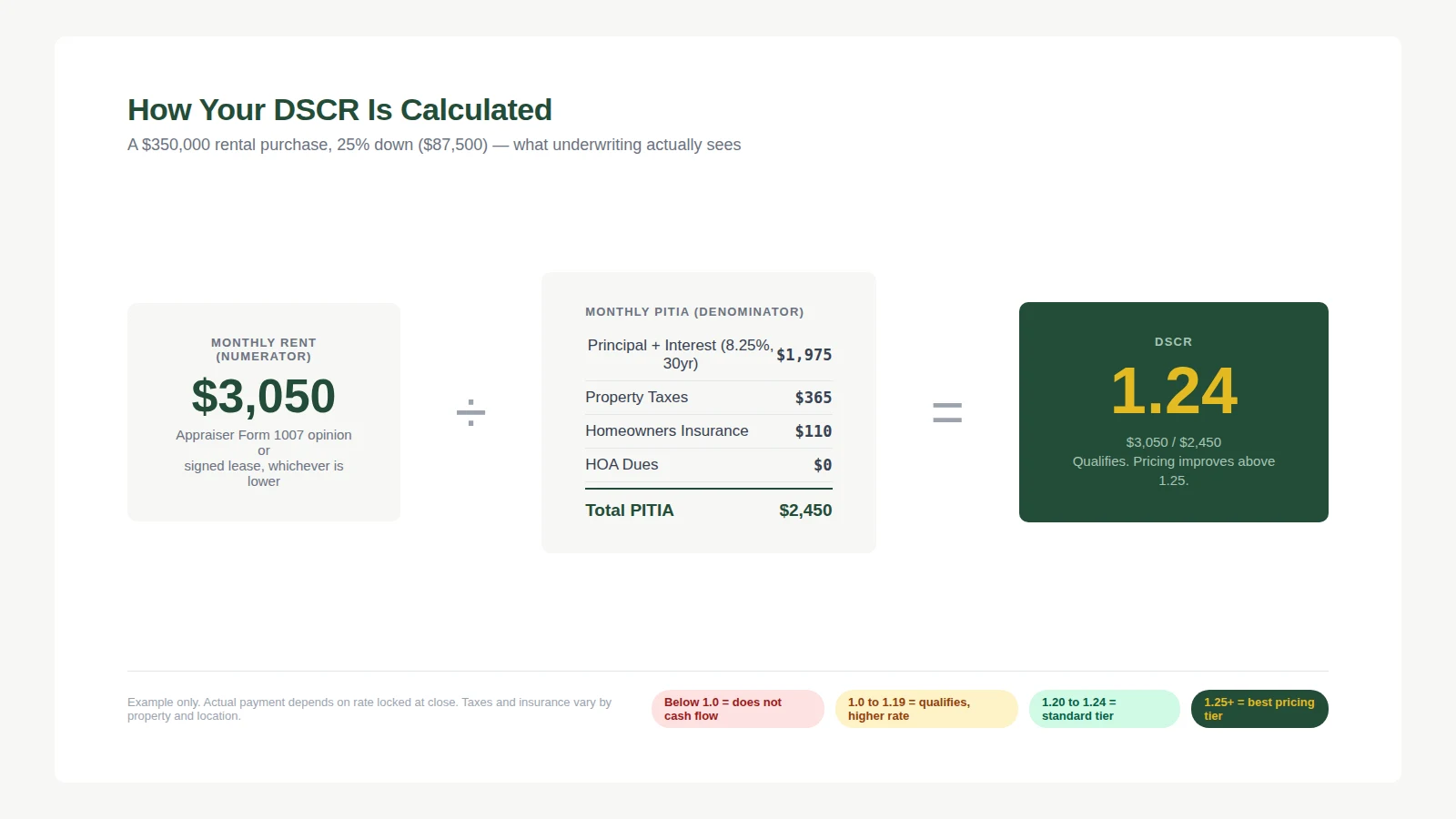
DSCR = Monthly Rent divided by Monthly PITIA
PITIA means principal, interest, taxes, insurance, and any HOA dues. It is the full monthly obligation on the loan, not just the payment. This is where first-time DSCR borrowers make the most expensive mistake: they run the ratio against principal and interest only and are surprised when underwriting returns a lower number than they expected.
Here is a worked example. A $350,000 purchase with 25% down leaves a $262,500 loan. At a 30-year fixed rate in the range market rates have occupied in 2026, the principal and interest payment on that balance runs approximately $1,975 per month. Add property taxes at $365 per month and insurance at $110 per month, and the PITIA lands at $2,450 per month. If the appraiser’s market rent opinion comes back at $3,050, the DSCR is $3,050 divided by $2,450, which equals 1.24.
At 1.24, that deal qualifies at most investor lenders. Pricing improves above 1.25 and again above 1.30 at most rate grids. Below 1.0, the property does not cash-flow and the loan is either unavailable or carries a significant rate penalty. Use the DSCR calculator to run your numbers before submitting a file. The calculator lets you enter rent, loan size, taxes, and insurance separately so you can see exactly which variable to adjust.
Where the rent number comes from
If the property has a signed lease in place, underwriting uses the lower of the appraiser’s market rent opinion or the actual lease rent. That protects the lender against inflated leases between related parties. If you purchased with a lease at $3,200 but the appraiser says market rent is $2,900, the DSCR is calculated on $2,900.
If the property is vacant at purchase, there is no lease rent to use. Underwriting relies entirely on the appraiser’s market rent addendum, called Form 1007. This is why vacant-property DSCR deals take slightly longer and are slightly less predictable than occupied ones. The appraiser’s opinion is the entire numerator. If it comes in below your pro forma, the DSCR drops and conditions get added. Model your deal around the appraiser’s likely range, not your ceiling estimate, before you set the purchase price.
Want terms on a specific deal?Answer seven questions and get a decision in 72 hours.
Get FundingThe full timeline, stage by stage
Here is what a standard DSCR closing looks like when nothing goes wrong:
| Stage | Typical timing | What happens |
|---|---|---|
| Application submitted | Day 1 | Property address, estimated rent, entity info, purchase price |
| Term sheet issued | Day 1 to 3 | Rate range, LTV, DSCR minimum, fee estimate |
| Appraisal ordered | Day 3 to 4 | AMC assigned, Form 1007 rent addendum must be specified |
| Title search started | Day 3 to 7 | Runs in parallel with the appraisal |
| Appraisal delivered | Day 8 to 14 | The critical path item on almost every file |
| Underwriting review | Day 14 to 16 | Conditions list issued if needed |
| Conditions cleared | Day 16 to 19 | How fast this moves depends on document readiness |
| Clear to close | Day 19 to 20 | Wire instructions issued, closing scheduled |
| Closing | Day 20 to 25 | Funds disbursed, lien recorded |
Approval within 72 hours is real. The 5 to 10 business days in most term sheets refers to the time from a complete file to close, not from first contact to close. A file is complete when the appraisal is in, title is clear, and entity documents are organized. Getting from first contact to a complete file is where the calendar expands.
The three documents that delay most files
In a typical DSCR closing, the same three items account for the majority of time added beyond the baseline. None of them are unusual. All of them are avoidable with preparation before the file opens.
The lease. If the property is occupied, underwriting needs a signed, fully executed lease that shows the tenant’s name, the monthly rent amount, and a term date. Month-to-month arrangements without a written term date raise questions about rental income stability during underwriting. A verbal or informal arrangement without a documented lease creates a problem that cannot be resolved quickly. Gather the current lease before you apply. If it expired and rolled month-to-month, get a signed renewal or an addendum confirming the rent and a new term date before the file opens.
The appraisal with Form 1007. Standard appraisal orders often do not include the market rent schedule automatically. If the appraisal management company delivers a complete value appraisal without Form 1007, underwriting cannot use it to calculate DSCR. The file goes back to the AMC, which typically costs 3 to 5 business days on a single oversight. When you submit a DSCR file, confirm in writing that the 1007 is specified on the appraisal order. If you do not see it on the order confirmation, ask the lender to add it before the appraiser schedules the inspection. An appraisal without the rent addendum is an incomplete appraisal on a DSCR file, and there is no shortcut around it.
Entity documents. Most investor lenders vest DSCR loans in an LLC for business-purpose compliance. An LLC vesting typically requires the operating agreement, the EIN letter from the IRS, and a certificate of good standing from the state of formation. If your LLC was formed in Wyoming but the property is in Ohio, a foreign qualification certificate filed with Ohio is also required. That requirement surfaces in almost no initial document checklist, and it typically appears in underwriting conditions on day 14 or later. Investors who have all entity documents organized at application, including the foreign qualification certificate if applicable, consistently shave 3 to 5 days off the back end of the close.

What this loan cannot do
A DSCR loan is a business-purpose product for investment properties only. It cannot fund a home you intend to occupy as a primary residence. That is not a lender preference; it is a compliance requirement built into how the loan is structured. Any application submitted for an owner-occupied property will be declined during underwriting. The DSCR product operates under a different regulatory framework from a consumer mortgage, and the income documentation it skips is omitted because it is irrelevant to a rental property assessment, not because lenders are being permissive.
The loan is also the wrong tool for a property where the rent does not cover PITIA at current rates. A DSCR of 0.85 is not a rounding error. It means the property runs a monthly deficit before vacancy, maintenance, or capital expenditure enter the picture. Some lenders will issue a loan below 1.0 with a higher rate and a larger down payment, but approving the loan does not make the deal cash-flow positive. Run the DSCR calculator with honest inputs, including realistic taxes and insurance for the specific county, before committing to a purchase price.
DSCR loans carry prepayment penalties on most programs, typically on a declining schedule over three to five years. A 3-2-1 prepayment structure on a $400,000 loan costs $12,000 to exit in year one. If your plan includes refinancing within 18 months, build that cost into your exit analysis before locking the rate. For more on how prepayment penalties and reserve requirements affect total returns, see the post on DSCR loan pros and cons.
Starting the process
A term sheet on a DSCR file requires the property address, the estimated purchase price or current value, the projected or current rent, and your entity information. No tax returns, no W-2, no debt-to-income calculation. All loans are subject to underwriting and lender approval. Loan sizes run from $100,000 to $25,000,000 and the program covers all 50 states.
Call 917-842-9982 or review the DSCR rental loan program page for current requirements, eligible property types, and the documents to gather before submitting a file.
Common questions
Does a DSCR loan show up on my personal credit report?
Yes. Even though the loan qualifies on the property’s income rather than yours, the lender pulls your personal credit and the loan is typically reported to your personal credit file. LLC vesting does not remove the personal liability. Most DSCR loan agreements include a personal guarantee, which makes you personally responsible for the loan regardless of entity structure.
Can I use projected rent on a vacant property?
Yes, but the number is set by the appraiser’s Form 1007 market rent opinion, not your estimate. If your pro forma rent exceeds what nearby comparables support, underwriting will use the appraiser’s lower number. Model your DSCR around the appraiser’s likely range before you go under contract so that a conservative appraisal does not change the deal economics at the last moment.
What happens if the appraisal comes in lower than the purchase price?
The loan is underwritten against the lower of the appraised value or the purchase price. If the appraised value is $320,000 and you agreed to pay $350,000, the LTV is calculated on $320,000. The cash required to hit 75% LTV increases by $22,500 over your original estimate. You can negotiate a price reduction with the seller, cover the gap in cash, or walk if the contract has an appraisal contingency.
Does it matter if my LLC was formed recently?
Some lenders have entity seasoning requirements, typically 3 to 6 months from the formation date. Others accept a newly formed LLC. The requirement varies by lender and is not standard across the product type. Confirm the seasoning requirement before you form an entity specifically for a transaction, because a 6-month requirement on a deal you want to close in 30 days cannot be worked around.
Can a short-term rental qualify for a DSCR loan?
Some lenders accept STR income for DSCR qualification, typically based on 12 months of platform earnings or an AirDNA market rent analysis. The formula is the same: gross income divided by PITIA. Not all lenders allow STR income, and some require a higher DSCR floor for short-term properties. Confirm the policy before submitting the file. For a standard long-term rental, the process follows the timeline described in this post.
Ready to fund your next deal?
Approval within 72 hours. Close in 5 to 10 business days.
Get Funding Now