How Much Down Payment a DSCR Loan Needs
A standard DSCR purchase requires 20 to 25 percent down. Total cash at close typically runs 29 percent of the purchase price once origination fees and 6-month reserves are added. Here is how the four line items stack up on a real deal, and what pushes the requirement to 30 percent.
A standard DSCR purchase requires 20 to 25 percent down. Most single-family rentals with a DSCR at or above 1.20 and a credit score around 700 qualify at the 20 percent floor. Multifamily, short-term rentals, and sub-1.20 DSCR files typically require 25 percent. This post is for real estate investors buying income properties on a business-purpose basis. If you are financing a primary residence, DSCR programs do not apply to you.
The down payment figure is the right starting point, but it is not the cash you need at close. On a typical DSCR deal, total cash at closing runs 25 to 30 percent of the purchase price once origination fees and reserve requirements are added. That gap is where investors most often get surprised.
The two standard down payment tiers
The 20 percent tier holds for a well-qualified file: a single-family rental or condo, DSCR at or above 1.20, credit score around 700 or better, and a long-term rental designation. On that profile, the loan-to-value ceiling sits at 80 percent and the core underwriting documents are straightforward: purchase contract, executed lease or market rent appraisal (form 1007), property insurance, and entity documents if you are taking title in an LLC.
The 25 percent tier applies when the property or borrower profile carries additional risk. Common triggers:
- DSCR between 1.0 and 1.19
- 2 to 4 unit property
- Short-term rental with projected income rather than a signed lease
- First-time real estate investor with no established track record
- Non-warrantable condo
A DSCR at exactly 1.0 means the property’s rent just covers the debt service, nothing more. Some programs approve at that threshold but push the required down payment to 25 to 30 percent to compensate for the thin margin. Below 1.0, many DSCR programs decline outright, and those that will fund typically require 30 to 35 percent down. For how your DSCR ratio affects pricing beyond just the down payment, see how the DSCR rental program is structured.
What the down payment actually costs you in cash
The LTV requirement tells you how much of the purchase price you are financing. It does not tell you how much cash you need to bring. Three additional line items add to the down payment in every DSCR transaction:
Origination and closing costs. On a DSCR loan, origination typically runs 1 to 3 points, plus appraisal, title, and escrow. On a $300,000 purchase, that lands between $9,000 and $15,000 depending on the program. Costs scale with loan amount, not purchase price, so a higher-priced market means higher absolute fees.
Reserves. Most DSCR programs require 3 to 6 months of PITIA to remain in a verifiable account after close. PITIA means principal, interest, taxes, insurance, and any HOA dues. On a $300,000 purchase at roughly 7.5 percent with $350 in monthly taxes and insurance, the PITIA runs around $2,100. Six months of reserves adds $12,600 to your required liquid position.
Prepaid items. The first year of homeowners insurance and upfront tax escrow are collected at closing. Depending on your state and property type, budget $3,000 to $5,000.
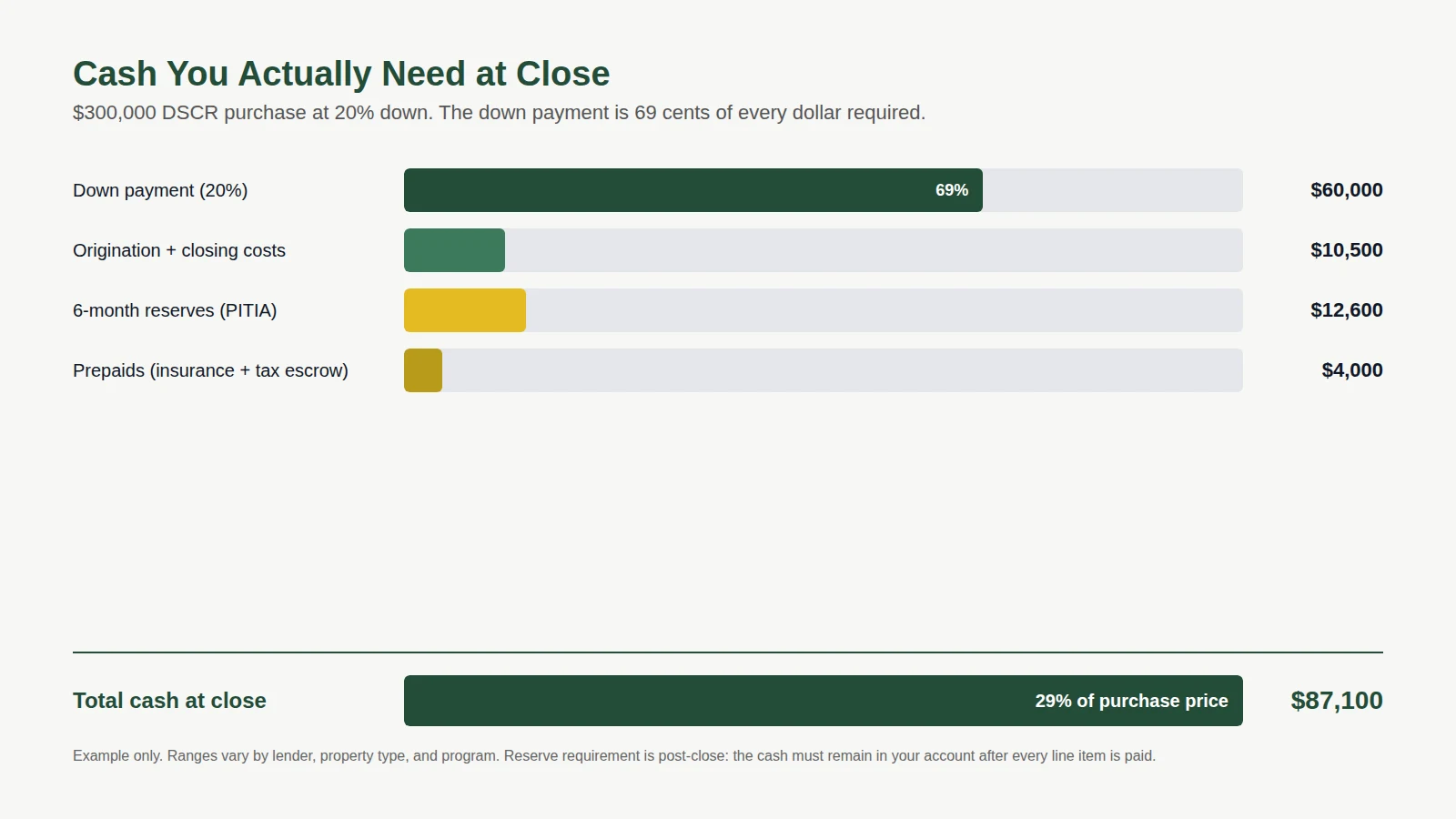
On a $300,000 purchase at 20 percent down, the cash at close breaks down like this:
| Line item | Amount |
|---|---|
| Down payment (20 percent) | $60,000 |
| Origination and closing costs (approx. 3.5 percent of loan) | $10,500 |
| 6-month reserves at $2,100 PITIA | $12,600 |
| Prepaids: insurance and tax escrow | $4,000 |
| Total cash at close | $87,100 |
That is 29 percent of the purchase price, not 20. Investors who run short at closing are almost always the ones who planned around the LTV and did not account for reserves. Use the DSCR calculator to confirm the ratio and estimate the reserve requirement before you commit to a purchase price.
Want terms on a specific deal?Answer seven questions and get a decision in 72 hours.
Get FundingHow reserves actually work
Reserves are not money you send to the lender. You keep the cash in your account; the lender verifies it exists before and, via the post-close attestation, after closing. The post-close reserve requirement means the funds must still be present after every line item on the closing disclosure is paid. Gifted funds and concurrent draws from other transactions do not satisfy the requirement on most DSCR programs.
Retirement accounts count toward reserves, but at a 60 percent haircut on most programs. If your only liquid asset is a $22,000 IRA, your effective reserve credit is $13,200. If the program requires $15,000 in post-close reserves, you are short by $1,800. Confirm the program’s specific treatment before you assume retirement funds bridge the gap.
Portfolio scale adds another layer. Some lenders apply the reserve test across your entire rental portfolio when you add a new property: 3 to 6 months of PITIA on each existing rental, plus the new acquisition. Two rentals at $1,900 PITIA each, plus a new one at $2,100, means a 6-month portfolio reserve of $35,400. That is a materially different number than a single-deal calculation, and it compounds with each property you add.
What pushes the required down payment to 30 percent
Three scenarios push past the standard 25 percent ceiling:
A DSCR below 1.0 puts the property in negative coverage. The rent does not cover the full debt service, which means you are covering the gap from personal cash flow. Programs that fund below-1.0 DSCR files typically require 30 to 35 percent down to compensate for that structural shortfall. The loan still qualifies as business-purpose financing, but the lender is pricing in a riskier repayment picture from day one.
High-balance loan amounts on certain programs hit a ceiling that forces a lower LTV. If you are buying in a high-cost market and the loan amount exceeds a program threshold, 25 to 30 percent down may be required regardless of the DSCR score.
Cash-out refinance LTV caps sit lower than purchase LTVs. On a DSCR refinance, 75 percent LTV (25 percent equity remaining after the cash-out) is the standard ceiling for a single-family rental. Multifamily and short-term rentals often cap at 70 percent. This governs how much equity you can recycle for future purchases.
The down payment across a portfolio of rentals

A single DSCR down payment is manageable. The constraint most investors feel is deal four or five, when capital deployed in prior purchases has reduced the liquid position that the reserve requirement keeps testing at each new closing.
The standard approach to recapitalize: use a cash-out refinance on a seasoned, appreciated rental to pull out equity for the next down payment. A property bought at $220,000, now worth $320,000 with a $160,000 loan balance, can support a cash-out at 75 percent LTV that returns roughly $80,000. That cash, once the refinance closes and funds are seasoned, satisfies the sourcing requirement on the next acquisition. The DSCR pros and cons post covers in detail where this recycling strategy breaks down, specifically when the refinanced property’s DSCR weakens at the new, higher loan balance after the cash-out.
Track reserves per property before you sign contracts. Some lenders need to see reserves documented separately for each property. If you pool everything in one account and the lender requires per-property reserve documentation, you may need to segregate funds ahead of closing, which adds time you may not have.
Who this loan is wrong for, and what it costs when the deal slips
DSCR financing does not work if the property’s rental income will not cover the debt service at a reasonable LTV. A 1.0 DSCR at close leaves no buffer. A furnace replacement in month three, a one-month vacancy, or a property tax reassessment can push effective coverage below 1.0 for the balance of the year. If the math only closes at a 0.90 DSCR, the property is a leveraged asset you are subsidizing from other income, not a self-sustaining rental investment. Build in at least 0.15 of cushion above the program minimum before you commit to the purchase.
It also does not work well if your liquid reserves are thin. Funds need to be sourced and seasoned, typically 60 to 90 days in the account depending on the program. A wire in from a relative two days before close does not satisfy the sourcing requirement. If you are assembling reserves for your next acquisition, keep them in a separate account and leave enough time to satisfy the seasoning clock before you go into contract.
The cost when a deal slips: a rate lock extension typically runs one to three points billed per 30-day period. On a $240,000 loan, a 30-day extension at 1.5 points adds $3,600 to your cost basis after origination has already been paid. Budget a 10 to 15 percent buffer on your total cash-at-close estimate as a planning margin. For a same-day read on the DSCR math, call 917-842-9982 or run the numbers at the DSCR calculator.
Common questions
Do DSCR loans require 20% down on every property type?
No. The 20 percent floor applies to a qualifying single-family rental with a DSCR at or above 1.20 and a credit score around 700. Multifamily (2 to 4 units), short-term rentals, and lower-DSCR files typically require 25 percent. Some programs cap LTV at 70 percent for certain borrower profiles or property types. The 20 percent figure is the floor for the best-qualified files, not a universal rule that applies to every deal.
Can reserves come from a retirement account?
Yes, but at a haircut. Most DSCR programs count 60 percent of a vested retirement account balance toward the reserve requirement. If the program requires $15,000 in post-close reserves and your only liquid asset is a $22,000 IRA, your effective reserve credit is $13,200, which may fall short. Verify the program’s treatment before you assume retirement funds fully satisfy the reserve requirement.
What happens to the down payment requirement if my DSCR is below 1.0?
A DSCR below 1.0 means the property’s rent does not cover the full debt service at the proposed loan amount. Many DSCR programs decline at sub-1.0 outright. Those that will fund typically require 30 to 35 percent down to compensate for the coverage deficit. You are also entering a loan where the property runs cash-flow negative from day one, which is a different risk profile than a standard rental acquisition.
Does the reserve requirement change as I add more rentals?
It can. Some lenders apply the reserve test to your entire portfolio when you are closing on a new property, not just the deal in front of them. That means 3 to 6 months of PITIA on each existing rental plus the new acquisition. As you scale from two properties to five, the reserve requirement grows with it. Model the portfolio-level figure before you go into contract, not after.
Can I use cash-out refinance proceeds to fund the next down payment?
Yes, if the timing works. Cash from a completed cash-out refinance is treated as your own sourced funds once the transaction is closed and the proceeds are in your account. The seasoning clock starts from when the funds land, typically 60 to 90 days before the next closing. A concurrent refinance and purchase on the same property, or an undocumented transfer in the days before close, does not meet the sourcing standard. Plan the refinance well ahead of the next acquisition contract.
Ready to fund your next deal?
Approval within 72 hours. Close in 5 to 10 business days.
Get Funding Now