DSCR Loan Pros and Cons, Honestly
A DSCR loan qualifies on the property rent, not your W-2s. That is the main advantage. The cons include a prepayment penalty that can cost $17,500 or more on a $350K loan, reserve requirements that lock up capital, and a rate spread above conventional that compounds over time. This post works through the numbers.
A DSCR loan qualifies on the property’s rent, not your W-2s or tax returns. That is its main advantage, and it is a real one. But the loan also carries a prepayment penalty that can cost $17,500 or more if your exit timeline shifts on a $350,000 loan, a reserve requirement that locks up capital you could have deployed elsewhere, and a rate spread above conventional that compounds across a 30-year amortization. This post is for investors who already know they can get approved and want to understand what they are actually agreeing to.
Note: DSCR loans are business-purpose financing for rental properties held as investments. If you are buying or refinancing the home you live in, this loan is not available to you, and no lender in this product category can fund that transaction.
The genuine advantages
The approval process skips the income documentation that kills most investor deals at the conventional lender. You do not submit W-2s, tax returns, or employer letters. The underwriter looks at the property’s rent, divides it by the proposed payment, and checks whether the ratio clears their floor. That matters to investors who are self-employed, who own multiple properties that depreciate their taxable income on paper, or who have more real estate income than their Schedule E shows after deductions.
Other advantages that are real:
- You can close in days rather than weeks when the property is clean and the title is clear
- You can hold title in an LLC rather than personal name, which most DSCR lenders allow and most conventional conforming loans do not
- There is no agency cap on the number of financed properties, unlike Fannie Mae’s 10-property limit for conventional investor loans
- Loan sizes from $100K to $25M let you finance a duplex and a 30-unit in the same portfolio with the same product
None of these advantages disappear when you understand the cons. But understanding the cons changes the math on when this loan is the right tool for a specific deal.
Prepayment penalties: the exit arithmetic is unforgiving
Most DSCR loans carry a step-down prepayment penalty, typically structured as a percentage of the outstanding balance in years one through five. A common structure is 5/4/3/2/1: you pay 5% of the balance if you sell or refinance in year one, 4% in year two, and so on down to 1% in year five. After year five, there is no penalty.
On a $350,000 loan at 7.875%, the penalty schedule produces these numbers:
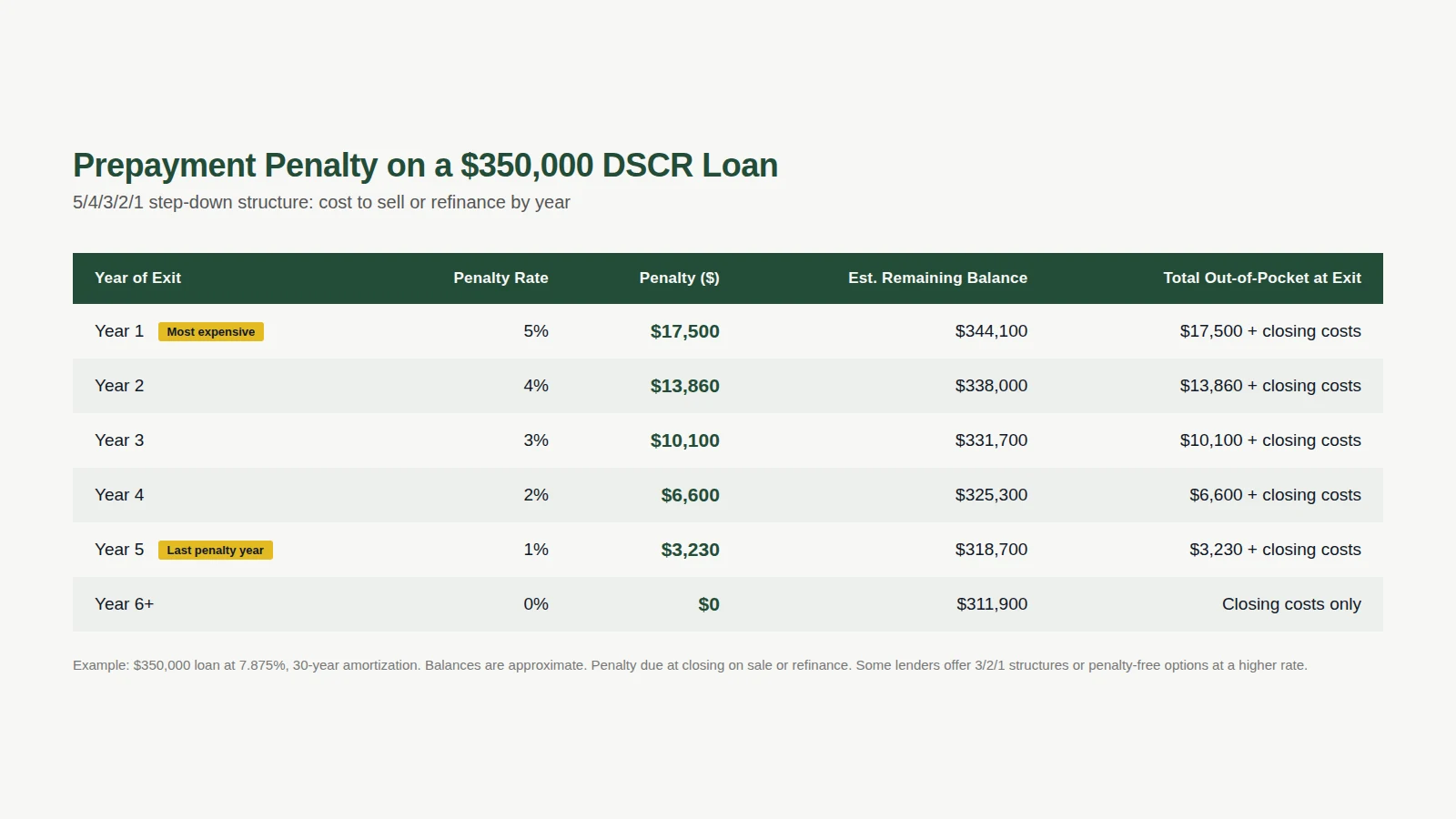
This penalty is a contractual obligation to the noteholder. It is not a lender fee you can negotiate away at closing. If your business plan involves refinancing into a lower rate in year two, that $13,860 goes on top of your closing costs. Not all DSCR lenders use 5/4/3/2/1. Some use 3/2/1, which halves the year-one exposure. A few offer penalty-free loans at a higher rate. If your hold plan involves selling or refinancing within three years, ask for the exact step-down schedule before you sign the term sheet, not after.
Want terms on a specific deal?Answer seven questions and get a decision in 72 hours.
Get FundingReserve requirements lock up capital you planned to deploy
Most DSCR lenders require three to six months of PITIA (principal, interest, taxes, insurance, and HOA dues) held in a verified liquid account after closing. On a $350,000 loan at 7.875% with $800 per month in taxes and insurance, the PITIA is roughly $3,255 per month. Six months of reserves is $19,530.
That money must be verifiable in your account at close and cannot be gift funds or a line of credit. If you are buying a property for $475,000 with a 25% down payment ($118,750) and financing $350,000, adding origination costs (typically 1 to 2.5 points), prepaid items, and a six-month reserve requirement means you are writing checks totaling $150,000 to $160,000 to put this deal together. Many investors who qualify on the DSCR ratio alone cannot actually close because they did not model the reserves.
If you are comparing this product to a conventional investment loan, the reserve requirement is usually similar. If you are comparing it to seller financing or a private note, the difference is substantial.
A 1.0 DSCR approval is not always a good deal
A DSCR of 1.0 means the rent exactly covers the payment. Some lenders will approve at 1.0. That approval is not the same as underwriting the deal yourself.
Take a $1,900 per month rent against a $1,900 PITIA. You are approved. But a single month of vacancy costs $1,900 out of pocket with zero cushion from the property. A $500 HVAC repair is an emergency, not a maintenance line item, because the property generates nothing after debt service. A property tax reassessment or insurance increase pushes you below 1.0 immediately, meaning the property no longer covers its own financing cost.
The DSCR ratio does not tell you the vacancy rate in the submarket, the quality of the current tenant, or how thin your overall portfolio is. Approval is not underwriting. A DSCR of 1.20 or higher means $200 in surplus per $1,000 of payment. That buffer is worth having before you factor in capital expenditures.
Use the DSCR calculator to run your actual numbers with current rent estimates and the rate on your term sheet before you treat a 1.05 approval as an investable deal.
The rate spread over conventional adds up
DSCR loans price higher than conventional conforming loans because they do not meet agency guidelines and cannot be sold to Fannie Mae or Freddie Mac. The spread varies by lender, credit score, LTV, and DSCR band, but investors typically see rates 0.5 to 1.5 percentage points above a comparable conventional loan on the same property.
On a $350,000 loan, that spread means roughly $35 to $105 extra per month in interest, or $420 to $1,260 per year. Over five years before a refinance, the extra carrying cost at a 1.0% spread is $4,200. That is manageable if the property is producing returns well above that figure. It becomes a more significant conversation if you are counting on rates falling before your prepayment penalty window closes.
For a full breakdown of what drives your rate in this product, see DSCR loan rates: what tier your deal lands in.
Who this loan is wrong for
DSCR financing is the wrong tool in these situations:
- Investors with strong documented income whose property qualifies for conventional financing. A lower rate and no prepayment penalty make conventional better for a long-term hold where a near-term refinance is not in the plan.
- Anyone buying or refinancing a primary residence. DSCR loans are business-purpose only. If the property is where you live, this product cannot fund it.
- Investors buying significantly cash-flow-negative properties. Starting a deal at negative cash flow after all costs means funding the gap from somewhere else indefinitely.
- Investors who plan to exit or refinance within 12 months. The year-one prepayment penalty on most loans makes the first 12 months the most expensive period you can hold a DSCR-financed property.
- Investors who cannot comfortably hold past the penalty window. If a job change, portfolio event, or market shift could force a sale in year two or three, price the penalty into your underwriting before you commit.
What the deal actually costs when the exit slips
If your exit takes longer than planned because a sale drags or the refinance market moves against you, the prepayment penalty step-down is working against your carrying cost. At year one on a $400,000 loan with a 5% penalty, you pay $20,000 to exit. If rates have risen and the new rate is higher than your current rate, it may be cheaper to hold through the penalty window than to refinance out of it.
The cost that surprises first-time DSCR borrowers is not the penalty alone but the combination: penalty plus rate spread plus reserve requirements means this product demands more capital than its no-income-docs marketing implies. A borrower who closes a $350,000 DSCR loan typically commits $150,000 to $160,000 in liquidity at close, carries a rate 0.75 to 1.25% above conventional for the first several years, and cannot exit penalty-free for three to five years. That is the real shape of the commitment.
It is a rational shape for the right deal. A stabilized rental with a 1.30 DSCR, a long-term tenant, and a five-year hold horizon works well in this structure. A speculative buy at 1.05 DSCR in a soft rental market with a two-year exit plan does not.
What to check before you apply
Run the DSCR before you engage a lender. Use the DSCR calculator with your actual projected rent and the payment at current market rates. If the ratio lands below 1.15, model what a 60-day vacancy does to your cash position for that year.
Then read the prepayment terms in the term sheet before you sign. Three questions worth asking: what is the exact step-down schedule, can you make principal curtailments without triggering the penalty, and what happens if you refinance within the same lender. The answers vary and they matter.
To see what DSCR financing looks like on a specific property, review the DSCR rental loan program or call 917-842-9982. For a look at the qualification side of this product, see DSCR loan requirements: what real estate investors need to qualify.
Common questions
Can you pay off a DSCR loan early without a penalty?
Only after the prepayment window closes. Most DSCR loans carry a 3/2/1 or 5/4/3/2/1 step-down structure. If you sell or refinance before the window expires, you owe the penalty on the outstanding balance at closing. Some lenders offer penalty-free options at a higher rate. Ask before you sign.
How many months of reserves do DSCR lenders typically require?
Most require three to six months of PITIA held as liquid assets after closing. The exact requirement varies by lender, LTV, and DSCR ratio. A 1.20 DSCR at 65% LTV with strong credit may qualify for three months. A 1.05 DSCR at 80% LTV will typically require more.
What happens if my rent drops and my DSCR falls below 1.0 after closing?
Nothing automatically triggers as long as you keep making payments. The DSCR is measured at origination, not on a rolling basis. If you fall into default, the lender will assess the situation at that point. A post-closing drop in DSCR is your operational risk, not an automatic covenant breach on most non-agency DSCR loans.
Is a 1.0 DSCR deal always a bad idea?
Not always, but it requires more context than the number alone provides. In a submarket with sub-3% vacancy and a long-term tenant in place, 1.0 can work. In a higher-vacancy area with a new lease, 1.0 means any disruption comes out of your other capital. Run the vacancy scenario explicitly, not just the ratio.
Can you get a DSCR loan with no down payment?
No. DSCR loans are non-agency products and require a minimum down payment, typically 20 to 25 percent. Some lenders allow 75% LTV with a 1.25 or higher DSCR; others cap at 70% LTV at lower ratios. There is no zero-down DSCR product available in the market.
Ready to fund your next deal?
Approval within 72 hours. Close in 5 to 10 business days.
Get Funding Now