DSCR Loan Rates: What Tier Your Deal Lands In
DSCR loan rates are set by three variables stacked on each other: your debt-service coverage ratio, your loan-to-value, and your credit score. Here is the tier table and the math that shows which tier your deal actually lands in.
A DSCR loan for a solid rental property is priced somewhere between 6.50% and 8.50% as of September 2026, and the distance between those numbers is not random. Your rate tier is set by three variables stacked on each other: your debt-service coverage ratio, your loan-to-value, and your credit score. This post is for real estate investors financing income-producing property. If you are refinancing or buying a home you plan to live in, DSCR loans are not available for that purpose.
How the tier system works
DSCR pricing is not a single rate with small adjustments. Most lenders price it as three or four discrete tiers, and a deal either qualifies for a tier or it does not. The DSCR ratio is the first gate because it measures the property’s ability to service the debt without touching the borrower’s personal income.
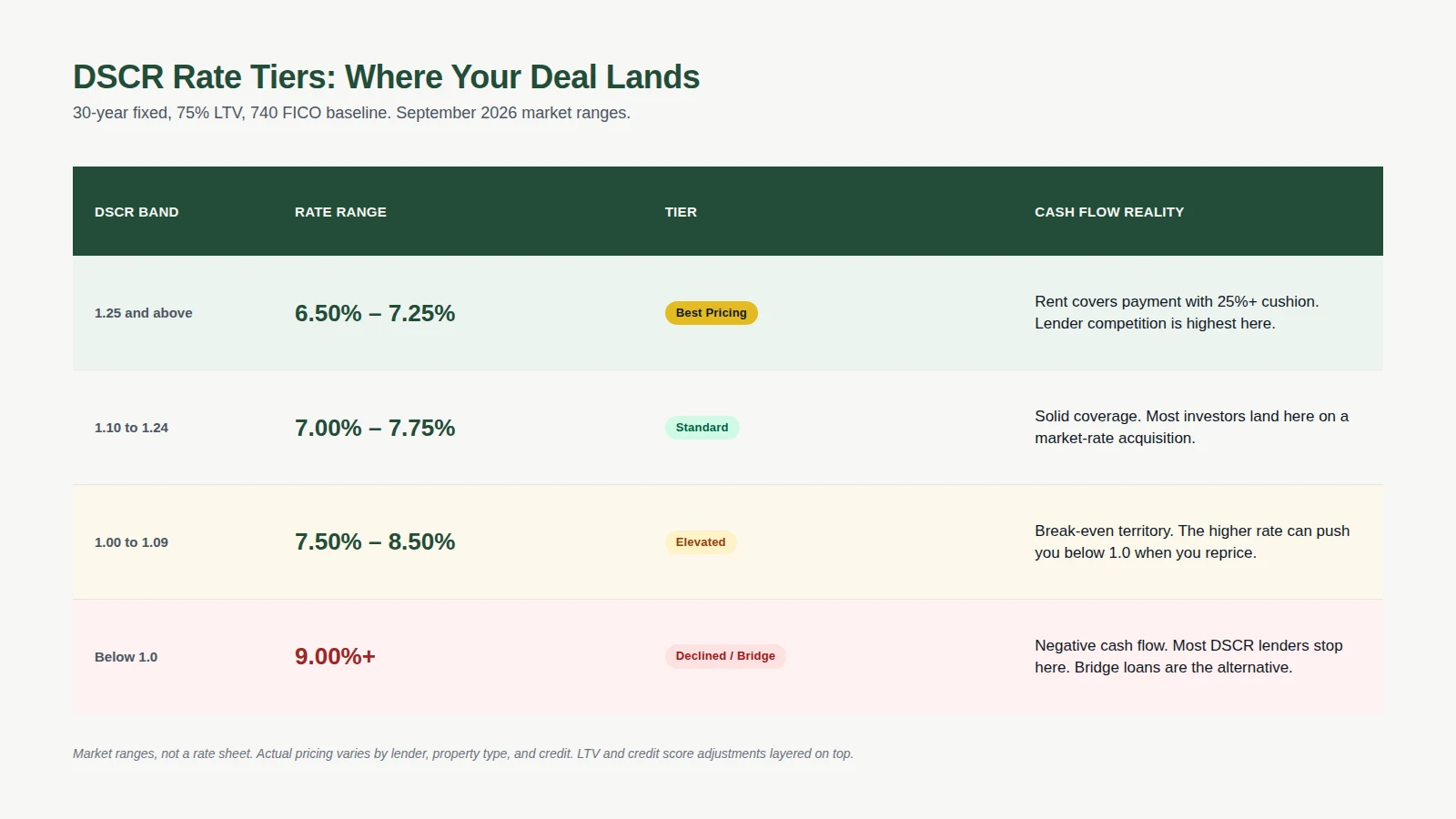
For a 30-year fixed DSCR loan at 75% LTV and a 740 FICO score, the tiers in the current market look roughly like this:
| DSCR Band | Rate Range (Sep 2026) | What it means on the deal |
|---|---|---|
| 1.25 and above | 6.50% to 7.25% | Best pricing. Property cash flows well above the payment. Lender competition is highest here. |
| 1.10 to 1.24 | 7.00% to 7.75% | Standard pricing. Acceptable coverage. Most investors on market-rate acquisitions land here. |
| 1.00 to 1.09 | 7.50% to 8.50% | Elevated pricing. Break-even territory. Fewer lenders participate, and the higher rate can push you below 1.0 when you reprice. |
| Below 1.0 | 9.00%+ or declined | Negative cash flow. Most DSCR programs stop here. A bridge loan is the typical alternative while you stabilize rent. |
These are market ranges observed in September 2026, not a rate sheet. Lender guidelines vary, and conditions move with the 5-year Treasury and credit spreads. What the table gives you is the tier logic, not a quote.
A worked example: the same property in two different tiers
Take a $350,000 single-family rental with a 25% down payment. The loan is $262,500. At 7.5% on a 30-year fixed, the principal and interest payment is approximately $1,836 per month. Add $350 per month for taxes and insurance and the PITIA sits at $2,186.
If the market rent is $2,800 per month, the DSCR is $2,800 divided by $2,186, which equals 1.28. That puts the deal in the top tier. At a 6.75% rate instead of 7.5%, the P&I drops to roughly $1,703 and the PITIA to $2,053. The DSCR improves to 1.36 at the lower rate. When underwriting reprices the deal at the tier it qualifies for, the numbers stay consistent.
Now the same property with a rent of $2,200 per month. The DSCR is $2,200 divided by $2,186, which is 1.007. That is break-even territory, the lowest qualifying tier, where rates come in around 8.25% to 8.50%. At 8.25%, the P&I climbs to $1,983 and the PITIA to $2,333. The DSCR at that higher rate is $2,200 divided by $2,333, which is 0.94. The property no longer qualifies for most DSCR programs at all once you reprice it at the elevated tier.
This is the feedback loop that catches investors off guard. A lower rent does not just move you to a worse pricing tier. The worse tier’s higher payment can drop your DSCR below 1.0 and disqualify you entirely. Run the numbers before the conversation with the underwriter using the DSCR calculator.
Want terms on a specific deal?Answer seven questions and get a decision in 72 hours.
Get FundingHow LTV moves the rate
LTV is the second leg of the pricing matrix. Most DSCR lenders cap at 80% LTV, but 80% and 70% are priced noticeably differently. The adjustments vary by lender, but a rough approximation of what the LTV overlay does to a Tier 1 deal on a $350,000 property:
| LTV | Down Payment | Approximate Rate Adjustment |
|---|---|---|
| 65% | $122,500 | -0.25% to -0.375% |
| 70% | $105,000 | -0.125% to -0.25% |
| 75% | $87,500 | Par (base rate) |
| 80% | $70,000 | +0.25% to +0.50% |
Putting down 35% instead of 25% saves $52,500 in upfront cash tied to this one deal. The rate credit is real, but most experienced investors who can choose between 65% and 75% LTV think about capital deployment across their next acquisition first. The rate saving on a single property rarely outweighs the opportunity cost of locking up an extra $35,000.
The credit score component
Credit score affects DSCR pricing, but less dramatically than it does on conventional loans. The floor to qualify is typically 620 to 660, depending on the lender and the LTV. Top-tier pricing usually starts at 720 to 740. The difference between a 680 and a 740 FICO on the same DSCR deal is often 0.25% to 0.50%, sometimes more at higher LTVs.
A 620 FICO is not an automatic decline on a DSCR loan, but it compounds costs. You will likely see a higher base rate, a lower maximum LTV, and stricter reserve requirements. Each of those variables adds friction independently. Together they can price a marginal deal out of range.
Property type adjustments
Single-family rentals price at the base rate described above. Multifamily, short-term rentals, and condos carry overlays. A 2-4 unit multifamily typically prices within 0.125% to 0.25% of a comparable SFR deal. A short-term rental where income is projected from Airbnb data rather than a signed lease is treated as higher risk by most lenders, and the rate reflects that. Some lenders do not fund STRs at all.
Rural properties, condotels, and properties in specific states can carry additional overlays or fall outside DSCR programs entirely. The DSCR rental loan program page covers the property types we fund and the ones we do not.

When a 1.0 DSCR approval is still a bad deal
A 1.0 DSCR means the rent exactly covers the payment, assuming no vacancy, no maintenance, no property management, and no capital expenditure reserves. On a real property with real tenants, that math fails within the first lease cycle.
A single month of vacancy on a $2,200 rent costs $2,200. If your cash flow at 1.0 DSCR is zero per month, there is no buffer. Add a $1,800 HVAC repair and the deal runs a deficit before the second tenant is placed. A 1.0 DSCR at an elevated rate, with reserves already thin at closing, is a property that becomes a problem rather than a position.
The honest floor for an investor who plans to hold is around 1.20 to 1.25 DSCR. That gives you a $300 to $400 monthly buffer on a $2,200 rent deal, which covers vacancy reserves and basic maintenance without touching personal cash. Anything below that requires a deliberate plan for how the shortfall gets covered, not an optimistic assumption that vacancies will not happen.
For the full picture of what gets a DSCR file approved or declined, see the earlier post on DSCR loan requirements.
Points and origination: what they add to the real cost
A DSCR loan is typically quoted with origination. One to two points is standard. On a $262,500 loan, one point is $2,625. If the rate difference between a one-point loan and a no-point loan is 0.25%, the breakeven on paying the point is roughly four years at the lower rate. Most DSCR investors are not holding a property for four years without refinancing or selling.
A common error is comparing DSCR rates to the 30-year fixed rate on an owner-occupied purchase. They are not the same product, priced in the same market, for the same purpose. DSCR loans are business-purpose financing. The relevant comparison is DSCR versus bank portfolio loans or conventional investment property loans, which carry their own pricing adjustments and income documentation requirements.
What to do with your numbers
Run the DSCR before you talk to any lender. Use actual market rent from active comparable leases, not optimistic projections. Include taxes, insurance, and any HOA fees in the PITIA. If your DSCR comes in below 1.15 on the first pass, figure out whether the issue is the purchase price, the verified market rent, or the LTV, then solve for one variable at a time.
The DSCR calculator runs the ratio with your numbers in under a minute. Call 917-842-9982 if the result produces a question the calculator does not answer.
When DSCR is the wrong loan
DSCR financing is business-purpose and investment-property only. You cannot use it to buy or refinance a home you live in. You cannot use it on a property where rental income has no documentation path, and verbal arrangements do not qualify. Short-term rental income based entirely on projected revenue is declined by many lenders.
First-time investors with no rental history can still access DSCR programs when the deal is strong, but some lenders require stronger reserves or limit LTV. A recent bankruptcy or foreclosure within the past two to three years triggers a waiting period at most programs. These are details to surface in the initial conversation, before earnest money is at risk.
Common questions
What DSCR do you need to get the best rate?
Most lenders set the top pricing tier at 1.25 or above. A 1.25 DSCR means the property’s gross rent is 25% higher than the full monthly payment including taxes and insurance. Below 1.25, you may still qualify, but the rate steps up by roughly 0.50% to 1.00% depending on how far you fall from the top tier.
Does a lower LTV always mean a lower rate?
Not automatically. A lower LTV reduces the lender’s exposure and usually earns a rate credit, but the size of that credit depends on the lender’s pricing matrix. Moving from 75% to 65% LTV typically saves 0.25% to 0.375% on the rate for a well-qualified deal. That saving has to be weighed against the additional cash you leave in the deal at closing.
Can you get a DSCR loan on a short-term rental?
Some lenders fund short-term rentals using projected STR income, typically from a market analysis rather than a signed lease. The underwriting is stricter, the eligible lenders are fewer, and the rate is usually higher than a standard single-family DSCR loan. Lenders vary significantly on what STR documentation they will accept, so confirm eligibility before you go under contract.
What happens if the rate moves between application and close?
DSCR loans are typically rate-locked for 30 to 45 days from application. If your close extends past the lock period, you will either pay a lock extension fee or re-lock at current market rates. On a volatile rate day, a two-week extension can cost 0.125% to 0.25% in rate. Build your closing timeline conservatively.
Is a 1.0 DSCR good enough to qualify?
A 1.0 DSCR meets the minimum threshold at some lenders, but it means the rent exactly covers the payment with no margin for vacancy, maintenance, or reserves. The investors who hold DSCR properties profitably tend to set their own floor at 1.20 to 1.25, regardless of what a lender will approve. A 1.0 DSCR at an elevated rate is often a property that costs money from year one.
Ready to fund your next deal?
Approval within 72 hours. Close in 5 to 10 business days.
Get Funding Now