What a Cash-Out Refinance on an Investment Property Really Costs
A cash-out refinance on an investment property comes with a 70-75% LTV cap, a rate 0.5-1.25 points above primary residence, and seasoning rules that can halve your borrowing capacity in the first 12 months. Here is what the numbers actually look like.
A cash-out refinance on an investment property pulls equity out as cash by replacing your existing mortgage with a larger loan. For investors, the rules differ from a primary residence in three meaningful ways: the LTV cap is lower (70 to 75 percent), the rate runs higher (0.5 to 1.25 percentage points above the primary residence equivalent), and seasoning requirements can limit your maximum loan size for the first 12 months. This post is for real estate investors financing rental or investment properties. Consumer cash-out refinances on primary residences work under different rules and are handled by conventional mortgage lenders, not by a business-purpose program.
How the math works: a worked example
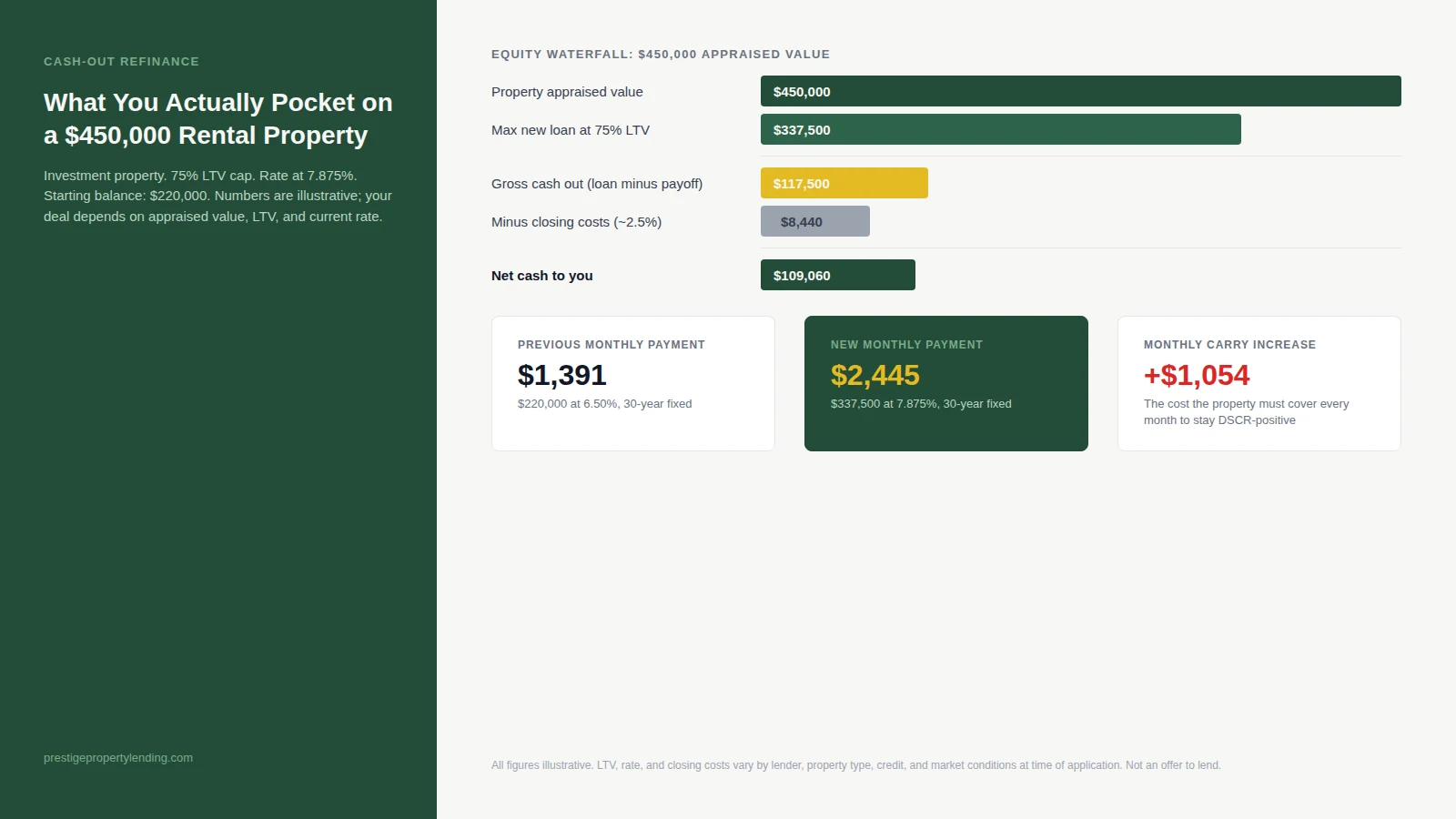
Take a rental property appraised at $450,000 with a $220,000 loan balance. At 75% LTV, the maximum new loan is $337,500. Gross cash out: $117,500. Subtract closing costs on the new loan at roughly 2 to 2.5 percent of the loan amount, and net proceeds land around $108,000 to $109,000.
The appraisal controls the outcome. If the property comes in at $420,000 instead of $450,000, the maximum loan at 75% drops to $315,000, and gross cash out falls from $117,500 to $95,000. A $30,000 appraisal shortfall cost you $22,500 in accessible cash. Order the appraisal before you count on a specific number.
The LTV cap: why 70 to 75 percent instead of 80
Primary residence cash-out refinances typically allow up to 80% LTV through conventional programs. Investment properties get 70 to 75%, depending on the lender, property type, and your borrower profile. Two-to-four unit properties often sit at the 70% end. A single-family rental with strong debt-service coverage and an experienced borrower can sometimes reach 75%.
The tighter cap means you need more equity before this loan makes financial sense.
| Property value | LTV cap | Max new loan | Current balance | Gross cash out |
|---|---|---|---|---|
| $450,000 | 75% | $337,500 | $220,000 | $117,500 |
| $450,000 | 70% | $315,000 | $220,000 | $95,000 |
| $300,000 | 75% | $225,000 | $195,000 | $30,000 |
That third row is why investors who purchased recently with a small down payment often cannot access a meaningful cash-out until the property has appreciated or the balance has dropped. If the current balance is $310,000 on a $450,000 property, the max loan at 75% is $337,500 but the payoff is $310,000. Gross cash out is $27,500 before closing costs, which likely exceeds what you net after fees. The deal does not close.
Want terms on a specific deal?Answer seven questions and get a decision in 72 hours.
Get FundingThe rate hit, in dollars
Investment property cash-out refinances carry a rate premium above the primary residence equivalent, generally 0.5 to 1.25 percentage points. Where your deal lands within that range depends on LTV, credit profile, property type, and whether it is a rate-and-term or cash-out transaction. Higher LTV and cash-out push the spread wider. Multi-unit properties face a slightly higher adjustment than single-family.
The number that matters is not the rate alone: it is the payment change and what that does to DSCR.
On the $450,000 example: if the previous loan was $220,000 at 6.50%, the principal and interest payment was roughly $1,391 per month. The new loan at $337,500 at 7.875% carries a payment of approximately $2,445 per month. That is $1,054 more per month the property must cover before the investment is DSCR-positive.
If the rent was $2,800 against the old $1,391 payment, the DSCR on the old loan was roughly 1.47 on a simplified basis. After the refinance, depending on taxes and insurance, it may fall to 1.05 or lower. That reduced DSCR changes what you can borrow against this property if you refinance again in the future, because any subsequent DSCR cash-out will underwrite to the new payment, not the old one.
Rate-and-term refinances on investment properties price 0.25 to 0.50 points better than cash-out. If your goal is to lower the monthly payment rather than pull cash, that distinction is worth running before you commit to a cash-out application.
Seasoning: the clock that shrinks your max loan
Most conventional lenders require 6 months of ownership before approving a cash-out refi on an investment property. The harder restriction: within the first 12 months, many lenders base the LTV calculation on the original purchase price, not the current appraised value. For an investor who bought a distressed property at a discount and improved it, this rule is expensive.
Example: you paid $280,000 for a property now appraised at $380,000 after rehabilitation. At month 8, the effective LTV basis is $280,000, not $380,000. At 75% of $280,000, the max loan is $210,000. If the current balance is $250,000, the max loan is less than the payoff. You cannot cash-out refi at all at month 8. Wait until month 13, and the appraised value controls: $380,000 at 75% yields a max loan of $285,000. The 12-month wait was worth $35,000 in accessible capital on this deal.
DSCR lenders generally require 12 months of ownership for a full cash-out up to 70 to 75% LTV. Some will consider 6 months at a reduced LTV of 65 to 70%. Investors using the BRRRR strategy face this seasoning window routinely. The detailed rules on who applies 6-month versus 12-month versus delayed-financing exceptions are covered in the BRRRR refinance seasoning requirements post.
DSCR cash-out vs conventional cash-out
The conventional route requires full income documentation: W-2s, two years of personal tax returns, all schedules, a personal DTI calculation, and a 30-to-45-day underwriting process. For an investor with depreciation deductions, cost segregation, and pass-through losses showing up on the return, qualifying on paper income alone can be difficult even when the portfolio is cash-flowing well.
A DSCR cash-out refi bypasses income documentation. Underwriting is based on the property’s gross rent relative to the proposed PITIA payment on the new loan. If the DSCR on the new loan meets the threshold (often 1.0 to 1.20 depending on lender and LTV), it qualifies. No personal returns, no DTI, no W-2s. DSCR programs also allow LLC and entity vesting, which most Fannie Mae and Freddie Mac programs do not.
The rate is higher, typically 1 to 2 percentage points above a conventional equivalent. You are paying for documentation simplicity and speed. For investors with complex tax situations or those borrowing in an LLC, that premium is frequently the right tradeoff. Use the DSCR calculator to check whether the proposed new payment works for your deal before you apply.
What it costs when the deal slips
Rate locks on a refinance typically run 30 to 45 days. If the appraisal is delayed or title comes back with an issue, you may need to extend the lock. Extension fees run approximately 0.25% of the loan amount per 15-day extension. On a $337,500 loan, one extension costs roughly $844. A second adds another $844. If the lock expires entirely, you float to the current market rate, which may be higher than what you locked.
If the appraisal comes in below your expectation, the maximum loan shrinks and you may not get the cash you planned to deploy. Have a backup plan that works with 10 to 15 percent less cash out than your base case, including the deal you were planning to fund with the proceeds.
Prepayment penalties are standard on DSCR loans. If you close a cash-out DSCR refi and need to refinance again within three to five years because rates drop, the penalty applies to the balance at payoff. On a $337,500 loan with a three-year step-down schedule, the penalty in year two is often 2% of the outstanding balance: roughly $6,700. Read the prepayment language in the note before closing, not after.
When a cash-out refinance is the wrong tool
A cash-out refi on an investment property is the wrong choice when:
- The property is already marginal on cash flow. Adding $1,000 per month to the carry on a property that barely covers itself converts a thin margin into a deficit. The 30-year obligation is not reversible quickly.
- You need funds in under four weeks. The refi process does not close that fast. A bridge loan against a different property in your portfolio can. See how bridge loans compare for time-sensitive capital needs.
- Your current rate is materially below the new rate. If your existing loan is at 5.5% and the cash-out rate is 8.0%, you are permanently refinancing the entire existing balance at a higher rate. The cost of capital on that existing debt increases for the life of the loan. The equity you pull out has to earn more than that drag to justify the transaction.
- The property is free and clear but you have owned it for fewer than 12 months. Seasoning requirements apply even when there is no existing mortgage to pay off.
For time-sensitive liquidity, a bridge loan against a different property is usually faster and does not require refinancing debt you would rather leave in place. If the numbers do support a cash-out refi, the cash-out refinance program page has the qualifying details. Call 917-842-9982 to run through the deal structure before you apply.
Common questions
What is the maximum LTV for a cash-out refinance on an investment property?
Most conventional lenders cap the loan at 70 to 75 percent of appraised value. Single-family rentals often reach 75%, while two-to-four unit properties are usually capped at 70%. DSCR lenders work in the same range. If you are within 12 months of purchase, many lenders will calculate LTV against the purchase price rather than the current appraisal, which can sharply reduce the maximum loan.
How long do you have to own an investment property before doing a cash-out refinance?
Most conventional lenders require 6 months of ownership. The harder restriction: within the first 12 months, many use the purchase price rather than the current appraised value as the LTV basis. DSCR lenders typically require 12 months before allowing a full cash-out up to 70 to 75% LTV. Some will consider 6 months at a lower 65 to 70% LTV.
How does a DSCR cash-out refinance differ from a conventional one?
A DSCR cash-out refi qualifies on the property’s rent relative to the proposed payment, not your personal income or tax returns. There are no W-2 requirements, no personal DTI calculation, and no two years of returns. The tradeoff is a higher rate, typically 1 to 2 percentage points above conventional. DSCR programs also allow LLC vesting, which most conventional programs do not.
Does a cash-out refinance on an investment property hurt cash flow?
Yes. The new loan is larger, and in most rate environments the new rate is also higher than your existing one. On a $450,000 property example, replacing a $220,000 loan at 6.5% with a $337,500 loan at 7.875% adds roughly $1,054 per month to the carry. If the rent does not support the new PITIA at a DSCR above 1.0, the property runs at a loss from the first month of the new loan.
Can you do a cash-out refinance on a property held in an LLC?
Yes, through a DSCR or other non-QM cash-out program. Business-purpose lenders routinely lend to LLCs and other entities. Conventional Fannie Mae and Freddie Mac programs typically require individual vesting and may ask you to transfer the property out of the LLC before close. For investors who need to stay in the LLC, a DSCR or portfolio cash-out refi is the standard path.
Ready to fund your next deal?
Approval within 72 hours. Close in 5 to 10 business days.
Get Funding Now