What the BRRRR Method Is, and Where It Breaks
BRRRR is a rental portfolio strategy built on recycling capital through a cash-out refinance. This guide covers the financing behind each step, a worked example showing both the good and bad appraisal scenario, carry cost math, seasoning requirements, and the four situations where the strategy breaks down.
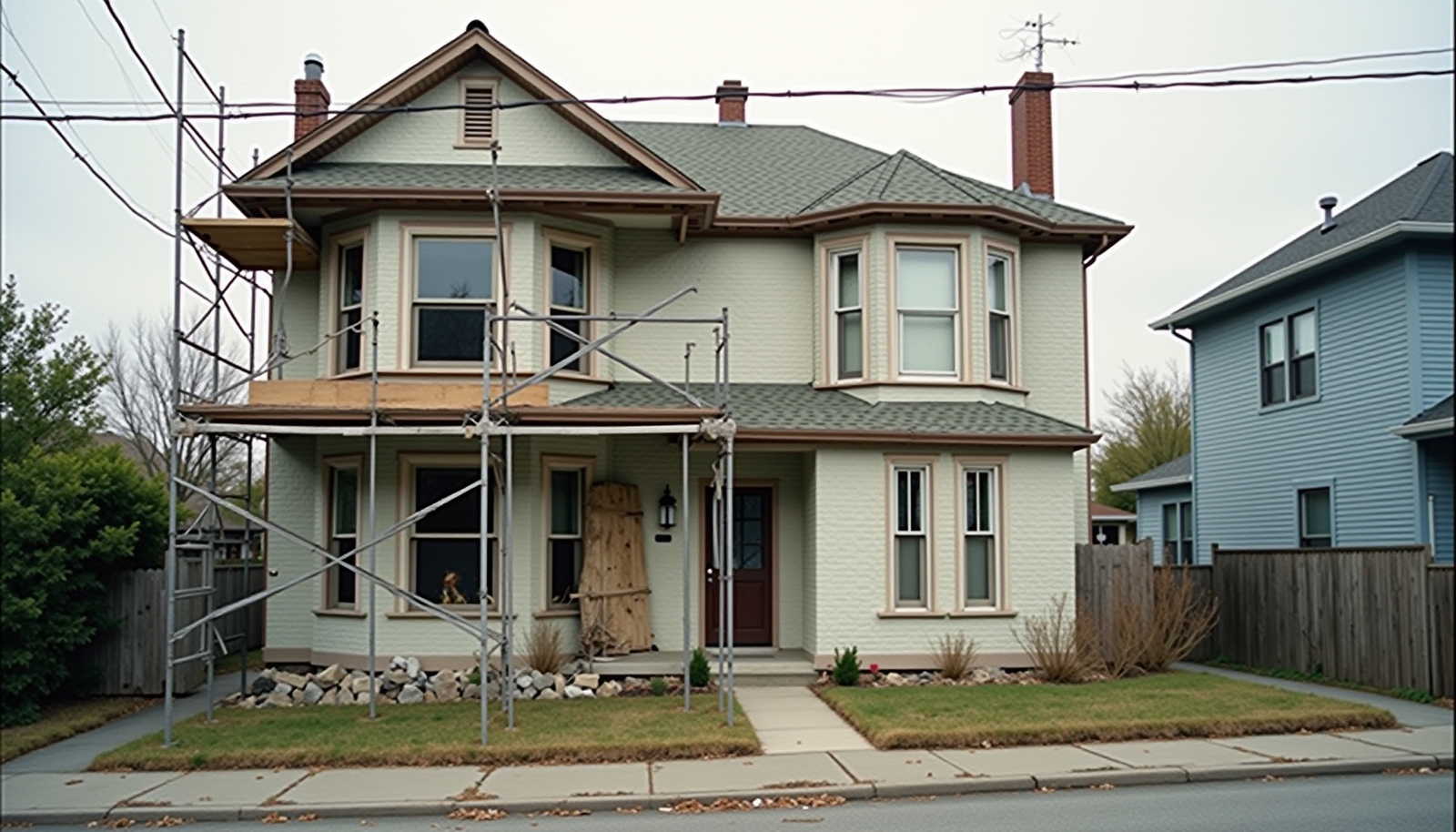
The BRRRR method stands for Buy, Rehab, Rent, Refinance, Repeat. It is a strategy for real estate investors building a rental portfolio on recycled capital: you buy a distressed property, force the value up through renovation, then refinance at the higher appraised value to recover most of what you put in. If you are financing the home you live in, this loan structure does not apply to your situation and the numbers below will not match what a consumer mortgage lender quotes you.
What makes the strategy work is buying far enough below market value that a post-renovation appraisal returns your capital. What makes it fail, more often than most articles say, is that the refinance step does not perform as planned. The appraisal comes in short. Seasoning requirements extend the timeline. The DSCR at the new payment does not qualify. Understanding where those breaks happen is more useful than a description of five steps that go smoothly.
The five steps, from a financing lens
Buy: You acquire the property with short-term financing. A distressed property in rough condition will not qualify for conventional or DSCR financing because it is not habitable or because the rental income is not yet established. Hard money or a bridge loan fills that gap. The trade-off for speed: rates in the 10 to 13 percent range as of late 2026, interest-only payments, and origination points typically between 1.5 and 3. Our post on hard money loan rates covers how to convert those points and rates into a deal cost you can compare.
Rehab: You draw on the renovation portion of the loan as work is completed. Each draw triggers an inspection before the next advance releases. The short-term loan is priced on your total project cost (purchase price plus rehab budget), not the ARV. The interest clock starts at closing, not at renovation completion.
Rent: You place a tenant before you apply for the refinance. Most DSCR lenders want a signed lease before they will use market rent in underwriting. A vacant property may be approved at a reduced DSCR or declined entirely. The lease gives the lender something concrete to underwrite against.
Refinance: This is where most BRRRR deals die quietly. A DSCR lender refinances the property at 70 to 80 percent of the appraised value, not your cost basis. If the appraisal matches your ARV estimate, you recover most of your capital. If the appraisal comes in short, you are stuck in the deal for the gap. That gap is real equity, but it is stranded until you sell or refinance again.
Repeat: The cash extracted from the refinance funds your next acquisition. This step only works if step four actually returned your capital. An incomplete capital recovery on deal one means you cannot fully fund deal two without fresh equity.
Worked example: $120,000 purchase, $210,000 ARV
The figures below illustrate the mechanics on a single-family rental in a secondary market. These are example figures, not a guarantee or commitment to lend.
- Purchase price: $120,000
- Rehab budget: $45,000
- Total all-in cost: $165,000
- Investor’s ARV estimate: $210,000
- Signed lease rent: $1,750 per month
You finance the purchase and rehab with a hard money loan at 85 percent of total project cost: $140,250 financed, $24,750 of your cash in at closing.
After renovation and lease-up, you apply for a DSCR cash-out refinance at 75 percent of the appraised value.
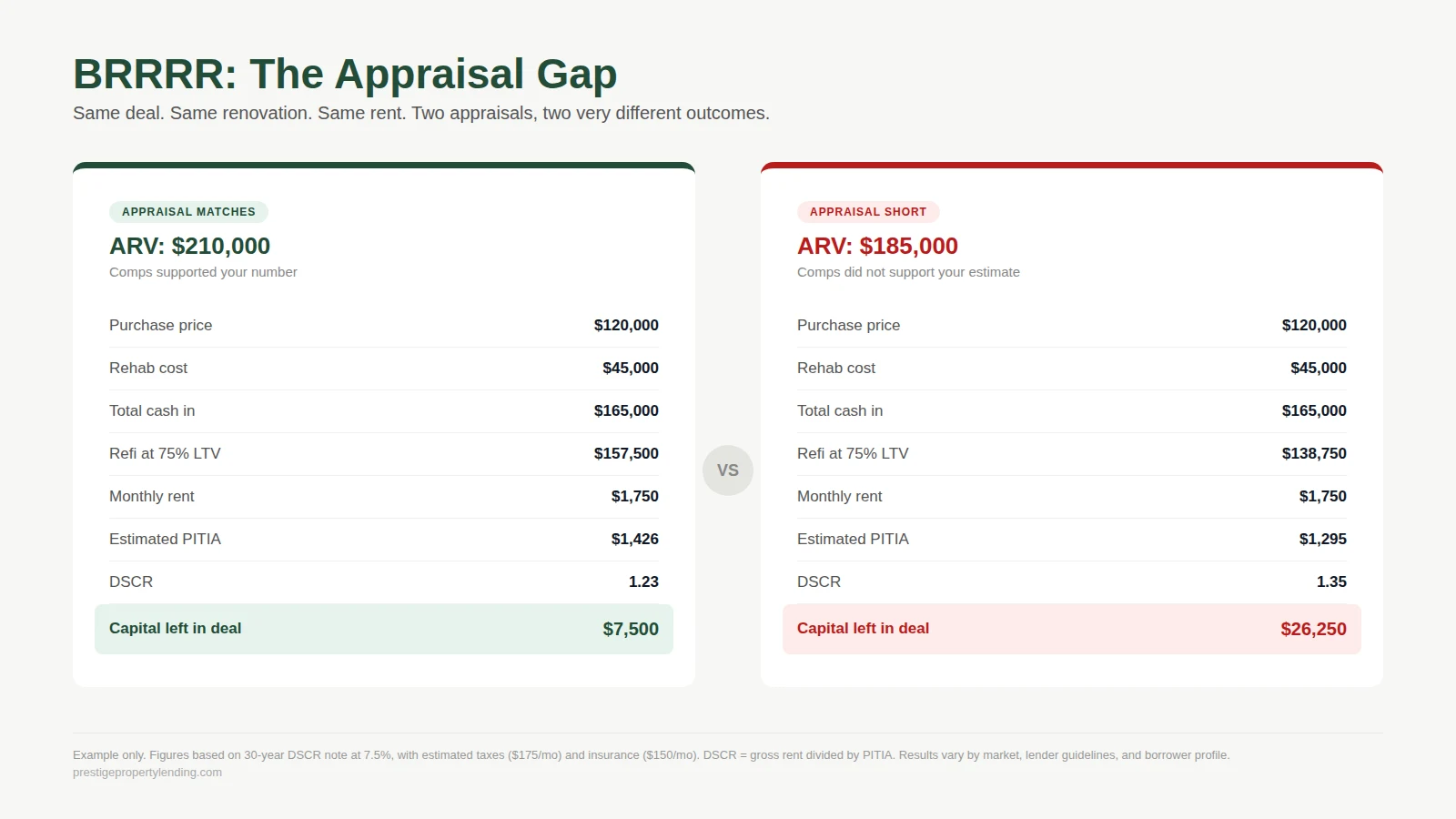
If the appraisal matches at $210,000: 75% x $210,000 = $157,500 refinance loan. Against your $165,000 total cost, you recover $157,500 and leave $7,500 in the deal. That is near-complete capital recycling.
If the appraisal comes in at $185,000: 75% x $185,000 = $138,750. You recover $138,750, leaving $26,250 stranded. That is real equity, but it cannot fund your next project until you exit.
Want terms on a specific deal?Answer seven questions and get a decision in 72 hours.
Get FundingThe DSCR check at the new payment
Even when the appraisal cooperates, the loan has to close on the income side. Use the BRRRR calculator to run your specific numbers before committing to an ARV. Here is what the math looks like on this example:
At $157,500 financed on a 30-year DSCR note at 7.5 percent, the monthly principal and interest payment is approximately $1,101. Add estimated property taxes ($175 per month) and insurance ($150 per month): total PITIA runs roughly $1,426. Against $1,750 in rent, the DSCR is 1.23. That qualifies for most DSCR programs and falls near the pricing threshold where rates begin to improve, typically around 1.20 to 1.25 on most lender matrices.
The DSCR fails if rent underperforms or the payment runs higher than projected. At $1,500 rent against a $1,426 PITIA, the DSCR is 1.05. That may clear a floor check but it prices at the worst tier, and a rate 50 basis points higher or a rent $75 lower and it does not qualify. The refinance failure point on a BRRRR deal is not always a bad appraisal. Sometimes it is a rent level that missed your projection by $150 a month.
The carry cost that most BRRRR projections ignore
From the day you close on the hard money loan to the day the DSCR refinance closes, you are paying interest on the short-term balance. A six to eight month timeline at 11 percent on $140,250 works out to approximately $8,982 in interest. Add origination points at 2 percent on the hard money: $2,805. Add closing costs on the DSCR refinance (title, appraisal, lender fees): typically $4,000 to $6,000 on a loan of this size.
Total carry and transaction cost on this deal: roughly $15,000 to $18,000, before you count a single dollar of rental income toward your return. A BRRRR calculation that does not include carry cost is showing you a more optimistic picture than the actual deal produces.
Seasoning: the timeline requirement that extends the clock
Most DSCR lenders require a minimum of three to six months of ownership before approving a cash-out refinance. Some apply title seasoning rules requiring twelve months before they will lend against the appraised value rather than the purchase price. If you closed in January, completed the rehab in March, signed a tenant in April, and applied for the refinance in May, you may be asked to wait until July. During that waiting period, your hard money interest keeps running. Two extra months on $140,250 at 11 percent adds about $2,571.
Our BRRRR loan program page covers current guidelines on seasoning requirements, LTV limits, and the documentation needed at the refinance stage.
The four places the deal breaks down
Paid too much for the distressed property. If your all-in cost approaches the ARV, the refinance has no equity to work with. The 70 percent rule (pay no more than 70 percent of ARV minus rehab cost) exists as a rough guardrail. At $210,000 ARV and $45,000 in rehab, that implies a maximum purchase price around $102,000. The $120,000 purchase in this example is workable because the ARV is verified, but the buffer is slim.
Rehab ran over budget. Each $10,000 in cost overrun requires roughly $13,333 in additional appraised value to break even at 75 percent LTV. The buffer between your ARV estimate and your total cost is the single most important number in the deal. A $15,000 overrun on a deal where you had $20,000 of buffer is a tighter outcome, not a disaster. A $15,000 overrun where you had $10,000 of buffer means cash to closing on the refinance.
The appraisal disagreed with your ARV. Appraisers use comparable sales closed within the past six to twelve months, not your renovation invoices. If comps in the neighborhood are trading at $185,000, your $210,000 ARV is speculative until an appraiser confirms it. Ordering a broker price opinion before you commit to the rehab budget costs a few hundred dollars. Being surprised at the appraisal stage costs you the $26,250 shown above.
The DSCR does not support the new payment. The refinanced loan carries a higher balance than the original purchase price. If the rent does not cover the payment at the required DSCR multiple, the loan does not close. This is more common when market rates have moved between when you underwrote the deal and when you apply for the refinance.
Who BRRRR is wrong for, and what it costs when the deal slips
BRRRR requires more active capital management than buying a stabilized rental outright. It may not fit your situation if:
You do not have liquidity beyond the rehab budget. Contractors find problems behind walls. Materials get backordered. A three-week delay in lease-up is a three-week delay in the refinance. You need a reserve on top of the stated rehab budget, not just enough to close the acquisition.
Your market does not offer a meaningful distressed discount. BRRRR depends on buying at a real discount to stabilized value. In markets where distressed properties trade close to their renovated comps, the arithmetic does not support capital recovery at 75 percent LTV.
You need the capital returned on a fixed timeline. Seasoning requirements, appraisal review periods, and lender queues mean the refinance may not close for six to twelve months after purchase. If you need capital recycled faster, a fix-and-flip with a sale exit may be a better structure.
The honest version of what it costs when a BRRRR deal slips: an appraisal $25,000 short of your estimate at 75 percent LTV leaves $18,750 stranded. Two extra months of hard money at 11 percent on a $140,000 balance is $2,567 in additional carry. A refinance that closes three months late is not a catastrophe, but it is not the friction-free capital recycling the strategy is often described as.
Call 917-842-9982 before you commit to a renovation budget on a BRRRR candidate. A conversation at the acquisition stage is significantly cheaper than an appraisal surprise at month seven.
Common questions
What is a DSCR loan and why does the BRRRR refinance use one?
A DSCR loan qualifies based on the property’s rental income, not your personal tax returns or employment history. The debt service coverage ratio compares the gross monthly rent to the monthly housing payment (principal, interest, taxes, insurance, and any association dues). Most lenders require a DSCR of 1.0 to 1.25 for approval, with better pricing above 1.20. For investors with multiple properties or complex income, a DSCR refinance is often the only viable path at the refinance stage because it does not require income documentation in the traditional sense. See our DSCR rental loan page for current program details.
How long does the whole BRRRR cycle take from purchase to refinance close?
Typical timelines run six to twelve months: one to four months for the rehab, one month for lease-up, then the lender’s seasoning requirement (three to twelve months from the original purchase date). If a lender requires six months of seasoning and the rehab took four months, the refinance may close in month seven or eight. Factor the full timeline into your carry cost projection before you commit to a purchase price.
What LTV can I expect on a BRRRR cash-out refinance?
Most DSCR lenders offer 70 to 75 percent LTV on a cash-out refinance for a single-family or small multifamily investment property. Some programs go to 80 percent for borrowers with strong credit and a high DSCR. The LTV applies to the appraised value at the time of the refinance, not your purchase price or renovation cost. What moves the number: credit score, DSCR, property type, and loan size. These ranges shift with market conditions and should be confirmed at application.
Can I use BRRRR on a multifamily property?
Yes. The strategy applies to two to four unit properties and larger multifamily with the same basic mechanics: short-term financing for acquisition and rehab, then a DSCR or conventional refinance at stabilized value. Larger multifamily underwriting is more complex because the appraisal uses an income approach rather than comparable sales alone, which changes how the appraisal gap risk plays out.
What happens if the appraisal comes in too low to cover the hard money balance?
If the DSCR refinance proceeds are less than the outstanding hard money balance, you bring cash to the closing table to pay off the difference. The deal is not lost: you own a cash-flowing rental with equity and a long-term loan in place. But it is a capital call, not a capital recovery. That scenario is the main argument for conservative ARV estimates and keeping your all-in cost well below 75 percent of what you expect the appraiser to confirm.
Does BRRRR still work in 2026 with current interest rates?
The strategy works when there is enough spread between your distressed purchase price and the post-renovation appraised value, and when the stabilized rent covers the new mortgage payment at the required DSCR multiple. Higher rates raise the monthly payment, which either requires higher rent or reduces the loan amount the DSCR math will support. Run the DSCR at today’s rate, not the rate from two years ago, before committing to a purchase price.
Ready to fund your next deal?
Approval within 72 hours. Close in 5 to 10 business days.
Get Funding Now