Hard Money Loan Rates and Why They Look So High
Hard money loan rates run from roughly 9.5% to 13% annualized for investment property in 2026, depending on your experience, LTV, and deal size. The annual rate looks alarming compared to a 7% bank loan. On a six-month flip, you pay a fraction of what that annualized number suggests. The more relevant question is what the loan costs per deal, not what it costs per year.
Hard money loan rates in the current market run from roughly 9.5% to 13% annualized for investment property, depending on your experience, the loan-to-value ratio, and deal size. These are business-purpose loans for real estate investors buying, renovating, or holding non-owner-occupied property. If you are buying the home you plan to live in, hard money is not designed for that transaction, and most hard money lenders will not fund it.
The rates look alarming next to a bank’s 7% mortgage. But that comparison uses the wrong frame. A 12% annualized rate on a six-month loan costs you 6% of the principal. A 7% bank loan that takes 90 days to close, requires full documentation, and prices its cost into a 30-year amortization costs far more when the deal requires speed or cannot qualify for conventional financing at all.
Why the annualized rate is the wrong number to look at
Hard money is a short-duration loan. Six to twelve months is the standard term on a fix-and-flip, and most borrowers exit in seven to nine months. When you annualize a short-term rate, you are measuring a six-month expense as if it ran for twelve months. The rate looks doubled.
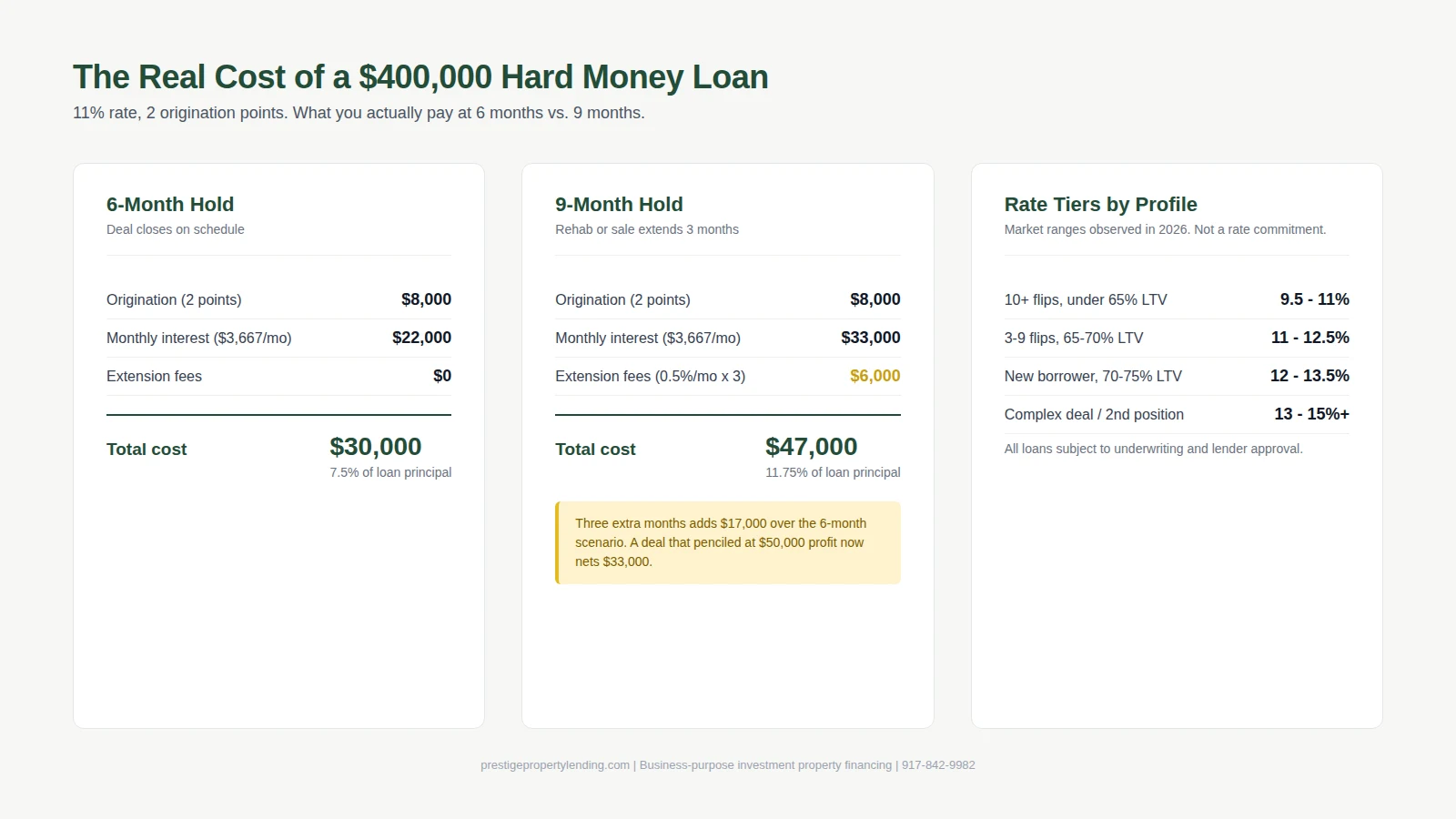
The number that matters is cost per deal: how many dollars leave your pocket between funding and payoff. On a $400,000 hard money loan at 11% annualized with two origination points:
- Origination (2 points): $8,000
- Monthly interest: $400,000 x 11% / 12 = $3,667
- Six-month hold total: $8,000 + $22,000 = $30,000
- That is 7.5% of the loan principal for the entire deal
Compare that to a conventional bank loan at 7% on the same $400,000 over 30 years: you pay roughly $1,865 per month, and for the first year almost all of that is interest. Twelve months of bank interest at 7% on $400,000 is $27,880, and the bank also charges origination fees, requires full documentation, and takes 45 to 60 days to close. The speed of a hard money loan is what you are paying for, and speed has a cost. Use the hard money loan calculator to run your specific scenario before you commit.
The four levers that move your rate
Hard money lenders price risk in four main variables. Understanding each tells you where you have real negotiating room and where you do not.
Your experience as a borrower
A first-time flipper is a different risk profile than someone who has closed twenty deals. Most lenders tier borrowers explicitly: zero flips, one to three, four to nine, and ten or more. The rate difference between a first-time borrower and an experienced one can be 1% to 2% annualized or more, depending on the lender. Your track record is the fastest lever to pull as you scale your portfolio.
Loan-to-value and loan-to-cost
Lenders care about both numbers. LTV (loan to current value) measures protection if you default today. LTC (loan to cost) measures how much of the total project budget they are funding. A $300,000 loan on a property with a $420,000 ARV and $340,000 all-in cost sits at a different risk level than the same $300,000 on a property with a $325,000 ARV and a $310,000 cost. Tighter spreads mean higher rates. Most lenders start pricing better below 70% LTV and improve again below 65%.
Property type
Single-family residential properties price at the best hard money rates because they have the deepest resale market. Two-to-four unit properties are a step higher. Mixed-use, commercial, or rural properties with limited comps carry higher rates because the exit is harder to underwrite. If your deal is a mixed-use building in a rural market, expect a rate at the high end of any range a lender quotes you.
Loan size
Hard money has a fixed cost of capital to deploy. A $100,000 loan costs nearly as much to underwrite and service as a $500,000 loan, which means small loans carry higher rates to compensate. Below $150,000 you will often see rates that are 1% to 2% higher than what the same lender quotes on a $400,000 deal. On the other end, large loans above $2M typically see tighter pricing because the absolute return justifies it at a lower rate.
| Borrower profile | LTV | Property type | Market rate range (2026) |
|---|---|---|---|
| Experienced (10+ flips) | Under 65% | SFR | 9.5% to 11% |
| Moderate (3-9 flips) | 65-70% | SFR or 2-4 unit | 11% to 12.5% |
| New borrower | 70-75% | SFR | 12% to 13.5% |
| Complex deal or second position | Varies | Mixed use or rural | 13% to 15%+ |
These are ranges observed in the market in 2026, not a rate sheet or a commitment to lend. Your specific rate depends on your file, the deal, and the lender. All loans are subject to underwriting and approval.
Want terms on a specific deal?Answer seven questions and get a decision in 72 hours.
Get FundingPoints, fees, and what you are actually quoted
Most hard money lenders quote an interest rate and origination points separately. One point is 1% of the loan amount. Two to three points is standard; some lenders charge one point on repeat borrowers and three on first-timers. The rate headline tells you the monthly cost. The points tell you the entry cost you pay at closing whether the deal works or not.
Some lenders also charge an exit fee at payoff, sometimes called a yield-spread premium. It typically runs 0.5% to 1.5% of the loan. A loan quoted at 10.5% with 2 points and a 1% exit fee on a $400,000 deal costs $8,000 at close, $3,500 per month in interest, and $4,000 at payoff. Over six months that is $33,000, not the $21,000 the 10.5% headline suggests. Always ask for the full fee schedule before you sign a term sheet.
When hard money is the wrong loan
Hard money rates are appropriate for certain deals. They are wrong for others.
If you are buying a stabilized rental property and intend to hold it for years, a DSCR rental loan will cost you significantly less. Hard money is an acquisition and renovation vehicle, designed to be paid off when the property is sold or refinanced into permanent financing. Holding a hard money loan past its original term is expensive, and it is where deals go wrong.
The extension fee is the number most borrowers do not plan around. If your six-month loan extends by three months because the rehab runs long or a buyer falls through, expect an extension fee of 0.25% to 1% per month on the outstanding balance, on top of continuing interest. On a $400,000 loan, three extra months at 0.5% per month adds $6,000 to your cost, plus $11,000 in additional interest at 11%. A deal that penciled at a $50,000 profit loses $17,000 of it to a single extension. Our post on how much cash you actually need to flip a house covers how to build that buffer into your proforma before you make an offer.
Hard money is also the wrong loan if your exit requires a conventional or DSCR refinance that has a seasoning requirement you have not met. Some lenders want six to twelve months of ownership history before they will refinance. If you are buying, renovating, and refinancing into a long-term hold, confirm the seasoning clock on your exit loan before you take the hard money. A mismatch between your hard money term and the seasoning requirement turns a bridge into a trap.
First-time investors sometimes expect to negotiate down to what an experienced borrower pays. The rate difference is not about margin. It reflects a real difference in the lender’s risk on an inexperienced borrower, and most lenders will not reduce it regardless of how attractive the deal looks.

What to do before you lock a rate
Run the cost-per-deal number on every scenario, not just the base case. If your rehab runs 90 days over, what does the hold extension cost? If the buyer backs out at inspection, what is the second month of carrying costs on top of continued interest?
The hard money loan calculator lets you model different hold durations and fee structures side by side. Run the optimistic case and the worst-case scenario before you commit to a loan size. If the deal only works on the optimistic timeline, the deal has a problem the financing cannot fix.
When you are ready to compare programs or request a term sheet on an investment property, call 917-842-9982 or visit our hard money loan program page.
Common questions
What is a typical hard money loan rate in 2026?
Market rates for hard money loans on investment property in 2026 run roughly 9.5% to 13% annualized, depending on your experience, LTV, property type, and deal size. Experienced borrowers at lower LTVs on single-family properties typically see rates in the 9.5% to 11% range. First-time borrowers at higher LTVs should expect 12% to 13.5% or higher. These are ranges observed in the market, not a rate commitment. All loans are subject to underwriting and lender approval.
Why are hard money rates so much higher than bank rates?
Hard money loans close in 5 to 10 business days and are underwritten on the asset and the deal, not your tax returns or debt-to-income ratio. That speed and flexibility costs more than a bank’s 45-day, fully-documented underwriting process. Hard money lenders also take on more concentrated risk per loan and do not securitize or sell their loans the way bank mortgages are sold. The rate covers the lender’s cost of that specific risk on that specific deal.
How do origination points affect the real cost of a hard money loan?
One point equals 1% of the loan amount, paid at closing regardless of how the deal performs. Two points on a $400,000 loan is $8,000 up front. Add that to your interest cost when you calculate total cost per deal. On a six-month hold with 2 points and 11% interest, you pay $8,000 at close plus about $22,000 in interest, for a total of $30,000. The annualized rate headline does not include points, so the true cost is always higher than the rate alone implies.
Can I lower my hard money rate by offering more equity?
Yes, within limits. Dropping your LTV below 65% typically moves you into a better pricing tier with most lenders. Below 60%, some lenders will offer their best available rate. But rate tiers have a floor: once you reach the lender’s best tier, bringing more equity does not improve pricing further. Your borrower experience tier has as much effect on rate as your LTV once you are in the range most lenders fund.
What happens if I cannot pay off the hard money loan on time?
Most lenders will offer an extension, but extension fees are significant: typically 0.25% to 1% of the outstanding balance per month, plus continuing interest. On a $400,000 balance, a three-month extension at 0.5% per month adds $6,000 to your cost, on top of $11,000 in continuing interest at 11%. If the deal is not selling, those costs compound fast. If you think you might need more time, discuss extension terms with the lender before you close, not after.
Is a hard money loan right for a BRRRR strategy?
Hard money can fund the buy-and-rehab phase of a BRRRR, but the refinance step requires planning. Many DSCR and conventional lenders have seasoning requirements: they want you to have owned the property for six to twelve months before refinancing. If your hard money term is six months and your DSCR lender requires twelve months of seasoning, you are paying hard money rates for the back half of that period. Confirm the seasoning requirement on your DSCR refinance before you take the hard money loan so the timeline matches.
Ready to fund your next deal?
Approval within 72 hours. Close in 5 to 10 business days.
Get Funding Now