Hard Money Loan Requirements: Asset First, Borrower Second
Hard money underwriting runs asset first, borrower second. The property is the collateral, and if the numbers work, most lenders will figure out the borrower. But the borrower track is not zero.
Hard money underwriting runs asset first, borrower second. The property is the collateral, and if the numbers on that collateral work, most lenders will find a way to get the borrower across the line. But the borrower track is not zero: experience, liquidity, and a credible exit all shape the outcome. This financing is for real estate investors on a business-purpose basis. It cannot fund a primary residence purchase or refinance, and if that is what you need, none of this applies to your situation.
How the asset gets evaluated
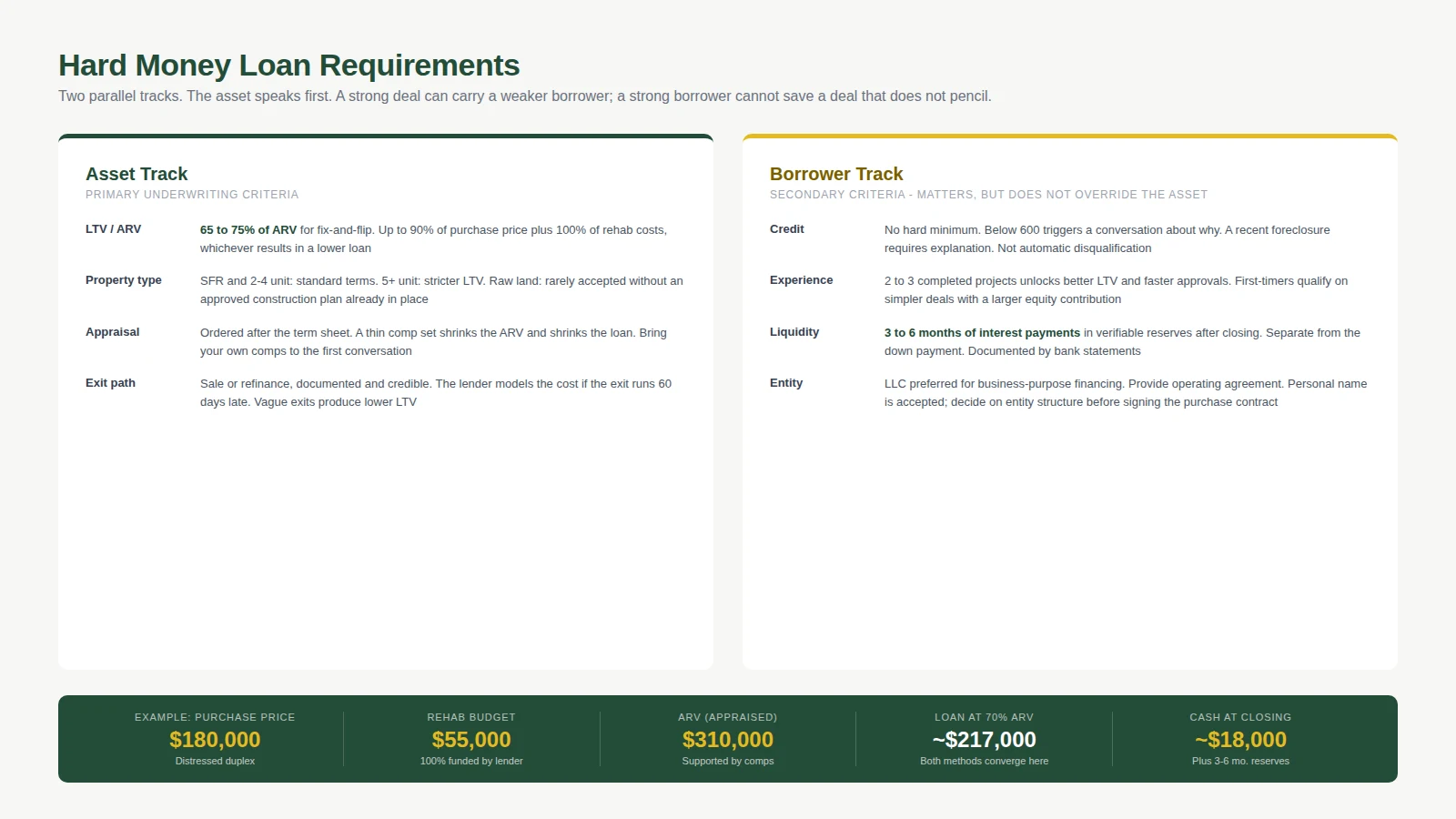
The first question any hard money lender asks is whether the asset supports the loan amount. That flows from two numbers: the as-is value and the after-repair value (ARV). Most programs lend against the lower of purchase price or ARV when there is a clear renovation plan, a budget, and a qualified contractor attached to the file.
A standard fix-and-flip loan lands at 65 to 75 percent of ARV, or 85 to 90 percent of the purchase price plus 100 percent of rehab costs, whichever produces the lower loan amount. Those are market-observed ranges as of September 2026, not a rate sheet, and they move based on deal type, market, and borrower profile. On a property where both methods converge, you have a clean deal. On a property where they diverge, the lender takes the lower number.
Worked example: you are buying a distressed duplex for $180,000, putting $55,000 into it, and a licensed appraiser says $310,000 ARV. At 70 percent of ARV, the loan is $217,000. At 90 percent of purchase ($162,000) plus 100 percent of rehab ($55,000), the loan is also $217,000. Both methods land in the same place on this deal. Your cash at closing is roughly $18,000, plus whatever you need to show for reserves. Run the exact numbers through the hard money loan calculator before the lender conversation, so you are not doing the arithmetic on the call.
The property type matters. Single-family and small multifamily up to four units get the most favorable terms. Five-plus unit and commercial collateral typically sees stricter LTV. Raw land without an approved construction plan is rarely accepted as collateral at all. If you are buying a lot to build on, read about new construction loan programs instead, where the draw structure is built for that deal type.
How the borrower gets evaluated
Credit score: hard money lenders do not publish a minimum the way a conventional bank does. In practice, a score below 600 opens a conversation about what happened and when. A thin file or a recent foreclosure requires explanation. Neither is automatic disqualification, but both shape the terms, and in some cases the LTV.
Experience: most lenders weight completed deals heavily, especially on anything beyond a straightforward single-family renovation. A borrower who has finished two or three projects moves through underwriting faster and often qualifies for better LTV than a first-timer buying the same property at the same price. Your track record is a risk factor that the lender is pricing. If you have not done deals before, a co-borrower with a track record, a larger equity contribution, or a simpler property can each compensate.
Liquidity: arriving at closing with exactly the down payment and nothing left is the fastest path to a declined term sheet. Most lenders want to see three to six months of interest payments sitting in an account you can document after the deal closes. That is not the same as the down payment. It is the cash that survives closing and is available to carry the project if a draw is delayed or the renovation runs long.
Entity: most investors borrow in an LLC or other business entity. Hard money lenders generally prefer it, because the loan is business purpose and clean entity vesting simplifies both the origination paperwork and the lender’s position if something goes wrong. Bring the operating agreement to the application. Borrowing in your personal name is accepted, but the entity structure needs to be decided before you sign the purchase contract, not during underwriting.
Want terms on a specific deal?Answer seven questions and get a decision in 72 hours.
Get FundingThe exit strategy, which is the whole product
Every hard money approval is built around one question: how does this loan get repaid? The two common exits are sale and refinance. Lenders want to see that you have thought through both, and that the numbers support at least one of them within the loan term.
For a flip, the exit is sale at or above ARV before the loan matures. If your term is 12 months and comparable sales in the market take an average of four months from list to close, you have eight months to complete a renovation. That eight months needs to account for contractor availability, permit timing, and the inspections that govern draw releases. Underwriters have seen the projects that ran 30 percent over budget and 60 days past schedule. They will push on your contractor, your contingency, and whether your carry costs were modeled honestly.
For a refinance exit into a long-term rental, the question is whether the property’s cash flow will support a DSCR loan at stabilized occupancy. A DSCR of 1.20 or better at a credible market rent gives a clean story. A DSCR of 0.90 is a conversation about what the backup plan looks like. Use the DSCR calculator to run the stabilized numbers before the hard money lender asks. The lender who is approving your bridge loan is already thinking about whether you can get out.

The documents that get a same-week term sheet
Most lenders will issue a conditional term sheet with this package assembled and clean:
- Signed purchase contract, or documentation of existing ownership for a refinance
- Two years of personal tax returns, or a CPA letter for self-employed borrowers who show limited W-2 income
- 60 to 90 days of bank statements from accounts that will document your reserves
- Line-item scope of work with a contractor estimate or detailed cost breakdown
- Your own comparable sales supporting the ARV, pulled before the formal appraisal
- Operating agreement if you are borrowing in an LLC or other entity
- Photos or a walkthrough report on the property’s current condition
You do not need a perfect credit report or a W-2 from an employer. You do need the property numbers to support the loan amount, and you need to demonstrate that you can carry the deal financially while the work is being done. Lenders who receive a complete package on day one move faster, because they are not chasing documents while the clock on your purchase contract runs.
For more on what the financing actually costs once you have the term sheet, see our post on hard money loan rates and why they look so high. The annualized rate number is often misleading on a short-term deal, and the post walks through how to evaluate the true cost against the return the deal produces.
When requirements become blockers
First-time borrowers: inexperience is not disqualifying, but it will show up in the terms. Expect a lower LTV offer, a request for a stronger contingency in the budget, or a recommendation to start with a simpler property. Lenders are not refusing the loan; they are pricing the additional risk into the structure. A first-timer who shows up with a clean scope of work, a licensed contractor already contracted, strong comparable sales, and six months of documented reserves is a much easier file than one who has the deal but not the preparation.
Thin liquidity: the reserve requirement catches more borrowers off guard than any other criterion. Getting to closing with exactly the down payment and nothing left signals to the lender that a single delayed draw or a three-week permit hold will put the project in distress. Most lenders will not issue a term sheet without documented reserves, and the ones who do will price the risk into a higher rate or a lower LTV.
Complicated exits: a loan where the exit depends on finding a specific buyer at a specific price within a narrow window is a hard underwrite. The lender is thinking about what happens if you do not find that buyer. A clean sale in a liquid market with strong comps is a simple exit story. A sale to an owner-occupant at a price 15 percent above any recent comparable sale is a story that will generate questions.
Weak ARV support: if your purchase price is $180,000 and you are arguing for $310,000 ARV with three comparable sales that average $265,000, the formal appraisal will land closer to the comps than to your projection. The appraisal is ordered after the term sheet, and it can reduce the loan amount mid-transaction. Come to the first conversation with honest comps, and the formal appraisal will be a confirmation rather than a surprise.
What this loan is not designed for
Hard money is business-purpose financing for investors. It cannot fund a primary residence purchase, a refinance of the home you live in, or any transaction where the borrower intends to occupy the property. If that is your situation, conventional, FHA, or VA programs are the relevant options.
It is also a poor fit for a borrower whose goal is the maximum loan term at the lowest rate and the lowest upfront cost. That describes a 30-year DSCR rental loan, not a 12-month hard money bridge. Hard money’s value is speed and flexibility, and those qualities cost money in rate and points. A loan at 10 to 13 percent interest plus 2 to 3 points is not cheap in absolute terms. The right question is whether the deal produces enough return to cover that cost of capital and still deliver a margin worth the work. If the numbers do not clear that bar, the problem is the deal, not the financing.
If the deal slips on timeline, the cost of capital does not stop. Extension fees, compounding interest, and a lender who decides the extension is not in their interest are all real outcomes. Build the contingency into your projections before closing, not after. The post on hard money loan rates walks through how to model the all-in cost, and the hard money loan program page covers the full terms available.
Call 917-842-9982 if you want to talk through a specific deal before you get to the application stage. Most files that get declined do so for reasons that were visible at the term sheet stage.
Common questions
Are hard money loans hard to get?
For a deal with clean numbers, no. Hard money underwriting skips most of what makes conventional financing slow: income verification, DTI ratios, lengthy bank review. If the property’s as-is value or ARV supports the loan amount and you can show liquidity for reserves, a term sheet typically comes within 24 to 72 hours. The deals that stall are the ones where the ARV is thin, the exit is vague, or the borrower cannot document reserves after closing.
How much do you need to put down for a hard money loan?
The down payment depends on how the lender structures the loan. At 70 percent of ARV on a fix-and-flip, the gap between the loan and the total project cost is your equity contribution. On a $310,000 ARV deal with a $217,000 loan and a $235,000 total cost (purchase plus rehab), you are bringing roughly $18,000 at closing plus reserves. Separate from the down payment, expect to show three to six months of interest payments sitting in a documented account after close.
What is the 70 percent rule for hard money loans?
The 70 percent rule is a quick check used by fix-and-flip investors: the most you should pay for a property is 70 percent of ARV minus the cost of repairs. On a property with a $310,000 ARV and $55,000 in repairs, that is $217,000 minus $55,000, or $162,000 maximum purchase price. Hard money lenders apply a similar lens when sizing the loan. A loan at 70 percent of ARV gives the lender a margin of safety if the ARV is overstated or the exit takes longer than projected.
Can a first-time investor get a hard money loan?
Yes, though the terms will reflect the additional risk. Most lenders compensate for zero track record by requiring more equity, a simpler property, or a co-borrower with completed projects. A first-timer buying a single-family property with a clean scope of work and a well-supported ARV is a manageable file. A first-timer buying a six-unit value-add with no contractor lined up is a much harder conversation. The loan is available; the LTV and rate will price the inexperience in.
What documents do I need to get a term sheet within the week?
The core package is: signed purchase contract, two years of personal tax returns or a CPA letter for self-employed borrowers, 60 to 90 days of bank statements showing reserves, a line-item scope of work with contractor estimate, and your own comparable sales supporting the ARV. If you are borrowing in an LLC, add the operating agreement. A lender who has all of that on day one can typically issue a conditional term sheet within 24 to 72 hours.
Do I need to borrow in an LLC to get a hard money loan?
No, but most investors do. Hard money is business-purpose financing, and an LLC creates a clean separation between the deal and your personal assets. Lenders generally prefer it and will ask for the operating agreement. Borrowing in your personal name is accepted, but the entity structure needs to be decided before you sign the purchase contract. A mid-transaction entity transfer creates title complications that can delay closing.
Ready to fund your next deal?
Approval within 72 hours. Close in 5 to 10 business days.
Get Funding Now