How to Get a Hard Money Loan Without Wasting Two Weeks
Most hard money files stall not because the deal is bad, but because the borrower cannot answer three questions fast. Here is the document pack that moves a file from first call to term sheet in 24 to 48 hours.
Most hard money files stall not because the deal is bad, but because the borrower cannot answer three questions fast: what is the property worth after repairs, what will the rehab cost, and how does the money come back? Have those answers ready with supporting documents before your first call, and a term sheet can come back in 24 to 48 hours.
If you are buying a home you plan to live in, this is not the right product. Hard money is business-purpose financing for real estate investors. It does not fall under TILA or RESPA, and it cannot fund an owner-occupied primary residence under any circumstances.
What a hard money lender looks at, in order
Hard money lenders do not read files the way a bank does. The review sequence is different, and understanding it tells you which documents matter first.
The property comes first. The lender needs the purchase price, your estimate of the after-repair value, and the scope of work. Those three numbers produce the loan amount and the loan-to-cost ratio. If the ARV is not supported by sold comparables, the lender builds their own analysis, and that adds time.
The exit comes second. Are you flipping and selling in 6 to 12 months? Holding and refinancing into a DSCR loan when there is a lease in place? The exit determines the loan term the lender will offer. An undefined exit is the fastest route to extended back-and-forth before you have a term sheet.
The borrower comes third. Asset-first underwriting does not mean the borrower is invisible. The lender needs to confirm you have the cash to close, carry the rehab, and service the debt if the project runs over. Experience matters as well. A first-time borrower is not automatically declined, but the deal needs to be cleaner than one from a borrower with a track record of completed projects.
The document pack that moves a file in a week
These are the six items that determine whether your file moves to underwriting in days or sits in a pile for two weeks. Have them ready before your first call.
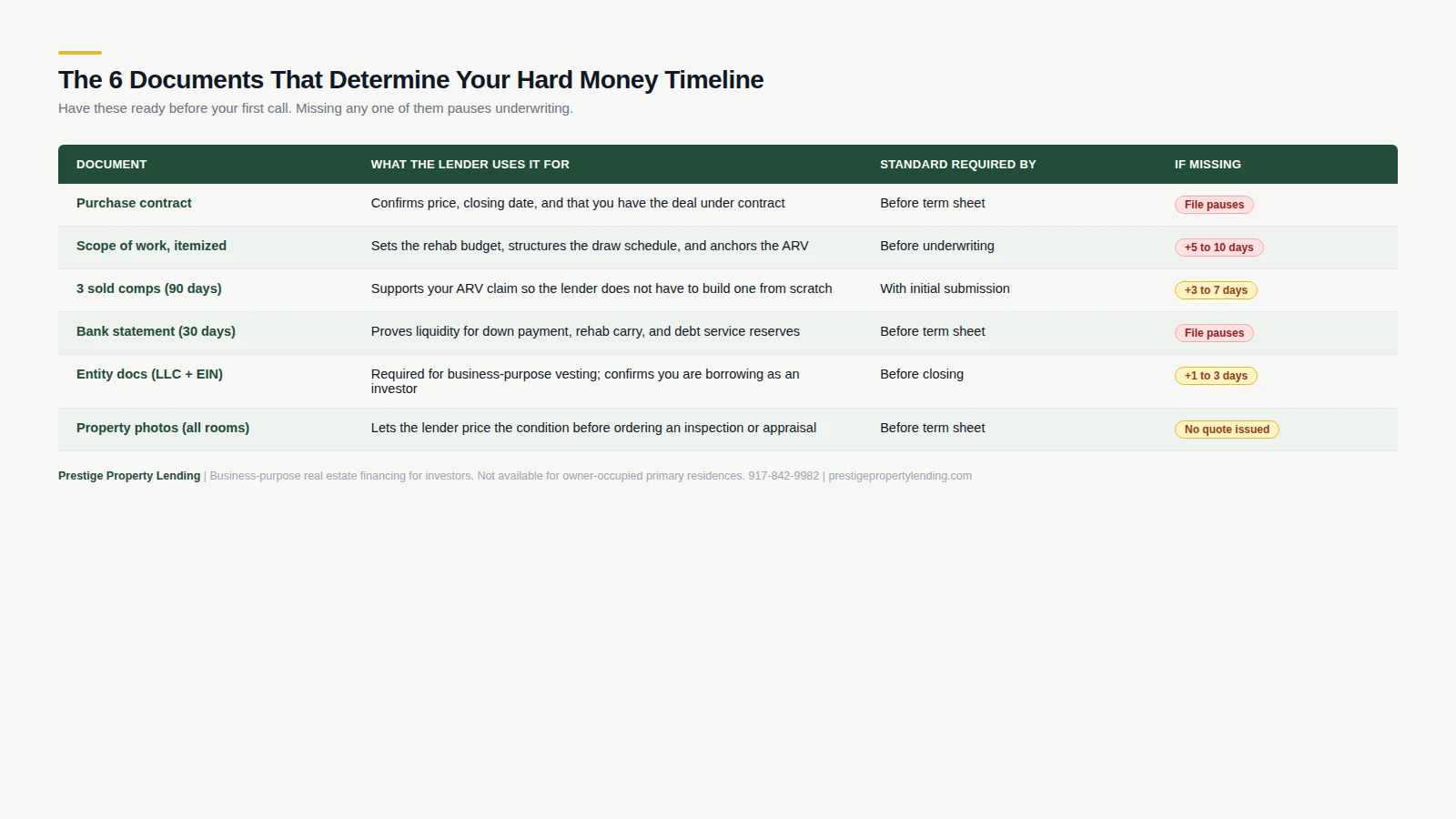
| Document | What the lender uses it for | Timeline if missing |
|---|---|---|
| Purchase contract | Confirms purchase price, closing date, and that the deal is under contract | File cannot proceed |
| Scope of work, itemized by trade | Sets the rehab budget and structures the draw schedule | 5 to 10 additional days |
| Three sold comps, within 90 days | Supports the ARV so the lender does not have to build their own | 3 to 7 additional days |
| Bank statement, most recent 30 days | Proves liquidity for the down payment, rehab carry, and debt service reserves | File cannot proceed |
| LLC operating agreement and EIN | Required for business-purpose vesting in most cases | 1 to 3 additional days |
| Property photographs, all rooms and exterior | Lets the lender price the condition before ordering an inspection | No quote issued |
A few things worth spelling out on this list.
The scope of work needs line items. “Kitchen remodel: $40,000” is not a scope of work. A contractor bid that breaks out labor and materials by trade, or a detailed schedule you have built yourself, is what the draw schedule gets built from. Without it, the lender cannot structure the loan. Getting a proper bid takes one or two days. Do not wait until after you have the term sheet.
The comps need to be genuine comparables. Three properties sold within 90 days in the same submarket is the standard in most markets. In lower-volume areas the window can stretch to 12 months. A comp from 8 months ago, 0.6 miles away, with 400 more square feet is not a comp. Pull the real ones before you submit.
The bank statement needs to show the money clearly. If the down payment cash moved in within the last 30 days, or sits in a brokerage account or self-directed IRA, say so when you submit. Some lenders accept a large recent deposit with a source explanation. Others will not. Find out before underwriting surfaces it.
Want terms on a specific deal?Answer seven questions and get a decision in 72 hours.
Get FundingWhat actually delays most files
Four issues account for the majority of extra time borrowers spend waiting.
No entity formed. Business-purpose hard money loans vest in an LLC or other entity in most cases, not in your personal name. Forming the LLC takes one to three business days in most states. Get the EIN from the IRS online portal the same day, and have the operating agreement in hand before your first submission. Do not call a lender on Monday and then spend Tuesday at the Secretary of State website.
A scope of work that says TBD or lists totals without breakdowns. Lenders understand that rehab costs are estimates. They do not accept an undefined scope. A line-item estimate you have built yourself is better than nothing. A contractor bid is better than that. Spend the time before you submit, not after the term sheet arrives.
An ARV the comps do not support. If your ARV requires three explanations before it makes sense, the lender will build their own, and it will be conservative. Use the ARV calculator to stress-test your number before you submit. Three comps that bracket the subject property on size, age, condition, and location close the ARV conversation fast.
Liquidity in the wrong place. The lender is looking for cash or near-cash, in your name or your entity’s name, seasoned for at least 30 days. Crypto, a pending inheritance, a HELOC you are already drawing, or funds held in a retirement account all require additional documentation and underwriting time. If your liquidity picture is complicated, say so at the start of the conversation, not at the end.
When hard money is the wrong tool
This loan does not fit every situation. Here is where it costs you money instead of making you money.
You are buying a property you plan to occupy. Hard money is business-purpose financing. If you plan to live in the property at any point, this loan is not available. There are no exceptions.
The deal only works at long-term rental rates. Hard money rates are higher than DSCR or conventional rates. If the rental economics only work at a DSCR rate from day one, the property is likely already stabilized and a DSCR rental loan is the right starting point.
The rehab scope is undefined. You are not ready to close a hard money loan if you are still figuring out the work. The draw schedule is built from the scope of work. A loan that closes without one either runs out of funds mid-project or requires a mid-construction modification, which costs time and fees.
The deal is thin at hard money all-in cost. A hard money loan carries origination points, a rate above conventional, and extension fees if the project runs past the loan term. Most extension fees run 0.5 to 1.5 percent of the outstanding balance per period. A project that runs three months over can add several thousand dollars to financing cost. Price that into the deal model before you start. The fix and flip calculator will show you whether the margin survives a two-month overrun before you commit.
All loans are subject to underwriting and lender approval. A term sheet is not a commitment to lend, and a verbal indication before a completed file is preliminary, not a guarantee.
Next steps
If you have a deal under contract and the six documents above, start at the hard money loan program page to confirm the parameters fit your deal: $100,000 to $25,000,000, approval within 72 hours, close in 5 to 10 business days.
Run the numbers through the hard money loan calculator to confirm the deal pencils at the rate and fee range you are likely to see. Then call 917-842-9982 to talk through the specifics before you submit. If you are planning to refinance a completed flip into a rental hold, read the DSCR rate tier breakdown to know what the exit rate environment looks like before you commit to the hard money entry.
Common questions
What credit score do you need to get a hard money loan?
Most hard money lenders do not set a hard minimum credit score. The primary criteria are the property value, the ARV, the exit strategy, and the borrower’s liquidity. A borrower with a 580 score and strong equity in the deal will often get further than a 720 score with a thin margin. Some lenders do have score floors, typically 600 to 620, so ask the question directly on your first call.
Can you get a hard money loan with no money down?
In some cases, yes. A few lenders will consider 100 percent loan-to-cost if the borrower has significant experience, strong equity at ARV, and cross-collateral security from another property. For most investors, a 20 to 30 percent contribution plus liquidity for the rehab and reserves is the realistic expectation. The cleaner the exit and the stronger the liquidity picture, the more flexible the lender can be on cash in.
How long does it take to close a hard money loan?
With a complete file, 5 to 10 business days is achievable. The variables are the appraisal or desk review turnaround, the title search, and any entity documentation that needs gathering. Files that take two to three weeks are almost always files where the document pack was incomplete at submission, or the ARV required a full appraisal rather than a desktop review.
Can a first-time investor get a hard money loan?
Yes, though the terms may be less favorable than those offered to experienced borrowers. Lenders offset the lack of a track record by looking more carefully at the deal: a smaller loan-to-cost, a stronger ARV margin, a clear scope of work from a licensed contractor, and proof of sufficient liquidity to absorb a cost overrun. Starting with a straightforward single-family flip rather than a multifamily or ground-up build reduces the friction on a first deal.
What is the difference between a hard money loan and a bridge loan?
The terms overlap significantly. Hard money typically refers to a short-term asset-first loan most commonly used for fix-and-flip or construction projects. Bridge loan describes a broader category that bridges from one property state to another, including investor, commercial, and transitional property loans. Hard money is the more common term in residential investment circles; bridge is more common in commercial contexts. Both are business-purpose products, not available for owner-occupied primary residences. See the investor bridge loan guide for a full breakdown.
Ready to fund your next deal?
Approval within 72 hours. Close in 5 to 10 business days.
Get Funding Now