Gap Funding in Real Estate: How Investors Cover the Shortfall When the First Lender Won’t Go Higher
Gap funding is a second-position loan that covers the difference between what your primary lender will fund and what the deal actually costs. Here is how the math works, what it costs, and when it is wrong for you.
Gap funding is a second-position loan that covers the difference between what your primary lender will fund and what the deal actually costs. If a hard money lender will go to 90 percent of project cost on your flip and your total costs are $340,000, the first loan covers $306,000, leaving $34,000 unfunded. If you have $10,000 liquid, a gap lender provides the other $24,000 in second position at a higher rate. This post is for real estate investors using business-purpose financing. It is not for anyone buying or refinancing a home they plan to live in.
How the gap arises
Hard money and fix-and-flip lenders cap their loans two ways simultaneously: loan-to-cost and loan-to-value at completion. Most lenders will go to 85 or 90 percent of total project cost and no higher than 70 to 75 percent of ARV. Both caps apply to every file, and whichever is lower governs what you actually get.
Consider this deal. You purchase a property at $275,000. Your rehab scope, priced by a licensed contractor with a signed contract, totals $65,000. Total project cost: $340,000. ARV, per an appraisal subject to repairs: $450,000.
Your hard money lender will go to 90 percent of project cost: $340,000 times 0.90 equals $306,000. The ARV cap is 70 percent of $450,000, which is $315,000. LTC binds at $306,000 because it is lower. First loan: $306,000.
Cash you must bring to close: $340,000 minus $306,000 equals $34,000. If you have $34,000 liquid, you close without a gap loan. If you have $10,000 and need the remaining $24,000, that is the gap.
The LTC vs LTV explainer walks through the cases where each constraint binds and by how much. Run the math on both before approaching a gap lender, because the binding constraint determines how large the gap actually is.
What gap lenders look for
A gap lender takes a second-lien position on a property already secured by a first lien. If you default, the first lender gets paid before the gap lender sees a dollar. That risk drives the underwriting and the price.
Most gap lenders look at four things.
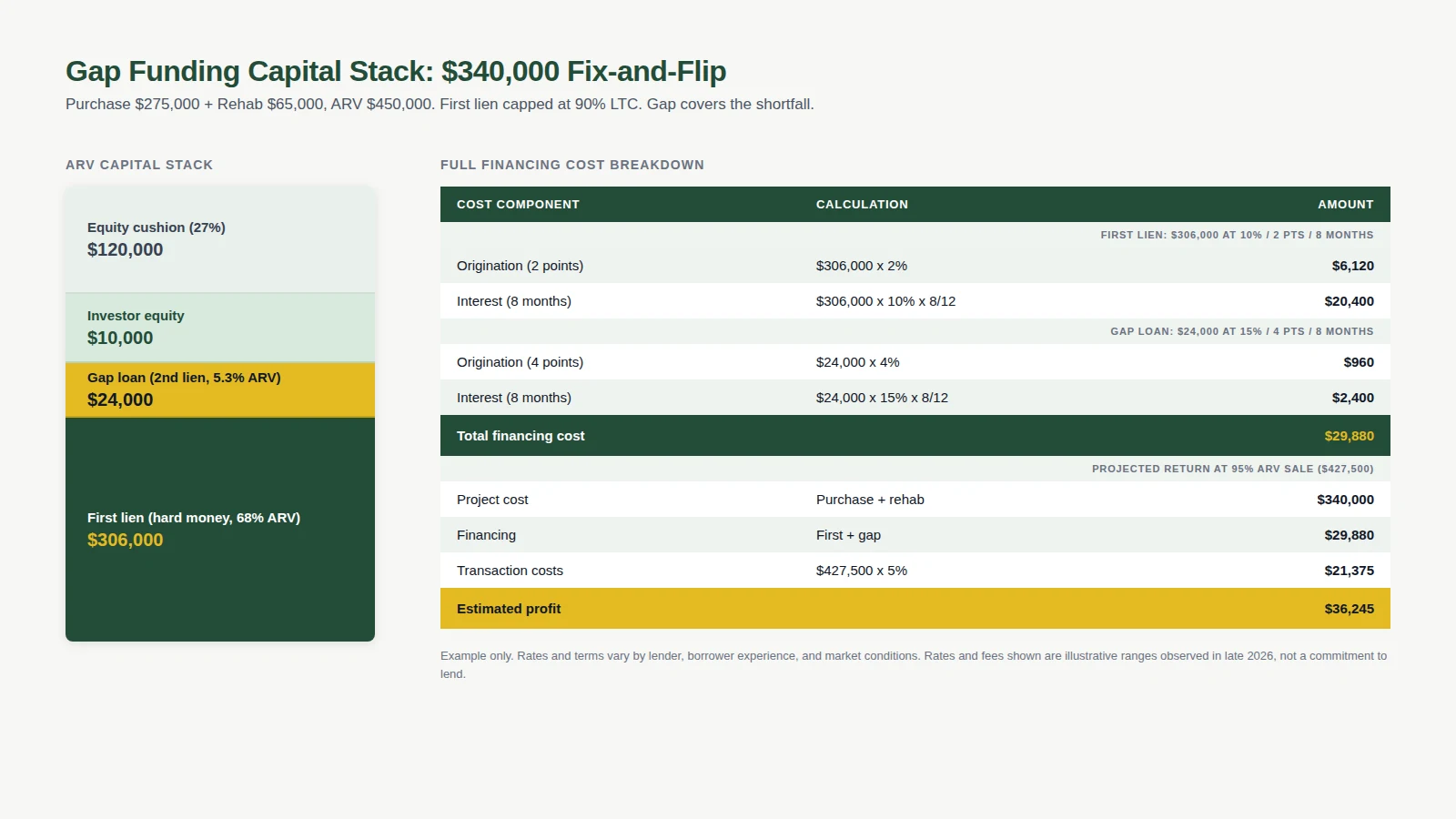
Deal quality, not borrower quality. The question is whether the deal has enough margin that both lenders get repaid even if the sale comes in below the target ARV. A combined loan-to-ARV above 85 percent is a hard stop for most gap sources. At $306,000 first lien plus $24,000 gap equals $330,000 combined against a $450,000 ARV: 73 percent combined LTARV. That clears the threshold with room.
The first lender’s approval. Many hard money lenders require notification of any second-position financing. Some prohibit it contractually. Check the first lender’s loan documents before approaching a gap source. Borrowing in second position without the first lender’s knowledge can trigger an acceleration clause, meaning the first lender demands full repayment immediately.
Your experience tier. A first-time flipper carrying a gap loan has real execution risk. Gap lenders tend to price that in with higher rates or decline outright. The borrower profile that clears most gap lenders is someone who has completed at least two or three flips and can show the first lender’s written consent alongside a detailed scope of work and contractor credentials.
Exit clarity. A gap loan on a flip must be repaid from the sale. The gap lender wants to see a realistic exit: a comparables package supporting the ARV, a licensed contractor with a signed contract, and a draw schedule that gets you to the finish line in the stated term. A vague sale expectation is not an exit plan.
Want terms on a specific deal?Answer seven questions and get a decision in 72 hours.
Get FundingWhat gap funding actually costs
Gap funding is priced as junior debt, which means more risk for the lender and more cost for you. As of late 2026, second-position bridge and gap loans typically run between 13 and 18 percent annualized, with origination ranging from 3 to 6 points. The term is usually co-terminus with the first loan.
On the $24,000 gap loan in this example:
| Cost component | Calculation | Amount |
|---|---|---|
| Origination (4 points) | $24,000 x 4% | $960 |
| Interest at 15%, 8 months | $24,000 x 15% x 8/12 | $2,400 |
| Total gap cost | $3,360 |
That $3,360 is what you pay to access a deal that otherwise requires $24,000 more of your own capital. The full financing picture: the first lender charges 2 points ($6,120) plus 10 percent for 8 months ($20,400), totaling $26,520. Add the gap cost of $3,360. Total financing on a $340,000 project: $29,880.
If the property sells at 95 percent of ARV ($427,500) and transaction costs run 5 percent of sale price ($21,375):
| Line item | Amount |
|---|---|
| Sale price (95% of $450,000 ARV) | $427,500 |
| Project cost (purchase + rehab) | $340,000 |
| Total financing (first + gap) | $29,880 |
| Transaction costs (5% of sale) | $21,375 |
| Estimated profit | $36,245 |
Use the fix and flip calculator to run those numbers on your actual deal before you commit to any financing structure.
When gap funding makes sense
Gap funding solves a specific problem: you have identified a deal that works at the numbers, you have a lender who will fund most of it, and you are $20,000 to $60,000 short of what the deal requires.
It makes sense when the deal margin is thick enough to absorb the extra cost. If your projected profit on a $450,000 ARV flip is $12,000, adding $3,360 in gap costs is a 28 percent reduction in that profit. If your projected profit is $70,000, the same gap cost is a 5 percent reduction. The math looks very different at different margin levels, and the gap should only close deals where the spread justifies the additional lender.
It also makes sense when you have a clear use for the freed capital. If the $24,000 you are not putting into this deal closes a second deal generating $18,000 in profit, the opportunity cost of tying up your own cash is $18,000. Gap funding at $3,360 comes out ahead by a wide margin.
It makes sense when you have already confirmed the first lender’s approval. Some hard money lenders will permit second-position financing with written notice; others prohibit it entirely. Getting the first lender’s answer before you spend time on a gap term sheet saves everyone time.

When this loan is wrong for you
Gap funding adds another lender, another set of conditions, and another maturity date to manage. The added cost and complexity are worth it on the right deal. On the wrong deal, they accelerate a loss.
When the deal margin is thin. Gap funding cannot make an unprofitable purchase profitable. It makes a marginal deal more expensive and more likely to lose money if the sale takes longer than expected or the buyer renegotiates at the last minute. Run the numbers at a 10 percent ARV haircut before you commit to any gap financing, and if the deal does not survive that test, it is not a gap funding problem.
When you have fewer than two completed flips. Managing two loans in first and second position, coordinating draw requests, and meeting two simultaneous maturity dates is an operational challenge. Investors earlier in their learning curve should focus on closing the equity gap with their own capital first. The experience tier requirements on most gap loans will push first-timers toward higher rates anyway.
When the first lender has not approved it. Borrowing in second position without notifying the first lender is a default event under most loan agreements. The first lender can accelerate the entire note, demand full repayment, and report the default. This is not a technicality; it has ended deals and cost investors far more than the gap loan was worth.
When exit timing is uncertain. A gap loan matures with the first loan. If the flip takes three months longer than projected, you will need to extend both loans. Extension costs on a gap loan often run 2 to 3 points per month. On a $24,000 loan, that is $480 to $720 per extra month added to your carry. The fix and flip loan extension post details what extension fees cost across three scenarios, including what happens when you hit the default rate.
When the first lender will fund more. Before signing up for a gap loan, ask the first lender whether the file qualifies for a higher LTC. A well-documented scope of work, a licensed contractor with verified comparable projects, and a detailed draw schedule sometimes buy an extra 5 points on the first loan. That eliminates the gap entirely and removes a lender from the transaction.
If you have a deal with a clear margin and a first lender who has already approved second-position financing, the fix and flip loan program page shows what the first lien covers, or call 917-842-9982 to discuss the full capital structure.
Common questions
What is the difference between gap funding and mezzanine financing?
Both are junior debt, but they are different products. Mezzanine financing is used on commercial deals above $1 million and is secured by a pledge of the borrower’s equity in the property-owning entity rather than a lien on the property itself. Gap funding in the residential investor context is a second-position lien on the property, usually on a fix-and-flip or ground-up build, and is typically sized in tens of thousands of dollars rather than hundreds of thousands. The legal structure, enforcement mechanism, and lender base are entirely different.
How much does gap funding typically cost?
Market rates as of late 2026 run between 13 and 18 percent annualized, with origination fees between 3 and 6 points. On a $24,000 gap loan for 8 months at 15 percent and 4 points, the total financing cost is approximately $3,360. Some gap lenders also charge exit fees or prepayment premiums. Read the full term sheet carefully before signing, and confirm in writing that the first lender has approved second-position debt on the same property.
Can you use gap funding on a construction loan?
Yes, but it is less common. Construction gap funding is used when a ground-up build has a development budget that exceeds what the construction lender will fund at the LTC or ARV cap. The complication is that construction loans disburse in draws, so the gap lender’s exposure changes over time as draws are funded. Some gap lenders will fund a fixed second-position note at the same time the construction loan closes; others will not take a second position on a draw-based facility at all and require a lump-sum second.
What happens if my flip does not sell before the gap loan matures?
Both the first and second loan typically mature on the same date. If you cannot sell or refinance in time, you need to extend both loans. Extension fees on a gap loan often run 2 to 3 points per month. On a $24,000 loan, that is $480 to $720 per additional month in carry. If the property is under contract with a known closing date, most lenders grant a short extension. If it has been sitting on the market for months without a buyer, neither lender will extend indefinitely, and a price reduction may be the only clean path to repayment.
Is gap funding available for DSCR rental loans?
Gap funding is a short-term hold product designed for fix-and-flip and construction transactions with a clear sale or refinance exit. DSCR loans are for stabilized rentals, and the equity requirement is simply the down payment. If you are short on a down payment for a DSCR loan, a gap loan is not the standard solution. Most DSCR lenders require the full down payment to come from your own verified funds, and borrowing your down payment from a secondary source changes the LTV picture and may disqualify the first loan entirely.
Ready to fund your next deal?
Approval within 72 hours. Close in 5 to 10 business days.
Get Funding Now