Fix and Flip Loan Extension: Costs, Default Rates, and How to Ask
Most hard money lenders will extend a fix and flip loan when a project runs long, but it costs money and it is not guaranteed. Here is what extensions cost, what kills the request, and what happens if you let the loan roll into default.

When a flip runs longer than the loan allows, most hard money lenders will extend the term for a fee. This post is for real estate investors on business-purpose loans, not homeowners extending a residential mortgage. Fix and flip loans are commercial instruments, and the extension process is governed by your note, not consumer lending rules. Extensions typically cost 1 to 2 points per period on the outstanding balance, are not automatic, and require your project to still be moving and your interest payments to be current.
What you are actually asking for
A fix and flip loan extension is a formal modification to your maturity date. The lender agrees to push the loan due date out by a fixed number of months in exchange for a fee and, in most cases, your continued performance under the original note. It is not automatic, it is not free, and it is not a right built into the loan by default.
Most extension agreements are executed as amendments to the original loan documents. You will sign a new maturity date acknowledgment, pay the extension fee, and confirm that you are not in default on interest payments or any other material covenant of the loan. Some lenders require updated property photos and a written payoff plan before they will prepare the extension agreement. Give them two weeks of lead time, not two days.
What an extension costs
Extension fees in the market as of late 2026 run 1 to 2 points on the outstanding loan balance per extension period, typically one to three months. Some lenders charge a flat fee instead: $500 to $2,000 per month of additional term, more common on smaller balance loans under $150,000.
On a $285,000 fix and flip loan with a 1-point per month extension fee, the arithmetic is straightforward:
| Extension period | Fee (1 point) | Cumulative fee cost |
|---|---|---|
| Month 1 | $2,850 | $2,850 |
| Month 2 | $2,850 | $5,700 |
| Month 3 | $2,850 | $8,550 |
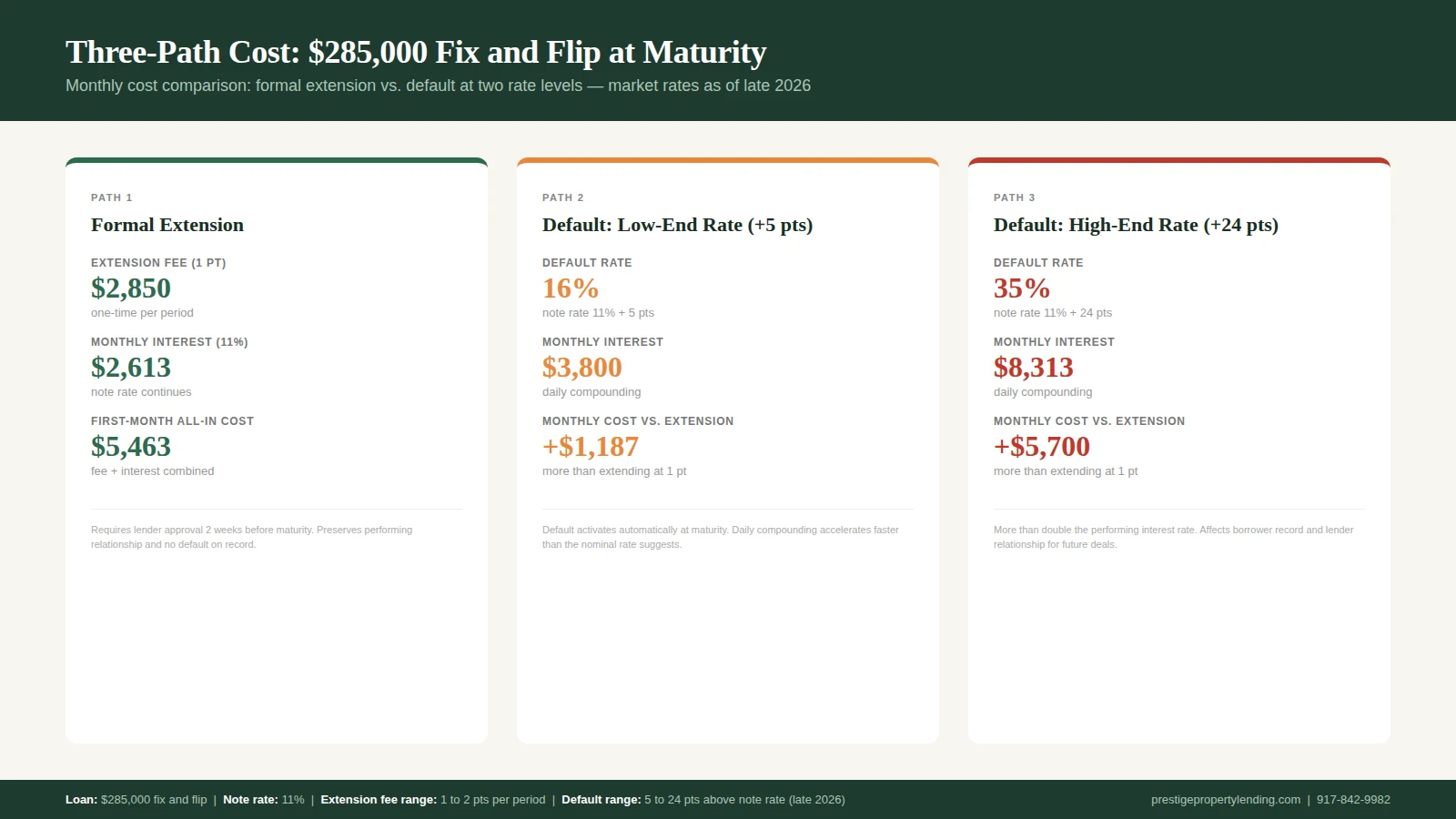
That $8,550 sits on top of your ongoing interest. If your note rate is 11% interest-only on $285,000, you are paying $2,619 per month in interest. Three months of extension adds $8,550 in fees and $7,857 in interest, for a total carry of $16,407 beyond your original maturity date. Add that number to your holding cost model before you price the deal. The fix and flip calculator can run your all-in cost including projected extension periods before you commit to a purchase price.
Want terms on a specific deal?Answer seven questions and get a decision in 72 hours.
The default rate trap
If your loan reaches its maturity date and you have not formally executed an extension agreement, you are in default. That is not a soft deadline. Most fix and flip loan notes include a default interest rate provision that activates automatically at maturity if the loan is not paid off or extended.
Default rates vary, but the typical range observed in the market as of late 2026 is 5 to 24 percentage points above the note rate, depending on the lender and state. On that same $285,000 loan at an 11% note rate, here is what the monthly interest looks like under each path:
| Scenario | Rate applied | Monthly interest | 3-month interest only |
|---|---|---|---|
| Performing (note rate 11%) | 11.00% | $2,619 | $7,857 |
| Default, low end (note +5%) | 16.00% | $3,800 | $11,400 |
| Default, high end (note +12%) | 23.00% | $5,463 | $16,389 |
At the high end of the default rate range, you are paying more than double your performing interest. Default rate interest also typically compounds daily rather than accruing monthly, which accelerates the balance faster than the table above suggests. The difference between requesting an extension two weeks before maturity versus letting the loan roll into default can cost thousands of dollars on a medium-sized deal, and it affects your relationship with the lender for every future file.
What lenders look at before they say yes
Lenders approve extensions based on three questions: Is the project still moving? Can you service the extended loan? And is the asset still worth what they underwrote?
Progress on the rehab is the primary factor. A project that is 85% complete with a licensed contractor still on-site is a very different conversation from a project where work stopped three months ago and the property is exposed to weather. Lenders will sometimes require a physical inspection or updated draw photos before approving an extension. If you have been submitting regular draw requests throughout the loan, you have already created the paper trail that supports the extension conversation.
Your interest payment history matters as well. A borrower who has paid every monthly interest payment on time, communicated proactively about the delay, and can show a clear path to payoff is in a much stronger position than one who is two months behind on interest and calling the lender for the first time at maturity. See the full breakdown of what each additional hold month costs, including taxes, insurance, and utilities, to build the realistic payoff timeline your lender will ask for.
Some lenders require a fresh appraisal for extensions past the first one, particularly if the market has moved or the scope of work changed from the original. If your ARV has declined since the original appraisal, the lender may reduce the extended loan balance or require a pay-down before granting the extension. That is a material cash requirement to plan for.
How many extensions you can get
Most fix and flip loan structures allow two to three one-month extensions. Some lenders offer a single six-month extension option at origination, exercised by paying a lump extension fee. Beyond the contractual limit, lenders typically require a full loan modification or payoff, not another extension. A modification is a more formal process, usually requires new underwriting, and may carry different fees and terms than a standard extension.
If you have exhausted your extension options and still cannot pay off the loan, your choices narrow: sell at market price, refinance into a longer-term product, or negotiate a workout with the lender directly. That last option usually involves the lender’s loss mitigation team rather than your loan officer, and the terms are less favorable than what you would have gotten by requesting an extension before the first maturity date.

When refinancing beats extending
If your project is finished and the property is tenant-occupied or generating income, a refinance into a DSCR rental loan may be more efficient than a chain of extensions. The DSCR loan will carry a lower rate and no extension fees. The trade-off is seasoning: many DSCR lenders require the property to have been owned for three to six months before they will refinance it. If you are within that window and the property qualifies on rent, start the DSCR application before the fix and flip loan matures so you can bridge the gap cleanly.
If the property is not stabilized but you need more time than the fix and flip lender will give you, a bridge loan is the other option. Bridge loans are structured for longer holds than the typical 12-month fix and flip term, with similar rate profiles. The refi into a bridge loan is a full payoff of the fix and flip note, not an extension, so you will pay origination on the new loan. That cost needs to pencil against the alternative of continuing to pay extension fees.
When this situation is wrong for you
If your project is significantly over budget and you cannot demonstrate a path to payoff at the extended maturity date, requesting an extension may delay the inevitable rather than solve the problem. Lenders will ask for a payoff plan. If you do not have one, the extension request is unlikely to succeed, and the time spent pursuing it may be better used finding a buyer or a buyout partner before the default rate kicks in.
If your profit margin has been consumed by cost overruns and the extended interest cost would eliminate what little remains, the math may favor a discounted sale before maturity rather than paying extension fees to preserve a deal that no longer pencils. Run both paths. The fix and flip calculator can model the extended carry cost against net proceeds at a reduced sale price.
The extension process assumes a performing relationship with the lender. Borrowers in default on interest, with active mechanics liens on the property, or with legal disputes tied to the project will face a materially harder extension conversation. Reach the lender proactively, provide documentation, and have a number in mind. Lenders extend loans to get paid back, not to take properties. That alignment works in your favor when you show up prepared.
Call 917-842-9982 to discuss where your deal stands before maturity.
Common questions
How much does a fix and flip loan extension typically cost?
Most extensions cost 1 to 2 points on the outstanding loan balance per extension period. On a $285,000 loan, that is $2,850 to $5,700 per period. Flat-fee structures ($500 to $2,000 per month) are common on smaller loans. The fee applies on top of ongoing interest accrual, not instead of it.
How many times can you extend a fix and flip loan?
Most fix and flip loan structures allow two to three extensions before requiring full payoff or a formal loan modification. Some lenders offer a single longer extension option instead of multiple shorter ones. Extensions beyond the contractual limit require new underwriting and different documentation than a standard extension request.
What happens if your fix and flip loan reaches maturity and you have not paid it off?
The loan goes into default and the default interest rate provision in your note activates. That rate is typically 5 to 24 percentage points above your note rate, depending on the lender and state. Default interest usually compounds daily. Contact your lender before the maturity date, not after, and request an extension formally while you are still performing.
Can a lender refuse to extend a fix and flip loan?
Yes. Extensions are at the lender’s discretion unless the original loan documents specify an automatic extension option. Lenders typically decline when the project has stalled, the borrower is behind on interest payments, the property’s value has declined, or the borrower has no credible payoff plan. Calling before maturity with current draw photos and a sale timeline substantially improves the outcome.
Does paying an extension fee reset your interest payments?
No. The extension fee is separate from interest accrual. You pay the extension fee to push the maturity date out, and you continue to owe monthly interest at your note rate throughout the extended period. The fee is a modification cost, not a prepayment credit or interest waiver.
Ready to fund your next deal?
Approval within 72 hours. Close in 5 to 10 business days.
Ready to fund your next deal?
Approval within 72 hours. Close in 5 to 10 business days.
Get Funding Now