Fix and Flip Scope of Work: What the Lender Reads Before Your First Draw
The scope of work controls your draws. Without a line-item SOW signed by a licensed contractor, most business-purpose lenders will not issue a term sheet. This covers what the document needs to contain and the three mistakes that delay payments mid-project.

The scope of work is the document your lender uses to approve the rehab budget, set the draw schedule, and send an inspector before each payment. Without a line-item SOW signed by a licensed contractor, most business-purpose lenders will not issue a term sheet. This post is about what that document needs to contain, not what it is in theory. If you are a homeowner renovating your primary residence, this does not apply to your situation: business-purpose fix-and-flip loans fund investor acquisitions only.
Why the SOW is the backbone of a fix-and-flip loan
A fix-and-flip lender does not advance all the rehab money at close. The rehabilitation portion is released in draws, typically three to six, each tied to a completed phase of the scope. Before releasing a draw, the lender sends an inspector to verify that the work matching that phase is complete. The inspector compares what is built against what the SOW says should be built. If the SOW is vague, there is nothing to compare against.
“Kitchen renovation: $18,000” is not a SOW. It is a guess. A lender reading that line has no idea what constitutes a completed kitchen, which means the inspector has no checklist, which means the draw can be disputed or held for weeks. That float comes out of your carry. At rates typical for fix-and-flip loans in the current market, ranging from 10% to 13% annualized, each 30-day delay on a $225,000 loan costs $1,875 to $2,440 in interest before you touch anything else.
What a lender actually needs in your SOW
Lenders differ on format, but the content requirements are consistent across business-purpose rehab programs. A SOW that gets approved without back-and-forth includes:
- Line items by trade, not by room. Separate electrical, plumbing, HVAC, structural, and finishes. A “kitchen” line item rolls together four trades and makes inspection impossible.
- Material spec and grade. “LVP flooring” means nothing. “LVP flooring, mid-grade, 900 sq ft, installed” is a line item.
- Permit requirements called out per item. Electrical panel upgrades, structural work, and plumbing reconfigurations require permits in most jurisdictions. Note which line items require a pull.
- Contractor details on every line. Name, license number, insurance certificate expiration. Lenders will not fund draws to an unlicensed contractor.
- Contingency, stated explicitly. A 10% contingency on the hard cost total is the minimum most lenders want to see. Properties with deferred maintenance or unknown structural conditions often require 15%.
The contingency is not a slush fund. It is a documented reserve for change orders and cost overruns on approved scope. If you draw from contingency to fund new work outside the original SOW, you still need a formal change order. More on that below.
Want terms on a specific deal?Answer seven questions and get a decision in 72 hours.
Get FundingA worked example: $95,000 rehab budget
The graphic below shows how a $95,000 SOW breaks down for a $175,000 purchase with a $320,000 ARV target. Each category maps to a single inspection trigger in the draw schedule. The lender’s inspector checks each trade against this line when the draw request comes in.
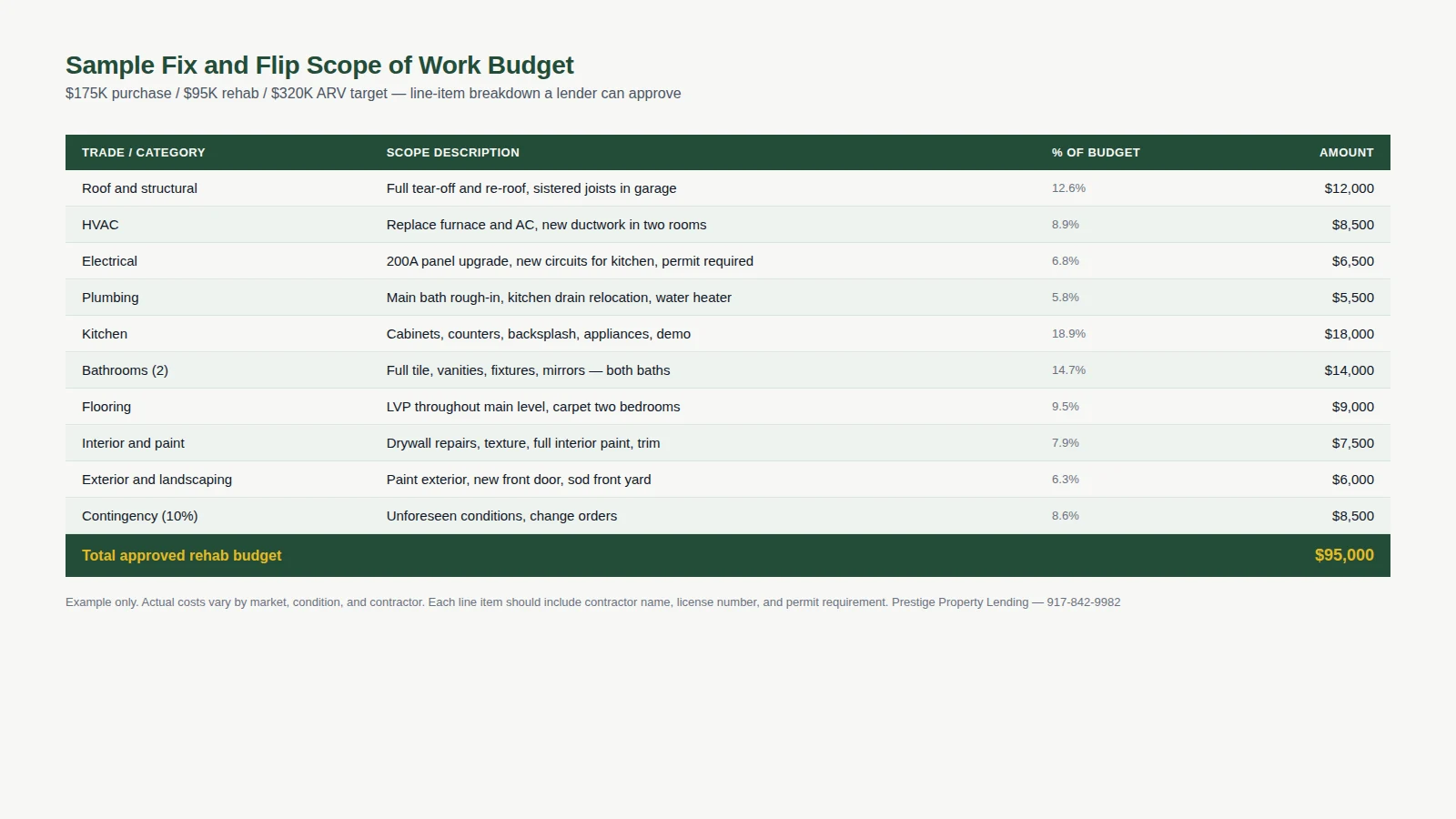
On this deal, the lender would typically structure three to four draws: rough-in trades after framing and utility work passes inspection, finishes after cabinets and tile are in, a punch-out draw after final walkthrough, and sometimes a holdback released after the certificate of occupancy or sale closes. The exact structure depends on the lender and the project timeline, but the draw count always traces back to the SOW categories.
Use the fix and flip calculator to model the all-in cost before you lock in your rehab number. Total project cost on this example is $175,000 purchase plus $95,000 rehab plus carry, points, and closing costs.
Three SOW mistakes that hold draws
Vague descriptions with no line items. The most common problem. If your contractor bids in room-level summaries instead of trade-level line items, push back before you submit the SOW to the lender. The revision takes an afternoon and prevents two to three weeks of draw delays mid-project.
Unlicensed or underinsured contractors. The lender’s inspector is required to verify that the contractor on file is licensed in the jurisdiction and carries adequate insurance. If you swap a sub mid-project or use a handyman for a permitted trade, the inspector will flag the mismatch and the draw is held until the credential gap is resolved. Keep a current copy of every sub’s license and COI in your project file. Update it at each renewal, not when the inspector asks.
Scope creep without a change order. You added a second bathroom that was not in the original SOW. The inspector arrives and sees new tile where the SOW shows no bathroom work. The lender cannot fund work outside the approved scope without a formal change order, which requires their review and typically takes 5 to 7 business days. Some lenders charge a change order processing fee in the range of $250 to $500. Three change orders on a 5-month flip adds two to three weeks of carry time. Build the scope thoroughly from the start, and put anything uncertain into contingency rather than leaving it off entirely.

Who can be the general contractor
On a fix-and-flip loan, you can act as your own GC in most states if you hold the appropriate license or the state allows owner-builders on investment property. Most business-purpose lenders will accept an owner-GC arrangement when licensed subs are pulling permits on regulated trades. What they will not accept is a SOW where every line reads “owner” with no licensed contractor attached to any work that requires a permit.
First-time borrowers should read the experience requirements before assuming owner-GC works on a first deal. Lenders apply LTC restrictions based on experience tier, and the SOW is one of the documents they use to judge whether a borrower has the project management depth to execute. A professional, detailed SOW signals competence. A one-page summary signals risk. The full breakdown of experience tiers and their impact on loan structure is covered in the fix and flip loan requirements guide.
How the SOW connects to the draw schedule
The draw schedule is not set by the lender independently. It is derived from the SOW by grouping trade line items into phases that can be verified in a single site visit. A well-structured SOW makes that grouping obvious, which means the lender’s processing team can set up the draw schedule faster and with less back-and-forth at origination.
The fix and flip draw schedule post covers the mechanics of how money actually moves: the reimbursement structure, inspection lag, and the cash float you carry during the active rehab phase. The SOW is the input. That post covers the output.
If you want to see the full cost structure and program terms for a rehab loan, the fix and flip loan program page covers LTC, rate ranges, and term structure for business-purpose loans across experience tiers.
When this loan structure is wrong for you
Most articles on fix-and-flip financing skip this section. It is the most useful part.
If you cannot produce a line-item SOW within two weeks of contract execution, you are not ready to fund. The SOW is required before the loan closes, not something you refine during the draw period. Borrowers who arrive at closing with a contractor who cannot produce a detailed scope will delay closing or lose it.
If the property has unknown structural conditions, a 10% contingency is likely not enough. A foundation problem, a failed sewer lateral, or a roof that looks serviceable but is not: each of those can cost $15,000 to $40,000 and will come from your pocket once the contingency is exhausted. On a $95,000 rehab, 10% contingency is $9,500. That covers material price changes and minor overruns. It does not cover a structural discovery.
If your contractor’s schedule is already strained, the inspection lag will compound. Most lenders take 3 to 5 business days to dispatch an inspector after you submit a draw request. If your contractor is also behind, you can wait two to three weeks between draw request and payment. On a tight hold period, that float is expensive. Model it before you commit to a contractor currently managing two other projects.
If the numbers only work at a high ARV, the appraisal is the real risk, not the SOW. A detailed SOW will not save a deal where the ARV was optimistic and the appraisal comes in 10% lower. Run the fix and flip calculator at both your target ARV and a conservative downside before you go under contract.
Questions about your project scope or what a term sheet would look like on your deal: call 917-842-9982.
Common questions
Does the scope of work need to be from a licensed contractor?
Yes, for any line item that involves a permitted trade. Electrical panel work, plumbing reconfigurations, HVAC replacements, and structural repairs all require licensed contractors in most states. The lender will verify the contractor’s license during the draw inspection. Cosmetic work, painting, and landscaping can be from unlicensed subs in states that allow it, but confirm with your lender before the SOW is finalized.
How detailed does the scope of work need to be?
Detailed enough that an inspector who has never seen the property can check each line against completed work. Each trade should have a description of the work, the material spec or grade, the contractor name and license number, the permit status, and a dollar amount. A SOW with fewer than 8 to 10 line items on a full rehab is almost always too vague to support a draw schedule.
What is a change order and when do I need one?
A change order is a written amendment to the approved SOW, submitted to the lender before the additional work begins. You need one any time you add scope that was not in the original SOW, or any time the cost on an existing line item increases beyond the lender’s tolerance threshold. Work completed outside the approved SOW without a change order will not be funded in the next draw inspection.
Can I use contingency funds without a change order?
It depends on the lender. Most will allow you to draw from contingency for cost overruns on items already in the SOW without a formal change order, up to the contingency amount. If you want to add new scope, you always need a change order, even if the contingency has funds available. Confirm the contingency draw policy with your lender before the project starts.
How does the scope of work affect the loan amount?
The lender uses the SOW total to set the rehab allocation in your loan. If your SOW is $95,000, the lender models draws and reserves against that number. If the actual rehab cost runs higher because the SOW was underestimated, you absorb the difference. There is no automatic increase to the loan based on field conditions. This is why contingency exists, and why a thorough SOW at the start is worth more than a lower-looking initial budget.
Can I submit a scope of work before I have the property under contract?
Not for a live loan application, but you can use the process as a pre-screening step. Walking a potential acquisition with a contractor and getting a preliminary scope will tell you whether the rehab budget supports your target LTC and ARV before you tie up earnest money. Many experienced flippers do a preliminary scope walk as part of their due diligence, not as a loan requirement.
Ready to fund your next deal?
Approval within 72 hours. Close in 5 to 10 business days.
Get Funding Now