Fix and Flip Financing: How the Loan Is Structured and What It Actually Costs
Fix and flip financing covers the purchase and rehab draws on an investment property you plan to sell. Here is how lenders structure the loan, how interest accrues on drawn balances only, and what the all-in cost looks like on a real deal.
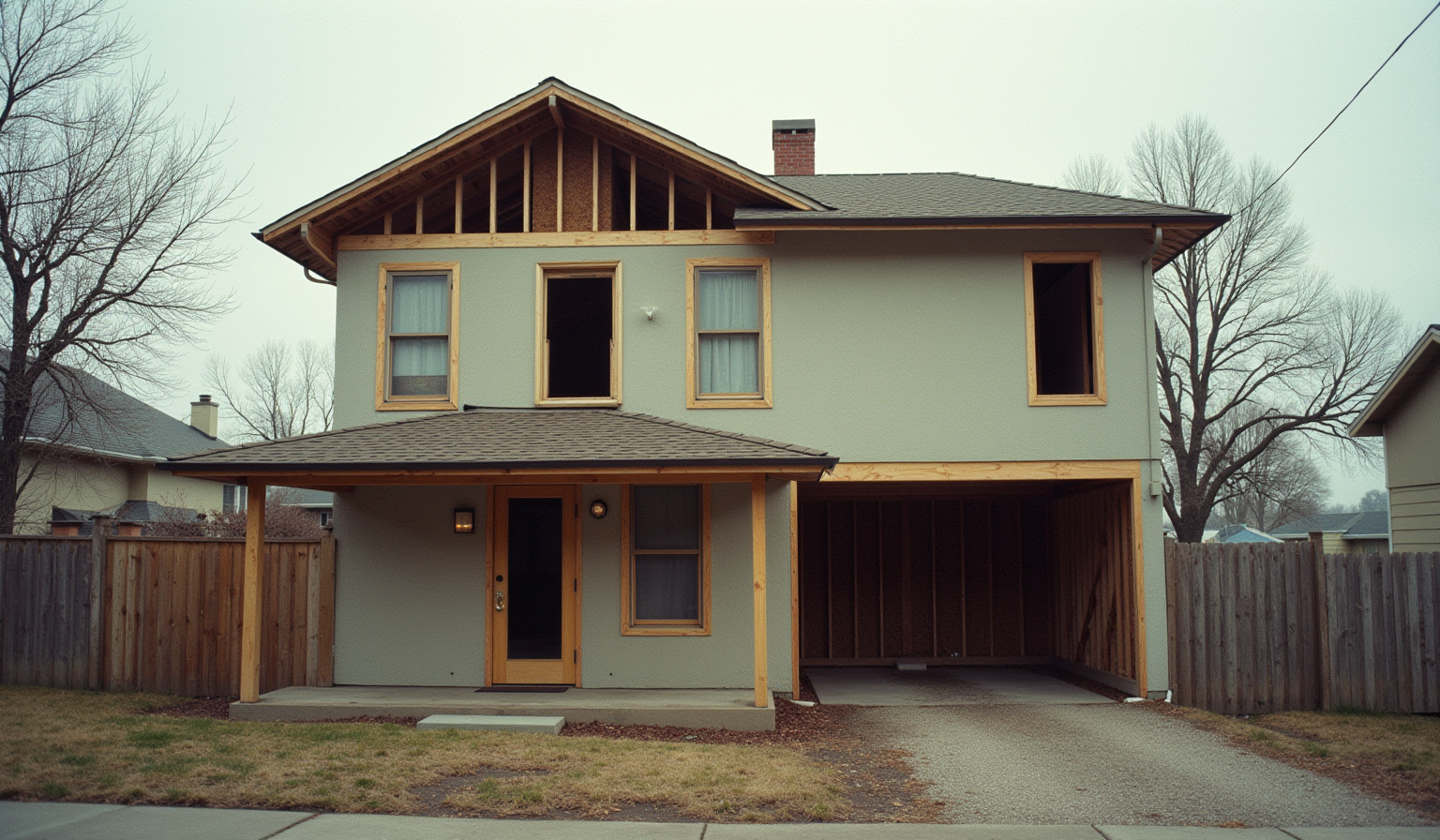
Fix and flip financing is a short-term loan for investors who buy a property, renovate it, and sell it. The loan covers the purchase and releases rehab funds in draws as work is completed, then gets repaid at the sale. This is not a consumer product: if you are buying a home to live in and renovating it, this loan is not available to you and neither is any other business-purpose loan.
How fix and flip financing is structured
Most fix and flip loans have three components: the acquisition draw, the rehab holdback, and the draw schedule that releases the holdback over the life of the project.
The lender funds the purchase at close, typically covering 80 to 90 percent of the purchase price. The full rehab budget is not disbursed at once. It sits in a holdback account and releases in draws after each phase passes a lender inspection. Six draws on a moderate rehab is common: demo and rough framing, rough mechanicals, drywall, finishes, fixtures, and final punch.
Interest accrues only on what has been drawn. If your total loan is $300,000 but only $215,000 has funded the acquisition, you are paying interest on $215,000, not $300,000. That distinction matters when you model the real cost of the deal, and it is why the rate alone does not tell you what the financing costs.
Loans are quoted against loan-to-cost (LTC), not loan-to-value (LTV). LTC is the loan amount as a percentage of your total project cost: purchase price plus approved rehab budget. A $300,000 loan against a $405,000 total cost is 74 percent LTC. The lender also models the loan as a percentage of the after-repair value (ARV), and whichever constraint is tighter sets the ceiling. See how ARV is established in the post on how appraisers actually set ARV.
Loans are interest-only, which means you pay only the accrued interest each month and repay the full principal at sale. There is no amortization. This keeps monthly payments low during the hold, but the full balance is due when you close on the exit sale.
What fix and flip financing actually costs: a worked example
Consider a $320,000 purchase, $85,000 rehab budget, $525,000 ARV. Total project cost: $405,000. A lender approves $300,000 at 12 percent annual rate, 2 origination points, 9-month term, interest-only.
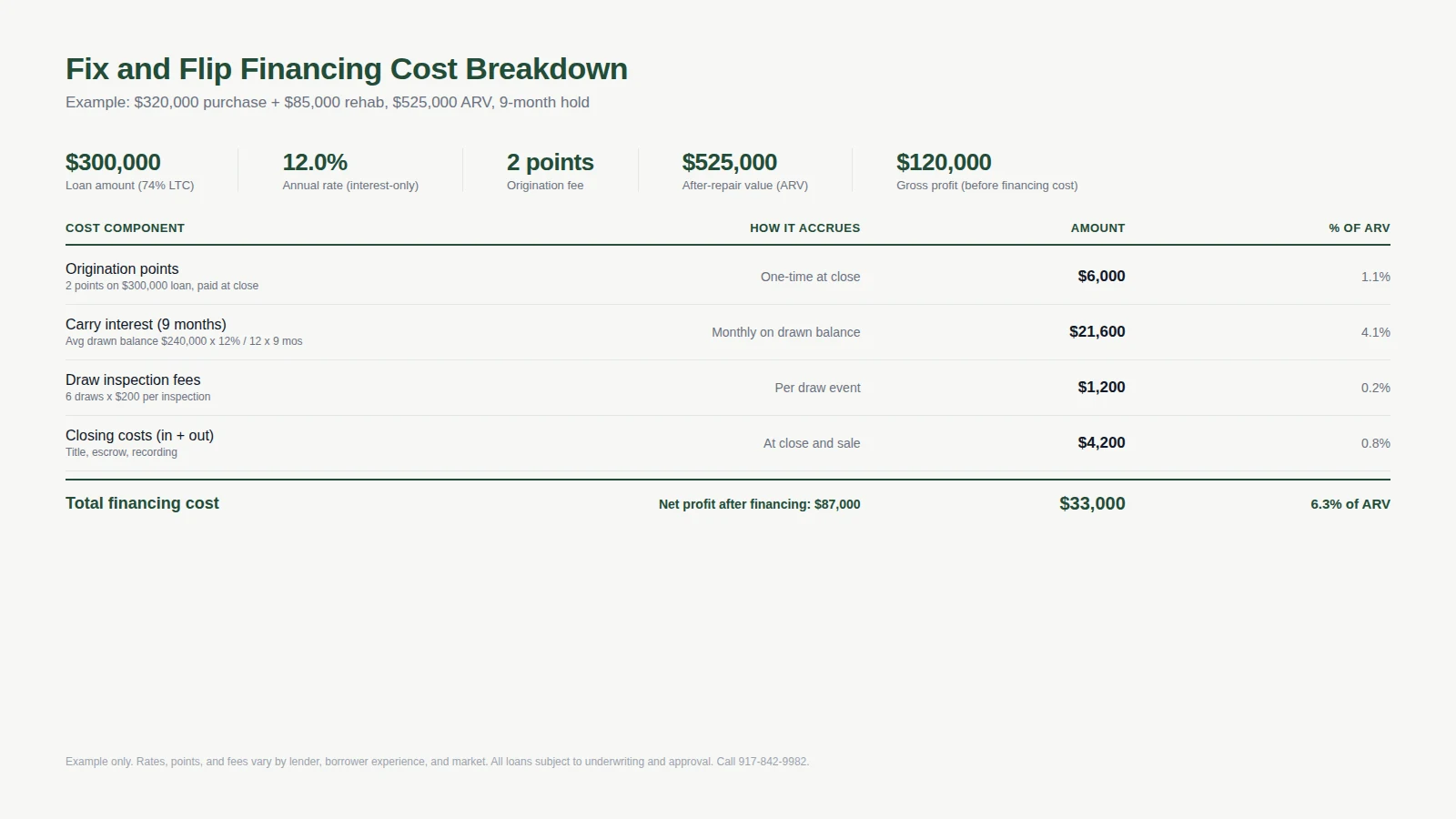
The four cost components:
Origination points: 2 points on $300,000 is $6,000, paid at close. Points range from 1 to 3 depending on deal size and borrower track record. They are not negotiable on a take-it-or-leave-it basis, but they are one of the variables that shifts between lenders on the same file.
Carry interest: The average drawn balance over a 9-month project with six roughly staged draws is around $240,000. At 12 percent annually, that is $2,400 per month average, or $21,600 for 9 months. Your first month, when only the acquisition is funded, costs less. Your last month, fully drawn, costs more. The blended figure is what you model when you underwrite the deal.
Draw inspection fees: Six inspections at roughly $200 each is $1,200. Some lenders bundle inspections into the origination fee; others charge per draw. Confirm which structure you are getting before you sign the term sheet.
Closing costs: Title, escrow, and recording at acquisition plus the title update at payoff typically runs $4,000 to $5,000 on a $300,000 loan, depending on the state.
Total financing cost: $33,000 on a deal with $120,000 gross profit leaves $87,000 before agent commissions, holding costs such as insurance, taxes, and utilities, and any contractor overruns.
The annualized cost on this loan is around 14 percent all-in when you include points and fees spread over 9 months. That looks high compared to a conventional mortgage rate. The comparison is not valid: conventional mortgages do not fund distressed properties, do not release rehab draws, and do not close in two weeks. The relevant comparison is what the capital costs versus what the deal returns.
Want terms on a specific deal?Answer seven questions and get a decision in 72 hours.
Get FundingWhat moves the rate and terms
| Variable | How it affects the loan |
|---|---|
| Borrower experience | First flip typically pays 1 to 2 points more and a higher rate. Five or more completed flips usually earns the best tier. Lenders want a track record of completed projects, not a construction resume. |
| LTC | Under 70 percent LTC gets the best pricing. Over 85 percent may require additional collateral or be declined. The rate spread between 65 and 85 LTC can be 1.5 to 2 percentage points. |
| ARV confidence | A presold flip (property under contract with a buyer identified) prices better than a spec flip. Spec in a slow market carries higher rate because the exit is less certain. |
| Market velocity | If comparable sales in the zip code are sitting 90 days before they close, the lender prices the longer hold into the rate or tightens LTC. |
| Loan size | Below $150,000, many lenders charge a floor rate because fixed overhead does not scale to small balances. Above $500,000, pricing often improves on a large-loan basis. |
When fix and flip financing is wrong for you
This product is built for a defined hold, a renovation, and a sale. It is wrong in five situations worth naming plainly.
You plan to hold the property as a rental
The loan terms assume a sale as the exit. If you decide to hold at the end of the renovation, you are refinancing under time pressure, usually into a DSCR rental loan or a conventional investment property mortgage. That transition is not automatic and is not always possible at the LTV the project needs. If holding is the actual plan, start with DSCR financing and underwrite the renovation as a value-add, not a flip.
Your ARV math requires a perfect market
If the deal only works at $525,000 and the most recent comparable sales in the neighborhood are coming in at $490,000 to $510,000, your profit buffer is the gap between what you modeled and what the appraiser actually says. Use the fix and flip calculator to run your deal at a sale price 5 percent below your ARV before you commit.
Your contractor timeline is optimistic
The example above uses 9 months. At 14 months, the same deal costs an additional $14,400 in carry interest plus a 60-day extension fee, which runs 1 to 2 percent of the loan amount on most standard terms. On a $300,000 loan that extension fee is $3,000 to $6,000. The deal may still work. It will not work the way you underwrote it, and the difference comes out of your profit.
You need to go above 85 percent LTC
Lenders who go above 85 percent LTC on a flip are taking on more risk than this product is priced to carry. If your deal requires very high LTC to pencil, the purchase price is probably too high relative to the ARV, or the rehab budget needs revisiting. The fix and flip loan requirements post walks through the LTC math lenders use by experience tier.
You have no real estate investing experience
If you have not flipped before but have completed three to five BRRRR deals or commercial rehab projects, many lenders treat that as relevant experience and price accordingly. General construction experience without an investing track record is weighted less. If you have no prior real estate investing at all, expect first-project pricing and plan for what overruns on a first deal actually look like before you model a profit.
The honest caveat
Fix and flip financing is the right tool when the arithmetic is sound: a defensible ARV, a defined scope of work, a contractor with a track record, and a profit margin that still works if the timeline runs 30 days long and the sale comes in 5 percent below the model.
When deals go wrong on this financing, they tend to go wrong in combination. The ARV was aggressive. The rehab scope grew. The timeline stretched from 9 months to 14. Each of those individually is manageable. Together, they can turn an $87,000 projected profit into a $10,000 loss. The extension fee, the additional carry, and the reduced sale price each take their share.
Run your deal through the fix and flip calculator with a 15 percent cost overrun, a 30-day extension, and a sale price that is 5 percent below your ARV estimate. If the deal survives all three stress inputs simultaneously, the financing structure makes sense. If it does not, the problem is in the underwriting, not the loan.
What to do next
The fix and flip loan program page covers loan parameters, documentation, and how to apply. To discuss a specific deal, call 917-842-9982.
Common questions
What is the typical rate on a fix and flip loan?
Rates in the current market range from around 10.5 to 13.5 percent annually, depending on borrower experience, LTC, and the lender. The rate is only part of the cost. Points, inspection fees, and any extension fees add to the all-in cost. A 12 percent loan with 2 points held for 9 months costs more than a 13 percent loan with 1 point held for 6 months. Model the full cost, not just the rate.
Can I get a fix and flip loan with no money down?
Rarely, and not in a standard way. Some lenders will go to 90 percent LTC on a strong deal from an experienced borrower, which means 10 percent cash in. Zero-down structures usually involve cross-collateralizing another property, which means you are using equity from a different asset, not truly buying with no money down. Most deals require 20 to 30 percent of total project cost in cash or equity.
How long does it take to close a fix and flip loan?
Most close in 7 to 14 business days once the file is complete. The common delays are the appraisal, which takes 5 to 7 business days for a subject-to appraisal on a distressed property, title search, and scope-of-work review. Having a complete document package ready at submission is the single biggest thing you can do to accelerate close.
What happens if I go over budget on the rehab?
The rehab holdback is fixed at the approved scope of work. If your costs run over, the overage comes from your own funds. Some lenders will amend the loan budget mid-project for a change order fee, but this requires submitting the updated scope and possibly a revised appraisal. The cleaner path is to build a 10 to 15 percent contingency into the original budget before you submit. Budget overruns are one of the most common reasons flips fall below their projected return.
Do I need an LLC to get fix and flip financing?
Business-purpose lenders generally prefer LLC or other entity vesting because it reinforces the investment-purpose nature of the loan and keeps liability contained. It is not always required, and some lenders will fund in a personal name with a guarantee. If you plan to flip regularly, the entity structure is worth setting up for asset protection reasons independent of the loan requirement.
Ready to fund your next deal?
Approval within 72 hours. Close in 5 to 10 business days.
Get Funding Now