Fix and Flip Holding Costs: What Every Extra Month Actually Costs You
Holding costs on a fix and flip compound with every extra month. On a $302,500 hard money loan at 11.5%, a 4-month extension costs $14,016 in extra carrying costs and can reduce a $20,000 profit to $6,000. Here is the monthly breakdown and a three-scenario comparison.
Holding costs on a fix and flip are four line items that compound with every extra month: loan interest, property taxes, vacant-property insurance, and utilities. On a $302,500 hard money loan at 11.5%, interest alone runs $2,899 per month. Budget a 7-month hold instead of the 5-month your pro forma assumed, and you have paid $7,008 more in holding costs before a single additional invoice comes in. This post covers business-purpose investment loans. If you are buying the property to live in, this financing does not apply to you.
The four holding cost categories
Most flippers track rehab costs to the dollar and treat holding costs as a few thousand dollars. That is a rounding error in a good month and a margin killer when the deal runs long. Here is what each category actually costs on a mid-market flip.
Loan interest. This is the biggest line item by far. Hard money and fix and flip loans are typically priced between 10% and 13% annually, payable monthly on the outstanding balance. On a $300,000 balance at 11.5%, you owe $2,875 every month the loan is open. On a $250,000 balance at 12%, it is $2,500. The interest does not stop because your contractor fell behind or your listing sat for six weeks.
One important nuance: during the active renovation phase, you pay interest only on what has been drawn, not the full approved loan amount. If you drew $233,750 for the acquisition and are drawing the rehab budget in stages, your average balance in month two might be $255,000, not the full $302,500. Interest is lower during the draw period. Once renovation is complete and the property is on the market, you are paying on the full balance. That is when holding costs hit their monthly peak, and that is when timeline pressure matters most.
Property taxes. Property taxes do not pause during renovation or while you wait for a buyer. On a $300,000 assessed-value property in most markets, expect $250 to $500 per month depending on the state and municipality. Texas and Illinois run higher; many Southeast states run lower. The exact number is on the county assessor’s website before you make the offer.
Vacant-property insurance. A standard homeowners policy is written for an occupied residence. An investor renovating a vacant property typically needs a vacant or builder’s risk policy, which costs more, not less. Budget $100 to $200 per month for a property in the $300K to $500K value range. Most standard policies stop covering a property after 30 to 60 days of vacancy. Verify your coverage before closing, not after demo starts.
Utilities. You need water, heat, and power to complete work and pass inspections. Even on minimal use, budget $100 to $200 per month. A vacant property that goes without heat through a cold week can freeze its plumbing, creating a repair cost far larger than the heating bill you were trying to avoid.
A worked example: what hold time does to your margin
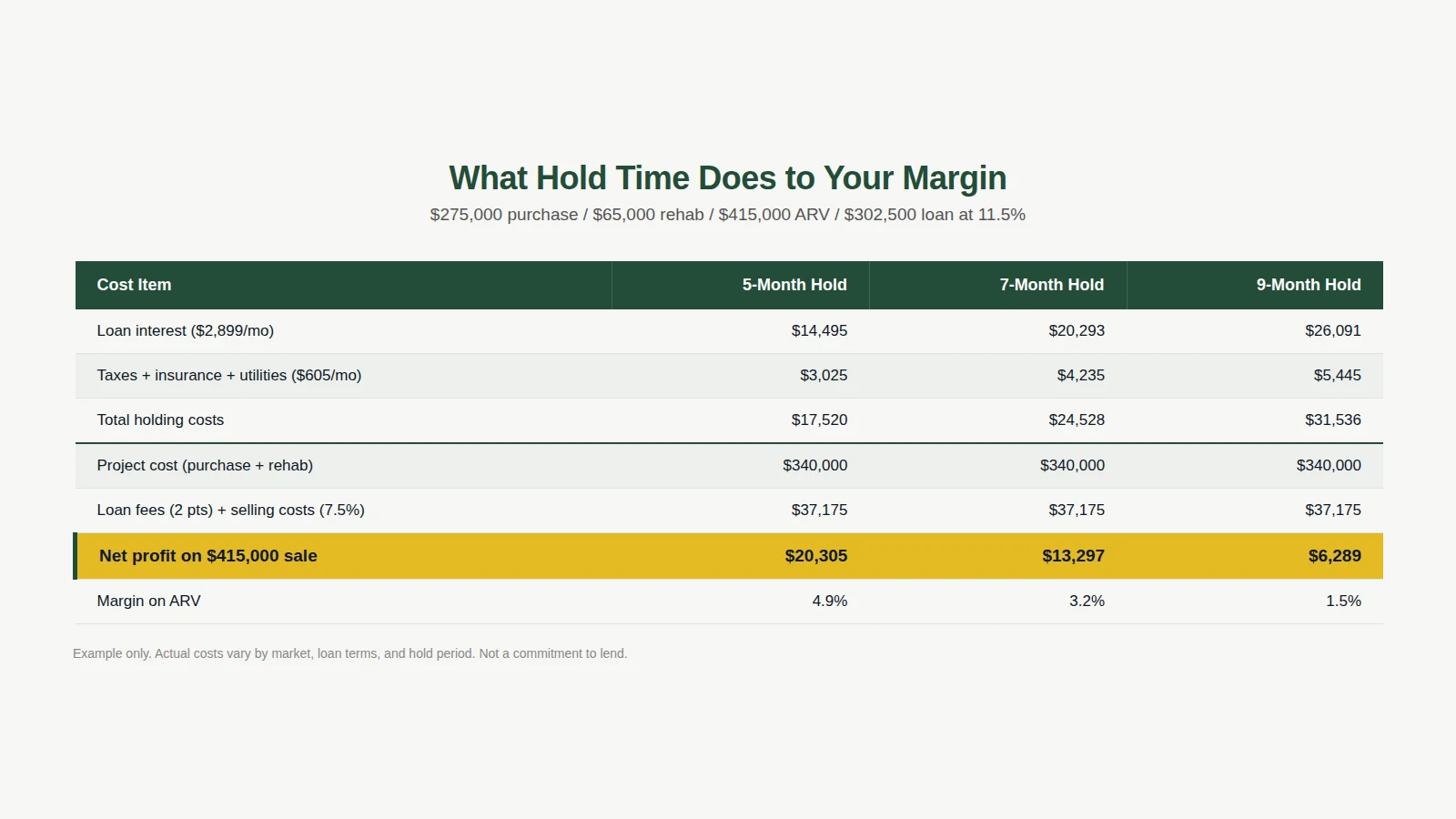
Here is a deal in numbers. Purchase price $275,000, rehab budget $65,000, after-repair value $415,000. You borrow $302,500 (roughly 89% of total project cost) at 11.5% interest only. Monthly interest: $2,899. Add property taxes at $325 per month, vacant insurance at $150 per month, utilities at $130 per month. Total monthly holding cost: $3,504.
You budget 5 months from purchase close to sale close. Your pro forma:
- ARV: $415,000
- Selling costs (6% commission, 1.5% closing): $31,125
- Total project cost (purchase plus rehab): $340,000
- Loan fees (2 points at close): $6,050
- Holding costs (5 months at $3,504): $17,520
- Net profit: $20,305
That is a 4.9% margin on ARV. Workable, but thin. Then the contractor runs six weeks behind schedule. You list two months late, and the property sits on the market for five weeks before going under contract. The actual hold runs to 9 months.
- Holding costs (9 months at $3,504): $31,536
- Net profit: $6,289
A 4-month extension cost $14,016 in additional holding costs and reduced a $20,305 profit to $6,289 on a $415,000 sale. The renovation came in on budget. The problem was time.
Use the fix and flip calculator to run these numbers on your specific deal before you make an offer. Adjust the hold period to see what a two-month overrun does to your margin.
Want terms on a specific deal?Answer seven questions and get a decision in 72 hours.
Get FundingWhat actually extends a hold
Most flippers do not plan for a 9-month hold. Most flippers run into at least one of these.
Permitting delays. A full gut renovation requiring HVAC, electrical, and plumbing permits can add 4 to 8 weeks in some markets just in inspection scheduling. In permit-heavy cities the delay is longer. Ask your contractor what the current inspection backlog is before you set your timeline.
Scope discovered during demo. Opening walls on a house built before 1980 frequently reveals knob-and-tube wiring, galvanized pipe, or asbestos-containing materials that were not in the original scope. Any of these adds 3 to 6 weeks and $10,000 to $30,000 to the rehab budget. The carrying cost clock runs the whole time.
Mispriced listing. An overpriced property does not attract buyers; it attracts price reductions and stale days-on-market that buyers use to negotiate further. Every 30 days the listing sits adds another $3,504 in holding costs. Set the price at what the comps support on listing day, not the price that makes the pro forma work.
Seasonal market slowdowns. Listing a property in November or December in a cold-weather market adds measurable time to the sale. Factor this into your timeline before you close on the acquisition. A property you plan to list in December should have a 7-month hold scenario modeled, not a 5-month one.
How to build holding costs into your maximum offer
Work backward from ARV. The calculation is: maximum offer equals ARV minus selling costs minus minimum profit target minus rehab budget minus loan fees minus holding costs.
The holding costs in that formula should reflect a realistic timeline plus a buffer. If you expect 5 months, model 7. The $7,000 difference in your max offer is the insurance you carry against a slow permit office or a contractor who disappears in month three.
The ARV number in that formula also needs to be conservative. Use the tightest comparable sales within a half-mile and 90 days, not the highest sale in the neighborhood. The ARV calculator walks through the key adjustments appraisers actually apply to comparable sales.
For a complete breakdown of how fix and flip loan costs stack, the post on how fix and flip financing is structured covers points, origination, interest on drawn balance, and exit fees in one place. All of those costs compound with hold time.
When holding costs mean the deal does not work
Not every deal with a thin margin is a deal that needs cheaper money. Some deals have the wrong numbers from the start.
If your holding cost analysis shows that a 7-month hold eliminates your profit, the problem is usually the acquisition price or an ARV set too high. Refinancing into lower-cost debt mid-project does not fix a thin-margin deal; it delays the recognition that the entry price was wrong.
A deal where $3,500 per month in holding costs represents more than 20% of your projected net profit is a deal with very little tolerance for error. One permit delay, one contractor change, one slow spring market, and the profit is gone.
- You are buying the property to live in. These are investment loans only. Owner-occupants cannot use this product.
- Your renovation timeline exceeds 18 months. Most fix and flip terms run 12 to 18 months. A longer project usually fits a different loan structure.
- Your margin at ARV is under 15%. That threshold exists because holding costs, undiscovered scope, and market softening all come out of the same profit pool.
- You do not have a licensed, verifiable contractor. Lenders require it, and not having one has caused more file declines than any ARV number.
- You cannot cover monthly interest payments from reserves. These loans require interest-only payments monthly. They are not deferred to payoff.
For deals with longer timelines or properties that need repositioning before sale, a bridge loan may be a better fit. For fix and flips that are scoped correctly and priced right, see what the fix and flip loan program requires. Call 917-842-9982 to walk through your specific deal numbers before you make the offer.

Common questions
What are typical holding costs on a fix and flip?
On a $300,000 hard money loan at 12%, loan interest runs $3,000 per month. Add property taxes, vacant-property insurance, and utilities, and the total monthly holding cost typically falls between $3,200 and $4,500 depending on market, property size, and loan balance. Budget the high end of the range, not the midpoint.
Do holding costs include the purchase price?
No. Holding costs are the monthly carrying expenses: loan interest, taxes, insurance, and utilities. The purchase price and renovation budget are separate line items in your cost stack. Holding costs are the variable component that grows with every extra month you own the property.
How do I reduce holding costs on a flip?
The main lever is time. A faster renovation and a faster sale directly reduce interest, taxes, insurance, and utility costs. Staging the property before listing, pricing it accurately from day one, and pre-lining contractor schedules before you close on the acquisition all reduce hold time. Negotiating the purchase price down a few thousand adds less to your margin than cutting 60 days off the timeline.
What happens if I need to extend my hard money loan?
Most hard money lenders charge an extension fee to renew the loan past its initial term, typically 1% to 1.5% of the loan balance per extension period, on top of continued monthly interest. On a $300,000 loan, a 1% extension fee is $3,000, paid upfront before continued interest accrues. Model at least one extension in your worst-case scenario before you close on the acquisition.
Are holding costs tax deductible for fix and flip investors?
That question is for your accountant, not your lender. The treatment of interest and carrying costs for investors holding properties as inventory differs from investors holding for rent. Get an opinion from a CPA who works with real estate investors before you rely on any deduction. This post does not constitute tax advice.
Ready to fund your next deal?
Approval within 72 hours. Close in 5 to 10 business days.
Get Funding Now