Fix and Flip Exit Strategy: How to Decide Between Selling and Refinancing Into a Rental
Sell the flip or refinance it into a rental? The decision comes down to one calculation: whether the property's rent can support a DSCR above 1.0 at the refinance loan balance. On a $390K ARV property, the refi path typically delivers more cash at close than a sale does. But only if the numbers hold.
You finish the renovation, the property appraises near target, and the question is whether to list it or refinance it into a rental. The answer depends on one calculation: can the property rent for enough to produce a DSCR of 1.0 or better at the loan balance a refinance would leave you with? If yes, the refinance path often puts more cash in your hands at close than a sale does. If no, selling is the cleaner exit.
This post covers business-purpose investor loans only. DSCR loans and fix-and-flip loans are not consumer mortgages. If you are considering keeping a house you plan to live in as a primary residence, these products do not apply to your situation, and a conventional mortgage lender is the right call.
The sell path: what you actually net
Most investors focus on the top-line profit: ARV minus all-in cost. That number is real, but it is not what you deposit. On a $260,000 purchase with $55,000 in rehab costs, the all-in basis is $315,000. If the property appraises and sells at $390,000, the gross spread is $75,000.
From that $75,000, subtract the actual costs of the sell path:
- Agent commission at 6 percent: $23,400
- Loan origination (2.5 points on a $252,000 fix-flip loan drawn at 80 percent LTC): $6,300
- Interest on drawn balance over the rehab and seasoning period, approximately 7 months: roughly $13,000
- Holding costs covering taxes, insurance, and utilities during the project: approximately $8,200
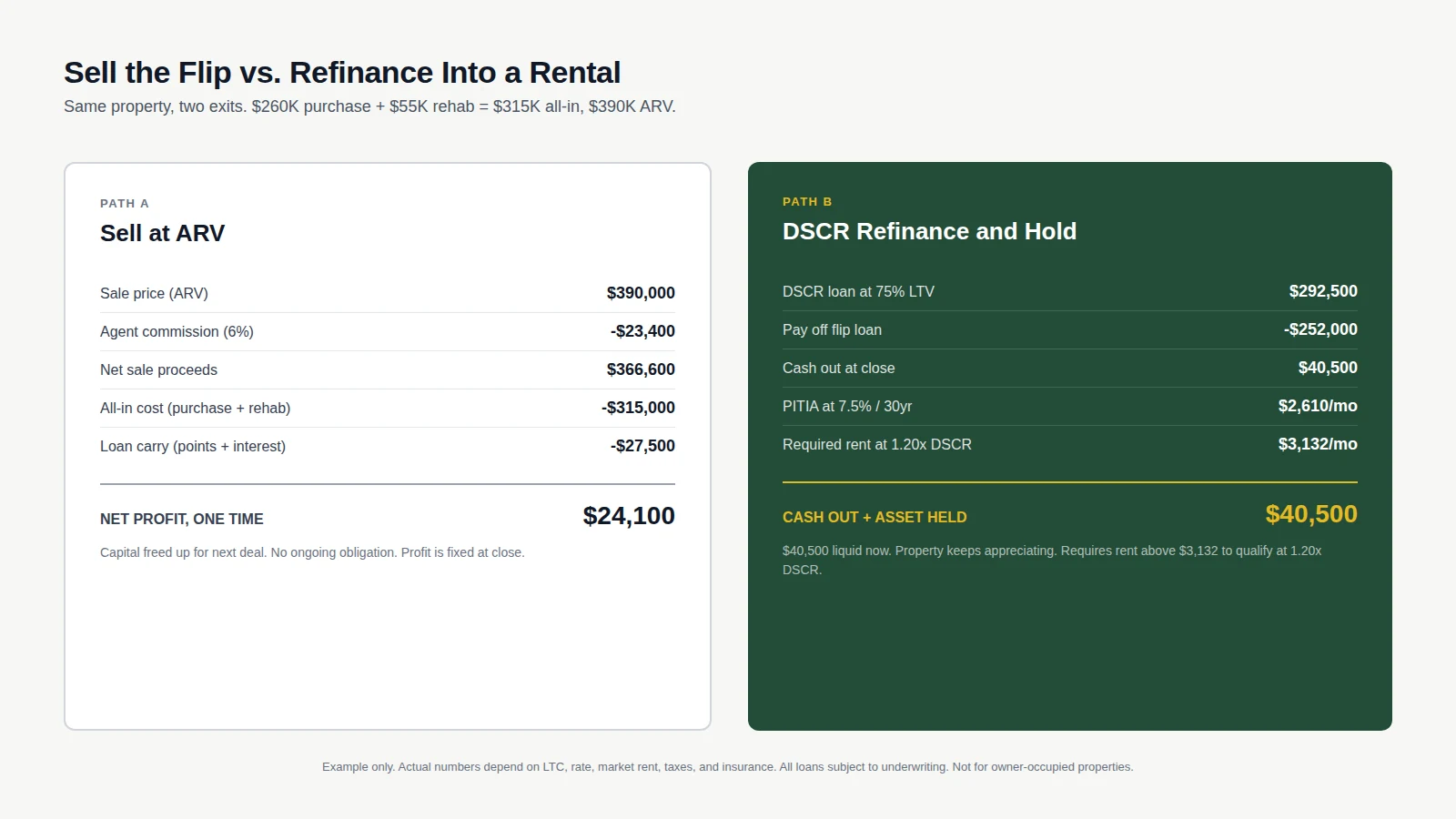
Total carry: approximately $27,500. Net profit from the sale works out to about $24,100 after all costs. That is the number that matters, not $75,000. It is also the number to compare to the refinance path before you decide anything.
The DSCR refinance path: what you actually net
A DSCR rental loan on a property you have already renovated is underwritten against the post-rehab appraised value, not your original purchase price. At $390,000 appraised value and a standard 75 percent LTV, the new loan is $292,500.
At the refi closing, two things happen. The flip loan gets paid off ($252,000 in this example), and the remaining proceeds come back to you. $292,500 minus $252,000 equals $40,500 cash at close. That is your immediate liquidity from the refinance path, compared to roughly $24,100 from the sale.
The difference is about $16,400 more cash from the refinance, and you still own the property. That property now generates rent, which produces cash flow on top of the cash-out proceeds, and it continues to appreciate if the market cooperates.
That calculation holds only if the property qualifies. A DSCR loan is approved on the rent, not your tax returns. The lender divides the gross monthly rent by the monthly PITIA payment, which is principal, interest, property taxes, insurance, and HOA where applicable. Most lenders want that ratio at 1.0 at minimum for approval, with better pricing above 1.15 or 1.20.
Want terms on a specific deal?Answer seven questions and get a decision in 72 hours.
Get FundingWhat the DSCR calculation looks like on this property
At a $292,500 loan balance, a 7.5 percent rate, and 30-year amortization, the monthly principal and interest payment is approximately $2,045. Add taxes and insurance of roughly $565 per month combined, and the PITIA is approximately $2,610. There is no HOA in this example.
For a 1.20 DSCR, the rent needs to be $2,610 times 1.20, which is $3,132 per month. For a 1.0 DSCR that barely qualifies, it needs to reach $2,610. These are the thresholds before you call anyone.
If the market rent for a renovated property in that neighborhood is $3,400, you qualify comfortably at 1.30 and land in a favorable rate tier. If market rent is $2,400, your DSCR is 0.92 and you cannot refinance using a DSCR product. The sell path becomes the only real exit.
Run your specific numbers in the DSCR calculator before you commit to either path. Plug in the post-rehab appraised value, the local market rent, estimated taxes and insurance, and the rate range you would expect. The output tells you whether the refinance option is viable.
How the rate you receive changes the rent you need
Rate is the variable most investors underestimate in this decision. A one-point swing in DSCR rate on a $292,500 loan moves the P&I payment by roughly $170 to $200 per month. That changes the required rent by $200 to $250 per month at 1.20 DSCR coverage.
On the same $390,000 property, here is how that math shifts across four rate scenarios, all with the same $2,900 per month rent assumption:
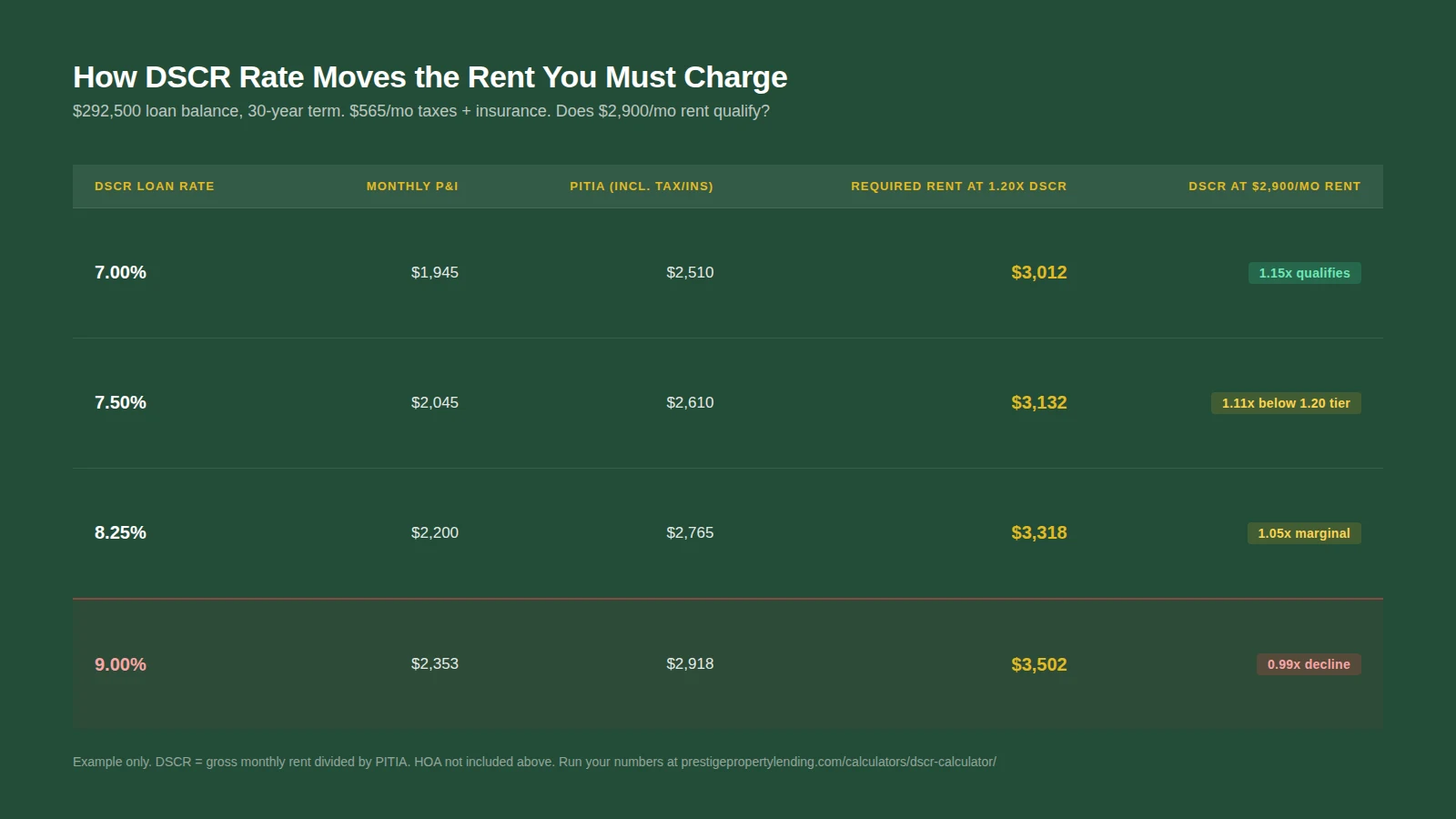
At 7.0 percent, the property needs $3,012 per month in rent to qualify at 1.20 DSCR. At 9.0 percent, it needs $3,502. If the market rent in your area is $3,100, a 7.0 percent quote works and a 9.0 percent quote does not. The rate you negotiate determines whether the refinance path is available at all, not just whether it is cheap.
This is one reason to get pre-approved on a DSCR refinance before the renovation wraps. You will know what rate range to expect, and you can make the exit decision with real numbers instead of assumptions.
Seasoning and timing: what affects the refinance window
DSCR lenders typically require the renovation to be fully complete and the property to be habitable or actively rented before they will underwrite a new loan. For a cash-out refinance, most lenders also want to see the property stabilized. Some will accept a signed lease agreement with no rental history. Others require three months of documented rent payments before they will proceed.
If you plan to refinance, get the property rented as soon as the renovation is done. A lease with a creditworthy tenant satisfies the income documentation requirement and can eliminate the three-month wait that applies to vacant files at some lenders.
Review the maturity term on your fix and flip loan early in the process. Most fix-flip loans are 12 months with extension options. If the renovation runs long and the exit decision gets pushed to month ten, you are making the sell-versus-refi call under time pressure instead of on the merits. That pressure almost always produces the wrong answer.
When the refinance is wrong for you
Not every flip should become a rental. The refinance does not make sense in several situations:
The rent does not support a 1.0 DSCR. If the property cannot service the loan on its own rent, you are funding a shortfall every month. That is a different investment thesis from what a DSCR loan is designed to finance. Do not refinance a flip into a rental at a negative DSCR to avoid recognizing a modest profit from a sale.
Your margin is thin. A $390,000 ARV on a $375,000 all-in does not leave enough spread for a 75 percent LTV refi to generate meaningful cash. After paying off the flip loan, you might net $5,000 to $10,000 at close. That capital may be more productive recycled into the next acquisition than locked into a 30-year hold.
You need capital velocity. Some investors run four to six projects per year and rely on recycling the same capital repeatedly. A refinance takes that equity off the table for as long as you hold the property. If your model depends on high-frequency flipping, holding may reduce your overall output more than the cash-out gain is worth.
The rental market is thin. If the property is in a market where vacancies run 10 percent or higher, the DSCR underwriting may apply a rental income haircut that lowers your qualifying income below the 1.0 threshold. A fast sale removes the ongoing exposure. Thirty years of carrying a hard-to-rent property is not a strategy.
You plan to occupy the property. Business-purpose DSCR loans are for investor-owned rental properties only. If you rehabbed a property you intend to live in, these loans do not apply. A consumer mortgage product covers that situation, and it is subject to a different regulatory framework entirely.
The honest summary: if the rent supports a 1.15 or better DSCR and you are not capital-constrained, the refinance path almost always delivers more cash at close than a sale. The numbers above show a $16,400 gap on a $390,000 property. That gap disappears quickly if the rent is thin, the rate comes in high, or the margin on the flip was narrow to begin with. Run the calculation before you decide, not after.
What to do next
Start the analysis on the fix and flip calculator to confirm your margin on the deal. Then carry the ARV figure into the DSCR calculator to see whether the rental income holds up at current rate levels. If both numbers work, call 917-842-9982 to discuss the refinance timeline, seasoning requirements, and what rate range to expect on your specific property.
For a closer look at the monthly costs that affect the sell path calculation, see the post on fix and flip holding costs.
Common questions
What DSCR do I need to refinance a flip into a rental?
Most DSCR lenders require a minimum of 1.0, meaning the rent equals or exceeds the full PITIA payment. Approval at exactly 1.0 is possible but prices at the highest rate tier. Pricing improves in steps at 1.10, 1.15, and 1.20 or above. If your DSCR is below 1.0, most lenders will not approve the loan regardless of the property’s equity position.
How long after finishing a flip can I do a DSCR refinance?
There is no universal seasoning rule for DSCR refinances the way there is for conventional loans, but most lenders require the renovation to be complete and the property to be habitable. Some lenders accept a signed lease with no rental history. Others require three months of documented rent payments. If speed matters, get the property rented immediately after completion and collect receipts from month one.
Do I need to show my income to qualify for a DSCR loan on a former flip?
No. DSCR loans are qualified on the property’s rental income, not on the borrower’s personal income or tax returns. The lender looks at the rent relative to the PITIA payment. Your employment status, W-2 income, and business profit-and-loss are not part of the underwriting file. This is why DSCR loans work well for investors who take significant write-offs on their tax returns.
What LTV can I get on a DSCR cash-out refinance after a flip?
Most DSCR lenders cap cash-out refinances at 75 percent of the post-rehab appraised value. Some lenders go to 80 percent for borrowers with strong DSCR coverage and established rental history. Rate-and-term refinances, where you are replacing the flip loan without taking cash out, can sometimes reach 80 percent LTV. The LTV cap drives the cash-out math, so confirm it with the lender before you commit to the refinance path.
What if I paid cash for the renovation instead of using a flip loan?
If there is no flip loan to pay off, the full DSCR refinance proceeds are cash-out to you. A cash buyer on the renovation who refinances at 75 percent LTV on a $390,000 property would receive $292,500 minus closing costs, with no payoff obligation. The DSCR qualification still applies, but the cash-out math is significantly better because you are not reducing proceeds to repay a flip loan. The trade-off is that you had all that capital tied up during the renovation rather than in circulation.
Ready to fund your next deal?
Approval within 72 hours. Close in 5 to 10 business days.
Get Funding Now