Fix and Flip Loan Requirements: What Lenders Actually Need Before They Say Yes
Fix and flip loan approval is mostly about the deal, not just your credit score. Lenders weight ARV, experience, scope of work, and liquidity in that order. Here is what each one means for your file.
Fix and flip loan approval comes down to the deal, not just your credit score. Lenders want an after-repair value that supports the math, a scope of work that matches the budget, a contractor who has done this before, and evidence that you have closed at least one transaction like this. If you are renovating your primary residence, this is not the right loan type and we cannot fund it. Business-purpose flip loans are for investors acquiring properties for sale or for conversion to income-producing rentals.
This post explains what flip lenders actually require, in the order they weight it, and what sends a file to decline even when the borrower looks fine on paper.
The short version: ARV sets the ceiling, everything else works inside it
A fix and flip loan is underwritten on three things in descending order: the property ARV, the experience of the borrower, and the borrower’s liquidity. Tax returns and W-2s are generally irrelevant. Your credit score matters, but it rarely drives the outcome on its own.
The total loan amount, purchase plus rehab, is capped at a percentage of the after-repair value. Most flip lenders work somewhere between 65 and 75 percent of ARV. An ARV of $350,000 at 70 percent means $245,000 in total exposure. If you are buying at $175,000 and need $80,000 in rehab, your total is $255,000, which is $10,000 over that cap. That deal does not fund as structured. The arithmetic is not flexible.
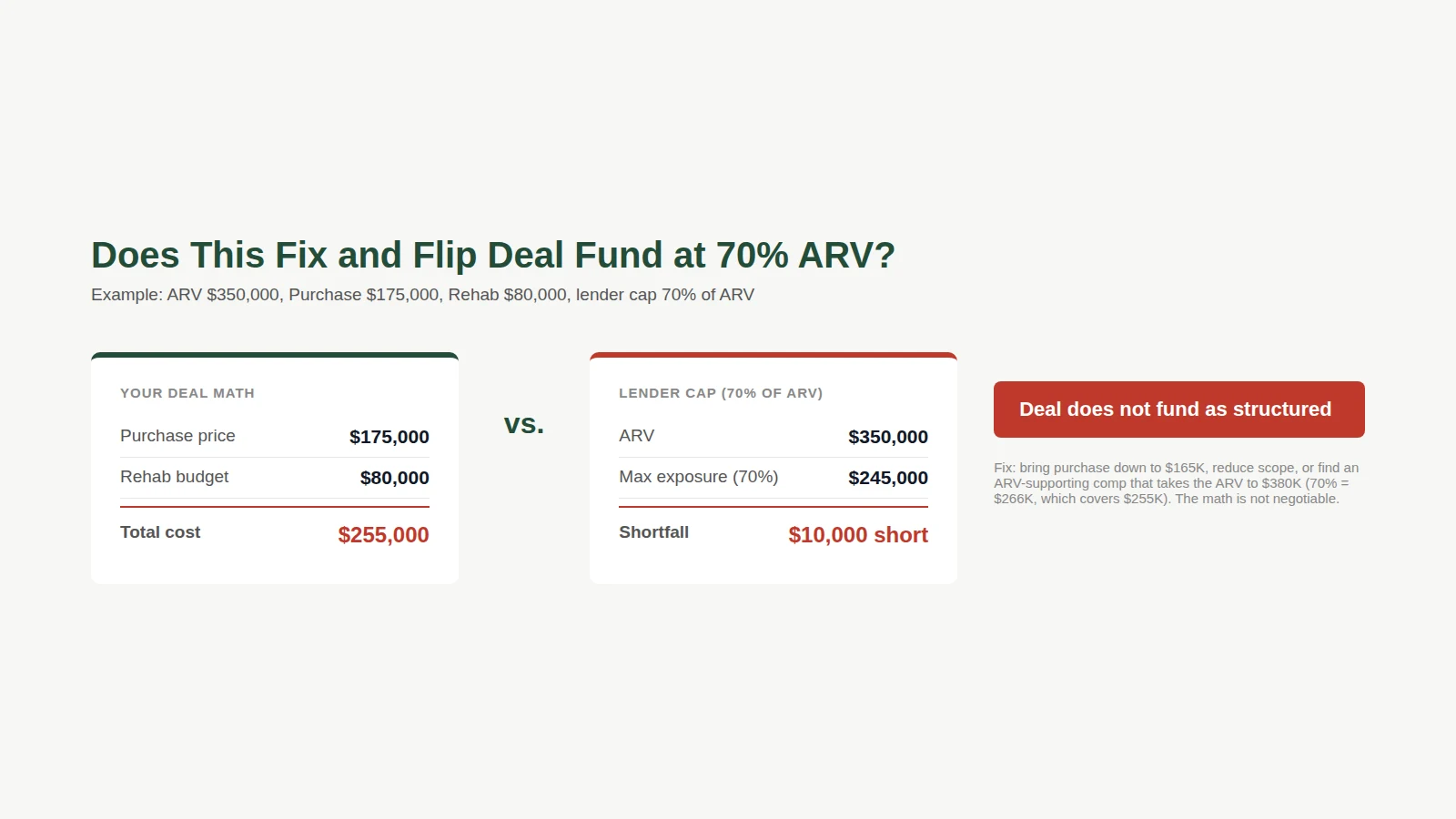
The fix and flip calculator runs this math before you go to a lender, including the ARV sensitivity. It is worth running before you make the offer, not after.
Experience: the requirement most first-time flippers underestimate
Most checklist posts on this topic mention credit score, down payment, and property condition. Experience is the one that actually moves the terms.
Flip lenders score experience by completed transactions, typically in the last 24 to 36 months. A borrower with zero flips gets a different loan than a borrower with three. The differences are real:
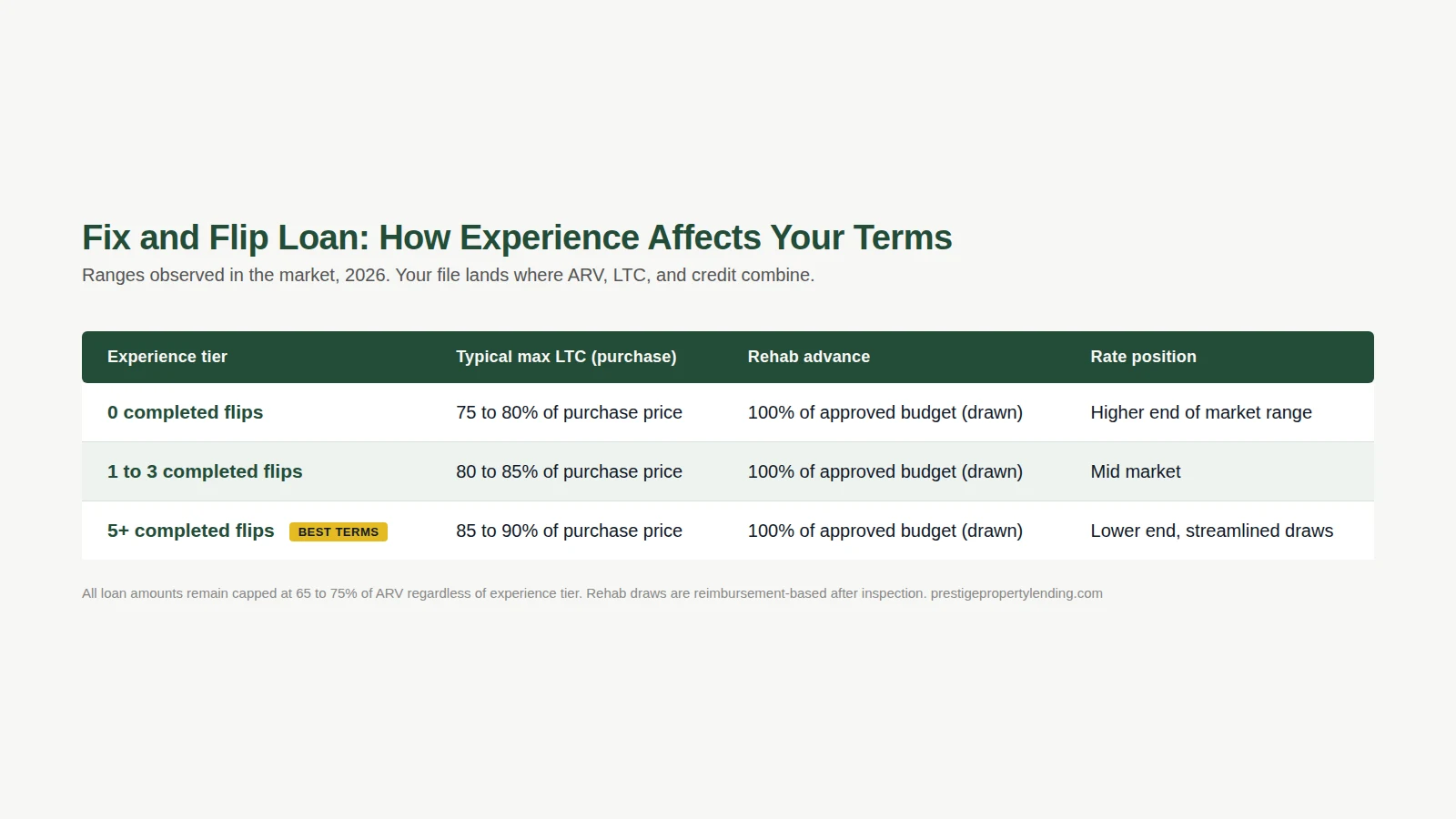
These are ranges observed in the market in 2026, not a promise. Your specific file will land where your ARV, LTC, and credit combine. A first-time borrower who brings strong reserves and a conservative scope can offset some of the experience gap. A first-time borrower who also wants maximum leverage generally cannot close.
You document experience with a list of completed transactions, settlement statements as evidence, and photos showing before and after condition. Some lenders will count experience gained as a partner or under a mentorship arrangement if you can document your specific role clearly.
Want terms on a specific deal?Answer seven questions and get a decision in 72 hours.
Get FundingThe property: ARV and what an appraiser will and will not support
The ARV appraisal is done subject to completion of the proposed scope. The appraiser picks comparable sales within a tight radius, typically 0.5 to 1 mile in dense markets, and makes adjustments for differences in size, age, condition, and features. They are not estimating what a remodeled kitchen is worth in abstract. They are matching your project to what actually sold nearby in similar condition.
The common mistake is planning an upgrade that has no comparable. If every home within a mile is three-bed, one-and-a-half-bath and you are adding a second full bath, the appraiser may add some value for that, but they cannot support a large number without a comp confirming buyers paid more for two baths in this specific market. The ARV appraisal post covers the comp selection process and the adjustment grid in detail.
Lenders also weigh the current condition of the property. A house needing a new roof, foundation work, or full systems replacement gets underwritten differently than a cosmetic rehab. Some lenders will not fund a gut rehabilitation for a first-time borrower. Others will, but only at lower leverage and with tighter draw controls.
Use the ARV calculator to stress-test your comps before the appraisal, so you are not surprised when the number comes back lower than your estimate.
The scope of work and contractor requirements
Almost every flip lender will ask for a line-item scope of work and a corresponding budget before they issue a term sheet. This is not a formality. The underwriter uses it to validate that your ARV is reachable given what you are actually doing, and to build the draw schedule.
What the scope needs to include:
- Every major system being touched (roof, HVAC, plumbing, electrical)
- Cosmetic work by category (flooring, kitchen, bathrooms, exterior)
- Cost per line item, not a single total labeled renovation
- A 10 to 15 percent contingency line, because scopes almost always grow
Contractor requirements vary by lender. Most want general liability insurance and, depending on the scope, a valid contractor license for the state where the work is being done. Some lenders will accept a self-managed project with multiple subs if you have the experience track record. A first-time borrower presenting a project with no GC and a vague scope is one of the faster ways to get a decline.
The rehab portion of the loan is disbursed in draws, not upfront. Work is typically completed first, then an inspector confirms it, then the draw is funded. You are advancing your own cash to pay subs and getting reimbursed. The float you need to carry between completion and reimbursement is real and it is not small. The draw schedule post walks through a full example of what that float looks like on a $95,000 rehab budget across six draws.
Credit score: a gate, not a dial
Most fix and flip lenders want a minimum credit score somewhere in the mid-600s to 680 range. Below that, the file is harder to place without compensating factors. Above 720, you are not getting meaningfully better terms than a 700 score in most cases.
What credit does in this underwrite: it determines whether the file gets approved, sometimes affects where you land in the rate pricing tier, and occasionally triggers a requirement for additional reserves. It does not substitute for ARV, experience, or a credible scope. A borrower with an 800 credit score and a deal that does not pencil at 70 percent of ARV is not getting a flip loan.
Liquidity: what you need to show and why
Flip lenders want to see that you can handle the deal slipping. Not the plan. The slip. That means enough in reserves to carry holding costs if the sale takes longer than projected, and a buffer to fund cost overruns without stopping work.
The floor lenders commonly look for is 10 percent of the total loan amount in liquid reserves after close. Some lenders want more for first-time borrowers or larger projects. Retirement accounts and illiquid equity in other properties typically do not count unless you can draw from them immediately without penalties or a multi-week wait.
The liquidity and reserves post covers what counts and what does not across all business-purpose loan types, including which account types pass the verification and which ones lenders routinely reject.
Where this loan is wrong for you
Fix and flip financing is the wrong tool in these situations:
- You are buying a property you intend to live in. Business-purpose lenders cannot fund owner-occupied primary residences. This is a compliance line, not a preference, and it applies regardless of how good the deal looks.
- You have never renovated a property and do not have a licensed, insured contractor managing the work. Some lenders will take first-time borrowers, but the terms, lower leverage and higher rate, often make the deal not work at the price you paid.
- Your ARV requires the highest comparable in the neighborhood to support it. If the whole project depends on one sale from eight months ago in better market conditions, an appraiser is unlikely to support that number today with no other matching comps.
- You need the rehab draws to fund the work before it starts. Draws are reimbursement-based. You advance the cash to your contractor, complete the work, pass the inspection, and then the draw is released. If you do not have the float to start the work, this loan structure does not solve that problem.
- Your exit timeline assumes a quick sale. Fix and flip terms run 6 to 12 months. Most lenders charge extension fees in the range of 1 to 2 percent of the loan balance when you go past the initial term. Budget for a 3 to 6 month sale process. Model the cost if it takes longer. On a $300,000 loan, a 1.5 percent extension fee is $4,500 per extension, on top of continued interest accrual.
What to do next
If your deal pencils at 70 percent of ARV or better, you have a scope of work ready, and you have at least some completed transactions to document, the fastest path is to organize your numbers before you call. Run the deal through the fix and flip calculator, confirm the ARV is supportable using the ARV calculator, then contact us at 917-842-9982. A term sheet on a fundable deal typically comes back within 72 hours.
If the ARV does not support the purchase price at the leverage you need, the problem is the deal structure, not the lender. Renegotiate the purchase price, reduce the scope, or pass on the deal. See the full program details at the fix and flip loans page.
Common questions
What credit score do you need for a fix and flip loan?
Most fix and flip lenders want a minimum in the mid-600s to 680 range. A score below 640 makes the file harder to place without strong compensating factors like low leverage or significant reserves. A 720-plus score helps but does not typically buy meaningfully better terms than a 700 score in this product category.
How much do you need down for a fix and flip loan?
The answer depends on the ARV math, not a fixed percentage. Most lenders will advance up to 70 to 85 percent of the total project cost, capped at 65 to 75 percent of the ARV. If your purchase price plus rehab budget is under that cap, the lender covers the full amount. If it exceeds the cap, you bring the difference. First-time borrowers typically face lower leverage limits, which means more cash in.
Do fix and flip lenders verify income?
No, not in the way a conventional lender does. There is no debt-to-income calculation on a business-purpose fix and flip loan. The underwrite is based on the property ARV, the deal structure, your experience, and your liquidity. Tax returns and W-2s are generally not required.
Can you get a fix and flip loan with no experience?
Some lenders will approve a first-time borrower, but the terms reflect the risk. Expect a lower maximum LTC, a rate at the higher end of the market range, and stronger liquidity requirements. Bringing a co-borrower or guarantor with experience can help. Having a licensed GC managing the scope also reduces the risk in the lender’s view.
What happens if the project costs more than the budget?
The draw schedule is based on the approved budget. If costs run over, you fund the overage out of pocket, or you ask the lender for a modification, which typically requires a new scope, an updated appraisal, and time. The best protection is building a 10 to 15 percent contingency into the original budget and treating that as real money, not padding.
Ready to fund your next deal?
Approval within 72 hours. Close in 5 to 10 business days.
Get Funding Now