Liquidity and Reserves: How Much Cash You Must Show Before a Business-Purpose Loan Closes
Post-close liquidity is not your net worth. Here is exactly how much cash each loan type requires, what counts as liquid, and what trips first-time investors at the closing table.

Business-purpose lenders require post-close liquidity: cash and liquid assets remaining in your accounts after your down payment, closing costs, and any funded reserves have cleared. This is not your net worth and it is not your gross savings. It is specifically what you can convert to cash within roughly 30 days. On a standard DSCR rental loan, expect to show 3 to 6 months of the subject property’s principal, interest, taxes, and insurance left over after closing. That number goes up if your LTV is high, your experience is limited, or you own other financed properties.
This post covers business-purpose investment financing only. If you are buying a home to live in, these requirements do not apply to your loan type.
What counts as liquid and what does not
The word “liquid” has a precise meaning in underwriting, and it is stricter than most first-time investors expect.
Counts as liquid:
- Cash in checking and savings accounts
- Money market accounts
- Publicly traded stocks, ETFs, and mutual funds, usually credited at 70 percent of current market value because securities can fall between statement date and close
- Certificates of deposit that are not in a lock-up period
Does not count:
- Retirement accounts (401k, IRA, SEP-IRA). Most business-purpose programs exclude them entirely. Accessing those funds requires a taxable distribution, a 10 percent early withdrawal penalty if you are under 59.5, and processing time that does not fit a fast close. Some programs will credit them at a deep haircut if you absolutely must use them, but do not plan around it.
- Equity in real estate you own. Equity is not cash. Turning equity into cash requires a sale or a refinance, neither of which you can complete in 30 days without significant cost.
- Funds already committed to another deal. If you have $60,000 set aside as a contingency reserve on an active construction loan, that $60,000 is spoken for. It does not count twice.
- Proceeds you expect but have not received. A pending sale that has not closed is not yet liquid. A private note receivable is not liquid. Expected rental income is not liquid.
Reserve requirements by loan type
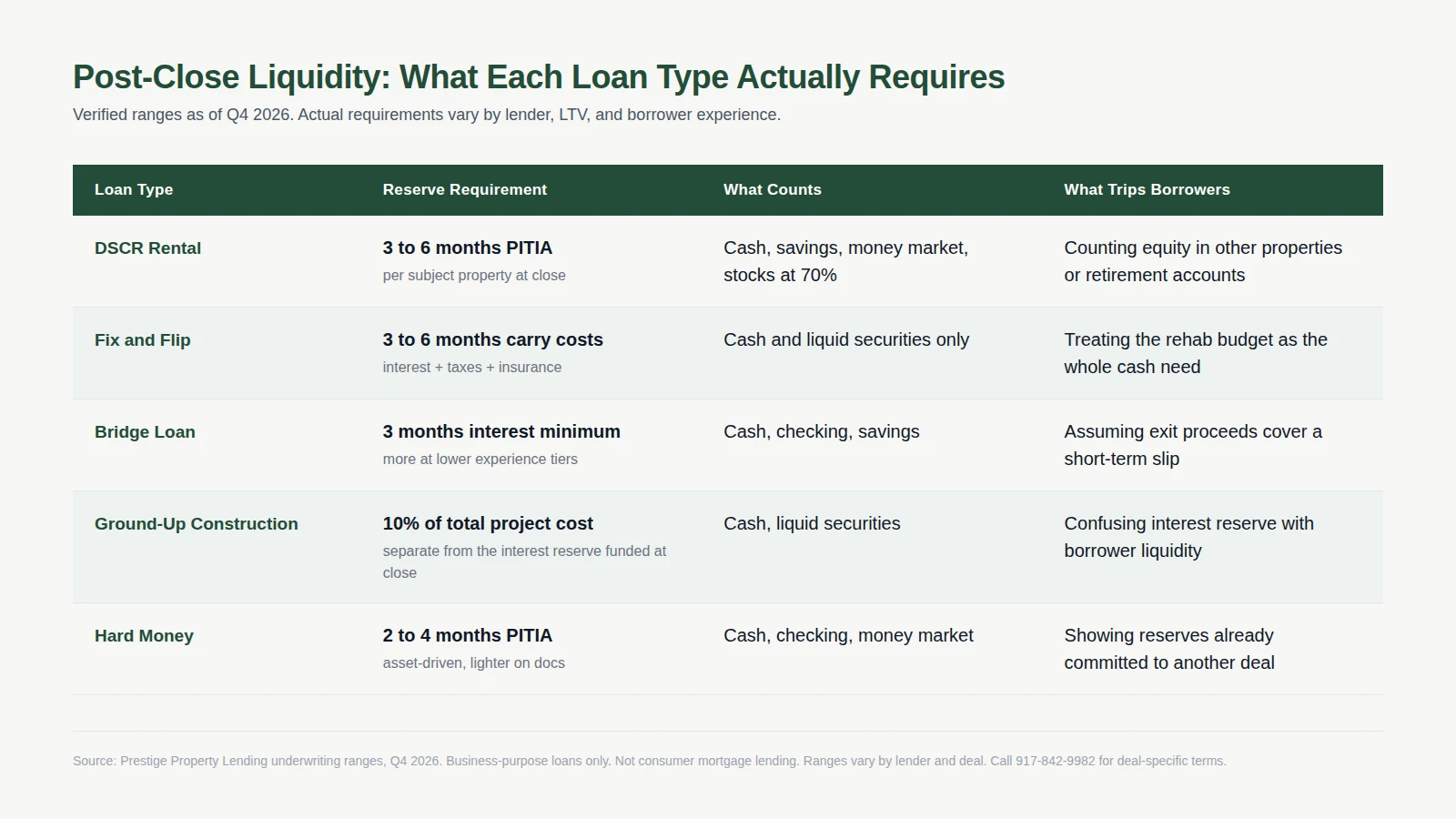
Reserve requirements are not uniform across loan types, because the risk profile of each program is different. A DSCR rental loan is held long term and priced on property income. A bridge loan is held 6 to 18 months and priced on exit certainty. The reserve requirement reflects which risk the lender is most exposed to.
| Loan Type | Typical Reserve Range | Measured Against |
|---|---|---|
| DSCR rental | 3 to 6 months | Subject property PITIA |
| Fix and flip (hard money) | 3 to 6 months | Interest carry plus taxes and insurance |
| Bridge loan | 3 months minimum | Monthly interest on the bridge balance |
| Ground-up construction | 10 percent of total project cost | Hard cost budget, separate from funded interest reserve |
| Hard money | 2 to 4 months | PITIA or monthly interest payment |
These are ranges, not floors. A first-time borrower at 80 percent LTV on a DSCR loan will face scrutiny that an experienced investor at 65 percent LTV will not. The lender’s interest is in knowing that if the property goes vacant for two or three months, you have enough to keep the loan current without becoming a workout file.
Want terms on a specific deal?Answer seven questions and get a decision in 72 hours.
Get FundingA worked example on a DSCR rental purchase
You are buying a single-family rental for $350,000. You are putting 25 percent down. Here is what the cash calculation actually looks like:
| Cash Out at Close | Amount |
|---|---|
| Down payment (25%) | $87,500 |
| Estimated closing costs and points | $7,200 |
| Post-close reserves at 6 months PITIA ($2,550/mo) | $15,300 |
| Total cash needed | $110,000 |
That example assumes a $262,500 loan at approximately 7.5 percent, with property tax and insurance running another $350 per month. The monthly PITIA works out to roughly $2,550. At 6 months, the reserve requirement is $15,300 that must remain in your account after closing. You cannot use it as the down payment and then show it again as reserves. Underwriters see the full 60-day bank statement history. Funds moved in the final week before closing raise questions.
Run the numbers on your own deal using the DSCR calculator to get the payment estimate before you build the reserve calculation.
What moves the reserve number up or down
LTV: A borrower at 65 percent LTV carries less risk than one at 80 percent. Some programs reward lower LTV with a lower reserve requirement, from six months down to three. Check what tier your deal falls into before you commit to a purchase price.
Investor experience: First-time borrowers are a known risk factor. Some programs require additional reserves from borrowers on their first one to three business-purpose loans. If you are new, account for this in your pre-approval conversation. The requirement is not a penalty, it is a proxy for the probability that a new investor manages a cash shortfall without defaulting.
Portfolio size: Once you own multiple financed properties, some lenders apply reserve requirements per property, not just per new loan. If you own four rentals and each requires 3 months of PITIA in reserves, your effective liquidity requirement across the portfolio is much larger than the minimum on any single deal. This is the most common reason experienced investors run into liquidity surprises when they try to scale quickly.
Asset type: Short-term rentals, mixed-use, and commercial properties often carry higher reserve requirements than long-term single-family rentals, because their income is less predictable. A STR with seasonal vacancy has more liquidity risk than a 12-month leased single-family home.
The requirement that trips first-time borrowers most often
The pattern we see repeatedly: a borrower accounts for the down payment and closing costs, gets the deal under contract, then discovers they do not have enough liquid assets left over to satisfy the reserve requirement. They have the net worth, but it is in a retirement account or tied up as equity in their primary residence.
The fix is to clarify the reserve requirement during pre-approval, before you have a purchase contract. Ask your loan contact specifically: “What is the post-close liquidity requirement, what assets count toward it, and does the requirement change across my existing portfolio?” Those three questions answered up front remove the most common source of last-minute deal failures.

For program details on each loan type, see DSCR rental loans, hard money loans, and the full loan programs overview. For a deal-specific liquidity check, call 917-842-9982.
When this loan is the wrong fit
Post-close liquidity requirements are not negotiable away. If you cannot meet them, the loan will not close at the planned LTV. The honest alternatives are:
- A larger down payment to lower the LTV, which in some programs reduces the reserve requirement at the same time
- A co-borrower with sufficient liquid assets
- Waiting to close until you have accumulated the required reserves, which avoids the rushed conversion of retirement assets or the bridge financing a short liquidity position sometimes prompts
- A portfolio loan structure where the lender underwrites the full portfolio and the per-property reserve math is different
Trying to close without adequate reserves and relying on a fix after submission costs time and usually money. Extensions on bridge loans run $1,500 to $3,000 per month in most markets. A delayed DSCR close can lose rate locks that cost several hundred basis points to replace.
Use the hard money loan calculator to model carry costs on shorter-term deals, and review what lenders check before issuing a term sheet for the full pre-approval picture.
Common questions
Can I use retirement account funds to meet the reserve requirement?
Most business-purpose lenders do not accept retirement accounts (401k, IRA, SEP-IRA) as liquid reserves at all, because accessing those funds requires a taxable distribution and a penalty. Some programs will credit them at 60 percent of market value with a haircut for the assumed tax hit, but you should not count them in your plan. Cash, savings, money market accounts, and publicly traded securities are the safe choices.
What is the difference between funded reserves and post-close liquidity?
Funded reserves are money the lender builds into the loan structure, typically on a construction loan as an interest reserve, to cover scheduled payments. Post-close liquidity is your own cash that stays in your account after closing. They serve different purposes. A lender can fund an interest reserve into a construction loan and still require you to demonstrate separate post-close liquidity as a risk buffer.
Does equity in other properties count toward the reserve requirement?
No. Equity is an asset but it is not liquid. You cannot write a check against equity without selling the property or completing a cash-out refinance, both of which take weeks and involve costs. Lenders want to see funds you can deploy within 30 days. Equity in a paid-off property may support the overall credit profile, but it does not satisfy a reserve requirement on its own.
How does the reserve requirement change when I own multiple investment properties?
It gets larger. Many DSCR and conventional investment lenders apply reserves on a per-property basis, meaning each property with a mortgage needs its own liquidity cushion. If you own four rentals and are closing a fifth, some lenders will ask for combined reserves across all five. This is one of the main reasons experienced investors keep more cash on hand than they think they need.
Can a co-borrower or guarantor satisfy the liquidity requirement on my behalf?
Yes, in most programs. A co-borrower who can document sufficient liquid assets can supplement a primary borrower who is short. The co-borrower’s assets are treated the same as the primary borrower’s. A guarantor who is not on the loan itself generally cannot substitute their liquidity for the borrower’s reserve requirement, so the structure matters. Discuss the specific program with your loan contact at 917-842-9982 before assuming a co-borrower arrangement will solve a short liquidity position.
Does the reserve requirement apply only to the subject property or all properties I own?
It depends on the lender and the loan program. On hard money and bridge programs, the reserve check is usually focused on the subject property only. On DSCR and portfolio loan programs, lenders frequently require reserves on every financed property in the portfolio. The more conventional the loan structure, the more likely it is to look at the full portfolio. Ask for the exact calculation during the pre-approval stage, not after you have a property under contract.
Ready to fund your next deal?
Approval within 72 hours. Close in 5 to 10 business days.
Get Funding Now