Delayed Financing for Real Estate Investors: How to Recycle Capital After an All-Cash Purchase
Delayed financing lets you buy a property with cash and pull that capital back out through a DSCR cash-out refinance, often within weeks of closing. Here is how the math works, what the lender checks, and the three situations where it fails.
Delayed financing lets you buy a property with cash and pull that capital back out through a cash-out refinance, typically within weeks of closing, before the standard seasoning clock that applies to conventional loans. This post covers the investor use case: the buyer who closed at auction, the BRRRR investor who just acquired a rental, the operator who needed to move fast and paid cash to win the deal. It is not written for homebuyers using cash to compete on a primary residence purchase. We do not fund owner-occupied primary residences.
What delayed financing actually means on an investment property
On a conventional loan, lenders typically require six to twelve months of ownership before they will process a cash-out refinance. The Fannie Mae delayed financing exception shortens that window for buyers who used all-cash funds, under a specific set of documentation requirements.
Business-purpose lending on investment properties operates under different rules. DSCR loans, bridge loans, and most private lending programs are not subject to Fannie Mae guidelines. Many business-purpose lenders apply no seasoning requirement because the underwriting is based on the property’s income and value, not your personal tax returns or how long you have owned the asset. In practice, that means you may be able to close a DSCR cash-out refi on a rental property within weeks of the original cash purchase, provided the property qualifies on its own merits.
The two gates that determine whether you qualify are the appraisal and the DSCR. Not the calendar. This is the distinction that separates business-purpose delayed financing from the consumer version.
How the math works: a worked example
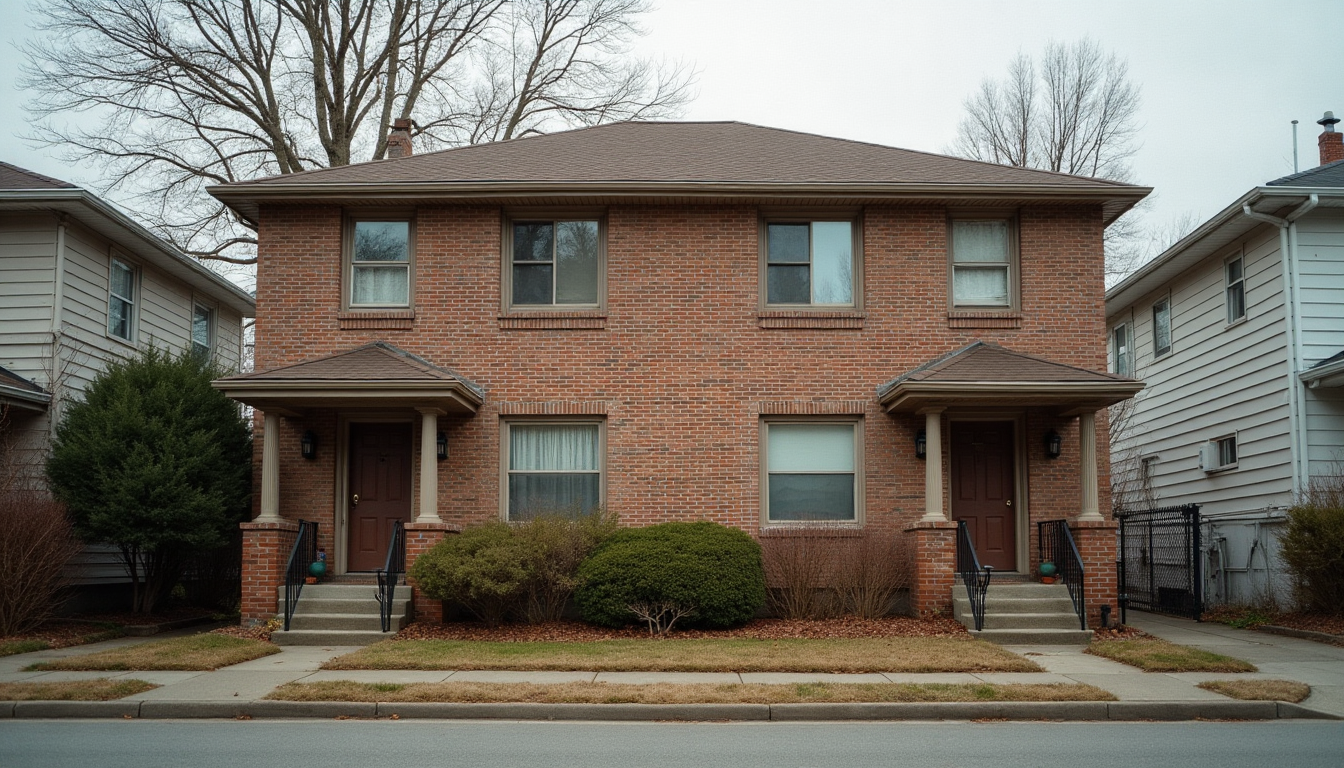
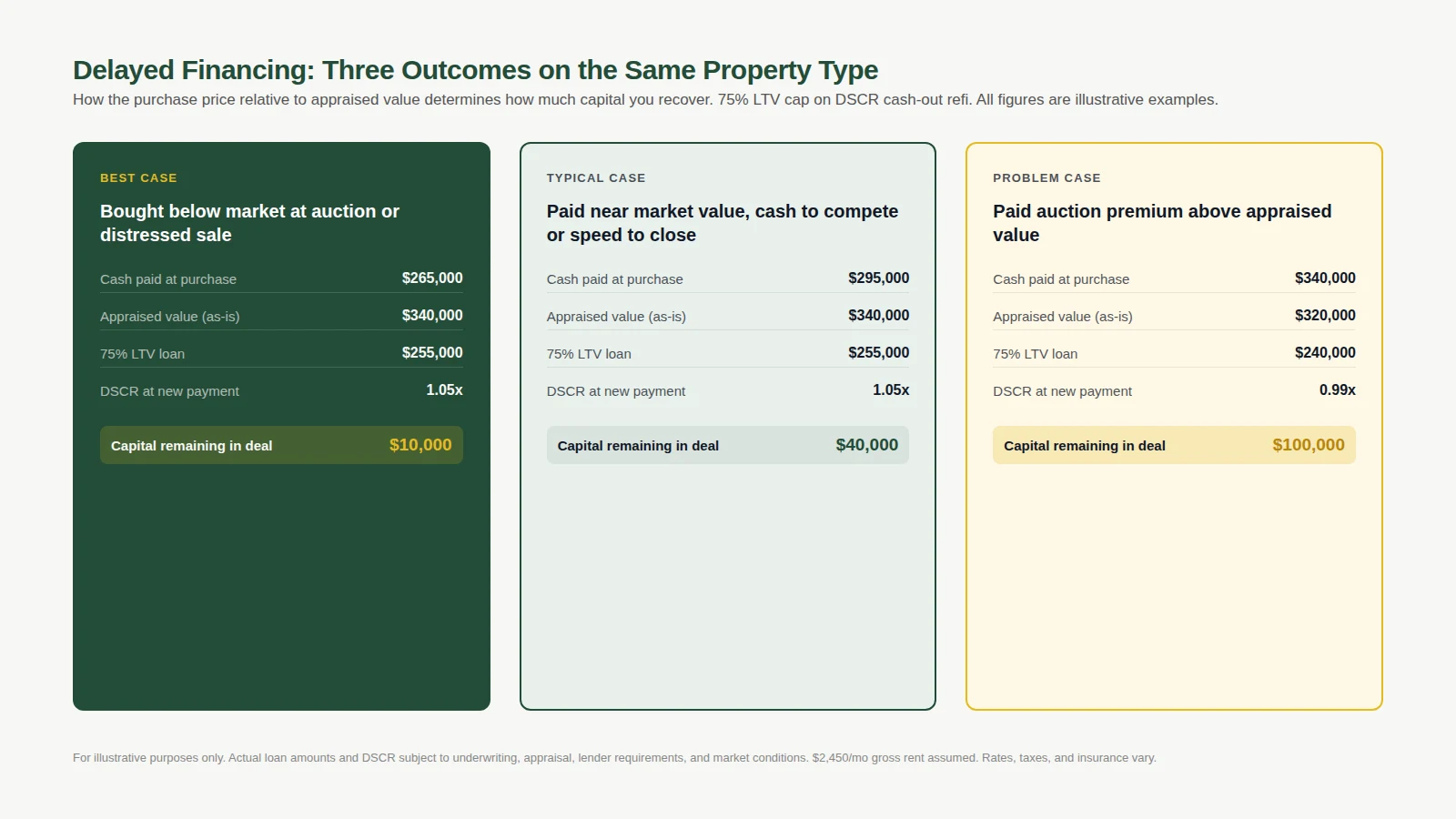
You buy a two-unit property at a foreclosure auction for $295,000 in cash. Both units are occupied. Gross rent is $1,300 from unit one and $1,150 from unit two, totaling $2,450 per month. After a clean title transfer, you order a DSCR appraisal and the property comes back at $340,000 on its current as-is condition.
On a DSCR cash-out refi at 75% LTV, your loan is $255,000. Using an example rate of 7.875% over 30 years, the principal and interest payment is approximately $1,848 per month. Add estimated taxes and insurance of $520 per month and your PITIA is around $2,368. Run the DSCR: $2,450 divided by $2,368 equals 1.03.
At 1.03 you qualify at most lenders, but you are sitting just above the floor. Pricing will not be the best tier. If you want to reach the 1.20 band where rates improve, you need higher rent, a lower loan balance, or a lower rate environment. In this example, $40,000 of your own capital remains in the deal after the refi, against $255,000 that is now free to deploy elsewhere. For most investors running multiple deals, that trade is worth a pricing concession.
Use the DSCR calculator to run your own property before committing to a purchase price.
Want terms on a specific deal?Answer seven questions and get a decision in 72 hours.
Get FundingWhat the lender checks before the cash-out closes
The appraisal is the first gate. If you paid $295,000 for a property that appraises at $280,000, your 75% LTV cap is $210,000. You recover less than you planned. A distressed property that needs significant work before it reaches its full value is not a delayed financing candidate yet. It needs stabilization first, which puts it in fix-and-flip or bridge loan territory. See the bridge loan program for that scenario.
Title is the second gate. A cash-out refi on an investment property requires clean title in your name or your entity’s name. Auction purchases sometimes carry outstanding mechanic’s liens, tax liens, or clouded chains of title that need clearing before a lender will fund. Order a preliminary title report as soon as possible after the purchase and before you build any refi timeline assumptions around it.
DSCR is the third gate, and the one that surprises first-time delayed financing borrowers. The income used to qualify has to be documentable. A vacant unit, a property you plan to occupy temporarily, or an Airbnb setup where the income is seasonal and not guaranteed by signed leases creates documentation complications. Some lenders use market rent from the appraisal’s comparable rental section for vacant units. Others require a signed lease. Know which approach your lender uses before you apply.
Seasoning requirements, where lenders apply their own minimums beyond program rules, are the fourth gate. Even on a business-purpose DSCR program with no official seasoning requirement, some lenders set their own 30, 60, or 90-day internal policy. Ask upfront. This is the question that often does not come up until a borrower is already under contract on their next deal expecting the refi proceeds to fund it.
The BRRRR connection

Delayed financing on a stabilized rental and the BRRRR method on a value-add property are the same capital recycling strategy applied at different stages of improvement. In a classic BRRRR, you buy distressed, complete a rehab, place tenants, then refinance to pull your capital back out. Delayed financing is BRRRR with the rehab removed: you bought a property already at or near its stabilized value, so you can go straight to the refinance step.
The same DSCR underwriting governs both. The same LTV caps apply. The practical difference is that a value-add BRRRR requires time to complete the work, stabilize occupancy, and in some cases wait through a seasoning period. A delayed financing refi on a move-in-ready rental can close faster because the appraisal reflects the property’s current state, not a future value subject to renovation completion.
For the full picture on value-add refinancing and where the BRRRR method most commonly fails, see what the BRRRR method is and where it breaks. The refinance step is where most BRRRR deals stall, and the DSCR math at the new payment is the most common reason.
When delayed financing is the wrong tool
Three situations where this does not work the way investors plan:
The auction premium problem. At a competitive foreclosure auction, you may pay $340,000 for a property that appraises at $320,000 on its own merits after you take ownership. You paid above what the market will independently confirm. Your 75% LTV cap is now $240,000, not $255,000, and if the DSCR barely clears at the lower number, you may find yourself short on the capital you expected to recycle. Run the appraisal scenario conservatively before you bid. The number that matters is not what you think the property is worth. It is what a licensed appraiser will put in a signed report.
The vacancy problem. You closed on a triplex and two units are occupied, one is vacant. Your lender counts only signed leases. Your qualifying income is two-thirds of the total rent you expected. The DSCR at that income level does not support the full loan you need. You wait until the third unit is leased, which may take 30 to 90 days depending on the market. If you were counting on the refi proceeds to fund your next purchase, that delay has a real carry cost.
The rate environment problem. You paid cash at a time when rates were elevated, expecting to refi once rates fell. If rates remain high, the payment on the refi loan may leave thin or negative cash flow after debt service. Delayed financing is a capital recycling tool, not a yield improvement tool. The decision to refi should be based on what you will do with the returned capital and whether the return on that deployment exceeds the cost of carrying debt on the current property. If the answer is not clearly yes, leaving cash in the deal and holding free and clear is often the better outcome.
Who this loan is wrong for
This financing structure is for investment properties held for business purposes. If the property you bought with cash is your primary residence, the Fannie Mae delayed financing exception exists for that transaction, but it is processed as a conventional loan through a residential lender. We do not fund that loan.
It is also not available if your original purchase included seller financing, a gift of equity, borrowed funds from a private party, or any arrangement where the acquisition was not a true arms-length all-cash transaction. Lenders require the source of purchase funds to be fully documented and to come from your own accounts. Anything that looks like borrowed equity disguised as cash at closing disqualifies the delayed financing path entirely.
See the cash-out refinance program page for full eligibility requirements. To discuss a specific deal, call 917-842-9982.
Common questions
How soon after an all-cash purchase can I do a delayed financing refi?
On a business-purpose DSCR loan, the answer depends on the lender, not a universal rule. Some lenders have no minimum ownership period. Others require 30 to 90 days. The more common constraint is the appraisal, not the calendar: the appraisal has to be ordered, completed, and reviewed, which typically takes 2 to 4 weeks. A realistic timeline from cash close to funded refi is 6 to 10 weeks.
Can I do delayed financing on a property I bought at auction?
Yes, if the auction purchase closed as a true all-cash transaction and title transferred cleanly. The key documentation is the HUD-1 or closing disclosure showing the full purchase price and no seller financing. Auction properties sometimes carry outstanding liens that need clearing before a refi can close. Order a title search immediately after winning the auction and before you plan the refi timeline.
Is the loan amount capped at what I paid, or what the property appraises for?
On a business-purpose cash-out refi, the loan is capped at the LTV limit applied to the appraised value, not the purchase price. If you paid $295,000 and the property appraises at $340,000, your 75% cap is $255,000. If you paid $340,000 and it appraises at $320,000, your cap is $240,000. The appraisal is the binding number.
What happens to my DSCR if one unit is vacant at refi time?
Lenders handle vacant units differently. Some use market rent from the comparable rental section of the appraisal. Others count only signed leases. If your lender requires signed leases and a unit is vacant, that unit contributes zero to your DSCR. At half the expected gross rent, most properties will not qualify for a full cash-out. Confirm the lender’s vacancy treatment before you apply, not after.
Is delayed financing the same as a cash-out refinance?
Mechanically, yes. The term describes the timing, not a different loan product. You are doing a cash-out refinance on a property you own free and clear because you paid cash at purchase. The loan product is a standard DSCR cash-out refi. What makes it a specific conversation with a lender is the absence of a long seasoning period and the documentation showing the original all-cash acquisition.
What documents do I need to show the all-cash purchase?
The standard package is the closing disclosure or HUD-1 from the original purchase, bank statements showing funds were wired from your account, the deed or vesting document, and a current title report. Some lenders also require a written explanation of the source of funds if they did not come from a single identifiable account. A missing closing disclosure is the most common delay on this type of refi.
Ready to fund your next deal?
Approval within 72 hours. Close in 5 to 10 business days.
Get Funding Now