Loan-to-Cost vs Loan-to-Value: How Lenders Use Both Numbers on the Same Deal
LTC (loan-to-cost) measures your loan against the total cost to complete the project: purchase price plus rehab or construction budget. LTV (loan-to-value) measures your loan against the property’s appraised value. On a fix and flip that means the after-repair value. Most business-purpose lenders cap both ratios simultaneously. You receive the lower of what each cap […]

LTC (loan-to-cost) measures your loan against the total cost to complete the project: purchase price plus rehab or construction budget. LTV (loan-to-value) measures your loan against the property’s appraised value. On a fix and flip that means the after-repair value. Most business-purpose lenders cap both ratios simultaneously. You receive the lower of what each cap permits, not the higher. Which ratio actually limits your loan depends on the structure of the deal.
If you are buying or refinancing the home you live in, this financing is not for you. Fix-and-flip loans, bridge loans and hard money are business-purpose investment products only. That distinction is not a technicality; it determines what consumer protections apply and why these loans can close in days rather than months.
What LTC actually measures
Loan-to-cost compares the loan to the cost of getting the project to completion. The formula is straightforward:
LTC = Loan / (Purchase Price + Rehab Budget)
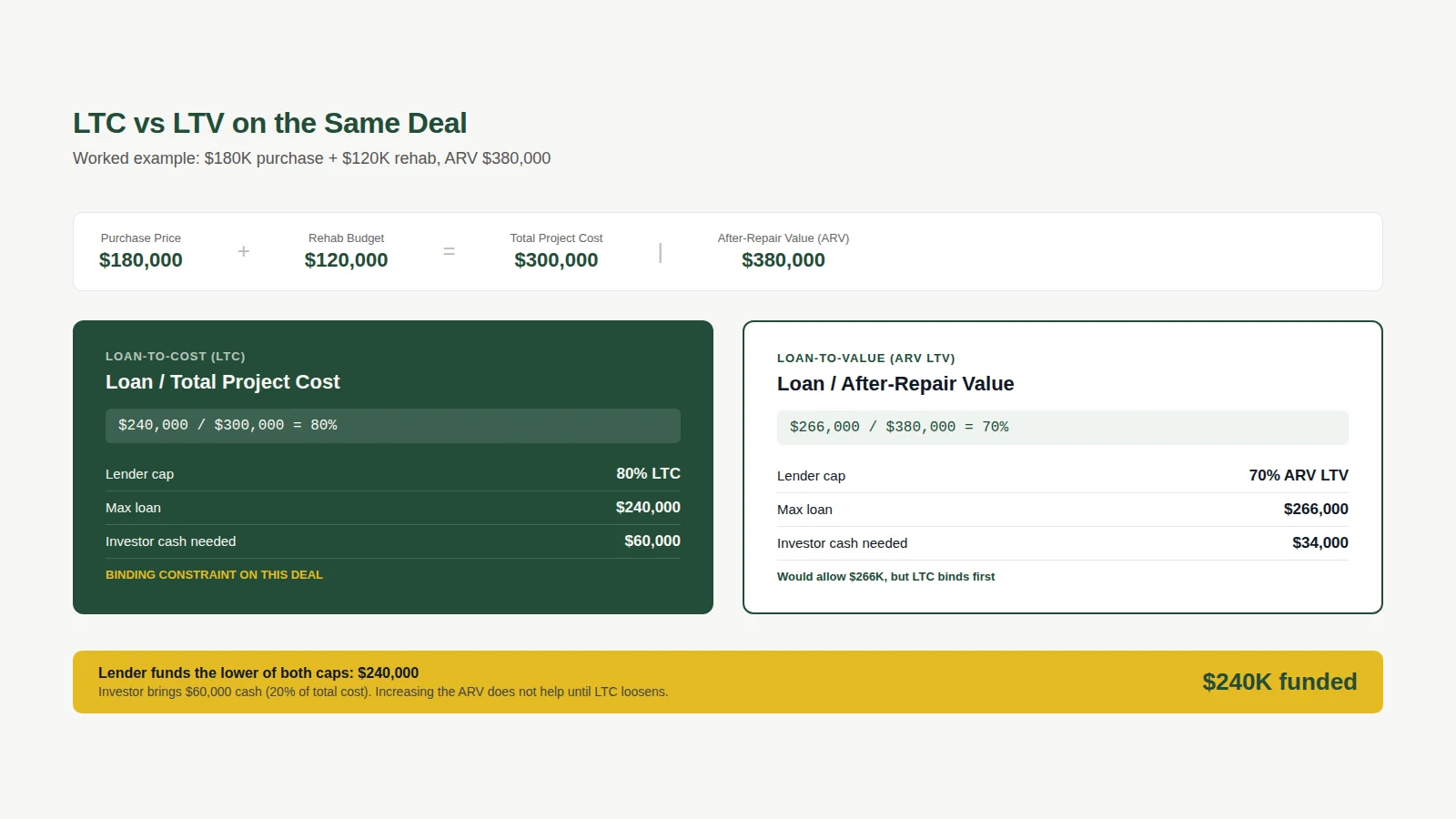
Say you buy a property for $180,000 and budget $120,000 for the rehab. Total project cost is $300,000. A lender offering 80% LTC will fund up to $240,000. You bring the remaining $60,000 to close.
The reason lenders use this ratio is that it measures cost-side exposure. If you under-budget the rehab and run out of money at 75% complete, the lender’s position is measured against what the work costs to finish, not what the finished property might sell for in an optimistic market. LTC is the conservative baseline that keeps the lender whole even if the ARV estimate turns out to be aggressive.
Typical LTC ranges on fix-and-flip loans run 80% to 90%, depending on your experience tier and the quality of your scope of work. A borrower with two completed flips rarely sees 90% LTC. Five documented, closed flips gets you closer to it.
What ARV LTV measures
ARV LTV compares the loan to the after-repair value, which is the appraised value of the property once all work is complete. The lender orders a subject-to-completion appraisal near the start of the process to set this number.
ARV LTV = Loan / After-Repair Value
On the same deal, if the after-repair value appraises at $380,000 and the lender caps at 70% ARV LTV, the maximum loan is $266,000. That is $26,000 more than the LTC cap allows on the same deal.
The ARV LTV cap tells the lender how much cushion exists between the loan amount and what they could recover in a foreclosure sale of the finished property. A 70% ARV LTV cap means the property would need to drop 30% below its finished appraised value before the lender is upside down. That exit-risk floor is what this ratio protects.
On a heavy value-add with speculative ARV assumptions, the lender will be skeptical. On a cosmetic flip where the ARV is supported by multiple recent, nearby sales in the same bedroom-bath configuration, the lender has far more confidence in the ceiling, and ARV LTV is easier to satisfy.
Want terms on a specific deal?Answer seven questions and get a decision in 72 hours.
Get FundingWhich ratio actually limits your loan
Both caps apply at once. You receive the smaller of what each allows. On the worked example above, LTC produces the lower number so that is the binding constraint. Flip the deal structure and ARV LTV can take over.
A cosmetic flip: buy for $320,000, spend $20,000 on paint and fixtures, ARV of $355,000.
- 80% LTC on $340,000 total cost = $272,000 max loan
- 70% ARV LTV on $355,000 = $248,500 max loan
- Binding constraint: ARV LTV at $248,500
The ARV is not far enough above cost to give the 70% cap room. This is the deal structure that catches investors who focus on the cost side and assume the ARV will handle itself.
| Deal type | Ratio that typically binds | Why |
|---|---|---|
| Heavy rehab, strong ARV upside | LTC | High cost relative to loan cap |
| Cosmetic flip, thin ARV spread | ARV LTV | Finished value not far above cost |
| Ground-up construction | LTC almost always | No finished value exists yet; ARV is subject-to-completion |
| Bridge loan on stabilized property | As-is LTV | No rehab planned; cost is not the relevant metric |
| BRRRR refinance exit | LTV against appraised value | Construction is done; project cost is no longer what the lender measures |
How to improve a deal when LTC binds
If LTC is limiting your loan, you have four levers.
Bring more cash. The most direct option. If the lender funds 80% of $300,000, you bring the other $60,000. Raising your equity contribution does not change the ratio the lender uses, but it closes the gap between what the loan covers and what the project costs.
Tighten the rehab budget. A bloated contingency line inflates your project cost and shrinks the LTC headroom. A detailed, line-item scope of work reviewed by the lender’s draw inspector can support a lower stated budget when the scope is genuinely tighter. Do not cut real work from the scope to game the ratio: the draw inspector will catch it, and mid-project scope additions cost more in time and fees than the extra cash at close would have.
Negotiate a higher LTC tier. Experienced investors with a clean file of completed deals can sometimes access 85% to 90% LTC. That access comes from documented track record, not from asking. Five completed and sold flips with appraisals and HUD-1s in your file changes what you can negotiate. See how our fix-and-flip loan program tiers by experience level.
Reconsider the acquisition. If the purchase price combined with the rehab scope produces an LTC that leaves you short on cash, the acquisition math may be the problem. A lower purchase price or a reduced scope is sometimes the right move before you think about financing.
How to improve a deal when ARV LTV binds
ARV LTV problems usually trace back to one of two places: the appraisal came in lower than the investor expected, or the deal has too thin a spread between cost and finished value.
Strengthen your comparables before the appraisal. The subject-to-completion appraiser selects comparables from nearby sales. You can influence those comps by providing a list of recent sales from the same street, same subdivision, or same bedroom and bathroom configuration that support your ARV target. Present this before the appraisal is ordered. After the appraisal is complete, your ability to influence the number is limited to a formal reconsideration, which rarely moves the figure much.
Model the deal with the ARV calculator before you write the offer. Run both ratios at the caps your lender uses. If either one requires more cash than you have, you know before you are in contract. Surprises at the closing table are expensive.
Accept a smaller loan and adjust your cash position. If the ARV cap limits you to $248,500 on a $340,000 project, you cover $91,500. That is a different deal than you may have underwritten. Know the number before you commit to the purchase.
When business-purpose financing is the wrong choice
Fix-and-flip loans and bridge loans are built for real estate investors. They are the wrong product in several scenarios:
You cannot cover the gap. If 80% LTC on your deal requires $75,000 in cash at close and you have $35,000 available, the deal does not work at this capital structure. Do not assume you will find the difference during the project. Construction draws are reimbursements, not prefunding. You need cash on hand to pay contractors before the draw check arrives.
Your ARV is built on one optimistic comparable. A single stretched sale produces an ARV that a careful appraiser will not support. The appraisal will average multiple comps and make adjustments for condition, size, and proximity. Build your ARV from the median of recent, relevant sales, not from the best case in the neighborhood.
The project timeline exceeds your loan term. Fix-and-flip and bridge loans run 6 to 18 months. A full gut renovation that takes 14 months in a slow permit jurisdiction leaves almost no margin before an extension. Extension fees on a $300,000 bridge loan can run $3,000 to $6,000 per month. Know the true timeline before you size the loan term. Our post on how fix-and-flip financing is structured covers the all-in cost model across extension scenarios.
You need owner-occupant financing. These are business-purpose investment loans only. A consumer buying a primary residence needs a conventional, FHA, or VA mortgage. We do not fund that transaction.
If you want to walk through both ratios on a specific deal before you write the purchase contract, call 917-842-9982. Bring the purchase price, your rehab estimate, and the ARV comps you are working from. That conversation is free and takes less time than a declined file.
You can also run the full cost model, including interest carry and points, with the fix-and-flip calculator before committing to a deal.
Common questions
What does LTC stand for in real estate?
LTC stands for loan-to-cost. It is the ratio of the loan amount to the total project cost, meaning purchase price plus rehab or construction budget. A lender offering 80% LTC on a $300,000 project will fund up to $240,000. The investor covers the remaining $60,000.
Can a lender apply both LTC and LTV on the same loan?
Yes, and most business-purpose lenders do. They calculate what each cap permits and fund the lower amount. On a fix-and-flip, that might mean LTC limits you to $240,000 while 70% ARV LTV would allow $266,000. You get $240,000 because LTC binds first. Understanding both numbers before you submit a deal is how you avoid a surprise at closing.
What happens if my ARV appraisal comes in lower than expected?
If the appraiser produces a lower ARV, the 70% ARV LTV cap produces a smaller maximum loan. On the same $300,000 project, an ARV of $340,000 at 70% caps the loan at $238,000, not the $266,000 a $380,000 ARV would produce. A lower ARV may also become the binding constraint, reducing what you can borrow even if LTC would allow more. Build your ARV from the median of recent comparable sales before you write the offer, not after.
Is 80% LTC standard on fix-and-flip loans?
80% is a common cap for investors with at least two or three completed flips. First-time investors often see 75% or lower. Experienced investors with five or more documented completed projects may access 85% to 90% LTC with some lenders, though the borrower’s liquidity and the deal quality also factor in. Ranges vary, and no LTC should be quoted as a guarantee without underwriting.
Do DSCR loans use LTC or LTV?
DSCR loans use LTV, not LTC. The property is already stabilized, so there is no construction cost to measure against. The LTV is calculated against the current appraised value of the rental property. Most DSCR loan programs cap at 75% to 80% LTV for a rate-and-term refinance and 70% to 75% LTV for a cash-out refinance.
Can you negotiate the LTC or LTV cap with a lender?
The caps themselves are usually program-level guidelines rather than open to negotiation. What you can negotiate is your experience tier, which affects where within the range you land. A flipper with ten completed deals and a clean file carries more weight in a conversation about LTC than one with two deals. Detailed scope of work, a strong contractor resume, and documented comparable sales can support the case for better terms.
Ready to fund your next deal?
Approval within 72 hours. Close in 5 to 10 business days.
Get Funding Now