Blanket Mortgage for Real Estate Investors: How the Partial Release Clause Actually Works
A blanket mortgage places one lien across multiple investment properties. The partial release clause is what determines whether you can sell individual properties later without paying off the entire note. Here is how the math works and when the structure makes sense.
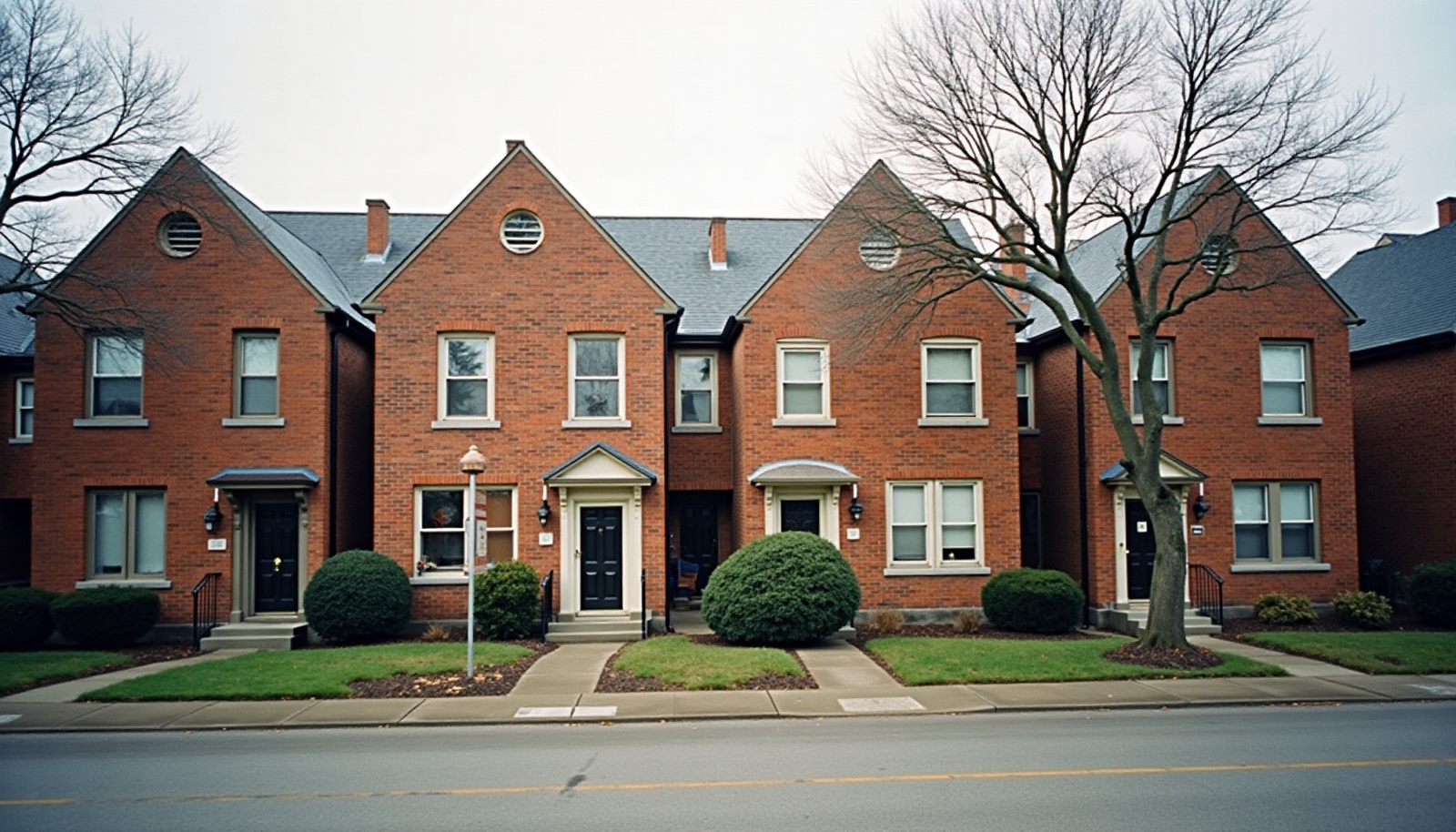
A blanket mortgage covers two or more investment properties under a single note. The lender holds liens on all of them, which means every property in the pool secures every other one. This loan is not available to owner-occupants purchasing or refinancing a primary residence: every blanket mortgage is a business-purpose, investment-only structure. The partial release clause is the mechanism that determines whether you can exit individual properties without paying off the entire note, and most explanations of blanket mortgages skip how it is actually priced.
What makes a blanket different from separate loans on each property
A blanket mortgage consolidates multiple acquisitions or refinances into one note with one payment, one lender, and one closing. Instead of running five files, five appraisals, and five title searches, you run one.
Three types of investor typically use the blanket structure. Builders and developers use them to acquire a subdivided tract under one note, then release individual lots as each one sells. Portfolio investors refinancing existing holdings sometimes use a blanket to consolidate separate mortgages, particularly when individual properties would not each qualify for their own DSCR loan. Active acquirers buying several properties in a cluster (a block of rental houses, four condos in one building) use a blanket to close everything simultaneously.
The distinction from a portfolio loan matters in practice. A portfolio DSCR loan pools your properties for underwriting purposes, but each property may still carry its own recorded lien. A true blanket mortgage records one lien across all named properties. That difference shows up in title work, in how partial releases are executed, and in what happens during a dispute with the lender.
How the partial release clause works: a worked example
The partial release clause gives you the right to sell or refinance one property out of the blanket without triggering repayment of the entire note. Without it, every property is locked until the full loan is retired. Most business-purpose blanket lenders price the release at 110 to 125 percent of the allocated loan amount for the property being released.
The allocated loan amount is calculated by weighting each property’s appraised value against the total collateral pool. On an $800,000 blanket across four single-family rentals appraised at $240K, $200K, $200K, and $160K (total appraised value: $800K, blended LTV: 80%), the allocation works as follows:
| Property | Appraised | Pool Weight | Allocated | Release at 115% |
|---|---|---|---|---|
| Property A | $240,000 | 30% | $240,000 | $276,000 |
| Property B | $200,000 | 25% | $200,000 | $230,000 |
| Property C | $200,000 | 25% | $200,000 | $230,000 |
| Property D | $160,000 | 20% | $160,000 | $184,000 |
You sell Property A for $290,000. The lender receives $276,000 (the release price). You pocket $290,000 minus $276,000 minus closing costs. The blanket balance drops from $800,000 to $524,000. The remaining three properties stay cross-collateralized under the same note.
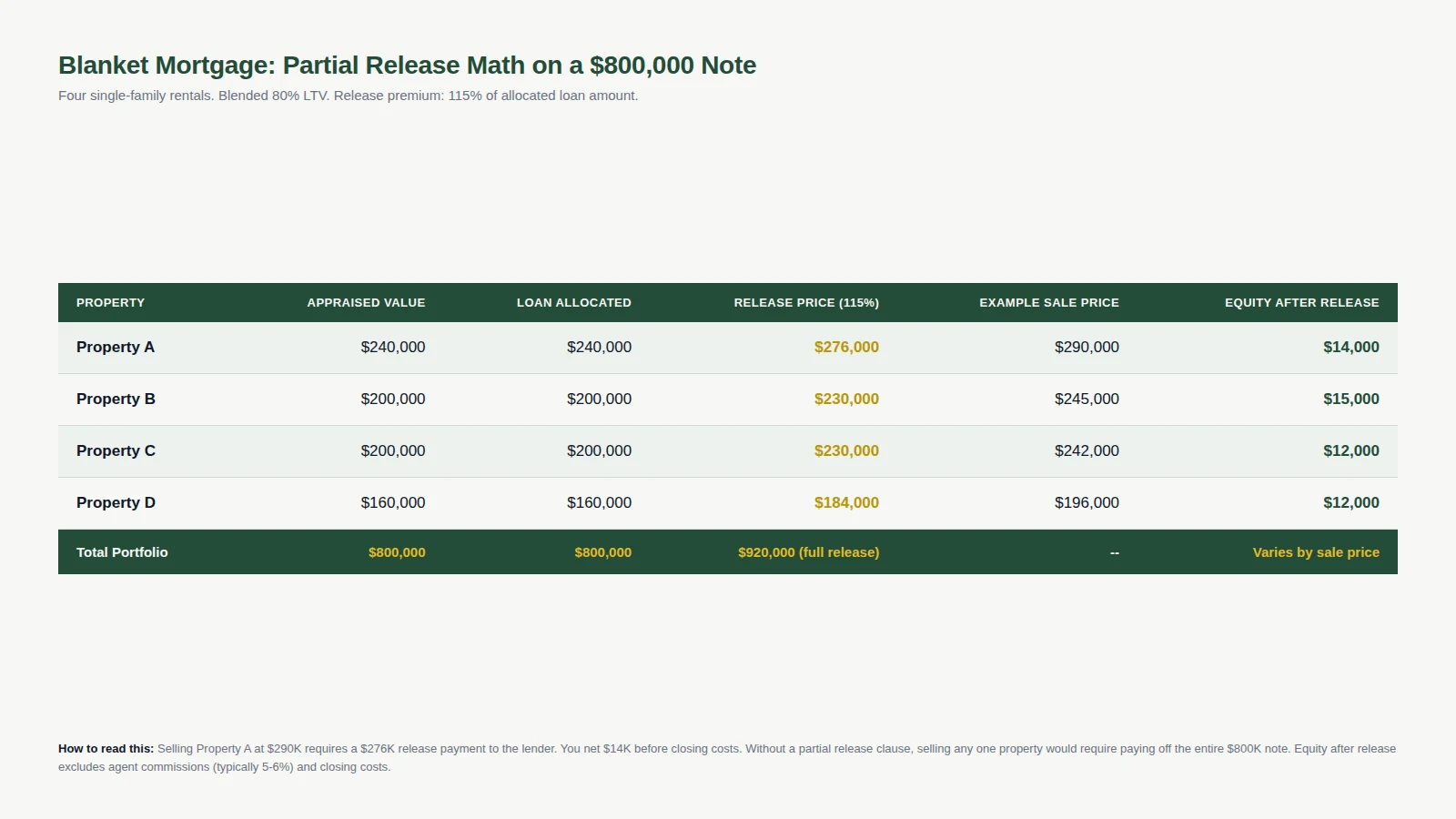
Notice what the release premium does to your equity. If Property A was acquired on thin margins, a 115% release requirement may consume most or all of your net proceeds. That arithmetic is the first thing to model before committing to a blanket structure. Use the DSCR calculator to check whether each property’s cash flow justifies holding through the full blanket term versus a partial release exit.
Want terms on a specific deal?Answer seven questions and get a decision in 72 hours.
Get FundingBlended DSCR underwriting: how lenders look at the pool
The lender underwrites the blanket on the combined rent roll, not on each property individually. Aggregate monthly rents of $4,800 across the four properties against a combined PITIA of $3,840 produces a blended DSCR of 1.25. One unit sitting at a 0.90 DSCR pulls the pool down, but three strong performers offset it.
Most lenders also set a per-property DSCR floor, commonly 0.80 to 0.90. You cannot average away a genuinely distressed asset: if Property D rents for $900 against a $1,050 PITIA portion, most lenders will require you to cure the shortfall before closing or remove that property from the pool.
Four things move the blended DSCR on a blanket: vacancy on any property (lenders apply a deduction, typically 5 to 10 percent of gross rents); tax reassessments that raise the PITIA denominator; any HOA fees on units that carry them; and the rate on the blanket note itself. Blanket notes typically price 25 to 50 basis points above a comparable individual DSCR loan, because the lender is carrying cross-collateral complexity and a longer origination process. That rate premium raises the payment and compresses the blended DSCR. Run the number both ways before you commit.
Cross-collateralization: the exposure most borrowers underestimate
Every property in the blanket secures the full obligation. If Property D goes vacant, you fall behind on payments, and the lender can pursue all four properties in foreclosure, not just Property D.
This is the part of a blanket mortgage that gets minimized in marketing materials and foregrounded in the note itself. Blanket structures are common in development lending precisely because lenders want maximum security when advancing against a pipeline of lots. As a rental investor holding cash-flowing properties, you are giving the lender the same broad security position in exchange for origination cost savings and administrative simplicity.

Cross-collateralization risk is manageable when your portfolio is stable, your tenants are reliable, and you intend to hold long-term. It is a real exposure when your properties are in different stages of renovation, spread across markets with different demand cycles, or when any single unit is occupied by one long-term tenant whose lease renewal is not certain.
Blanket vs separate DSCR loans: a side-by-side
The comparison that matters is not rate vs rate. It is total cost and operational fit across your specific hold period.
| Factor | Blanket Mortgage | Four Individual DSCR Loans |
|---|---|---|
| Number of closings | One | Four |
| Estimated closing costs | $14,000 to $18,000 | $24,000 to $36,000 |
| Rate vs DSCR equivalent | 25 to 50 bps premium | Standard market rate |
| Selling one property | Release clause, release premium | Pay off that loan, no restriction on others |
| One weak property | Pulls blended DSCR down | Isolated to that loan file |
| Default exposure | All properties at risk on any default | Each loan stands alone |
| Admin | One payment, one escrow | Four payments, four tax and insurance escrows |
For a four-property portfolio with a three-to-five-year hold and no near-term sale plans, the closing cost savings (roughly $10,000 to $18,000 on this example) and the administrative simplification are real advantages. For a portfolio where you plan to rotate properties over the next 18 months, individual DSCR loans give you cleaner exits without release premiums cutting into your proceeds on every sale.
Our earlier analysis of when a portfolio loan beats separate DSCR notes covers the blended-DSCR underwriting mechanics in detail, including how partial release fits into a BRRRR-style recycling strategy.
When a blanket mortgage is the wrong structure for your deal
A blanket mortgage solves a specific problem: the cost and complexity of originating multiple separate loans at once. It creates a different problem: exit friction. Here are the situations where the structure works against you.
You plan to sell properties on different timelines. Release premiums add cost to every partial exit. If your plan requires selling or refinancing three of four properties over 18 months, individual loans let you move cleanly without negotiating a release price each time.
Your portfolio has one weak property. Blanketing a 1.40 DSCR rental with a 0.75 DSCR fixer creates a structural dependency. The weak property pulls the blended number down and, if it deteriorates further, triggers cross-default risk for the properties that were performing.
Your properties are in multiple states. Foreclosure law varies significantly by jurisdiction. A lender holding cross-collateralized properties across three states faces procedural complications that often translate into higher rates or tighter terms on the blanket. Some lenders will not write cross-state blankets at all.
You have a co-investor with a different exit timeline. A blanket tied to one entity creates complications when partners want to liquidate their share on different schedules. The release mechanism belongs to the note, not to the partnership agreement. Confirm entity structure and exit alignment before committing.
You are buying or refinancing a home you live in. Blanket mortgages are business-purpose, investment loans. They are not subject to consumer lending protections, which is part of why they can close faster than conventional loans. If you are financing a primary residence, this product does not apply.
What to do next
If you have two or more investment properties and want to understand whether a blanket structure makes sense for your hold period and exit assumptions, the DSCR calculator is the right starting point: plug in each property’s rent and estimated payment to model the blended DSCR before you call anyone.
The portfolio loans page covers how multi-property financing is structured on business-purpose deals, including how blended DSCR underwriting compares to a property-by-property approach. For a specific deal, call 917-842-9982.
Common questions
What is the minimum number of properties for a blanket mortgage?
Most business-purpose lenders require at least two properties. Some set the floor at three or four. The more important question is whether partial release is available: a blanket without a release clause locks every property until the full note is paid off, which makes it a hold-to-payoff product, not a flexible portfolio tool.
Do I need a separate appraisal for each property in a blanket mortgage?
Yes. The lender needs individual appraised values to allocate the loan amount across the pool and to set a defensible release price for each property. Most borrowers order appraisals simultaneously to speed the timeline, but each property still receives its own report and its own allocated loan amount.
Can I add properties to an existing blanket loan after closing?
Some lenders offer open-end blankets that can absorb additional properties through draw requests, similar to a construction line. Most business-purpose blankets are closed-end: the collateral pool is fixed at origination. If you acquire a fifth property later, you typically need a separate loan or a full note amendment, both of which take time and cost money.
How does a blanket mortgage affect my ability to refinance later?
Refinancing one property out of a blanket requires paying the release price, not just the payoff on that one property. If you want to refinance the entire portfolio, you pay off the blanket balance and originate a new note. This is more complex than refinancing an individual DSCR loan and carries more closing cost exposure, which should factor into your original hold period analysis.
Is a blanket mortgage the same as a portfolio loan?
Not always. Some lenders use the terms interchangeably, but the structures differ. A portfolio loan typically refers to a non-QM or non-agency loan held on the lender’s balance sheet, which may or may not cross-collateralize multiple properties. A blanket mortgage specifically means one note with recorded liens across two or more named properties and a defined release mechanism. Ask any lender which structure their product uses before assuming they are equivalent.
Ready to fund your next deal?
Approval within 72 hours. Close in 5 to 10 business days.
Get Funding Now