Bridge Loan vs Hard Money Loan: How Real Estate Investors Tell Them Apart
Hard money and bridge loans overlap constantly, but for an investor choosing between them the distinction is real. Hard money funds a distressed asset where the value depends on what you do to it. A bridge loan funds a transition on a property that already functions. Here is the cost math, the underwriting difference, and when each one is wrong for your deal.
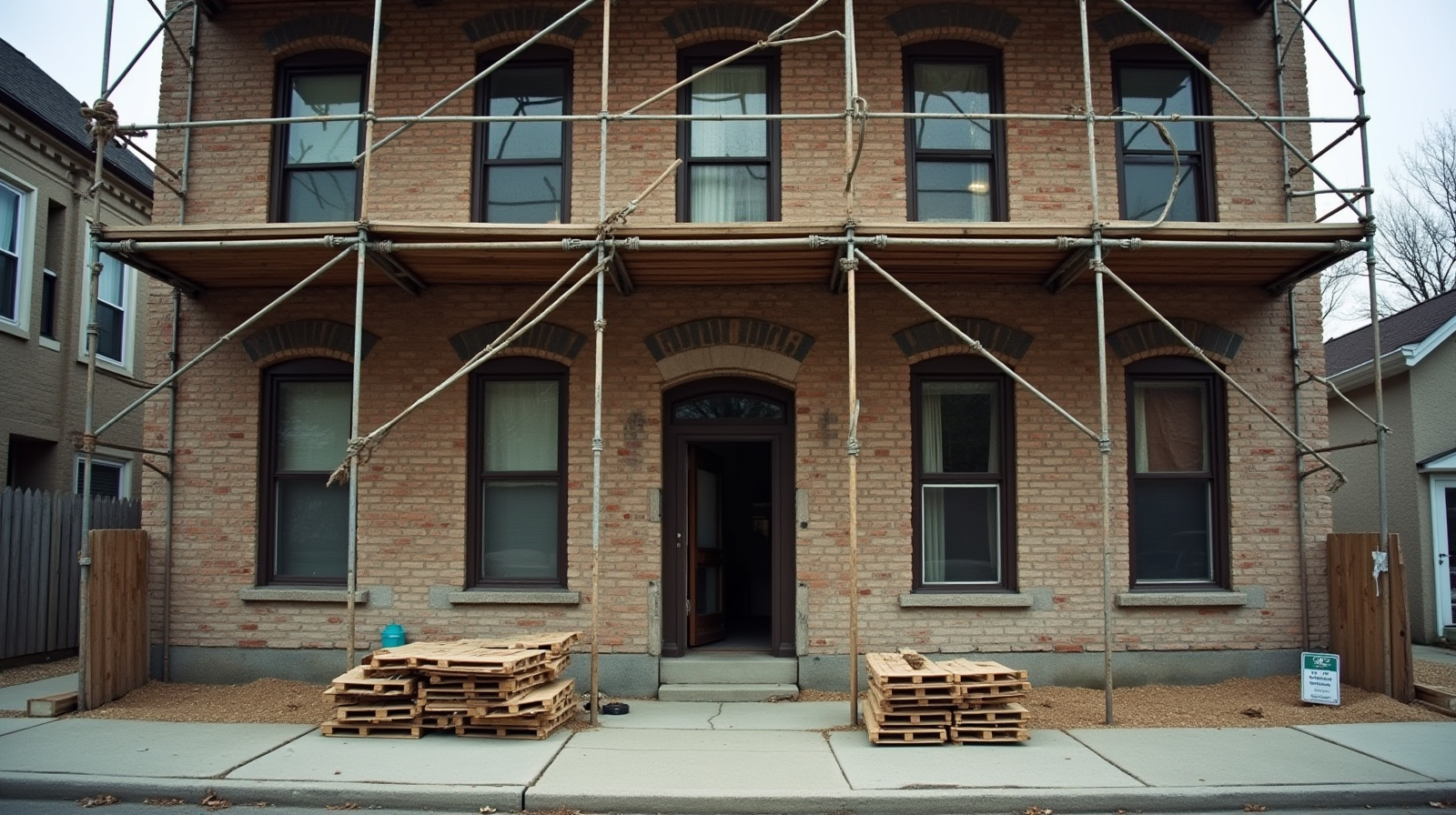
Both bridge loans and hard money loans are short-term, business-purpose financing secured by real estate. Neither product is available for an owner occupant buying a primary residence. If you are looking to buy or refinance the home you live in, these loans do not apply. For a real estate investor, the practical distinction comes down to what you are financing: hard money funds an impaired or distressed asset where the value depends on what you do to it, while a bridge loan funds a transition on a property that already functions, where the exit is clear and the question is timing.
Where the terms overlap, and where they do not
“Hard money” describes the funding source and underwriting approach: a private lender securing the loan against a hard asset and evaluating the deal on collateral value rather than borrower income or tax returns. “Bridge loan” describes the loan’s purpose: bridging a gap between two events, usually between acquisition and permanent financing, or between a distressed purchase and a stabilized refinance.
In practice, many bridge loans are hard money loans. A private lender advancing 65 percent of stabilized value on a multifamily until occupancy recovers is making a bridge loan and a hard money loan at the same time. The terms are not mutually exclusive, and some lenders use them interchangeably. What matters to an investor doing deal math is the underwriting approach, the use of proceeds, and the cost structure.
How each loan is actually sized
Hard money: the ARV drives the number
A hard money lender underwrites the asset you will create, not the one you are buying. The loan is sized as a percentage of after-repair value (ARV). On a $180,000 acquisition with $70,000 in rehab needed and a $350,000 ARV, a lender offering 70 percent of ARV might fund up to $245,000, covering both the purchase and the bulk of construction draws. You put in less cash upfront, but the loan has two parts: an acquisition advance and a draw facility released against completed work.
That draw structure is the product. You cannot access construction funds until inspections confirm the work is done. Interest accrues only on what has been disbursed. If you are three draws in and your contractor disappears, you carry interest on the drawn balance while the project sits. The lender’s risk is in execution, and that is priced into the rate. For a detailed walkthrough of draw mechanics, see our post on what lenders read in your scope of work before the first draw.
Bridge loan: current or stabilized value sets the ceiling
A bridge lender looks at the property as it stands today, or as it will stand once a short, defined improvement is complete. The loan is sized against as-is or as-stabilized value, typically 65 to 75 percent LTV. If you completed a rehab and now want to bridge to a permanent DSCR loan, the bridge lender underwrites $350,000 in stabilized value, not the $180,000 distressed acquisition cost from before the rehab.
The bridge lender’s thesis is that the value already exists, the borrower is moving between two known events, and the exit is visible. The hard money lender’s thesis is that the value will be created and the loan funds the work to get there. Different risk profiles, different rates, different draw mechanics.
Want terms on a specific deal?Answer seven questions and get a decision in 72 hours.
Get FundingThe cost comparison on real numbers
Neither product is cheap, but the rate structure differs in ways that matter depending on how long you hold the asset.
Hard money for a fix and flip typically runs, as observed in the market in late 2026, roughly 11 to 14 percent interest, 2 to 4 origination points, and an inspection fee of $150 to $300 per draw. Terms typically run 6 to 18 months, with interest accruing on the drawn balance rather than the total commitment amount.
Bridge loans on stabilized or near-stabilized assets typically run a bit lower: roughly 9 to 12 percent, 1 to 3 origination points, with terms of 12 to 36 months. Fewer draw inspections because there is less construction, and the lender’s risk profile is lower because the asset already functions and generates income.
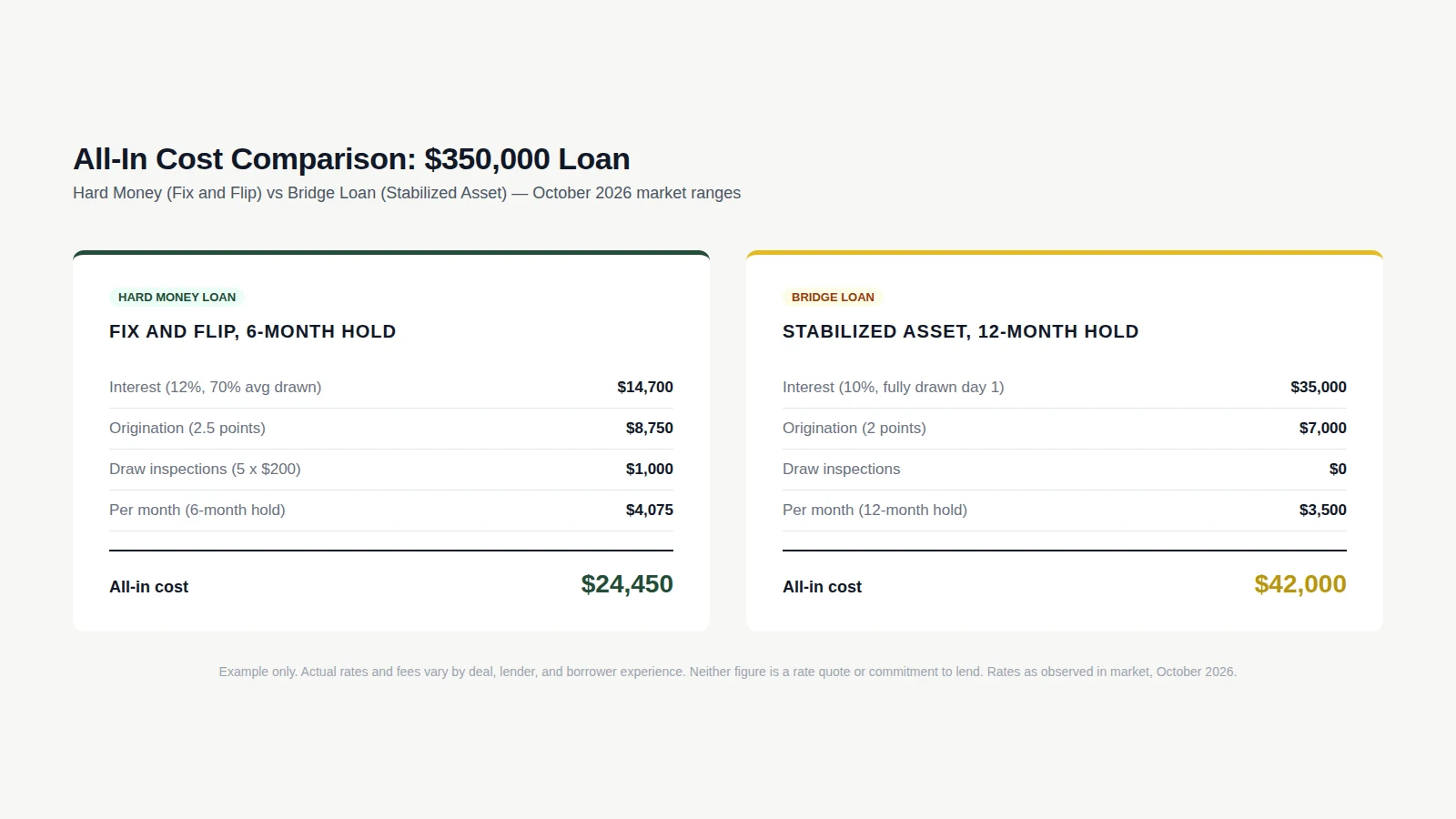
Take a $350,000 loan in both cases. Hard money, fix and flip, 6-month hold at average 70 percent of the commitment drawn: interest on the drawn balance is $350,000 x 70% x 12% x 6/12 = $14,700. Origination at 2.5 points is $8,750. Five draw inspections at $200 each adds $1,000. All-in cost: $24,450, or roughly $4,075 per month.
Bridge loan, stabilized asset, 12-month hold, fully drawn on day one: interest on the full balance is $350,000 x 10% = $35,000. Origination at 2 points is $7,000. No draw inspections. All-in cost: $42,000, or roughly $3,500 per month.
The bridge loan is cheaper per month because the rate is lower and there are no draw fees. It costs more in total because you hold it twice as long and the full balance accrues from the start. The hard money loan accrues on a partial balance during construction, which reduces the effective cost on short holds. Once you extend a hard money loan past 9 months, the cost advantage narrows fast.
Which loan fits which deal
| Scenario | Loan that fits | Why |
|---|---|---|
| Distressed property, heavy rehab, sell after | Hard money | ARV underwriting enables higher advance on a damaged asset; draw structure matches phased rehab spend |
| Stabilized rental, transitioning to DSCR loan | Bridge | Lender underwrites stabilized value; lower monthly rate on a fully drawn balance |
| Light cosmetic rehab, sell or refi within 6 months | Either | Depends on rehab depth and lender product; some bridge lenders accept light rehab |
| Occupied multifamily, lease-up to stabilization | Bridge | No draw inspection needed; rate advantage on a partial vacancy improvement play |
| Distressed note, messy title, fast close needed | Hard money | Private hard money lenders more comfortable with complicated title; fewer income requirements |
The overlap case is a property requiring 2 to 3 months of work before a DSCR refinance. Some lenders write that as a bridge loan with a light rehab allowance. Others write it as a 12-month hard money loan with a short draw period. The product name matters less than the underwriting method and the total all-in cost. Use the hard money loan calculator to model interest accrual on drawn balances before committing to a structure.

When each loan is wrong for you
Both products have failure modes that are predictable before the loan closes. Most comparison articles skip this part.
Hard money is wrong when:
- Your exit is a DSCR refinance and the completed property does not produce a DSCR ratio above 1.0 at the rate you will refinance into. The hard money loan matures regardless of whether the DSCR refi closes.
- Your rehab timeline exceeds the term. A 6-month loan on a 9-month project forces an extension at typically 0.5 to 1.5 percent of the loan balance per extension period, sometimes more.
- The as-repaired appraisal comes in below your estimate. Hard money lenders order an as-repaired appraisal before funding. If the appraiser does not agree with your ARV, your advance drops. That means more cash in at close or a lower acquisition price.
- You have no construction experience and no licensed general contractor under contract before closing. Most hard money lenders require contractor documentation before releasing the first draw.
Bridge loans are wrong when:
- The property needs major work. A bridge lender underwriting stabilized value will not fund a property that is uninhabitable or substantially below market condition. If the value story requires the rehab, hard money is the correct structure.
- Your exit is not bankable. A bridge loan is only as good as the refinance or sale at the end. If the stabilized DSCR on the property is 0.9, no DSCR lender will take you out at close of the bridge term. You will need to sell, pay from another source, or negotiate an extension.
- You need a 6-month commitment but the lender’s minimum term is 12 months. Bridge lenders typically do not write very short terms because the economics do not work at that duration. If your deal is a 4-month hold, a hard money loan with a short prepayment window is more likely to be available.
In either case, if the deal slips by 90 days, you are paying extension fees and continuing to carry interest on a non-producing asset. On a $350,000 loan, a 90-day extension typically costs $5,250 to $10,500 (1.5 to 3 percent of balance), before the additional interest. That number belongs in your underwriting before you close, not in your inbox in month 9. For more on how extension costs compound across a deal, see Bridge Loan Rates and the Real Cost of a 12-Month Loan and Hard Money Loan Rates and Why They Look So High.
What to do next
If you have a specific deal and are unsure which structure fits, model the numbers before you call a lender. The hard money loan calculator shows interest accrual on drawn balances across a draw schedule. For bridge exits into a permanent rental loan, the DSCR calculator is the right check: if the stabilized income qualifies, a DSCR refi is the exit and a bridge loan is the tool to get there.
For program details, see our bridge loans page and hard money loans page. Both programs run from $100,000 to $25 million, with approval within 72 hours and close in 5 to 10 business days. We lend in all 50 states. Call 917-842-9982.
Common questions
Can a loan be both a bridge loan and a hard money loan?
Yes. Many bridge loans funded by private capital are technically hard money loans. The terms describe different things: hard money refers to the source and collateral-based underwriting; bridge refers to the loan’s purpose. A private lender funding a 12-month transition on a stabilized asset is making a bridge loan and a hard money loan at the same time. The overlap is real and common in investor lending.
Which closes faster, a bridge loan or a hard money loan?
Both can close in under two weeks with a prepared borrower. Hard money construction loans sometimes take a few days longer because the lender must order an as-repaired appraisal and review a scope of work and contractor documentation. A bridge loan on a stabilized asset with a straightforward appraisal can close in 5 to 7 business days. Speed depends more on borrower preparation than on loan type.
What happens if I cannot refinance out of my bridge loan before it matures?
You have three options: extend the loan at a fee (typically 1 to 2 percent of the outstanding balance per 90-day extension), pay it off from another source of capital, or sell the property. The default rate on a bridge loan runs materially above the interest rate, often 5 to 7 percent above the note rate. If you are approaching term and the refi is not closing, contact the lender before the maturity date. Extensions negotiated in advance cost less than cures after default.
Do hard money lenders care about my credit score?
Asset value and exit strategy take priority over credit score in hard money underwriting, but credit is not irrelevant. A FICO below 600 will disqualify you at many lenders or limit you to a lower LTC tier. Experience completing comparable rehabs matters as much as credit on a fix-and-flip loan. Lenders need confidence you can execute the project, not just that you have a clean credit file.
Are bridge loans and hard money loans business-purpose only?
Yes. Neither product as described here is available for a property the borrower intends to occupy as a primary residence. These loans are not subject to TILA or RESPA, which is a primary reason they can close in days rather than weeks. If you are buying a home to live in, these products do not apply and you will need a conventional or government-backed mortgage.
Ready to fund your next deal?
Approval within 72 hours. Close in 5 to 10 business days.
Get Funding Now