Portfolio Loans for Rental Investors: When One Note Beats Five DSCR Loans
A portfolio loan consolidates multiple investment properties under a single note, potentially saving investors $9,000 to $13,000 in closing costs versus five individual DSCR loans. Here is the arithmetic, the partial release mechanics, and the cross-collateralization risk the blended DSCR argument glosses over.
A portfolio loan consolidates multiple investment properties under a single note. If you own four or more rentals and are refinancing them into long-term debt, a portfolio loan may cut your total closing costs by $9,000 to $13,000 compared to five individual DSCR loans, and reduce your monthly administration from five servicers to one. This loan is for real estate investors on a business-purpose basis. It is not available for the home you live in and is not a suitable structure if one of your properties has a DSCR below 1.0 or significant deferred maintenance that could disrupt income.
The problem a portfolio loan solves
Individual DSCR loans are strong products for single-property financing. But once you accumulate rentals, each one carries its own origination fee, appraisal, title search, and escrow setup. Four loans at $5,000 in closing costs each adds up to $20,000 out of pocket before you collect a dollar of rental income. Five loans at $4,500 each is $22,500. The number is not dramatic on any one loan, but across a portfolio it becomes material.
There is also a ceiling to consider. Fannie Mae and Freddie Mac limit most investors to 10 financed conventional properties. Once you cross that threshold, individual agency loans are still available in some cases but often at tighter terms. A portfolio loan, which stays in the lender’s own book rather than being sold to the agencies, does not count against that ceiling the same way individual conventional or DSCR loans do.
How blended DSCR works across a mixed portfolio
A portfolio loan underwrites the combined debt service coverage across all included properties, not each property individually. This is both the main advantage and the main structural risk, and it is worth understanding the arithmetic before choosing the product.
Consider five single-family rentals:
- Properties A and B: each renting at $1,700 per month, strong tenants, low vacancy
- Properties C and D: each renting at $1,450 per month, solid but ordinary
- Property E: renting at $1,200 per month, the weakest performer in the group
Total monthly rent across all five: $8,500. Combined appraised value: $1,050,000. At 75% LTV, the portfolio loan amount is $787,500. At a rate in the 8.0 to 8.25 percent range, the combined monthly principal and interest runs approximately $5,900 to $6,000. Blended DSCR: $8,500 divided by $5,965 equals roughly 1.43. That qualifies cleanly.
Now look at Property E alone. At $1,200 rent and a proportional loan balance of roughly $157,500, the monthly payment sits around $1,165. Individual DSCR: 1.03. That property either gets declined on its own or lands in a rate penalty tier that makes the individual loan significantly more expensive. Bundled with four stronger properties, Property E qualifies without friction and the blended DSCR looks as strong as the group’s average performer.
Want terms on a specific deal?Answer seven questions and get a decision in 72 hours.
Get FundingThe closing cost arithmetic
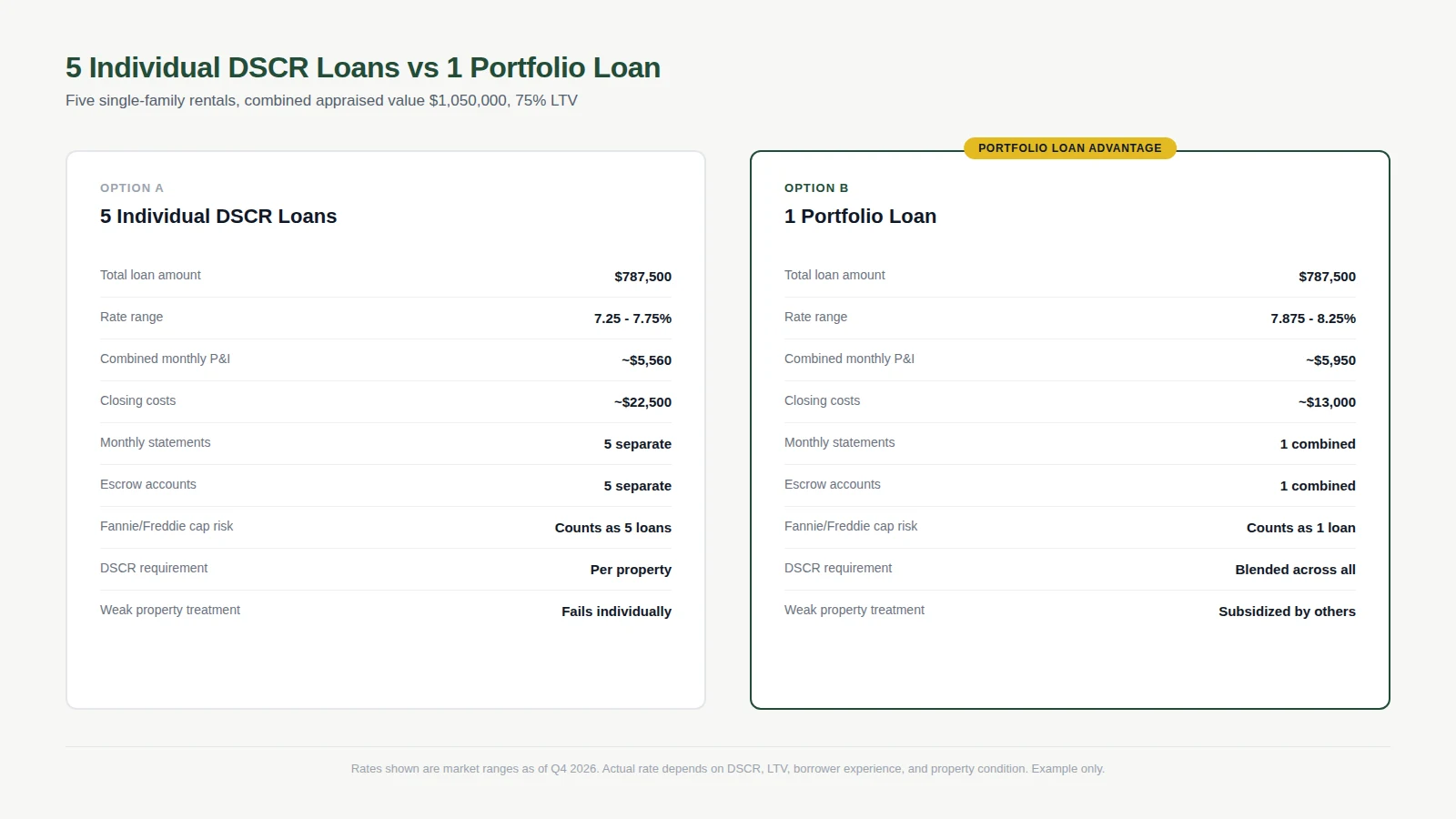
The case for a portfolio loan is most concrete in the closing cost comparison. Most individual DSCR loans carry total closing costs in the $4,000 to $6,000 range per property. Five loans at $5,000 each is $25,000 out of pocket before you refinance is complete.
A portfolio loan on those same five properties typically requires one origination fee, one set of coordinated title work (each property still needs its own title search, but title agent coordination and document preparation combine into one engagement), and one set of lender fees. Total closing costs for a five-property portfolio loan commonly run $12,000 to $16,000 depending on state title fees and geographic spread.
The savings range: $9,000 to $13,000 on a five-property refinance. That figure is real and it arrives on day one. Use the DSCR calculator to model what the blended debt service coverage looks like for your specific properties before you commit to the structure.
The rate trade-off and when the math flips
Portfolio loans price 50 to 100 basis points above individual DSCR loans in most market conditions, because the lender is holding the note rather than selling it into a securitization. On $787,500 in debt, 75 basis points is roughly $490 per month in additional interest. Over 12 months, that is $5,880 in extra cost.
Compare that to $11,000 in closing cost savings at the midpoint of the range above. In year one, the portfolio loan is ahead by roughly $5,000. By year two, it is approximately break-even. By year three, the accumulated rate premium has erased the closing cost advantage entirely.
This means the portfolio loan structure makes the most economic sense when you plan to refinance again within two to three years, when you are acquiring a large group of properties simultaneously and want to avoid five sets of closing costs at once, or when the blended DSCR benefit is significant enough on your weakest property that individual financing is not viable at a reasonable rate. If you plan to hold all five properties for ten or more years without another refinance, five individual DSCR rental loans will cost less over the life of the debt, even accounting for higher upfront closing costs.
The partial release clause: selling one property without closing the loan
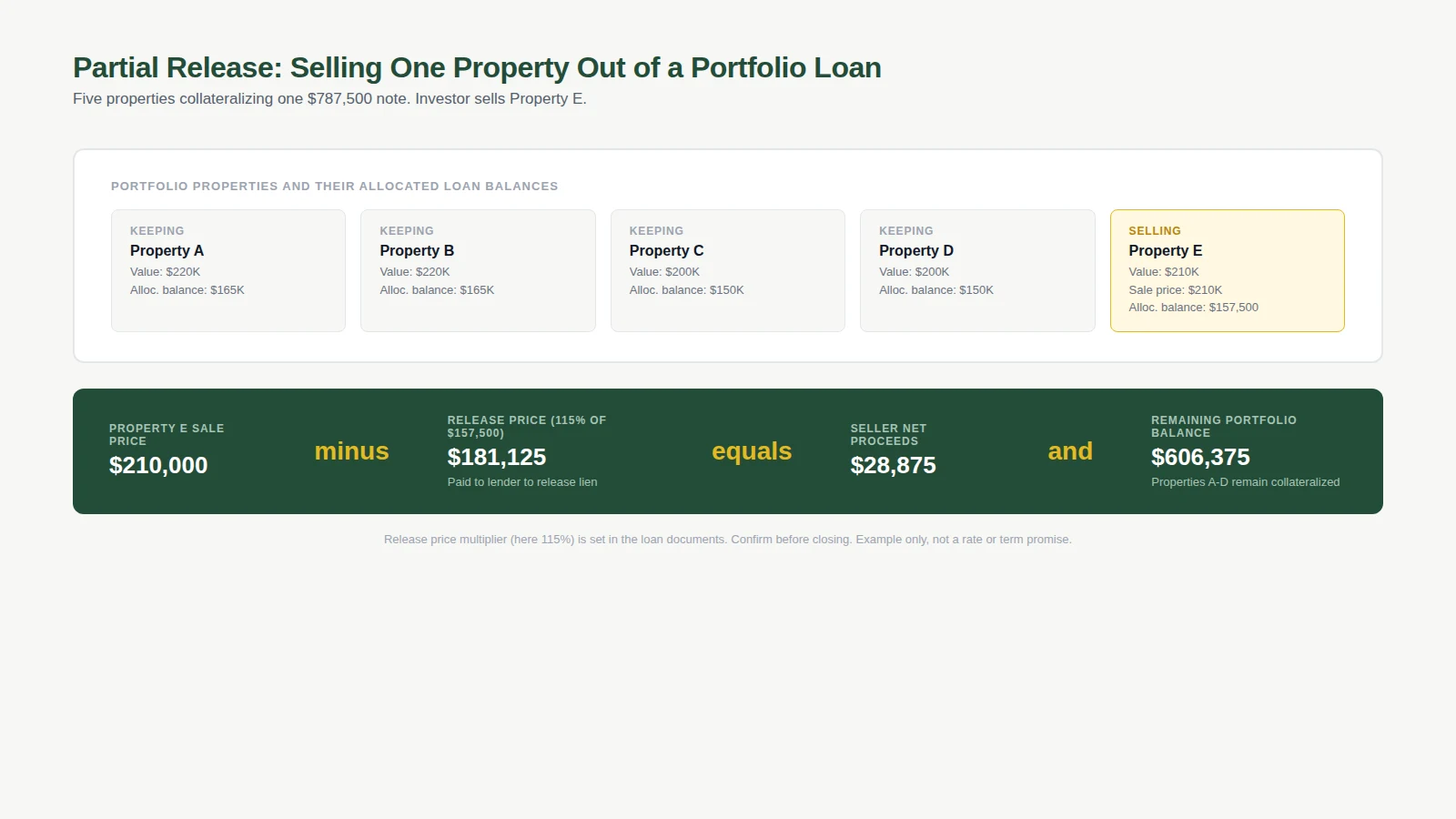
A well-structured portfolio loan includes a partial release clause. This provision allows you to sell one property out of the collateral pool by paying down a specified portion of the loan balance, typically 110 to 125 percent of that property’s allocated loan amount. The remaining properties stay collateralized and the note continues on the reduced balance.
Example: Property E has an allocated loan balance of $157,500. The release price at 115 percent is $181,125. You sell Property E for $210,000, use $181,125 to pay down the portfolio loan at closing, and net roughly $28,875 from the transaction after the release payment. Properties A through D remain in the loan with a reduced balance and a lower monthly payment.
Not every portfolio loan includes a partial release clause. Some lenders structure the product as a true blanket mortgage with no partial release, which means you cannot sell any individual property without refinancing the entire note. Confirm whether a partial release clause is included, and what the multiplier is, before you sign the term sheet. A portfolio loan without this provision effectively locks every property in the group until the note matures or you refinance out entirely.
Cross-collateralization: the risk the blended DSCR argument skips
Cross-collateralization is the structural feature that makes a portfolio loan efficient. It is also the feature that can turn a problem in one property into a problem across all of them.
With five individual DSCR loans, a six-month vacancy on Property E affects one loan. The other four continue unchanged. You might negotiate a forbearance, a modification, or, worst case, face a default that affects one property. The lender’s remedy is limited to that one asset.
With a portfolio loan, all five properties secure the same obligation. If the combined note goes into default, the lender’s remedy extends to all five properties. A single-property income shortfall, if severe enough to breach the debt service coverage covenant in the loan documents, can trigger a default event against the entire group.
This does not make portfolio loans unsuitable. It means the structure works best when all included properties have stable income, proven tenants, and no significant deferred maintenance that could reduce rent or generate a code violation. Do not bundle your four strongest properties with one property that is one major repair away from being uninhabitable. The risk is not symmetric, and the term sheet will not spell this out in plain language.
When this loan is wrong for you
You plan to sell one or two properties within the next 12 to 18 months. The partial release fee adds real cost to a sale you were already planning. If a sale is coming, keeping that specific property on a bridge loan or an individual DSCR note is cleaner and less expensive than paying a 115 percent release price out of your sale proceeds.
Your properties are spread across four or more states. Title search and closing requirements vary significantly by state. A multi-state portfolio loan generates more legal complexity than a single-state group, and the closing cost savings narrow or disappear when you are paying for title work in four separate jurisdictions.
One property has a DSCR below 1.0. The blended figure may still qualify the group, but you are using equity in your stronger properties to support an asset that does not cover its own debt service. That is a fundamentally different risk profile than owning five separate loans, and it means the weakest property’s problems now become your entire portfolio’s problems.
You own fewer than three or four properties. The closing cost savings on two properties do not typically justify the rate premium, and most portfolio lenders have minimums of three to five properties. For single-property and two-property investors, individual DSCR loans remain the more efficient structure. Review the DSCR rental loan program for what single-property financing currently looks like.
What to do next
The right starting point is calculating what your portfolio’s blended DSCR looks like at current market rates. Use the DSCR calculator to input each property’s rent and model the combined debt service at two rate scenarios: the individual DSCR rate and then that rate plus 75 basis points for the portfolio premium. The difference in monthly payment, multiplied by 12 and then by two or three years, is the cumulative cost of the portfolio structure. Compare that to the closing cost savings on the number of properties you are considering bundling.
If the numbers favor the portfolio loan, the next question is which properties belong in the group and whether any of them carry risks that argue for keeping them separate. Call 917-842-9982 or review the portfolio loan program for current minimum property counts, minimum loan sizes, and state availability.
For investors still building toward the property count where a portfolio loan makes sense, the post on DSCR loan pros and cons covers the individual loan structure in detail, including the prepayment penalty tiers that affect portfolio loan economics just as much as they affect a standalone note.
Common questions
How many properties do you need for a portfolio loan?
Most portfolio loan programs require a minimum of three to five properties. Some programs start at two, but the closing cost savings that make the structure attractive typically require at least four properties bundled together. There is no standard maximum, though underwriting complexity increases with every property added to the group.
Does a portfolio loan count differently than individual loans against the Fannie Mae 10-property cap?
A portfolio loan is not sold to Fannie Mae or Freddie Mac, so it does not count toward the conventional 10-financed-property ceiling the same way individual agency loans do. For investors who have already hit or are approaching that ceiling, a portfolio loan on a group of rentals can free up capacity for future acquisitions.
Can you add properties to an existing portfolio loan later?
Some lenders allow cross-collateralization additions to an existing note, but it is not standard. Most portfolio loan programs treat additions as a new origination, meaning you would close a revised loan covering the expanded pool of properties. Confirm the modification policy before closing, particularly if you expect to keep acquiring rentals.
What happens to the portfolio loan if one property loses its tenant?
A vacancy on one property reduces the combined rent and therefore the blended DSCR for the whole portfolio. If the drop is severe enough to breach the loan’s minimum DSCR covenant, the lender may have rights under the loan documents to require additional collateral or call the note. With individual DSCR loans, a single-property vacancy affects only that one loan. This is the structural tradeoff of cross-collateralization.
Is a portfolio loan the same as a blanket mortgage?
The terms are often used interchangeably, but they describe slightly different concepts. A blanket mortgage technically means one lien covering multiple properties. A portfolio loan describes a loan the lender holds in its own book rather than selling to the secondary market. In practice, most investor-focused portfolio loans are also structured as blanket mortgages, but confirm the lien and partial release mechanics with any specific lender before signing.
Does a portfolio loan require a separate appraisal for every property?
Yes. Each property in the portfolio still requires its own appraisal to establish individual market value and allocate the loan balance across the collateral pool. The savings in a portfolio loan come from consolidating origination, title agent coordination, and document preparation, not from eliminating per-property valuations.
Ready to fund your next deal?
Approval within 72 hours. Close in 5 to 10 business days.
Get Funding Now