DSCR Loan Prepayment Penalty: How the Step-Down Table Affects Your Actual Exit Cost
A DSCR loan prepayment penalty can cost $9,000 to $15,000 on a $300K loan if you exit in year two. Here is how the three penalty structures work, what the rate-saving tradeoff actually looks like over time, and when refusing the penalty is the smarter call.
A DSCR loan prepayment penalty is a fee charged when you sell, refinance, or make large unscheduled principal payments before a set window closes. On a $300,000 DSCR loan with a 5-4-3-2-1 step-down structure, exiting in year two costs $12,000. This post covers business-purpose investor loans only. Consumer mortgages carry federally regulated prepayment rules that work differently. If you are looking for guidance on a primary residence, this post is not for you.
The three prepayment penalty structures in the DSCR market
Three structures appear regularly in 2026 business-purpose rental lending.
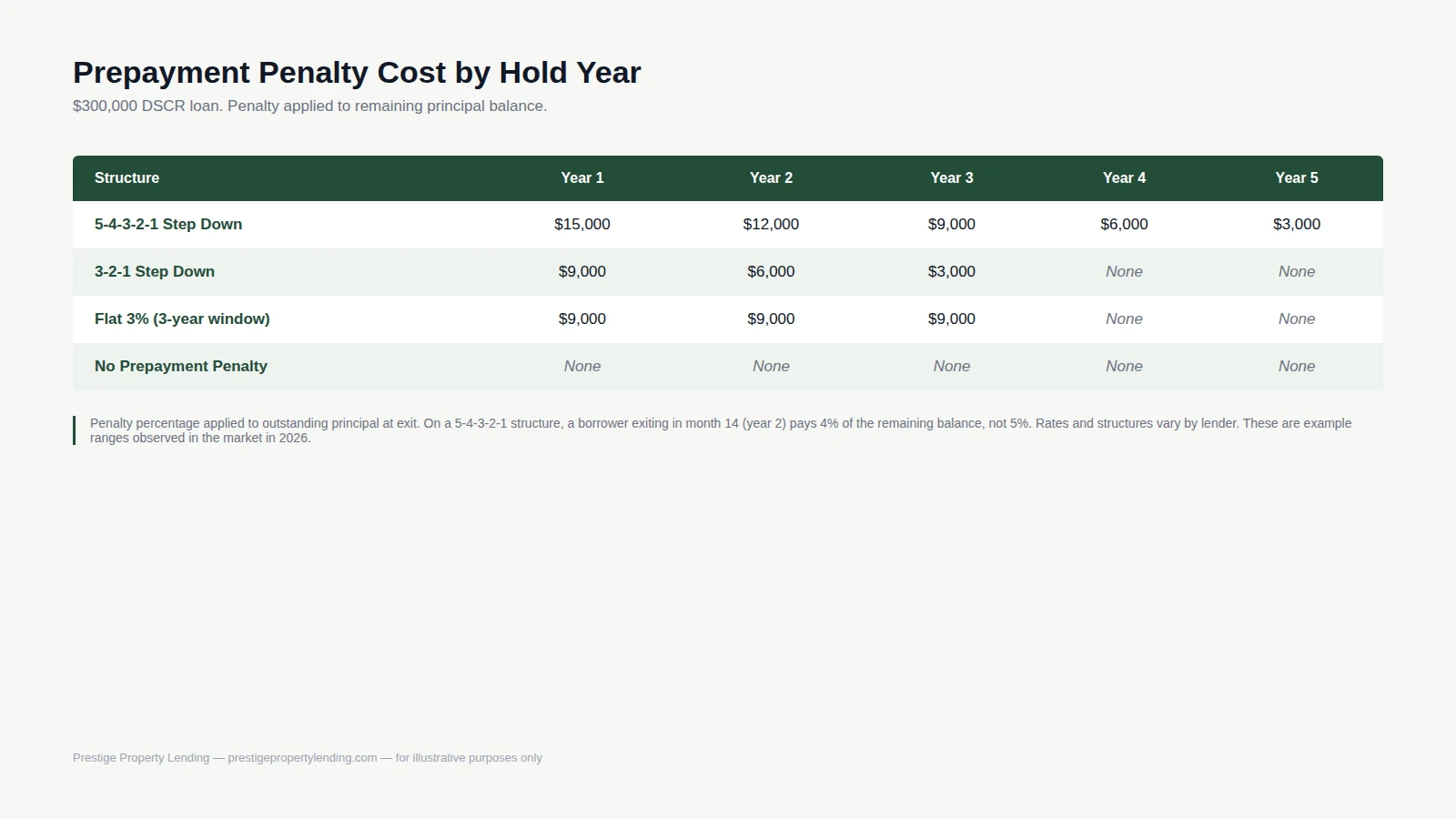
Step-down penalties are the most common. The percentage falls each year. A 5-4-3-2-1 structure charges 5% of the outstanding principal in year one, 4% in year two, 3% in year three, 2% in year four, and 1% in year five. After year five, no penalty applies. The shorter 3-2-1 variant works the same way over three years: 3% in year one, 2% in year two, 1% in year three, then gone. Both are calculated on the outstanding principal at the time of exit, not the original loan amount.
Fixed-percentage penalties apply a flat rate for the full penalty period, often 2% to 5% over a 2- or 3-year window. There is no annual step down. A year-two exit costs the same as a year-one exit. This structure is simpler to model but penalizes borrowers who exit late in the window just as much as those who exit early.
Six-months-interest structures are less common on standard retail DSCR programs and appear more often in wholesale lending matrices. You can prepay up to 20% of the original balance per year without penalty. Any amount above that triggers a fee equal to six months of interest on the excess. This structure rewards partial paydowns while penalizing large lump sums.
The infographic below shows the exact dollar cost of each structure across five hold years on a $300,000 loan.
The rate-penalty tradeoff: the math no term sheet shows you
Lenders offer lower interest rates to borrowers who accept prepayment penalties because the penalty guarantees a minimum return on deployed capital. A borrower locked in for five years is a more predictable income stream than one who might refi the month rates drop. Lenders price that certainty into the rate.
In practice, accepting a 5-4-3-2-1 penalty versus choosing the no-penalty option typically saves between 0.125% and 0.375% on the rate, based on spreads observed across the DSCR market in 2026. The actual number depends on the lender, loan size, and prevailing conditions. Use these as a planning range, not a quote.
Here is what a 0.25% rate saving looks like on a $300,000 loan, year by year, against the penalty cost at each exit point:
- Annual rate saving at 0.25%: $750
- Year-one exit: penalty $15,000, rate savings $750 = net extra cost $14,250
- Year-two exit: penalty $12,000, rate savings $1,500 = net extra cost $10,500
- Year-three exit: penalty $9,000, rate savings $2,250 = net extra cost $6,750
- Year-four exit: penalty $6,000, rate savings $3,000 = net extra cost $3,000
- Year-five exit: penalty $3,000, rate savings $3,750 = net saving $750
The breakeven on a 5-4-3-2-1 structure at a 0.25% rate saving is close to year five. At a 0.375% saving, the breakeven moves to around year three and a half. The comparison below shows the two most relevant scenarios side by side.
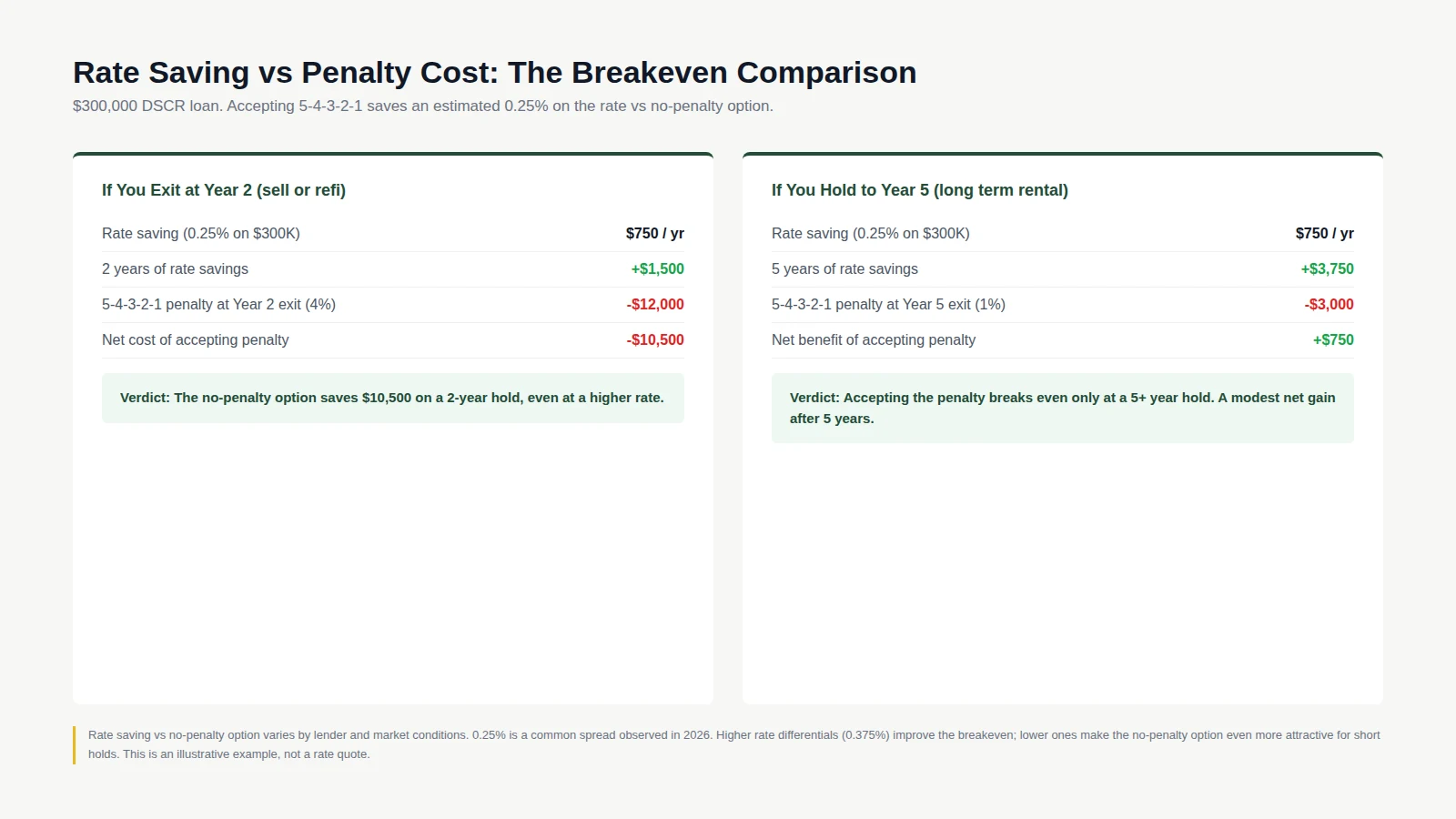
The honest reading: unless you are confident in a 4-plus-year hold with no refinance, the no-penalty option is typically the better deal on a straight-line cost basis. The rate saving rarely covers the penalty cost on short holds.
Want terms on a specific deal?Answer seven questions and get a decision in 72 hours.
Get FundingThe BRRRR timing trap
If you are running a BRRRR strategy, a DSCR prepayment penalty and your refinance plan are in direct conflict. The BRRRR sequence requires a cash-out refinance once the property is stabilized. That refinance pays off the existing note, which is exactly the trigger event for the penalty.
A 6-month seasoning period after stabilization is the minimum most lenders require before they will count the stabilized appraised value. Some require 12 months. If you close a DSCR loan with a 3-2-1 structure and then cash out refi in month 10, you pay a 3% penalty on the payoff balance. On $300,000, that is $9,000 handed directly to the lender, layered on top of your new loan’s closing costs.
The cleaner structure for a BRRRR is hard money or a bridge loan for the acquisition and rehab, then a DSCR loan once the property is stable and you have no planned refi in the near term. At that point, a step-down penalty carries much less risk because your exit strategy is long-term hold, not another refi. See the BRRRR refinance seasoning requirements post for the 3-, 6-, and 12-month rules by lender type.
When to take the penalty and when to refuse it
Take the penalty if: your plan is to hold for 5 or more years as a stabilized rental with no cash-out refi in the penalty window; the rate saving is at the higher end of the observed range (0.375% or more); and your state does not restrict the structure anyway.
Refuse the penalty if: your hold timeline is under 3 years; you are running a BRRRR and a refinance is part of the plan within the window; the loan balance is below $200,000, where the rate savings in absolute dollars are too small to outweigh even a modest penalty; or you have any meaningful uncertainty about your exit timing. Uncertainty is the key word. Unforeseen vacancies, a rate-and-term refi opportunity that surfaces in year two, a partnership dissolution, a capital call on another deal: any of these can push you into an exit you did not plan.
Use the DSCR calculator to confirm the property qualifies at the rate associated with your chosen penalty election before you commit. A deal that qualifies at the penalty rate may not qualify at the no-penalty rate. If it does not qualify at the higher rate, the election is forced.
A short note on state restrictions
Prepayment penalty rules vary by state. Some states prohibit them on residential investment properties below certain loan sizes. Others cap the penalty period, the percentage, or both. A few have exemptions for entities (LLCs, corporations) that do not apply to individual borrowers.
This post cannot substitute for legal review in your specific state. Before you accept a penalty structure, confirm the rules with your attorney or at minimum review the lender’s own prepayment matrix for your state. Lenders originating across all 50 states maintain these matrices; ask for the one that applies to you.
Who this loan structure is wrong for
A DSCR loan with a prepayment penalty is the wrong choice if your plan has any real exit uncertainty within the penalty window. The math is clear: for holds under 3 years, the no-penalty option wins on cost in nearly every scenario.
It is also wrong for an LLC that may dissolve, transfer ownership, or bring in new partners during the penalty window. Some loan documents treat title changes as prepayment events. Read the definition of “prepayment” in your note, not just the marketing materials.
Finally, it is wrong for a property you might convert to a primary residence. That conversion is a trigger event, it contradicts the business-purpose nature of the loan, and it creates compliance exposure that is separate from the penalty cost.
For a complete picture of DSCR costs beyond the prepayment penalty, including origination points, reserve requirements, and prepayment penalty in context of the full term, the DSCR loan pros and cons post covers the full list. The DSCR rental loan program page covers qualification criteria.
What to do before you sign
Negotiate the penalty structure at the term sheet stage. Most DSCR lenders offer multiple elections and will show you the corresponding rate for each option if you ask. Run the math on your specific hold timeline using the numbers in this post, then choose based on your actual plan, not the one that looks best on paper.
Read the full prepayment clause before closing. The definition of the trigger, the threshold for partial prepayments, and the state-specific carve-outs all live in the note, not the term sheet. A borrower who reads the clause is the only one who knows what they signed.
If you want to talk through a specific deal and which penalty election makes sense for it, call 917-842-9982.
Common questions
Is there a DSCR loan with no prepayment penalty?
Yes. Most DSCR lenders offer a no-penalty option alongside their step-down structures. The tradeoff is a higher interest rate, typically 0.125% to 0.375% higher, depending on the lender and market conditions. For short hold timelines or BRRRR strategies where a refinance is planned, the no-penalty rate is often the better economic choice even though the starting rate is higher.
Does a prepayment penalty apply if I make extra monthly payments?
It depends on the loan documents. Most DSCR prepayment clauses allow you to prepay up to 20% of the original principal balance in any 12-month period without penalty. Amounts above that threshold in a given year trigger the fee. A full payoff through sale or refinance always triggers the penalty during the window. Read the exact clause in your note, not the term sheet summary.
What happens to the penalty if I refinance with the same lender?
The same lender is not automatically exempt. A refinance pays off the existing note and creates a new one, which is the trigger event. Some lenders waive or reduce the penalty for a same-lender refi as a retention incentive, but this is a negotiated exception, not a default right. Ask specifically, get it in writing, and confirm whether it applies to both rate-and-term and cash-out refis.
Can I negotiate the penalty structure after the term sheet is signed?
Rarely. The penalty election is typically locked at term sheet acceptance because it affects the rate, which the lender prices at commitment. The time to negotiate is before you sign the term sheet, when the lender is still competing for the deal. At that stage you can request to see multiple penalty elections with the corresponding rate for each. After commitment, changes require a new term sheet or an amendment, and lenders are not obligated to offer one.
Does the prepayment penalty apply to the original loan balance or the remaining balance?
Almost all DSCR step-down penalties apply to the outstanding principal balance at the time of prepayment, not the original loan amount. On a 30-year amortizing loan at typical rates, the outstanding balance in year two is only marginally lower than the original balance, so the practical difference is small. On an interest-only loan, the balance does not decrease at all during the IO period, so the penalty is calculated on the full original amount.
Ready to fund your next deal?
Approval within 72 hours. Close in 5 to 10 business days.
Get Funding Now