How DSCR Is Actually Calculated: The Two Formulas and What They Mean for Your Loan
DSCR lenders use gross rent divided by PITIA, not the NOI formula used in commercial underwriting. The same property can show 1.25 under one formula and 1.03 under the other. Here is why both numbers are correct and which one determines your loan.
The formula looks simple: divide income by debt service. The part most explainers leave out is that income and debt service mean different things depending on who is underwriting the loan, and a single-family rental can produce a DSCR of 1.25 or 1.03 on the same day using the same rent roll. This is not an error in the math. It is two different questions being answered at once.
If you are applying for a DSCR rental loan, the formula your lender uses is not the one in the Investopedia article. Understanding the difference before you run your numbers will save you from pricing a deal on the wrong ratio.
The two formulas
For a DSCR rental loan, the non-QM product that qualifies on property income without tax returns, most lenders calculate:
DSCR = Monthly Gross Rent / Monthly PITIA
PITIA is principal, interest, taxes, insurance, and any HOA dues. Gross rent is the contracted or market monthly rent with no vacancy deduction and no management fee removed. The formula is arithmetic on two monthly figures.
For commercial real estate loans and multifamily properties of five or more units, the standard is:
DSCR = Annual Net Operating Income (NOI) / Annual Debt Service
NOI requires subtracting vacancy, property management, maintenance reserves, taxes, and insurance from gross income. Debt service is typically principal and interest only, because taxes and insurance already sit above the NOI line rather than below it.
Why the same property produces two different numbers
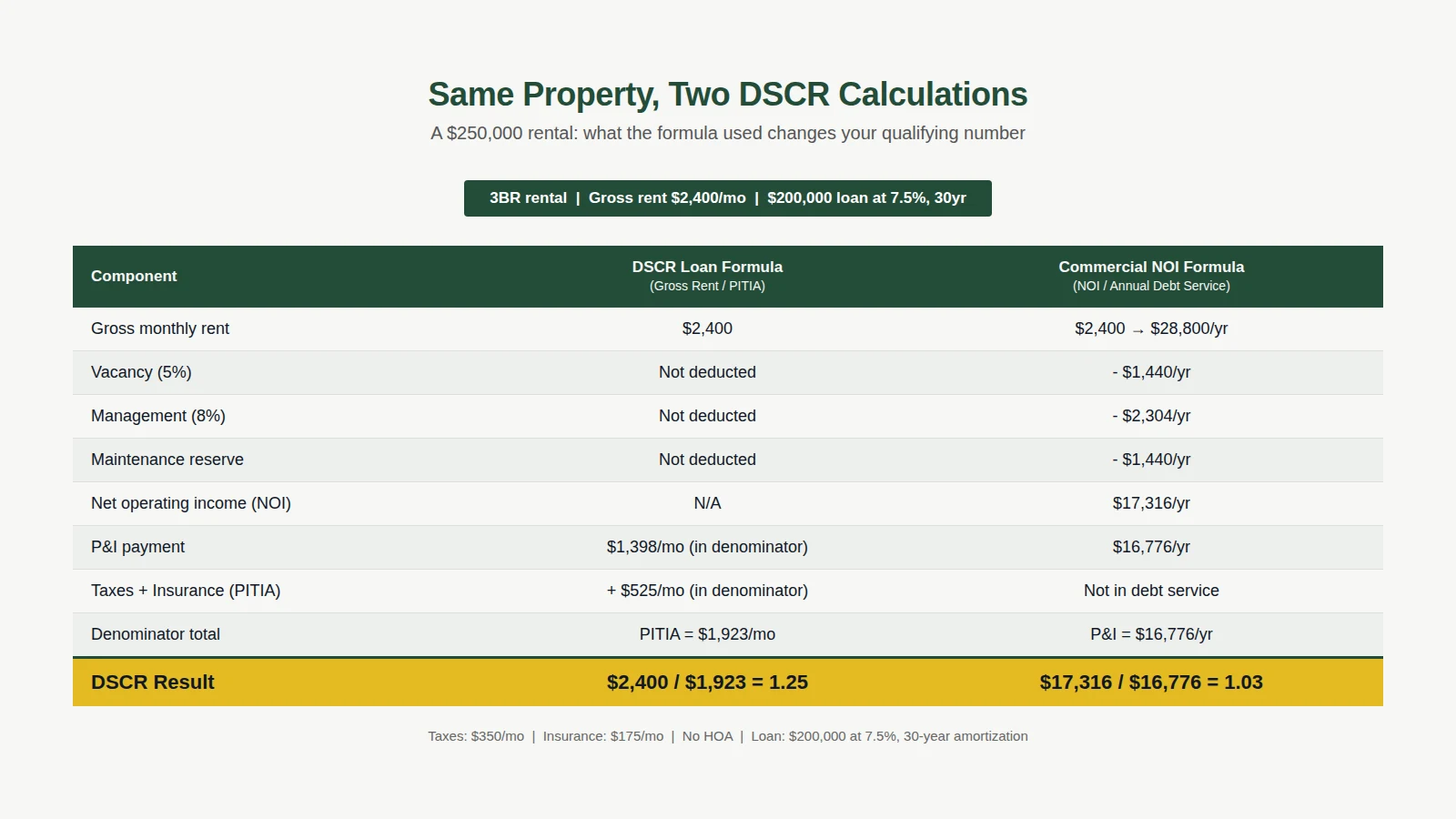
Take a three-bedroom rental with $2,400 in monthly gross rent and a $200,000 loan at 7.5% over 30 years. The principal and interest payment is $1,398 per month. Property taxes run $350 per month. Landlord insurance runs $175 per month. No HOA.
Under the DSCR loan formula: $2,400 divided by $1,923 (the combined PITIA) equals 1.25. That clears the threshold at most DSCR lenders and lands in standard pricing territory.
Under the NOI formula: start with $28,800 in gross annual rent. Subtract a 5% vacancy allowance ($1,440), 8% property management ($2,304), a 5% maintenance reserve ($1,440), annual taxes ($4,200), and annual insurance ($2,100). NOI is $17,316. Divide by annual P&I of $16,776. Result: 1.03. A commercial bank sees a property that barely clears the debt service with nothing left over.
Both calculations are correct. They ask different questions. The DSCR loan formula asks whether the rent covers the total housing payment. The NOI formula asks whether the property, run as a business with realistic operating costs, generates a meaningful surplus over its mortgage payments alone.
Want terms on a specific deal?Answer seven questions and get a decision in 72 hours.
Get FundingWhat moves the PITIA denominator
On a DSCR rental loan, your ratio is only as strong as the accuracy of the PITIA estimate. Each component in the denominator is a variable, and most of them move at closing or shortly after.
Property taxes. Lenders use the assessed tax figure on file, which lags the purchase price in most states. If you buy at $320,000 and the current tax bill reflects an assessment of $195,000, the PITIA at origination looks better than the PITIA after the county’s next reassessment cycle. Investors in New Jersey, Illinois, and Connecticut regularly watch their DSCR erode in year two because the tax assessment catches up to the transaction price.
Insurance. A landlord policy on a rental property runs 15% to 25% higher than a standard homeowner policy on the same structure. In coastal markets, wind and flood endorsements can push monthly insurance costs above $300 on a $250,000 property. Use the actual insurance quote in your calculation, not a round-number estimate. A $50 gap in monthly insurance moves a 1.22 DSCR to 1.19 on a $200,000 loan, and 1.19 sits in a different pricing tier at many lenders.
HOA dues. On condos and most townhomes, HOA dues belong in the PITIA denominator. Dues of $400 per month on a property with $2,400 in rent and a $1,398 P&I payment would mean a PITIA of $2,323 and a DSCR of 1.03, versus a 1.25 on a comparable single-family home. Many borrowers model the deal without the HOA and find out at commitment that the number does not work.
Interest rate. A half-point rate move on a $200,000 loan shifts the monthly P&I by roughly $65. On a property at 1.20 DSCR, a rate lock 50 basis points higher than you underwrote can push the final number to 1.16 or below a lender’s floor. Lock the rate before you run your final DSCR calculation, or run the calculation at a 0.25% buffer above your expected rate.
How lenders actually use the ratio
Most DSCR lenders tier their pricing on the ratio. A property below 1.0 almost always results in a decline: the rent does not cover the payment, and there is no underwriting basis to approve the loan on the income alone. Between 1.0 and 1.09, some lenders will approve at a rate premium and a lower maximum LTV. From 1.10 to 1.24, you are in standard-approval territory at most lenders. At 1.25 and above, the deal qualifies for best-tier pricing and full LTV allowances.
A handful of lenders will approve at a ratio below 1.0 for borrowers with strong credit and substantial reserves, on the theory that the investor is subsidizing the property from other income. That is a legitimate loan structure, but it is not a DSCR loan in the standard sense: the property itself is not covering its cost.
Use the DSCR calculator to run your gross rent and PITIA before you apply. It uses the same gross-rent-over-PITIA approach the majority of non-QM lenders apply, so the number you see is close to the number your lender will compute at underwriting.
For a full breakdown of how the ratio maps to rate tiers and LTV allowances, see DSCR loan rates: what tier your deal lands in.
When the DSCR loan formula is the wrong one
If you are buying or refinancing a property of five or more units, you will not be using a DSCR rental loan. Commercial underwriters want a full NOI analysis: actual rent rolls, trailing 12-month expenses, and vacancy history. A 1.25 on the gross-rent-over-PITIA formula means nothing in that context.
If you are analyzing a deal before applying, running both formulas tells you more than running one. The DSCR loan formula shows whether the deal qualifies for this type of financing. The NOI formula shows whether the property actually operates at a surplus after real expenses. A property at 1.25 on one and 1.03 on the other is covering its mortgage, but it is not generating meaningful cash flow above that. If taxes reassess upward, if a unit sits vacant for two months, or if a capital expense hits, the property goes negative. That is not a reason to reject the deal, but it is information you need before setting your reserve target.

When this loan is wrong for you: the honest limits
DSCR loans are not the right structure in several situations that come up regularly.
Vacant properties. A vacant property has no rent and therefore no DSCR. If you are buying a property you intend to stabilize before holding, you need bridge financing or hard money during the renovation and lease-up, then a DSCR loan once the income is documented. See the bridge loan program if you are in that position.
Thin coverage at origination. A 1.01 DSCR means there is almost no margin for any of the variables described above to move against you. Technically approvable at some lenders, but the property has no operational cushion. A tax reassessment, a rate adjustment at refinance, or a month of vacancy can push the operating reality below break-even.
STR income you cannot document. Short-term rental income from Airbnb or Vrbo can qualify, but lenders haircut the projection by 25% to 30%, and some fall back to the long-term market rent equivalent if the property has no operating history. If your deal pencils only at the full STR projection, run the numbers at a 70% occupancy assumption and verify the DSCR still clears your lender’s floor.
Owner-occupied purchases. DSCR loans are business-purpose financing for investors. They are not available for a home you will live in as a primary residence. If you are buying a primary residence, these loans are not for you and we cannot fund that transaction.
What it costs when the deal slips. If the property does not lease up at the projected rent, or if you miscalculate PITIA and close on a ratio below 1.0, you are carrying a loan on a property that does not generate enough income to cover its payment. On a 30-year note at 7.5%, you are paying roughly $1,398 monthly on a $200,000 loan. A vacancy of two months costs $4,800 in lost rent. There is no interest-only period on most DSCR loans, and the payment does not pause because the property is vacant. Budget the reserve before you close.
Common questions
What DSCR formula do rental lenders actually use?
Most non-QM DSCR lenders use gross monthly rent divided by monthly PITIA (principal, interest, taxes, insurance, and any HOA dues). They do not subtract vacancy, management fees, or maintenance before calculating the ratio. This is different from the NOI-based formula used in commercial lending.
Is a DSCR of 1.0 enough to qualify?
It depends on the lender. Some approve at 1.0, meaning the rent exactly covers the payment with no cushion. Most tier their pricing, so 1.0 to 1.09 often comes with a rate premium and a lower LTV cap. Standard pricing typically starts at 1.10 or 1.25 depending on the lender. Below 1.0 almost always declines.
Why does the DSCR loan formula give a higher number than the NOI formula?
The DSCR loan formula uses gross rent in the numerator with no expense deductions. The NOI formula subtracts vacancy, management, maintenance, taxes, and insurance from gross income. Because the loan formula front-loads the numerator and moves taxes and insurance to the denominator instead of deducting them above the line, the resulting ratio is almost always higher.
Do property taxes and insurance affect my DSCR?
Yes, and more than most borrowers expect. In the DSCR loan formula, taxes and insurance are part of the PITIA denominator. Higher taxes in high-tax states, landlord insurance surcharges, and coastal wind or flood riders all increase the denominator and reduce the ratio. Use actual quoted figures, not estimates.
Can I use projected short-term rental income to calculate my DSCR?
Some lenders accept STR income, but they apply a haircut to the projection, typically 25% to 30% off the AirDNA or trailing estimate. If the property has no rental history, lenders often fall back to the long-term market rent equivalent, which will be lower than your optimistic STR projection. Run both numbers before you commit to a purchase price.
What happens if my DSCR is below 1.0?
A sub-1.0 DSCR means the gross rent does not cover the PITIA payment. Most DSCR lenders will decline or require a substantial rate premium and lower LTV. If the property is vacant or you intend to raise rents after renovation, a bridge loan or hard money loan is the more appropriate structure until the income supports a DSCR approval.
Ready to fund your next deal?
Approval within 72 hours. Close in 5 to 10 business days.
Get Funding Now