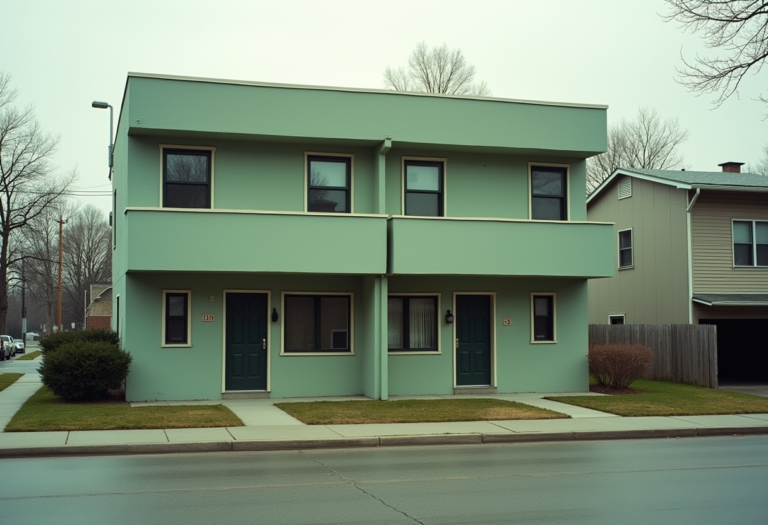
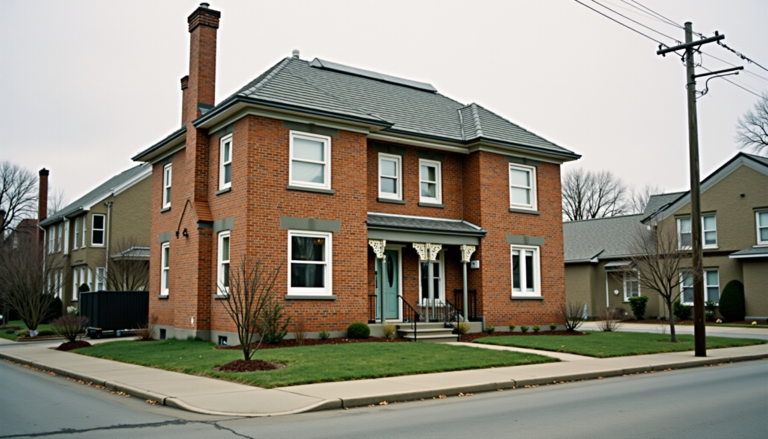
DSCR Loans for Multifamily: How Underwriting Changes at 2-4 Units vs 5+ Units
The residential DSCR formula and the commercial DSCR formula produce very different qualifying outcomes on the same rent roll. Here is where the threshold is, why it exists, and what moves the number on each side.
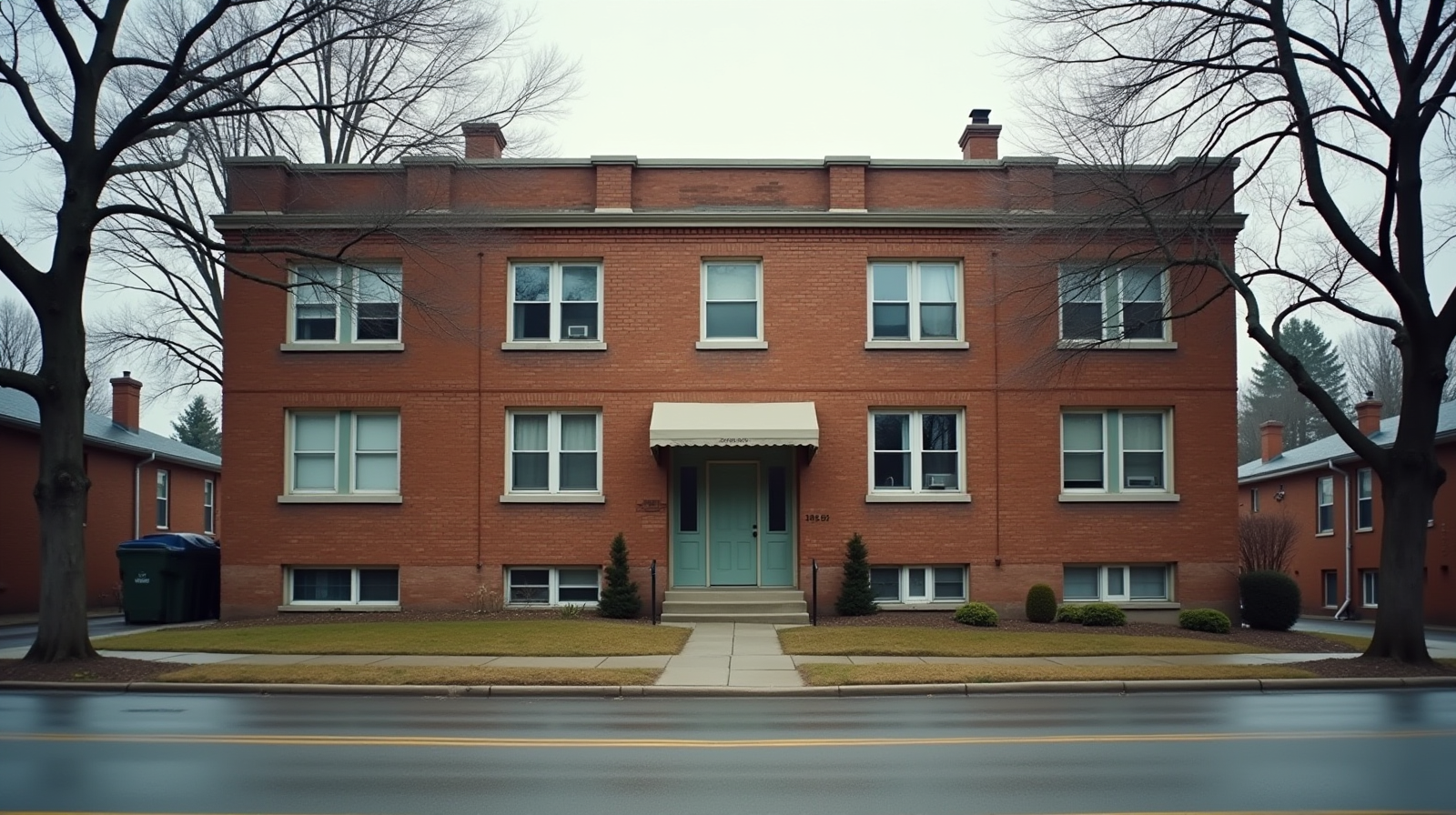
A DSCR loan qualifies a property on its income, not your tax returns. For 2- to 4-unit rentals, lenders calculate DSCR against the full PITI payment. Cross the 5-unit line and the framework shifts to commercial underwriting: NOI divided by annual debt service, with vacancy and operating expenses pulled out first. This post covers investor-held income properties only. It is not for owner-occupants or anyone financing the home they live in.
Where the residential and commercial threshold falls
The 1- to 4-unit threshold is a regulatory artifact, not an arbitrary lender preference. Properties with one to four residential units are treated as residential real estate under conventional lending guidelines. Loans on these properties carry residential underwriting rules, residential appraisal requirements, and residential-style rate sheets. Above four units, federal guidelines classify the property as commercial real estate, and the underwriting framework changes accordingly.
For business-purpose investors, this matters because most standard DSCR loan programs are written for the 1- to 4-unit world. Once you are looking at a 5-unit apartment building or larger, you are dealing with commercial underwriting whether the term sheet says “DSCR loan” or not. Some lenders do offer DSCR-style products for small multifamily up to 10 or 20 units, but the calculation method is almost always the commercial framework described below.
How DSCR is calculated on a 2-4 unit property
On a 1- to 4-unit rental, the DSCR formula is straightforward: divide the gross monthly rent by the full PITI payment. PITI is principal, interest, taxes, and insurance. Some lenders also include HOA fees if applicable.
Example: a fourplex renting for $4,800 per month total, with a PITI of $3,840 per month, has a DSCR of 1.25. Most DSCR lenders want 1.0 or better, with better pricing starting around 1.20. A 1.25 sits in a solid middle tier on most rate sheets. See how DSCR loan rates tier by DSCR band and LTV for how a 1.25 versus 1.0 affects your actual rate.
What the formula does not do is subtract vacancy or operating expenses. The lender uses gross scheduled rent against a payment that already includes taxes and insurance. Your personal income, DTI ratio, and employment history are not factors. Your CPA’s Schedule E does not enter the file.
Want terms on a specific deal?Answer seven questions and get a decision in 72 hours.
Get FundingWhat changes at 5 units: the commercial framework
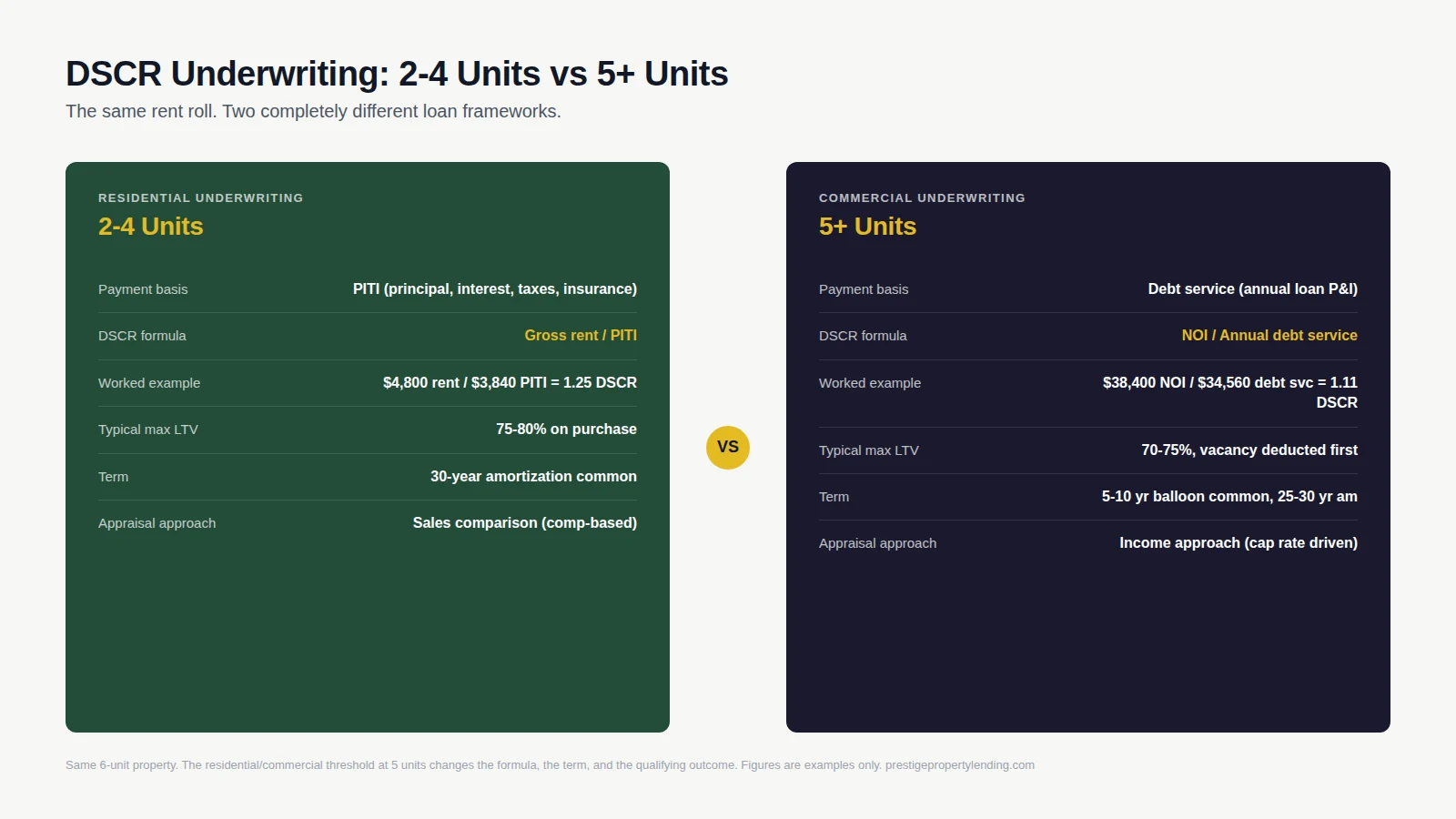
Once you cross into 5 or more units, lenders switch to a commercial DSCR calculation. The formula is NOI divided by annual debt service, where NOI is net operating income. The shift matters because NOI is not gross rent. It is gross rent minus a vacancy allowance minus operating expenses, before the mortgage payment enters the calculation.
The appraisal method changes too. A residential appraisal on a fourplex compares it to recent sales of similar properties in the area. A commercial appraisal on a 6-unit building is primarily an income approach: the appraiser estimates the market cap rate, applies it to the NOI, and derives value from the income the property produces. If your rents are below market, the appraised value may come in below the purchase price even on a deal that looks clean on paper.
Loan terms also diverge. Residential DSCR loans often offer 30-year fully amortizing terms. Commercial loans at the 5-unit level more commonly carry 25-year amortization with a 5- or 10-year balloon, after which you refinance or sell. A 25-year amortization at the same rate raises the monthly payment and compresses the DSCR on the same rent roll. That compression is one of the reasons deals that look easy as a fourplex become harder to qualify when you step up to a six-unit.
From gross rent to qualifying NOI: the calculation in full
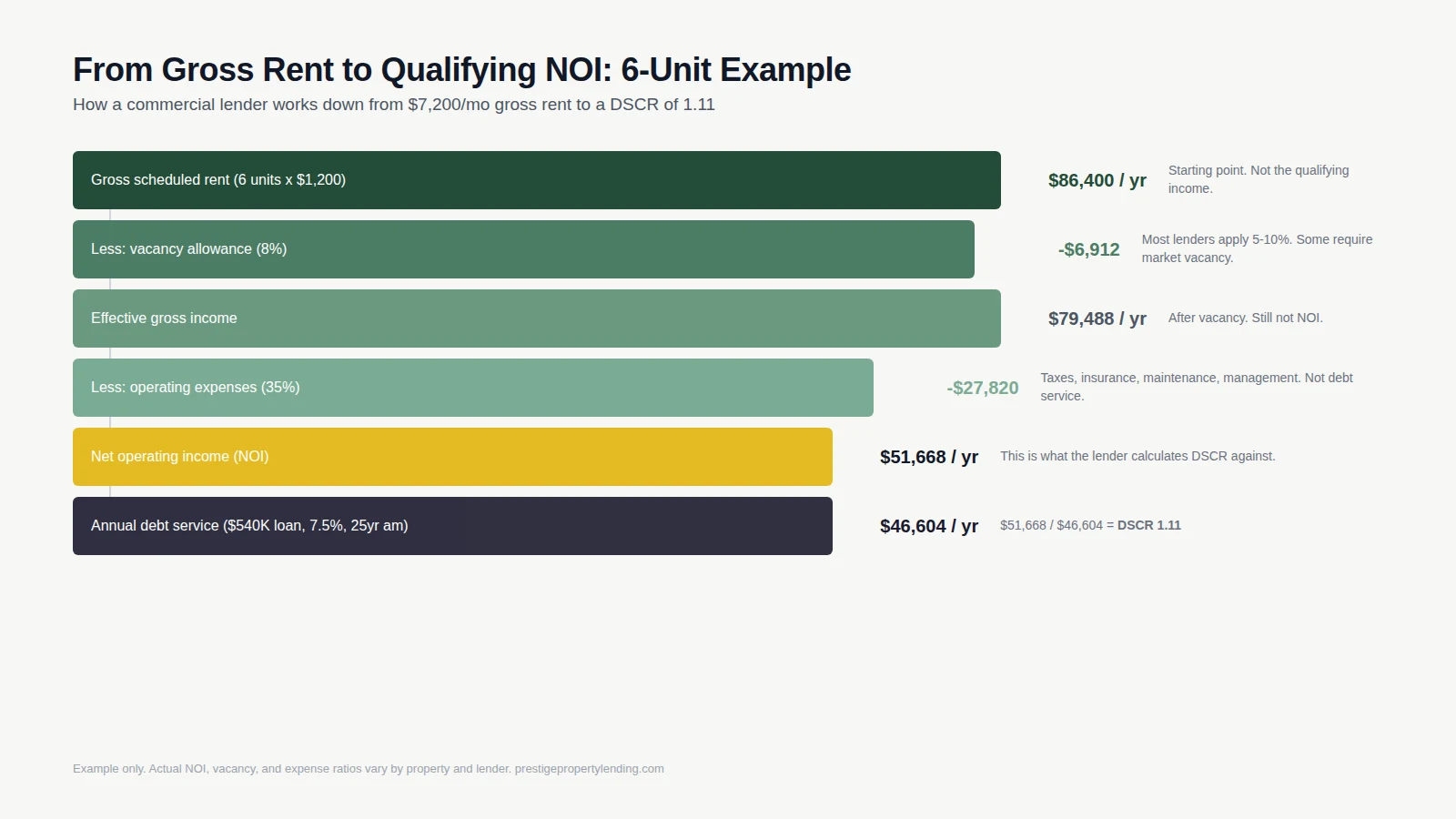
The graphic above walks through a 6-unit property at $1,200 per unit per month: $7,200 gross monthly rent, $86,400 per year. Here is how a commercial lender works down to the NOI they actually underwrite against.
First, a vacancy allowance. Most commercial lenders apply 5 to 10 percent. At 8 percent on $86,400, effective gross income drops to $79,488.
Second, operating expenses are subtracted. These include property taxes, insurance, maintenance, property management fees, and any utilities paid by the owner. Operating expenses typically run 30 to 45 percent of effective gross income for a small multifamily property. At 35 percent, that is $27,820 in expenses, bringing NOI to approximately $51,668 per year.
The DSCR is then $51,668 NOI divided by annual debt service. On a $540,000 loan at 7.5 percent over 25-year amortization, annual debt service is roughly $46,604, producing a DSCR of 1.11.
Compare that to the same rent roll treated as a 4-unit under the residential formula: $7,200 gross rent against a monthly PITI of roughly $3,884 ($46,604 annualized) gives a DSCR of 1.85. Same economics, same loan, same rent. The formula is the entire difference. The 4-unit version qualifies easily at any threshold; the 6-unit version sits at 1.11, which qualifies but lands in a weaker pricing tier at most lenders. Use the DSCR calculator to run your own numbers with different rent, expense, and loan assumptions.
What moves the qualifying DSCR on a commercial multifamily deal
Rents relative to market. Commercial appraisers note where your leases sit versus market rents. Below-market rents lower both the appraised value and the qualifying income. If you are buying a building where a long-term tenant is paying $800 in a $1,200 market, the lender will not give you credit for $1,200 until the lease turns over.
Actual operating expenses versus the lender’s floor. Lenders often apply a standardized expense ratio rather than using your actual numbers if the property has limited operating history. A well-maintained building with demonstrably low expenses cannot always override the lender’s floor. Ask what expense ratio the lender underwrites to before running your deal.
Vacancy assumption. In a tight market with documented low vacancy, you may be able to support a lower factor with data. In a market with 12 percent vacancy, the lender may apply more than the standard 5 to 8 percent, which compresses qualifying NOI further.
Amortization period. Pushing for a longer amortization, where available, reduces annual debt service and increases the DSCR on the same NOI. The difference between 25 and 30 years at 7.5 percent on a $540,000 loan is roughly $3,000 in annual debt service, which moves the DSCR from 1.11 to 1.18 on this example. Worth negotiating.
When this financing is the wrong choice
A commercial DSCR loan is the wrong tool in several situations worth naming directly.
If you are buying a 5- to 10-unit property where two or three units are currently vacant, the lender’s vacancy adjustment will stack on top of an already weak NOI. A deal that cash-flows at full occupancy may not qualify at all under stabilized underwriting assumptions. The better path is a bridge loan to carry the asset through lease-up, then a refinance into a permanent loan once occupancy is verified and seasoned. See the bridge loans page for how that sequence works.
If rents are below market due to long-term tenants, the income-approach appraisal will use market rents, not current rents, to set cap rate value. You may need more equity at closing than the purchase price math suggested, because the appraised value comes in lower than expected.
If you need a 30-year term to make the debt service work, many commercial lenders at this property size will not offer it. The balloon payment risk at year 5 or 10 is real. If rates are materially higher at refinance time, the new payment may not qualify on the existing rent roll.
And if you are buying or refinancing the home you live in, none of this applies. Business-purpose DSCR financing is for investor-owned income properties. Consumer mortgage financing is a separate product with different rules and different eligibility. Call 917-842-9982 to discuss whether a specific property qualifies.
What to do next
For 1- to 4-unit rentals, the standard program on the DSCR rental loans page likely fits. Start with the DSCR calculator: plug in the gross rent and estimated PITI to see where you land. A 1.20 DSCR or higher is where pricing improves meaningfully.
For 5 or more units, the NOI-based calculation above is the starting point. The qualifying outcome depends on the expense ratio the lender applies, the vacancy assumption, and the amortization period on offer. Getting a preliminary term sheet before going under contract is worth the two days it takes. Call 917-842-9982 or email info@prestigepropertylending.com to run the numbers on a specific property.
Also see portfolio loans for rental investors, which covers how multiple properties can be blended onto one note, including how a weaker-DSCR property in a portfolio can be offset by stronger ones.
Common questions
Can you get a DSCR loan on a property with 5 or more units?
Some lenders offer DSCR-style products for small multifamily properties up to 10, 20, or even 30 units. The calculation method shifts to the commercial framework: NOI divided by annual debt service rather than gross rent divided by PITI. The qualifying standards, LTV limits, and loan terms also differ from residential DSCR programs. Not every DSCR lender works in this space, so confirm before applying.
Why does the DSCR come out differently on the same property at 4 units versus 5 units?
The formula changes. On a 4-unit property, DSCR is gross rent divided by the full PITI payment. On a 5-unit property under commercial underwriting, DSCR is NOI (after vacancy and operating expenses) divided by annual debt service. The commercial calculation deducts vacancy and expenses before computing the ratio, which typically produces a lower DSCR number on the same rent roll. The two numbers are not directly comparable.
What is a normal expense ratio for a small multifamily property?
Most lenders underwrite to 30 to 45 percent of effective gross income for properties in the 5- to 20-unit range. The actual figure depends on the property type, age, whether utilities are included in rent, and property management structure. If you have 12 months of actual operating statements, a lender may use your actuals rather than a standardized assumption, but many apply a floor regardless.
Does the 4-unit threshold apply to mixed-use properties?
Mixed-use properties, those with commercial space on the ground floor and residential units above, are generally treated as commercial regardless of unit count. The income approach applies to the whole property, and the residential DSCR calculation does not typically apply. Some lenders also have stricter LTV caps on mixed-use collateral.
What LTV can you get on a 5-plus unit DSCR deal?
Most commercial lenders cap at 70 to 75 percent LTV on a purchase, and some calculate it against the income-approach appraised value rather than the purchase price if those figures differ. Cash-out refinances typically go to 65 to 70 percent. The vacancy and expense deductions in the NOI calculation mean that a property needs a stronger gross rent relative to the purchase price to qualify at higher LTVs.
Can a 5-unit property qualify using the residential DSCR formula?
Not through most standard DSCR loan programs. Those programs are structured for 1- to 4-unit residential properties. A lender applying a residential DSCR calculation to a 5-unit property would be stepping outside the collateral type the program is designed for, and most will not do it. If a lender offers a DSCR loan on a 5-unit property, read the term sheet carefully to understand which formula they are using.
Ready to fund your next deal?
Approval within 72 hours. Close in 5 to 10 business days.
Get Funding Now