Interest-Only Loans for Real Estate Investors: How the Payment Structure Affects Your DSCR and Your Exit
Interest-only loans are the default payment structure on DSCR rentals, bridge loans, and hard money products, not the exception. The IO period lowers your monthly payment and directly raises your DSCR on the same rent. Here is the arithmetic, the conversion trap at month 61, and who IO is wrong for.
If you have looked at a DSCR loan, a bridge loan, or a hard money loan term sheet, you have already seen an interest-only payment. These are not special programs aimed at homeowners stretching into a house they cannot afford. On business-purpose investor loans, interest-only is the default structure. This post covers the mechanics for real estate investors. If you are buying a primary residence, this loan type is not available through business-purpose lenders, and the programs that apply to you are different.
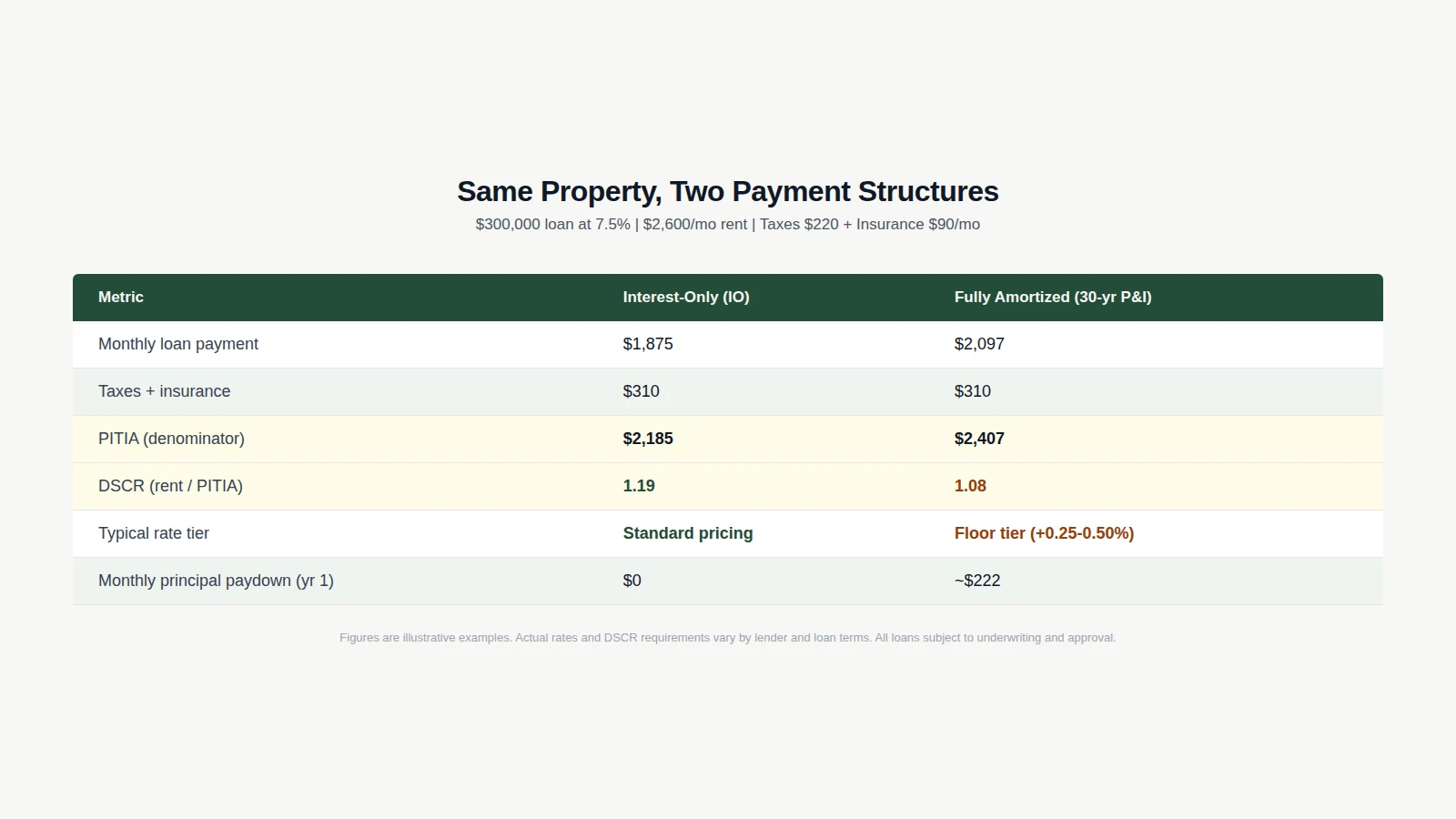
On a $300,000 loan at 7.5%, the interest-only payment is $1,875 per month. A 30-year fully amortized payment on the same loan is $2,097. That $222 difference does not seem significant until you run it through the DSCR formula, where it can determine your rate tier and whether your deal qualifies at all.
How the IO payment is calculated
The arithmetic is straightforward: loan balance multiplied by the annual interest rate, divided by 12. On a $300,000 loan at 7.5%, that is $300,000 times 0.075, divided by 12, which equals $1,875. Nothing amortizes. The balance stays at $300,000 for the entire IO period.
A fully amortized 30-year payment on the same loan runs through a formula that spreads both interest and principal across 360 payments. The result is $2,097 per month at 7.5%. In the first month, $1,875 of that $2,097 is still interest. Only $222 reduces the principal. After five years of paying $2,097 each month, your balance has dropped to roughly $279,000, a paydown of $21,000 on a $300,000 loan over 60 months.
For an investor on a 5-year hold, the equity difference is minimal either way. The meaningful difference is the $222 per month in payment and the DSCR calculation that flows from it.
Why IO changes the DSCR on the same property
DSCR lenders calculate the ratio as gross rent divided by PITIA, where PITIA is principal, interest, taxes, insurance, and any HOA. The denominator is the number that changes between IO and P&I.
Take a property generating $2,600 per month in rent, with taxes of $220 and insurance of $90 per month. On a $300,000 loan at 7.5%:
- IO payment: $1,875. PITIA = $1,875 + $220 + $90 = $2,185. DSCR = $2,600 divided by $2,185 = 1.19.
- P&I payment: $2,097. PITIA = $2,097 + $220 + $90 = $2,407. DSCR = $2,600 divided by $2,407 = 1.08.
Both numbers clear the typical 1.0 minimum. But 1.19 lands in the pricing sweet spot for most DSCR lenders, where rates improve meaningfully compared to floor-tier deals. At 1.08, you are in the floor tier, which typically means a rate premium of 0.25 to 0.50 percentage points over standard pricing. On a $300,000 loan, a half-point rate premium adds roughly $125 per month in cost and compounds over the hold period.
Use the DSCR calculator to run these scenarios with your specific property numbers before calling. The calculator shows both IO and P&I outcomes on the same input set.
Want terms on a specific deal?Answer seven questions and get a decision in 72 hours.
Get FundingWhich loan types use IO and which do not
| Loan type | IO structure | Why |
|---|---|---|
| DSCR rental (30-yr) | IO period of 5, 7, or 10 years, then amortizes | Improves DSCR at qualification; keeps carry low during hold |
| Bridge loan | IO for the full term (12 to 24 months) | Short term with no equity to build; exit is sale or refinance |
| Hard money | IO for the full term (6 to 18 months) | Same rationale as bridge: short duration, exit-driven underwriting |
| Fix and flip | IO on drawn balance during construction | Balance grows as draws are taken; interest accrues only on disbursed funds |
| New construction | IO during the build; full payment triggers on completion | Draw schedule controls the balance; term loan begins when funds are fully disbursed |
The mechanics of drawn-balance IO on a construction or fix-and-flip loan work differently from a standing loan balance. The post on how construction loan draw schedules work covers the inspection lag and the float you carry between draws.
What happens to your balance when the IO period ends
On a 30-year DSCR loan with a 5-year IO period, you pay interest only through month 60, then the loan converts. At conversion, your balance is still $300,000, because you paid down nothing. The new payment must now amortize that full balance over the remaining 25 years.
At 7.5%, a 25-year amortization on $300,000 runs $2,217 per month. That is $342 more than the $1,875 IO payment you had been making, and $120 more than the $2,097 you would have paid on a 30-year fully amortized loan from day one.
The PITIA at conversion: $2,217 plus $220 taxes plus $90 insurance equals $2,527. If your rent is still $2,600, the DSCR at conversion is $2,600 divided by $2,527, which is 1.03. That is above the 1.0 minimum, but barely. A lender refinancing this loan at conversion will underwrite it at 1.03, not at the 1.19 you showed at origination. If the lender’s standard pricing threshold is 1.10, your next refinance lands in the floor tier regardless of how clean your payment history has been.
This is the conversion trap the IO period obscures. The IO payment qualified the deal comfortably. The same deal at IO-to-P&I conversion qualifies at the floor, assuming no rent growth and no rate improvement. Rent growth is the buffer. Model it before you originate, not after the IO clock starts ticking.

IO on bridge and hard money: why the structure is different
A 12-month bridge loan at 10% IO on $500,000 costs $4,167 per month. That is the full payment, and the balance stays at $500,000. There is no amortization because the loan was never designed to be paid down, only paid off. You acquire the asset, execute the business plan, and exit by sale or by refinancing into a longer-term product. The IO structure keeps the monthly carry calculable from day one and allows you to underwrite the deal on the spread between acquisition cost and exit value, not on whether current income covers the payment.
IO on bridge and hard money also means your break-even hold analysis stays clean. If the project runs over on timeline, you know exactly what each additional month costs before you need the extension. On a $500,000 IO bridge at 10%, one extra month is $4,167 plus the extension fee, which typically runs 1 to 2 points on the balance. The post on how investors tell bridge loans apart from hard money has the drawn-balance cost difference that matters on rehab projects where the balance builds over time.
See the bridge loan program page for current structures on short-term investor loans.
When IO is the wrong choice for your deal
Interest-only suits a specific investor profile and hold strategy. Here are four cases where it is the wrong tool:
- Your hold plan requires equity paydown. IO does not build it. You exit with the same balance you started with unless the property appreciated. In flat appreciation markets, you are holding all the principal risk with no paydown buffer.
- Your rent barely covers the IO payment. The DSCR at conversion will be below 1.0 on the same property. The IO period was not a buffer; it was a countdown. You need a refinance plan before month 60, not a reaction after the payment spikes.
- You are a long-hold investor aiming to own properties free and clear. IO slows that timeline considerably. On a 30-year loan with a 5-year IO period, you begin amortizing the original balance at month 61 over only 25 years rather than building paydown from day one.
- Your market is thin on rental demand. A vacancy during the IO-to-P&I transition can push a break-even property into negative cash flow with no easy refinance path available at 1.0 DSCR.
This loan type is available only for business-purpose real estate investment, not for owner-occupied primary or secondary residences. All loans are subject to underwriting and lender approval. For deal-specific numbers, call 917-842-9982.
Common questions
Do all DSCR loans have an interest-only period?
Not all, but most DSCR loans from business-purpose lenders include an IO option, typically 5, 7, or 10 years. Some lenders offer only fully amortized products. Some offer the IO period as a rate upgrade that costs a small premium over the fully amortized version. Ask specifically when comparing term sheets, because the IO versus P&I choice can shift the qualifying DSCR by 0.10 to 0.20 points on the same property.
Does the IO period let me borrow more on the same property?
Indirectly, yes. Because DSCR qualification runs on the PITIA payment rather than on income documentation, a lower IO payment allows the same rent to clear the DSCR threshold at a higher loan balance. A property that fails the test at $350,000 on a P&I payment might clear it on an IO payment. Run both scenarios in the DSCR calculator before sizing the loan.
What happens to my balance when the IO period ends?
It is still the full original loan amount. On a 30-year DSCR loan with a 5-year IO period, you spent 60 months paying only interest. At month 61, the remaining 25-year amortization schedule begins on the original balance. The monthly payment rises, and how much it rises depends on the rate you locked at origination and what the current market looks like for a refinance.
Can I make extra principal payments during the IO period?
Typically yes on DSCR loans. Most business-purpose IO loans allow voluntary principal payments, which would reduce the balance before conversion and lower the conversion payment. The prepayment penalty governs whether there is a cost to paying off the loan entirely, but voluntary extra payments toward the balance are usually permitted. Confirm the specific terms with the servicer before sending additional principal, because some IO DSCR products restrict prepayment differently than their P&I counterparts.
Are bridge loans and hard money loans always interest-only?
Almost always. Bridge and hard money loans are short-term by design, 6 to 24 months, and the underwriting is built around the exit rather than the monthly cash flow. A fully amortizing bridge loan would require a very high monthly payment on a short schedule and would not be competitive with IO alternatives. There are a small number of lenders who offer P&I bridge structures for specific borrower profiles, but IO is the market standard for short-term investor bridge financing.
Ready to fund your next deal?
Approval within 72 hours. Close in 5 to 10 business days.
Get Funding Now