What Lenders Check Before They Issue a Term Sheet
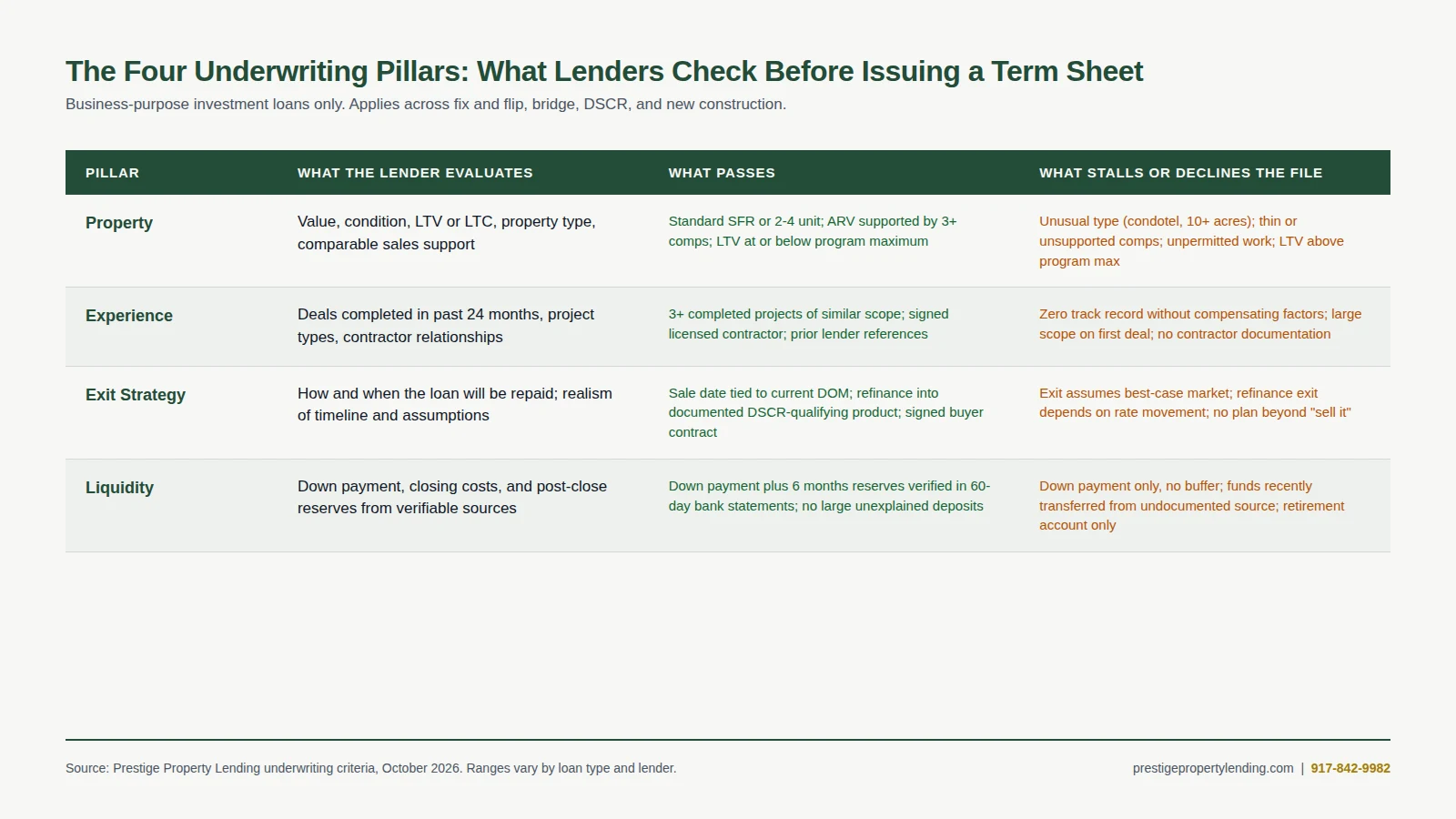
A term sheet comes after a lender has evaluated four things: the property, your track record, your exit plan, and your liquidity. Most applications stall because one of those four is unclear. This post walks through what that evaluation actually looks like, and where files get declined.

A term sheet is not an approval. It is a lender’s preliminary offer: the rate, term, LTV, and conditions they are willing to underwrite after reviewing enough about the deal and the borrower to price it. Most applications stall because one of four things is unclear: the property value, the borrower’s track record, the exit plan, or the cash position. This post covers business-purpose investment loans only. If you are buying or refinancing a home you intend to live in, this is not your process.
What a term sheet actually is
A term sheet is a preliminary commitment, not a binding agreement to lend. It states the loan amount, rate, term, LTV or LTC, fees, and conditions the lender will require to close. It arrives after enough review to price the deal, which is usually less than a full underwrite. The appraisal, title search, and full file review come after, not before, the term sheet.
That sequence matters because most investors treat a term sheet as harder to get than it is, and treat an approval as easier. The term sheet is issued when a lender decides the deal is worth pursuing. The approval is when they have verified everything they said they would verify.
The four things every lender evaluates
Regardless of loan type, these four factors determine whether a term sheet gets issued and what it says.
Want terms on a specific deal?Answer seven questions and get a decision in 72 hours.
Get FundingThe property: what the lender is actually valuing
The property is the collateral, and that fact drives every other number in the term sheet. For a fix and flip, the lender works off after-repair value (ARV): the estimated value once the project is complete. For a bridge loan, it is the current as-is value. For a DSCR loan, the lender cares about both the appraised value and whether the rent covers the payment.
LTV caps vary by loan type and lender. A fix and flip program typically lends up to 70 to 75 percent of ARV. On a property with a $350,000 ARV, that supports a loan of $245,000 to $262,000. If your purchase price is $210,000 and your rehab budget is $85,000, you are asking for $295,000 against a $350,000 ARV, which is 84 percent. That exceeds the program maximum for most lenders, and the term sheet either does not come or comes with conditions: additional collateral, a larger down payment, or a co-borrower.
Run the numbers through the ARV calculator before submitting. A lender who receives a file with a worked ARV estimate, the three comparable sales you used, and a line-item rehab budget has less reason to slow down than one who receives a round number and an assumption.
Property type affects terms independently of value. Standard single-family and 2-4 unit properties are the clearest path. Condotels, rural properties over 10 acres, properties with significant unpermitted work, or anything with title complexity will add time, reduce the maximum LTV, or both.
Your experience: how much it matters and why
Business-purpose lenders do not rely on credit history the way consumer lenders do. For short-term loans like hard money and fix and flip, the property is the primary underwriting vehicle. But track record still matters, and zero experience is a different file than three completed projects.
A borrower with three flips completed in the last 24 months gets different options than a first-time borrower on the same property. The gap shows up in rate, LTV, and sometimes in whether the loan gets approved at all. A first-time borrower on a $500,000 project in an unfamiliar market is a materially different risk than a borrower who has sold four projects in that county.
What compensates for limited experience:
- A lower LTV request. Asking for 60 percent of ARV instead of 75 percent changes the risk profile on both sides.
- A documented contractor relationship. A signed contract with an established licensed contractor is not the same as an informal arrangement.
- Strong liquidity beyond the down payment. A borrower with six months of interest in verified liquid form is a different file than one who arrives at closing with nothing left over.
- A simpler project. A cosmetic flip with a $35,000 scope is fundable at LTVs that a full gut renovation is not.
The exit strategy: why the end of the loan matters from the start
Every business-purpose loan has a maturity date. A lender issues a term sheet knowing they will need to be repaid, and the exit strategy is your answer to how that happens.
For a fix and flip, the exit is a sale. Lenders want to know your realistic timeline for completing the renovation and selling, and they will compare it against the current days-on-market in that submarket and your ARV assumptions. If you estimate a 90-day project with a 30-day listing period and local DOM is 60, you are already at the edge of a 6-month term. Building in a buffer is not pessimism, it is underwriting.
For a bridge loan, the exit might be a sale of the bridge property, a refinance into a permanent product, or the close of a separate transaction the bridge is funding. Lenders want the exit to be probable, not merely possible. A concrete date and a documented plan carry more weight than a general intention to refinance.
For a DSCR rental loan, the exit question is different. The loan is not expected to be repaid in 12 months. The underwriting question is whether the property’s rental income covers the payment for the life of the loan. The detailed walk-through of how a DSCR loan works from application to close covers the specific documents and timeline.
Liquidity and reserves: the number that surprises most borrowers
Your down payment is not your total cash requirement at closing. Lenders require verified liquidity that covers the down payment, closing costs, and, depending on the loan type, a cash reserve that must remain after close.
On a fix and flip with a $300,000 ARV and a 70 percent LTV loan, the cash requirement at close looks roughly like this:
| Line item | Amount (example) |
|---|---|
| Purchase price | $195,000 |
| Rehab budget (funded via draws) | $75,000 |
| Loan amount (70% of $300K ARV) | $210,000 |
| Down payment at close | $60,000 |
| Closing costs (2 to 3%) | $4,200 to $6,300 |
| Reserve requirement (6 months interest, varies) | $12,000 to $18,000 |
| Total cash needed at close | $76,000 to $84,000 |
That last figure surprises many first-time borrowers. The reserve requirement is not arbitrary. A project that runs three weeks over schedule because of a permit delay or a material backorder costs real money in carry. Verified reserves are the lender’s assurance that a minor delay does not become a default.
Reserve requirements vary by loan type. Some short-term programs require six months of interest in verified liquid form. DSCR loans typically require 6 to 12 months of principal and interest post-close. Use the fix and flip calculator to model the full cash requirement before approaching a lender, not after.
What a complete submission file looks like
The file that answers the four questions before the lender has to ask them earns a term sheet faster than a thin submission that requires three rounds of follow-up.

For most business-purpose loans, a complete initial submission includes:
- Property address and a short project description
- Estimated purchase price and, for fix and flip or construction, an itemized scope of work
- A comp-supported ARV estimate: three comparable sales, adjusted for condition and size
- A track record summary: deals completed in the last 24 months, with purchase price, sale price, and close date
- Entity documents for the borrowing LLC: operating agreement and articles of formation
- Bank statements covering the last 60 days, showing funds for the down payment and reserves
- A signed purchase contract, or a letter of intent if you are still in negotiation
You do not need an appraisal at submission. Most lenders order their own after issuing the term sheet. What you need is enough information for a lender to make a preliminary decision without requesting everything piecemeal.
When this loan is the wrong tool
Business-purpose loans carry higher rates and shorter terms than conventional financing because they close in days rather than months and underwrite the deal rather than the tax return. That tradeoff only makes sense in specific situations.
This loan is the wrong tool if you are buying a property you intend to live in. Business-purpose financing is not available for owner-occupied residential purchases. That is a regulatory line, not a preference.
This loan is the wrong tool if your exit is speculative. A 12-month bridge loan on a property where your only exit is selling at a price the market has not yet confirmed is a bet on timing. If the exit slips, you face extension fees, a default rate, or forced liquidation. Reserve requirements exist precisely because these scenarios are not hypothetical.
This loan is the wrong tool if your margin is too thin. A fix and flip that pencils at a $15,000 profit at ARV, with a $75,000 rehab budget and a 6-month loan, does not have enough margin to absorb a $10,000 cost overrun and two months of additional carry. The math stops working before you start.
Business-purpose loans are asset-based and deal-driven. When the property supports the value, the exit is concrete, and you have the liquidity to carry the project to repayment, they are one of the fastest and most flexible capital sources in real estate investing. When one of those three is missing, the term sheet reflects it, or it does not come at all.
To discuss a specific deal, call 917-842-9982.
Common questions
How long does it take to get a term sheet?
For most business-purpose loans, a term sheet arrives within 24 to 72 hours of a complete submission. The range depends on how much information is in the initial file. A submission with a clear ARV, a documented scope, and verified funds typically moves faster than one that requires multiple rounds of follow-up. Approval requires additional review after the term sheet and is separate.
Does a term sheet mean my loan is approved?
No. A term sheet is a preliminary offer, subject to appraisal, title review, and full underwriting. It confirms that a lender has reviewed enough to price the deal. It does not confirm that all conditions have been verified. The approval comes after those verification steps are complete.
What credit score do I need for a business-purpose investment loan?
Requirements vary by program. Short-term loans like hard money and fix and flip are primarily asset-based, and some programs have no minimum credit score requirement. DSCR loans typically require a 620 to 680 minimum, depending on LTV and other factors. A lower score may still qualify at a reduced LTV or with compensating factors such as strong reserves.
Can I get a term sheet if I have never done an investment deal before?
Yes, though your options are narrower than a borrower with a track record. Lenders compensate for zero experience by requiring a lower LTV, stronger liquidity, a simpler project, or a documented contractor relationship. A first-time borrower asking for 80 percent of ARV on a full gut renovation is unlikely to get a term sheet. The same borrower asking for 65 percent on a cosmetic flip with a signed contractor has a much better starting position.
What happens after I accept a term sheet?
After you sign the term sheet, the lender orders an appraisal and requests additional documentation: full entity documents, insurance binders, background checks, and title. That process takes 5 to 10 business days for most programs. The appraisal result can change the final loan amount if the appraised value comes in below the estimate you submitted.
Does the lender check my income or tax returns?
For most short-term business-purpose loans, no. The underwriting is asset-based: the property value and the borrower exit plan carry the decision. For DSCR loans, the lender checks that the rental income covers the debt service, not your personal income. Tax returns are generally not required for business-purpose investment loans, which is one of the reasons they can close quickly.
Ready to fund your next deal?
Approval within 72 hours. Close in 5 to 10 business days.
Get Funding Now