Mezzanine Financing in Real Estate: How the Capital Stack Works and What It Actually Costs
Mezzanine debt is not a second mortgage. It is secured by a pledge of the borrower's LLC interest, not by a lien on the property. Here is how the capital stack layers, what it actually costs, and the three failure modes investors miss.
Mezzanine financing is not a second mortgage. It is a subordinate debt instrument secured by a pledge of the borrower’s ownership interest in the entity that holds the property, not by a lien on the property itself. That distinction determines how the lender forecloses, what it costs to service, and why it only makes sense on deals large enough that the senior loan leaves a gap an investor cannot fill with equity alone.
This post is for investors working on commercial acquisitions or value-add projects above $3 million where the capital stack has three layers. If you are buying a single-family rental or a small multifamily property, mezzanine is not your financing tool. For smaller funding gaps on residential or light commercial deals, see our post on gap funding in real estate.
How the capital stack actually layers
Every real estate deal has three basic sources of capital: senior debt, subordinate debt, and equity. Senior debt gets the first lien and the lowest rate. Equity gets the highest return requirement and absorbs the first losses. Mezzanine debt sits between them, subordinate to the senior but ahead of the equity investors.
The standard capital stack on a $6 million commercial value-add project looks like this:
| Position | Amount | % of Project Cost | Typical Rate (late 2026) |
|---|---|---|---|
| Senior debt | $3,900,000 | 65% | 8.0 to 10.5% |
| Mezzanine debt | $1,350,000 | 22.5% | 13.0 to 18.0% |
| Equity | $750,000 | 12.5% | 18 to 25%+ IRR target |
| Total | $6,000,000 | 100% |
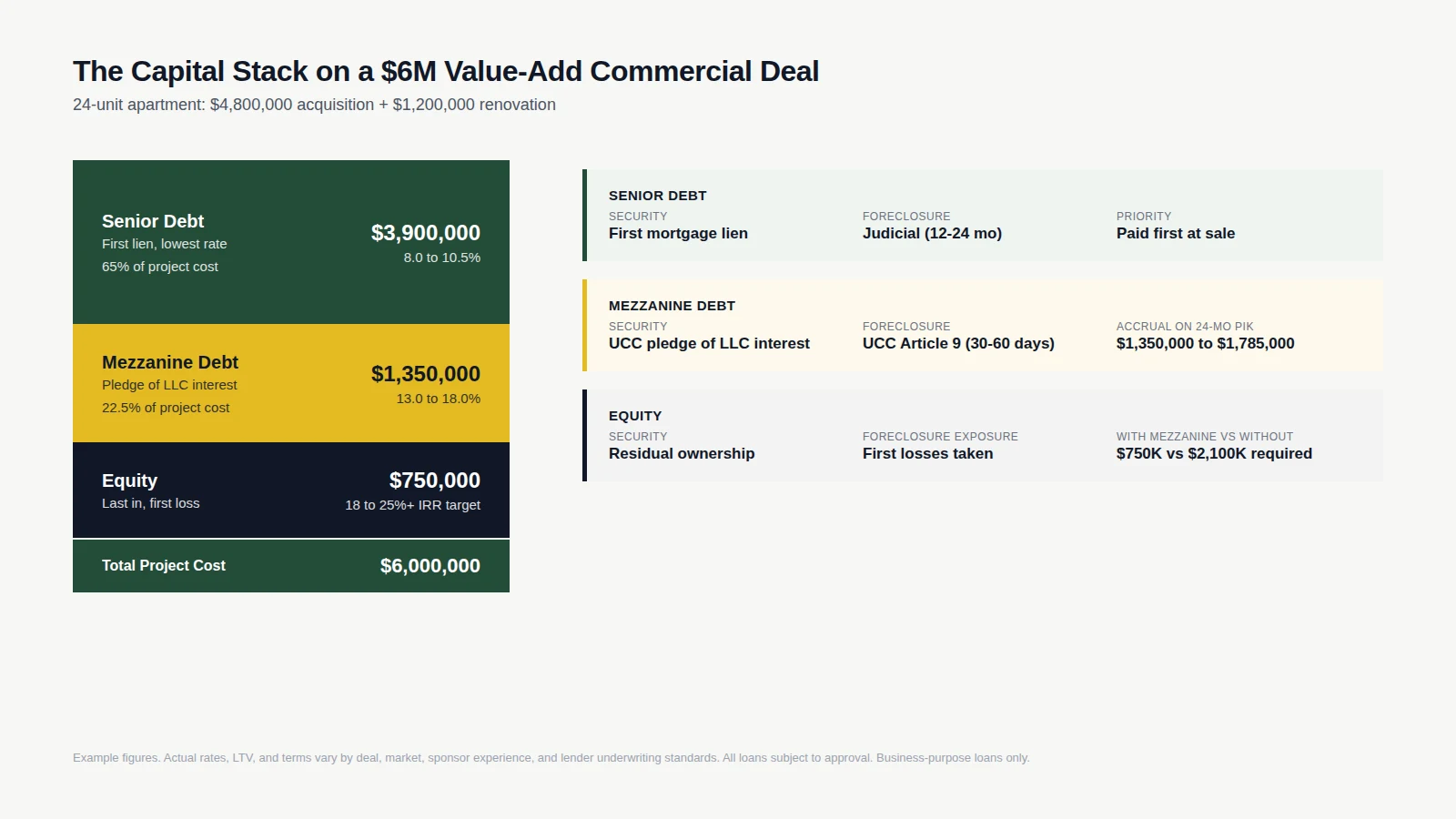
The mezzanine lender does not appear on the property deed. Instead, the lender holds a pledge of the LLC membership interest in the special purpose entity that owns the property. If the borrower defaults, the mezzanine lender forecloses under UCC Article 9. That process can be completed in 30 to 60 days rather than the 12 to 24 months a judicial mortgage foreclosure takes in most states.
How mezzanine differs from a second mortgage or gap funding
The practical difference between mezzanine and a second lien comes down to three things: how the lender is secured, how they foreclose, and how the intercreditor agreement controls them.
A second mortgage (or a hard money second lien) is secured by the property directly. If you default, the second lender forecloses on the real estate using state foreclosure law. That process is slow and constrained by the first lender’s rights.
A mezzanine loan is secured by equity, not property. The lender has a UCC lien on your LLC interest. This means the property must be held in a single-asset special purpose entity, and the mezzanine lender takes a pledge of that LLC’s membership interests, not a deed of trust or mortgage.
An intercreditor agreement governs the relationship between the senior lender and the mezzanine lender. It defines cure rights (the mezzanine lender’s ability to step in and cure a senior loan default before losing their position), notice requirements, and standstill periods. Most institutional senior lenders will not allow a mezzanine position without an approved intercreditor agreement in place before closing.
For deals below $3 million, or for residential properties where a simple second lien serves the same purpose, gap funding or a hard money second is simpler and faster. The entity structure and legal work that mezzanine requires has fixed costs in the range of $15,000 to $40,000 per deal that only make sense at commercial scale.
Want terms on a specific deal?Answer seven questions and get a decision in 72 hours.
Get FundingWhen mezzanine financing actually makes sense: a worked example
The clearest case is a commercial value-add acquisition where the senior lender will fund 60 to 65 percent of cost and you need to close at 80 to 85 percent combined to make the equity return work for your investors.
Worked example: 24-unit apartment, $4,800,000 acquisition price, $1,200,000 renovation budget, $6,000,000 total project cost.
The senior bridge lender funds 65 percent of cost: $3,900,000.
That leaves $2,100,000 to fund. Option one: raise all of it as equity. Option two: raise $1,350,000 as mezzanine at 14 percent and $750,000 as equity.
At stabilization (say, 18 months later, $7,500,000 appraised value), the DSCR refinance takes out the senior loan. If the refinance is sized at 70 percent of the stabilized value, that is $5,250,000, enough to retire both the $3,900,000 senior balance and the mezzanine payoff.
The mezzanine payoff after 18 months at 14 percent current-pay: $1,350,000 principal plus $283,500 in interest ($1,350,000 x 14% x 1.5 years). Total mezzanine payoff: $1,633,500.
Refinance proceeds ($5,250,000) minus senior payoff ($3,900,000) minus mezzanine payoff ($1,633,500) leaves $316,500 in equity proceeds at that refi close, before distributing back to equity investors. Without mezzanine, the equity investors put in $2,100,000 and that same math applies at their position. With mezzanine, they put in $750,000, used $1,350,000 of cheaper mezzanine capital, and took home a better cash-on-cash multiple on a smaller dollar commitment.
The math only works when the stabilized value is high enough to pay off both the senior and the mezzanine at refinance. That is the stress test to run before you use the structure.

What it costs when the deal slips
Mezzanine financing has three failure modes worth modeling before you use it.
Accrual on a delayed stabilization. Most mezzanine debt is structured as current-pay (monthly cash interest) or PIK (payment in kind, where interest accrues to the loan balance and you pay at maturity). PIK is more borrower-friendly during construction because there is no monthly cash obligation, but the balance compounds. A $1,350,000 mezzanine loan at 15 percent PIK for 24 months reaches $1,785,375 at maturity ($1,350,000 x 1.15^2). That balance has to refinance out, and your DSCR loan has to be sized large enough to cover it. If the stabilized value comes in lower than projected, the refinance may not reach that payoff number.
UCC foreclosure speed. If you miss a mezzanine payment or violate a covenant, the lender can move to foreclose your LLC interest in 30 to 60 days. You do not get the 12-month judicial buffer that a first or second mortgage gives you in most states. Cure rights under the intercreditor agreement typically give you 30 to 60 days to fix a default before the mezzanine lender can act. Missing that window is not recoverable without the lender’s cooperation.
Loss of the full equity position. When the mezzanine lender forecloses and takes your LLC interest, they own the entity that owns the property. Your equity, your renovation investment, your promote, and your upside are gone. This is the scenario that makes mezzanine the most consequential mistake in a capital stack when the deal does not perform.
DSCR stress test before you structure. Before adding mezzanine to any deal, run the DSCR calculation at stabilized NOI divided by PITIA at the stabilized senior loan amount. That senior loan needs to be large enough to retire both the original senior balance and the mezzanine payoff. If the stabilized DSCR does not reach 1.20 at current market rates with the senior loan sized to cover the mezzanine payoff, the structure does not close. Run the refinance exit first, before you close the construction stack. Use our DSCR calculator to stress-test the exit scenario at different rent and rate assumptions.
Who this loan is wrong for
Mezzanine financing is not a tool for residential investors, single-family rental buyers, or anyone working on deals below $3 million. The legal structure adds cost and complexity that only pays off on larger commercial deals where the alternative is raising a lot more equity.
It is also wrong for:
- First or second-time borrowers who have not managed a complex capital stack before. The forgiveness window on a mezzanine default is very short. If you have not been through a loan default or a lender workout, the speed of UCC enforcement will be a surprise.
- Deals where the stabilized value is not substantially above the combined debt. You need a clear refinance exit that retires both the senior and the mezzanine, with enough remaining equity to give investors a reason to participate.
- Projects where the renovation timeline is uncertain. PIK interest compounding on a delayed project turns a fundable gap into an unfundable payoff at maturity.
- Any deal structured on a consumer residential property. These loans are business-purpose and commercial in nature. Consumer residential properties and owner-occupied primary residences cannot support the entity structure mezzanine requires, and consumer lending law prohibits this structure for residential owner-occupants entirely.
If the gap in your deal is smaller, a hard money second or a gap funding position from a single lender is simpler and far more forgiving on timeline slippage. For the full comparison between gap funding and senior-only structures, revisit our post on gap funding for real estate investors.
What to do before approaching a mezzanine lender
Build the full stack pro forma: senior amount, mezzanine amount, equity amount, and the refinance scenario that takes all three out. The stabilized DSCR must support a loan large enough to cover both the senior balance and the mezzanine payoff, with enough cushion for a value miss of 10 to 15 percent below your projection.
Confirm the senior lender will allow a mezzanine position and will sign an intercreditor agreement. Many bridge lenders will not. Institutional senior lenders typically have approved intercreditor forms, and negotiating off their form adds cost. Know this before you spend money on legal work.
Budget $15,000 to $40,000 for legal: intercreditor agreement drafting, UCC filings, entity clean-up, and the time it takes to get two sets of lender counsel aligned. That is not a barrier at $5 million. It is a dealbreaker at $500,000.
For deals where the gap is too small for mezzanine but too large for the first lender alone, our bridge loan program and hard money loans are worth reviewing to see what leverage is available at the first lien before you add a second layer. Most deals below $5 million do not need mezzanine. They need a better understanding of what the senior lender will fund. Call 917-842-9982 to discuss how we fund value-add commercial and multifamily acquisitions.
Common questions
What is the minimum deal size for mezzanine financing?
Mezzanine financing is rarely used on deals below $3 million, and most mezzanine lenders have minimums of $1 million to $5 million for the mezzanine tranche alone. The legal structure required (entity pledges, intercreditor agreements, UCC filings) has fixed costs that do not scale down. For smaller funding gaps, a second-lien hard money position or a gap funding loan is typically more cost-effective and faster to close.
How does a mezzanine lender foreclose?
Mezzanine lenders foreclose under UCC Article 9, not through the judicial mortgage process. They sell the pledged LLC membership interest at a UCC sale, which can be completed in 30 to 60 days. The mezzanine lender does not need court approval in most cases. This speed is precisely why cure rights in the intercreditor agreement matter: a 30 to 60 day cure window is the borrower’s only protection once a default is declared.
What is a mezzanine intercreditor agreement?
An intercreditor agreement is the contract between the senior lender and the mezzanine lender that defines how they relate to each other on the same deal. It specifies cure rights (how much time the mezzanine lender gets to fix a senior default), notice requirements, standstill periods, and purchase option rights (the mezzanine lender’s ability to buy out the senior loan if the deal is in distress). Most institutional senior lenders require an approved intercreditor agreement before allowing a mezzanine position.
Can you use mezzanine financing on a single-family rental?
No. Mezzanine financing requires the property to be held in a business-purpose entity (typically a single-asset LLC). The lender takes a pledge of the equity interest in that entity, not a lien on the property itself. Single-family rentals are rarely structured this way, and even when they are, the deal size does not support the fixed costs of a mezzanine structure. For single-family and small multifamily deals, a bridge loan or hard money loan covers the same capital need at lower complexity.
What is the difference between mezzanine debt and preferred equity?
Both sit between senior debt and common equity in the capital stack. Mezzanine debt is a loan with a fixed interest rate, a maturity date, and UCC foreclosure rights if the borrower defaults. Preferred equity is an equity position that gets a preferred return before common equity, but the preferred equity investor becomes a co-owner of the entity rather than a creditor. Preferred equity typically has no foreclosure right, only the right to block distributions and in some structures to force a sale. Preferred equity is generally more expensive than mezzanine because the investor has weaker enforcement rights.
What rate should I expect on mezzanine financing for a commercial deal?
As of late 2026, mezzanine rates on commercial real estate range from 12 to 18 percent annualized depending on deal leverage, asset type, market, sponsor track record, and whether the interest is current-pay or PIK (payment in kind, where interest accrues to the balance). The more subordinate the position, the higher the rate. Add origination fees (typically 1 to 2 points), legal costs for the intercreditor agreement and UCC filings, and the opportunity cost of the equity co-invested alongside the mezzanine tranche to get the true all-in cost.
Ready to fund your next deal?
Approval within 72 hours. Close in 5 to 10 business days.
Get Funding Now