NOI in Real Estate: How Lenders Calculate It and Why It Drives Your Loan on 5-Plus Units
Net operating income is gross rental revenue minus operating expenses, before debt service. It drives loan sizing, cap rate value, and debt yield on commercial properties. If you own 1-to-4 units, your DSCR lender ignores it and uses a different formula. Here is how the calculation works and what it means for your maximum loan amount.
Net operating income is gross rental revenue minus operating expenses, before debt service, income taxes, and capital expenditures. That single number drives loan sizing on commercial properties, sets the cap rate value, and feeds the debt yield test that larger lenders run on every deal. If you own a 1-to-4 unit rental property, your DSCR lender ignores NOI entirely and uses a different formula. That 5-unit threshold is where lending mechanics change, and understanding what moves NOI is what separates investors who get the loan they asked for from investors who get a smaller one.
This post is for investors at the 5-plus unit threshold and above. If you are evaluating a single-family, duplex, or fourplex rental, skip to the DSCR section below.
The NOI formula, broken down
Start with gross scheduled rent: the total rent you would collect if every unit were occupied and paying on time. From there, subtract a vacancy and credit loss allowance, typically 5 to 10 percent depending on the market and asset class. What remains is effective gross income (EGI).
Add other income: laundry, parking, storage, late fees. This gets you to total gross income. Then subtract operating expenses.
Operating expenses typically include:
- Property taxes
- Hazard and liability insurance
- Property management fees (8 to 10 percent of EGI, even if you self-manage)
- Repairs and routine maintenance
- Utilities you pay as the owner (common area electricity, water on a master meter)
- Landscaping, snow removal, pest control
- Capital reserves (3 to 5 percent of EGI, sometimes higher on older assets)
What does not go in: your mortgage payment, depreciation, income taxes, and capital expenditures you have already spent or plan to spend. Those are accounted for elsewhere. NOI is a property-level operating metric, not a personal cash flow statement.
Worked example: a 10-unit apartment building
Ten units at $1,350 per month is $162,000 gross scheduled rent. Applying a 7 percent vacancy rate leaves effective gross income of $150,660. Add $3,600 in annual laundry income and you are at $154,260.
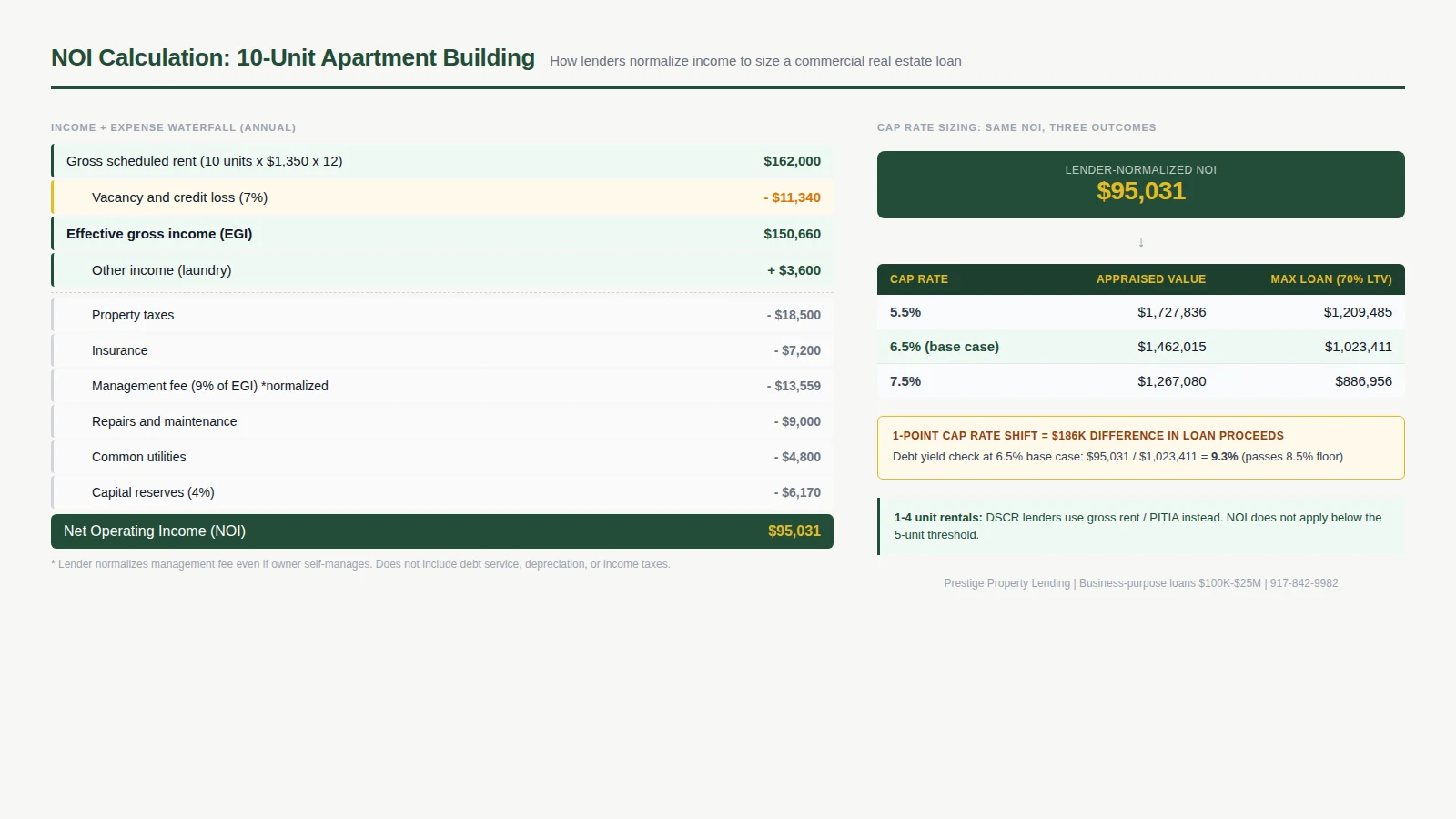
Now subtract the operating expenses: $18,500 in property taxes, $7,200 in insurance, a 9 percent management fee of $13,559, $9,000 in repairs and maintenance, $4,800 in common utilities, and $6,170 in capital reserves at 4 percent. Total expenses: $59,229. NOI: $154,260 minus $59,229 equals $95,031.
At a 6.5 percent cap rate, the income approach values this property at $95,031 / 0.065 = $1,462,015. A lender at 70 percent LTV will size the loan at approximately $1,023,000. Run the debt yield check: $95,031 / $1,023,000 = 9.3 percent. If the lender has an 8.5 percent debt yield floor, this deal passes.
Want terms on a specific deal?Answer seven questions and get a decision in 72 hours.
Get FundingWhat lenders do to your NOI before they accept it
Lenders do not use your reported NOI. They normalize it. That means they add a management fee even if you self-manage, because they cannot guarantee you will continue managing it after the loan closes. They add reserves to a level they consider prudent, regardless of whether you actually set money aside. They apply their own vacancy assumption rather than your historical occupancy.
In practice, normalized NOI runs 10 to 20 percent below the number a self-managing owner reports. On the 10-unit example above, if the owner self-manages and reports no reserve contribution, their claimed NOI might be $95,031 plus $13,559 management plus $6,170 reserves, or approximately $114,760. The lender normalizes it back to $95,031. The difference in loan size, at 70 percent LTV and a 6.5 cap rate: roughly $218,000.
This is one of the most common reasons investors enter a commercial loan conversation with an expectation that does not survive underwriting. Submitting a rent roll and trailing-12-month operating statement before the appraisal is ordered gives you and the lender a chance to reconcile the number before the clock is running.
The 1-to-4 unit difference: DSCR, not NOI
If you are financing a single-family rental, a duplex, a triplex, or a fourplex with a DSCR loan, your lender is not running this calculation. Business-purpose DSCR lenders on 1-to-4 unit residential properties use gross monthly rent divided by PITIA: principal, interest, taxes, insurance, and any HOA dues. No vacancy deduction. No management fee. No expense normalization.
The same property that produces a 1.25 DSCR on the gross rent / PITIA method might produce a 0.91 NOI-based coverage ratio after all operating expenses are deducted. The gross rent method is more borrower-friendly, which is partly why DSCR loan approvals are possible at rental yields that would not qualify under commercial underwriting.
Use the DSCR calculator for 1-to-4 unit deals. The commercial NOI calculation in this post applies at 5 units and above, where the property crosses from residential to commercial lending and lenders switch to NOI-based underwriting and income-approach appraisals. See the DSCR rental loan program for how the 1-to-4 unit qualification works in detail, including the 5-plus unit mechanics that apply when a residential DSCR loan is not available.
Stabilized NOI vs in-place NOI on value-add deals
When you are buying a value-add apartment building at below-market occupancy or below-market rents, the in-place NOI is not the number a bridge lender will use to size your exit loan. They will want to see a stabilized NOI projection, supported by market rent comparables and a credible lease-up plan.
A common structure on a value-add multifamily: a bridge lender sizes the acquisition and renovation loan based on a 65 percent loan-to-cost on the total project budget. The takeout loan is sized at the stabilized NOI after renovation and lease-up. If that stabilized NOI at a 6.0 cap rate produces a value below what you paid plus renovation costs, there is no equity at the exit and the numbers do not work.

Underwriting entry and exit on the same deal requires running both numbers. The bridge lender checks whether the stabilized value supports a loan that takes them out cleanly. The borrower needs to know whether that exit loan covers enough of the project cost to justify the carry on the bridge. If the gap is too large, you are paying down principal at the refinance or bringing additional capital to the exit, neither of which was in the original model. See how the two-phase value-add strategy works for a full worked example of this structure.
Cap rate, NOI, and your maximum loan: how the chain works
On commercial property, the appraisal value is usually driven by the income approach: NOI divided by the market cap rate. What comps set the cap rate is local, asset-class-specific, and subject to market timing. That means your maximum loan size is not primarily a function of what you paid for the property. It is a function of what the property earns, what expenses the lender normalizes, and what cap rate the market supports for that asset type in that location.
Three different cap rate assumptions on the same $95,031 NOI produce three very different loan sizes:
| Cap rate assumption | Appraised value | Max loan at 70% LTV |
|---|---|---|
| 5.5% | $1,727,836 | $1,209,485 |
| 6.5% | $1,462,015 | $1,023,411 |
| 7.5% | $1,267,080 | $886,956 |
A one-point shift in cap rate on a deal of this size changes available loan proceeds by roughly $186,000 in either direction. If a lender in your market is running deals at a 7.5 cap and you modeled 6.5, you will be short at close. This is worth verifying with market evidence before you sign a purchase contract on a commercial asset.
See how debt yield connects to NOI and why some lenders use it as a cap-rate-agnostic size check on larger deals. The debt yield formula is simply NOI divided by the loan amount, and it gives lenders a way to test loan size without depending on the appraiser’s cap rate selection.
Who this is wrong for, and what it costs when things slip
The NOI framework in this post applies to investors financing commercial multifamily (5-plus units), mixed-use, or other income-producing commercial properties. It does not apply to 1-to-4 unit residential rentals, single-family fix and flips, or owner-occupied commercial purchases. A homeowner financing a primary residence or second home cannot use business-purpose commercial lending at all, regardless of property size.
If you are preparing for a loan conversation on a commercial asset, the number you need is the lender-normalized NOI, not the owner-reported figure. Submit your rent rolls, trailing-12-month operating statements, and property tax bills and let the underwriter run their version. If your modeled NOI and their normalized NOI diverge by more than 10 percent, work through the differences before the appraisal is ordered, not after.
The cost when the deal slips: a 10-unit commercial property at a mid-market price point generates roughly $1,000 to $1,500 per month in hard carrying costs at typical bridge loan rates. A three-week delay at underwriting while NOI discrepancies are resolved adds $750 to $1,100 in carry, and the appraisal was already ordered so that clock is running. Run the normalization before you lock your rate.
What to do next
For a 1-to-4 unit rental, use the DSCR calculator to check how the gross rent method qualifies your deal. For a 5-plus unit apartment building, the DSCR calculator will give a directional answer but the actual loan sizing comes from the income approach appraisal and lender normalization. For a commercial bridge loan on a value-add multifamily, the terms are on the bridge loan program page. For a stabilized multifamily, review the DSCR rental loan program. We fund business-purpose loans from $100K to $25M in all 50 states, with preliminary sizing typically within 72 hours of receiving the rent roll and operating statement. Call 917-842-9982 to start.
Common questions
Does NOI include the mortgage payment?
No. Net operating income is calculated before debt service. It measures the property’s ability to generate income from operations, independent of how it is financed. The mortgage payment is accounted for separately when the lender calculates debt service coverage and debt yield.
Why do lenders add a management fee even when I self-manage?
Lenders normalize NOI to reflect what the property would cost to operate under professional management. If you stop managing it, or if the property is sold or transferred, management costs will be a real expense. Excluding it overstates the economic NOI and would inflate the loan size relative to what the property can actually support.
At what property size does a lender switch from DSCR to NOI-based underwriting?
The threshold is 5 units. One-to-four unit residential properties are underwritten as residential, using gross rent divided by PITIA to calculate DSCR. At 5 units, the property is classified as commercial, and lenders switch to NOI-based underwriting and income-approach appraisals. The difference can be dramatic: the same rent roll produces meaningfully different qualifying numbers under each method.
What is a good NOI for an investment property?
There is no universal target. What matters is the relationship between NOI and purchase price (the cap rate), and between NOI and your loan amount (the debt yield). A 10-unit building generating $95,000 in NOI is a good deal at $1.1M and a marginal one at $1.9M. The loan question is whether NOI divided by the loan amount exceeds the lender’s debt yield floor, typically 8.0 to 9.5 percent for commercial bridge loans as of late 2026.
Can I use projected rent to increase NOI for a value-add deal?
On a stabilized acquisition, lenders use in-place rent rolls. On a value-add deal with a bridge loan, the bridge lender will evaluate both entry NOI and your projected stabilized NOI, with the stabilized number supported by market rent comps and a lease-up proforma. The takeout loan will be sized on the stabilized NOI once the property actually achieves it, not on the projection. If you cannot achieve the stabilized rents, the takeout loan will be smaller than modeled.
Ready to fund your next deal?
Approval within 72 hours. Close in 5 to 10 business days.
Get Funding Now