Multifamily Bridge Loan for Value-Add Investors: How the Two-Phase Strategy Works
How investors use a bridge loan to acquire a distressed apartment building, stabilize it over 12-18 months, and exit into permanent DSCR financing. The real mechanics for 5-20 unit deals.
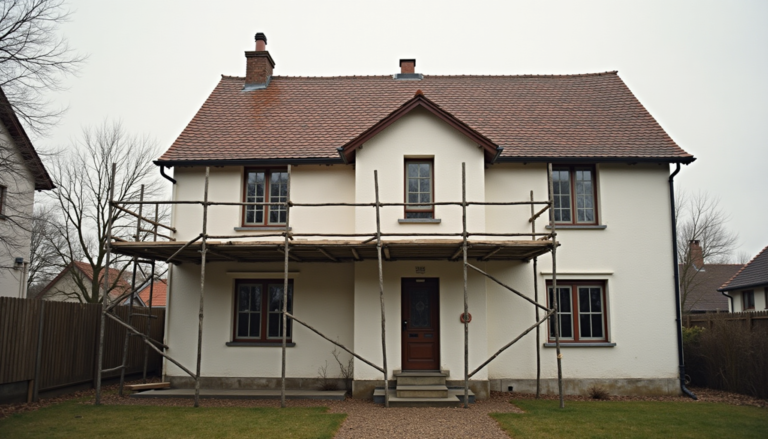
A multifamily bridge loan is short-term, business-purpose financing for investors acquiring a 5+ unit apartment building that does not yet qualify for permanent lending. This is not for owner-occupants. The typical trigger: a 10-unit building at 50% occupancy that will not pass DSCR underwriting until you fill it and push rents to market. Bridge financing buys the time to execute that stabilization plan.
When a bridge loan is the right tool on a multifamily deal
Not every apartment acquisition needs bridge financing. If the property already generates income sufficient to cover permanent loan payments at 90% or better occupancy, a DSCR rental loan or small bank loan is cheaper and closes almost as fast for an experienced borrower. Bridge pricing carries a rate premium you do not need to pay unless the deal actually requires it.
Three situations where bridge is the correct call:
- The property is distressed: occupancy below 80%, rents well below market, or deferred maintenance that would trigger an appraisal condition on a conventional loan.
- You need certainty of close in 10 to 30 days. A seller fielding multiple offers is not waiting 60 days for bank underwriting.
- The value-add plan creates enough income lift to support permanent financing that does not exist at day one. The bridge is what makes that gap crossable.
If none of those apply to your deal, check whether the property qualifies for permanent financing first. Run the numbers through the DSCR calculator before committing to bridge pricing.
How multifamily bridge underwriting works
Lenders underwrite a value-add bridge against two values: the current as-is value and the projected as-stabilized value. The bridge is sized on a percentage of the current value or total project cost, typically 60% to 75%. The as-stabilized value is what sets the exit: if it does not support a permanent loan large enough to retire the bridge, the deal does not pencil.
For 5+ unit properties, some lenders add a debt yield test on current income. Debt yield is current NOI divided by the loan amount, with a common floor of 7% to 8%. On a building at 50% occupancy, that test is painful. Lenders focused on value-add will often suspend the day-one debt yield requirement if the stabilization plan is credible and the sponsor has a track record of completing similar projects.
What determines the terms you get:
| Factor | How it moves the number |
|---|---|
| Sponsor experience | First-time buyers face lower LTC and higher rates. Three completed value-add deals typically moves you to the next tier. |
| LTC | 60% prices better than 75%. Each additional 5 points of leverage costs you in rate and origination. |
| Market and asset type | Garden-style apartments in primary markets price tighter than mixed-use or tertiary market locations. |
| Loan size | Sub-$500K loans carry a premium relative to $1M+ on the same LTC, due to fixed underwriting costs. |
| Exit visibility | A building with pre-signed leases or a committed takeout lender prices better than one relying purely on projected lease-up. |
Rates in the market as of late 2026 for smaller multifamily bridge (5 to 20 units, $500K to $5M) have run in the 9.5% to 12.5% range depending on the factors above. These are market observations, not a rate sheet. Call 917-842-9982 with your specific deal for current terms on loans from $100K to $25M.
Want terms on a specific deal?Answer seven questions and get a decision in 72 hours.
Get FundingThe renovation holdback: how the money moves
Most multifamily bridge loans on a value-add deal include a renovation holdback: funds committed at close and held in escrow, disbursed in draws as work is completed. The mechanics are the same as a fix-and-flip draw schedule applied to a building with multiple units turning over at different times.
Typically 5 to 8 draws over the renovation period. Each draw requires an inspection confirming the work claimed is done before funds are released. The inspector schedules 3 to 5 business days after your draw request, which means you float costs during that window. On a $144,000 rehab budget across 6 draws, you are carrying roughly $24,000 per inspection cycle out of pocket while waiting for reimbursement.
Interest accrues only on the drawn balance, not on the full commitment. If the bridge is $858,000 principal and a $144,000 holdback, you pay interest on $858,000 from day one. The holdback starts accruing only as draws are taken. That math matters when you model carry costs across a 16-month stabilization period. Our post on construction loan draw schedules covers the same mechanics in detail, including how inspection lag adds to actual carrying costs.
Worked example: a 12-unit value-add acquisition
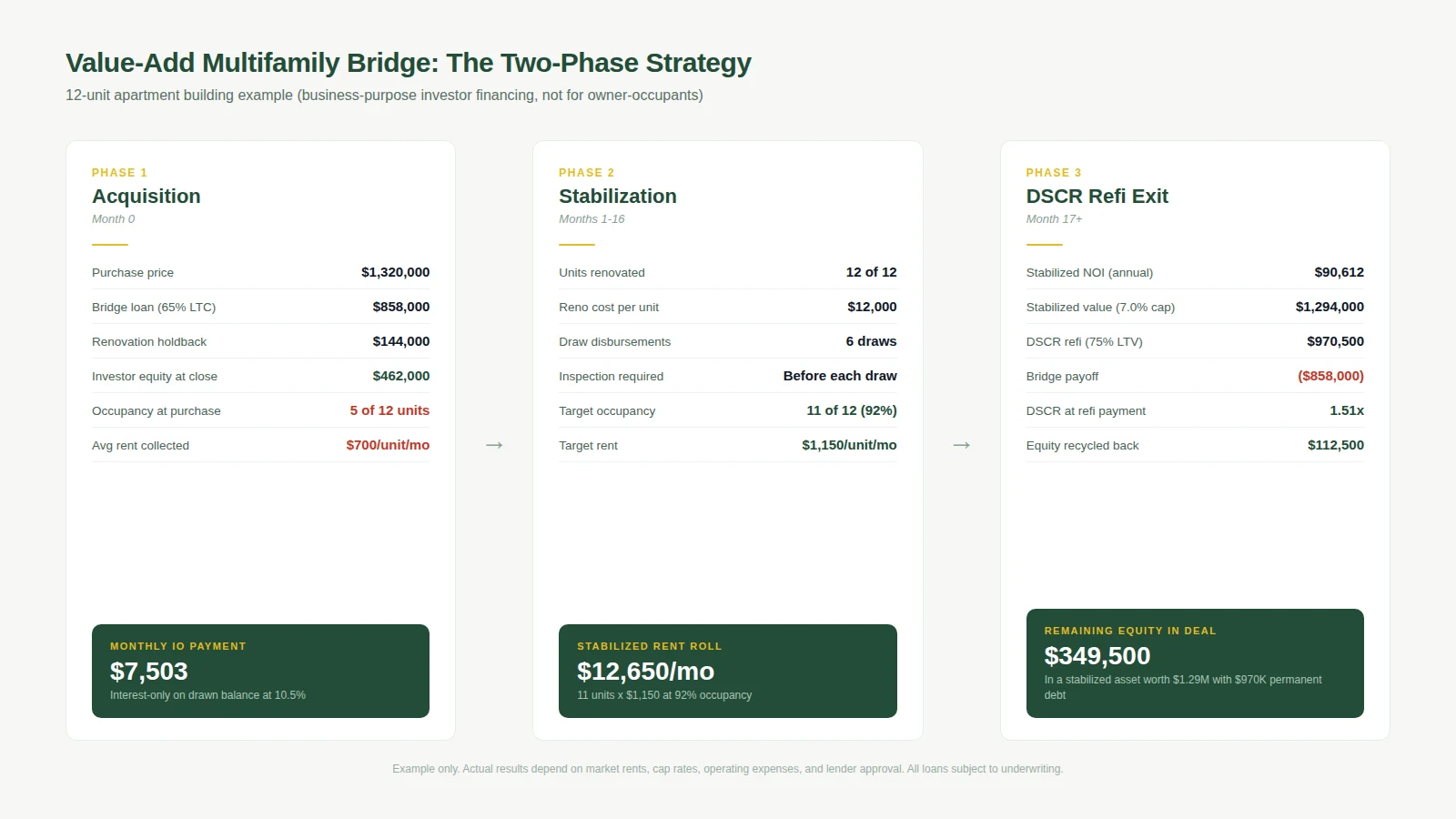
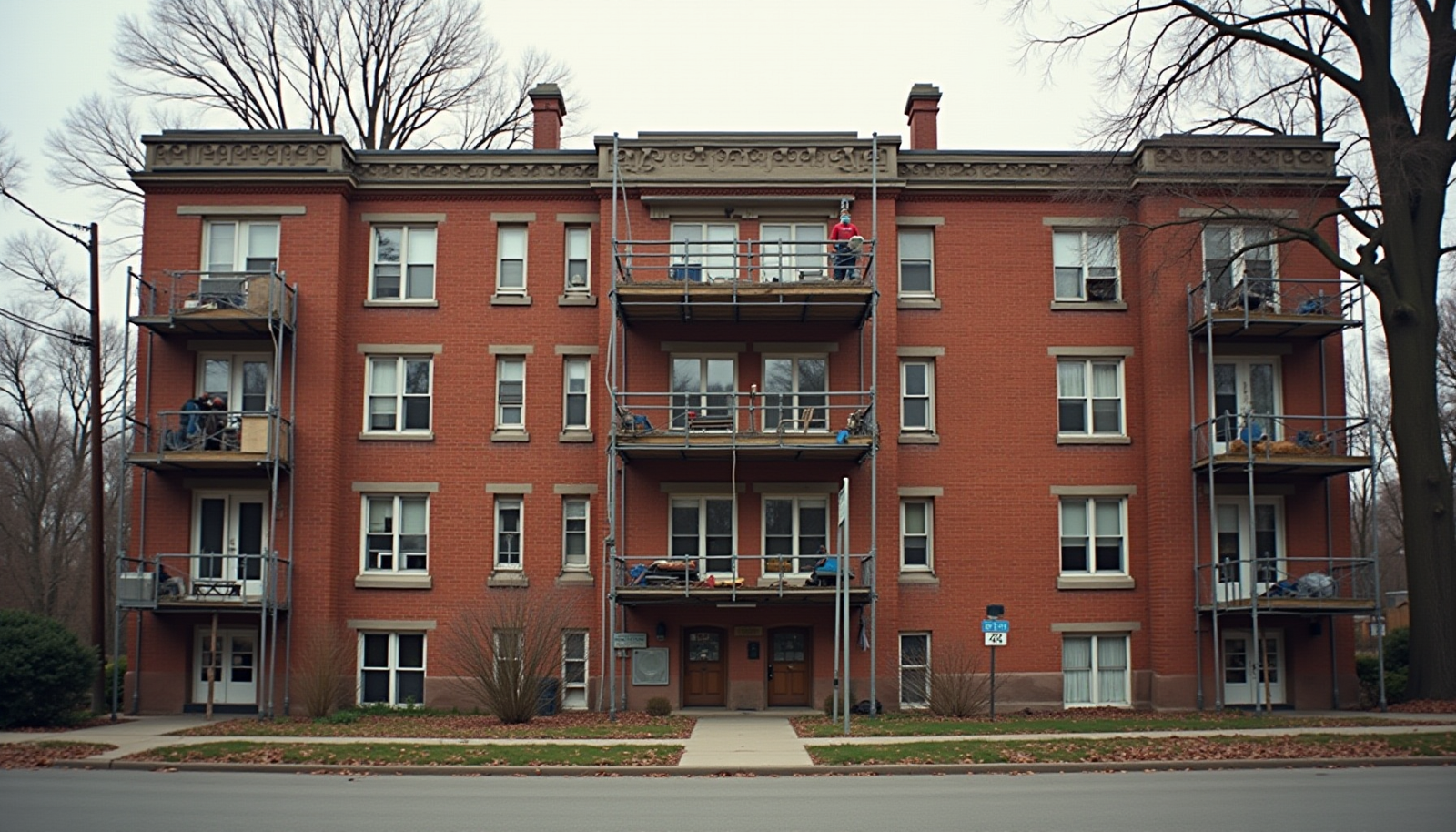
The building: 12 units in a secondary Midwest market. Five of 12 units occupied at $700 per month average, legacy tenants below market, three units needing full cosmetic renovation. Seller motivated: two years deferred maintenance. Negotiated from list to $1,320,000.
The financing structure at close:
- Bridge loan at 65% of purchase price: $858,000
- Renovation holdback for 12 units at $12,000 each: $144,000 (held in escrow at close)
- Investor equity contribution: $462,000 plus closing costs of approximately $38,000
Monthly interest-only payment on the $858,000 drawn balance at 10.5%: $7,503 per month. As renovation draws are taken over the first 8 months, the IO burden reaches roughly $8,778 per month when the full holdback is drawn.
The stabilization target: 11 of 12 units occupied at $1,150 per month average, achievable as units are renovated and re-leased. Total monthly rent roll at target: $12,650. Annual gross: $151,800. After a 40% operating expense ratio covering taxes, insurance, maintenance, and property management: NOI of approximately $90,612.
At a 7.0% capitalization rate, the stabilized value is approximately $1,294,000. A DSCR refi at 75% LTV produces a loan of $970,500, which retires the $858,000 bridge and returns $112,500 to the investor before closing costs. After estimated refi transaction costs of $28,000 to $32,000, net cash returned is roughly $80,000 to $84,000.
The DSCR at the permanent loan: $970,500 at 7.75% on a 30-year amortization gives a principal and interest payment of $6,956 per month. Add estimated taxes and insurance of approximately $1,380 per month, giving total PITIA of $8,336. Gross rent divided by PITIA: $12,650 divided by $8,336 equals 1.52, which clears most lenders’ floors comfortably for a smaller multifamily deal. Use the DSCR calculator to run your own stabilized income scenario before committing to the bridge.
Note on the DSCR formula: for buildings under 10 units, many lenders use gross rent divided by PITIA, the same approach as for single-family DSCR. For 10+ unit commercial deals, the standard typically shifts to NOI divided by annual debt service. The formula matters because the same rent roll produces a different qualifying number depending on which the lender applies. Our post on DSCR loans for multifamily covers the threshold in detail.
The exit: moving from bridge to permanent financing
The exit is where most value-add bridge deals run into trouble. The bridge term is 12 to 24 months with one or two 6-month extensions available, typically at a fee of 0.5% to 1.0% of the outstanding balance per extension. An extension on the $858,000 bridge at 0.75% costs $6,435. If you need two extensions, that is $12,870 in additional cost before you even account for the continued IO payments.
What a DSCR lender on a 5+ unit building typically wants before committing to a takeout:
- 90% or better occupancy for 90 consecutive days, backed by executed leases
- Rents at or near the appraiser’s market rent estimate, not just your projected rents
- Operating history: 6 to 12 months of bank statements showing actual income and expenses
- Clean title: any mechanic’s liens, code violations, or pending disputes resolved
Three things delay exits more than anything else. Vacancy that stalls at 80% when the lease-up plan assumed 95%. Rents that come in below the appraiser’s market rent analysis (the appraiser uses their own comp set, not your pro forma). And operating expenses that run 5 to 8 points higher than modeled once you see real utility, maintenance, and management costs on a fully occupied building. Any one of these can push stabilized value below the number needed to retire the bridge cleanly.
When this loan is wrong for you

A multifamily bridge loan is the right tool in a narrow set of situations and the wrong tool in most others. Be honest about which category your deal falls into before you commit to the pricing.
This loan is wrong for you if:
- You have no multifamily track record. Most lenders on 5+ unit deals above $750,000 require demonstrated experience with comparable assets. A first-time buyer typically needs a co-sponsor with a track record or a significantly lower LTC to access reasonable terms.
- The property already qualifies for permanent DSCR financing. If day-one income supports permanent loan payments, bridge pricing costs you 2 to 4 points in rate for no benefit.
- The renovation relies on contractor capacity you have not secured. A bridge clock starts at close. Uncontracted rehab adds months and extension fees.
- The exit depends on rent growth rather than lease-up. Stabilization plans built on “rents will rise” rather than “we will fill vacant units” are speculation, not execution. Lenders underwrite lease-up plans, not rent-appreciation assumptions.
- The building has structural problems, active code enforcement violations, or environmental issues not priced into the acquisition. Bridge lenders rely on the same as-stabilized value for their exit that you rely on for your return model. If the appraiser discounts the stabilized value for deferred structural work, the exit loan shrinks with it.
- You are buying a primary residence or a property you intend to occupy. These are commercial, business-purpose loans for investors only.
One more honest point: interest-only payments make bridge loans look cheaper on a monthly basis than they are on a total-cost basis. You are not amortizing. When the bridge matures, you owe the same principal you borrowed. If the value-add plan has not produced the stabilized value you projected, the permanent takeout loan does not exist at the size you need. That is the failure mode that is most common and most costly.
To discuss a specific deal, call 917-842-9982. You can also review our bridge loan programs page for the full structure and eligibility criteria, or run your stabilized income scenario through the DSCR calculator to check the exit before you commit to the bridge.
Common questions
Can you get a multifamily bridge loan on a 2-4 unit property, or is this only for 5+?
Both are possible, but the underwriting is different. A 2-4 unit bridge loan typically follows residential underwriting guidelines, where lenders assess the property more like a fix-and-flip or single-family bridge. At 5+ units the property crosses into commercial underwriting, where lenders look at NOI, debt yield, and operating history rather than comparable sales. The programs, rates, and documentation requirements are separate. Make sure you know which threshold your deal falls under before comparing lender quotes.
What occupancy rate do lenders need before they will approve a multifamily bridge?
There is no universal floor. Some lenders will bridge a property at 0% occupancy if the sponsor is experienced and the LTC is conservative enough. Most want to see evidence of rental demand through comparable properties in the area. What lenders are actually underwriting is the stabilization plan, not the current occupancy number. The lower the occupancy, the more conservative the LTC they approve and the more they lean on sponsor experience to fill the gap.
How is DSCR calculated differently for 5+ unit properties vs. a single-family rental?
For 1-4 unit properties, most DSCR lenders use gross rent divided by PITIA (principal, interest, taxes, insurance, and HOA if applicable). For 5+ units, many programs shift to NOI divided by annual debt service, where NOI already accounts for vacancy and operating expenses. The same rent roll can produce very different qualifying numbers depending on which formula the lender applies. A $12,650 monthly gross rent on a 12-unit building shows a 1.52 DSCR on the gross PITIA method but closer to 1.09 on the NOI method at a 40% expense ratio. Confirm which formula applies before you model the exit.
What happens if the bridge term expires before stabilization is complete?
Most bridge loans include one or two extension options, typically 6 months each, at a fee of 0.5% to 1.0% of the outstanding balance. Exercising one extension on an $858,000 bridge at 0.75% costs $6,435. The extension requires that payments are current and, in most cases, that demonstrable progress toward stabilization has been made. If neither extension is sufficient and the lender does not offer a further option, you are in default on a matured note. The outcomes range from a negotiated forbearance to a forced sale timeline. Build extension cost into your underwriting from day one, not as a contingency.
How does the renovation holdback work on a multifamily deal compared to a fix and flip?
The mechanics are the same: the lender holds renovation funds in escrow at close, you draw them down as work is completed, and each draw requires an inspection before funds release. On a multifamily deal, work happens in multiple units simultaneously or in sequence as units turn, so inspections typically cover a batch rather than a single scope. You also tend to have more draws (5 to 8) spread over a longer period. The float between completed work and reimbursement is the same as on a flip: plan for 1 to 2 weeks per draw cycle. See our post on fix and flip draw schedules for the full mechanics.
Ready to fund your next deal?
Approval within 72 hours. Close in 5 to 10 business days.
Get Funding Now