Commercial Bridge Loans for Real Estate Investors: How Underwriting Changes on Commercial Property
A commercial bridge loan funds a transitional income-producing property while you stabilize it, lease it up, or reposition it for permanent financing. The underwriting differs from residential in one critical way: lenders look at net operating income and stabilized value, not rent divided by a payment.
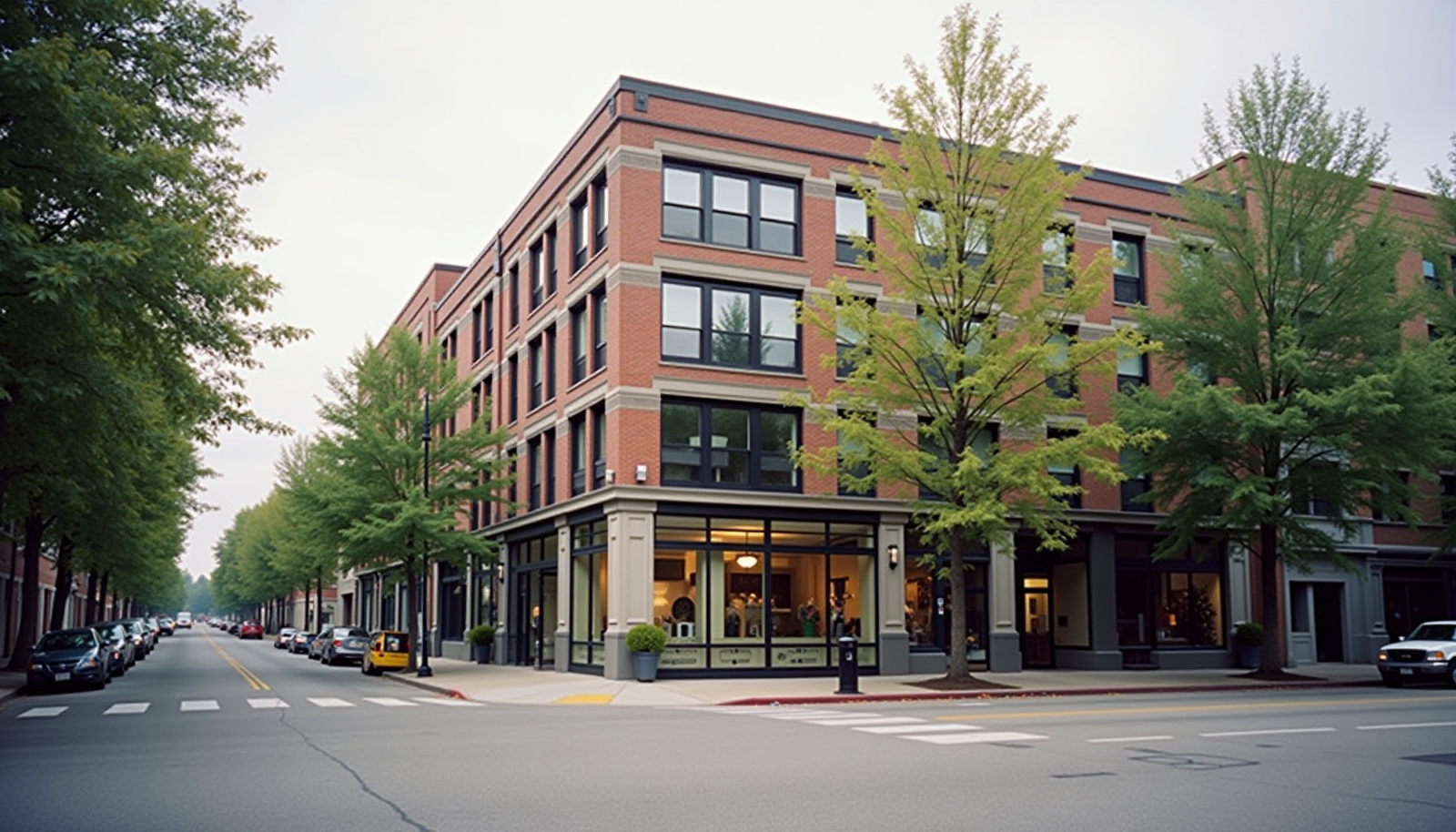
A commercial bridge loan is a short-term loan for income-producing commercial real estate: an apartment building with five or more units, a mixed-use property, a retail strip center, an office building, or an industrial warehouse. If you are a homeowner bridging between two primary residences, or a business owner bridging an operating line of credit, this is a different product and this post is not for you. Commercial bridge financing is for investors and developers acquiring or repositioning commercial assets.
The term runs 12 to 36 months in most cases, interest only throughout. The purpose is to give you time to stabilize the asset, lease it up, or reposition it for permanent financing or a sale. What makes it different from a residential investment property bridge loan is how the lender calculates maximum loan size and how seriously they stress-test the exit.
The 5-unit threshold: where residential underwriting stops
Properties with one to four units are underwritten as residential, even if they are rentals. A duplex, triplex, or four-plex uses residential loan guidelines. A DSCR rental loan on a four-plex calculates income as gross rent divided by the full payment, which includes principal, interest, taxes, insurance, and any HOA. That is the residential method.
At five units and above, the rules change. The loan is treated as a commercial real estate transaction. The lender does not divide rent by the payment. They look at net operating income, which is gross rent minus actual operating expenses: vacancy losses, management fees, maintenance, insurance, taxes, and capital reserves. That NOI number gets tested against a debt yield threshold or a cap rate model, not against a payment-to-rent ratio.
This distinction matters more than most investors moving up from residential realize. A 20-unit apartment at $1,250 per unit per month looks strong on gross rent. But if vacancy is high and management is inefficient, the NOI can be thin enough to reduce the loan significantly. The commercial lender sees the NOI picture, and the residential DSCR method is not available.
How lenders underwrite a commercial bridge loan
Two tests drive commercial bridge lending: debt yield and LTV against stabilized value.
Debt yield is the property’s current or near-term NOI divided by the proposed loan amount. Most bridge lenders want 8 to 10 percent at entry. On a $1,000,000 loan, the property needs to be producing at least $80,000 to $100,000 per year in NOI today, or close to it. If the property is in the middle of lease-up, lenders will often model forward NOI based on current leasing momentum, with a conservative assumption on how many units will be stabilized by month six.
Stabilized LTV is the loan amount expressed as a percentage of what the property will be worth when it reaches its target occupancy. A lender funding a lease-up bridge will project the stabilized NOI, apply a market cap rate to get a stabilized value, and lend against that number: typically 65 to 75 percent depending on asset type.
The worked example below uses a 20-unit apartment to show how these two tests interact in practice.
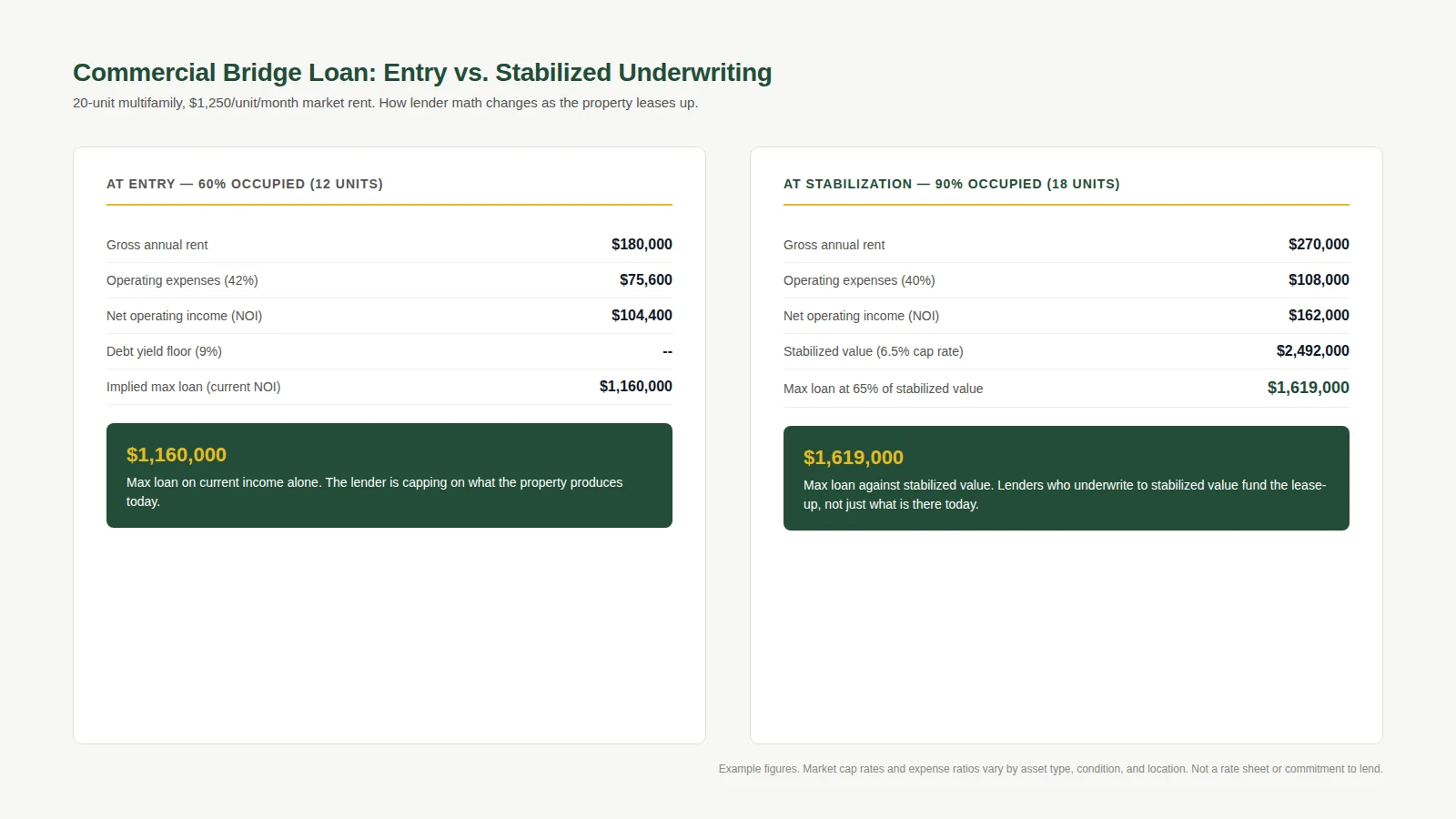
At entry with 60 percent occupancy (12 of 20 units paying), annual gross rent is $180,000. After 42 percent operating expenses, NOI is $104,400. At a 9 percent debt yield floor, the current income supports a loan of about $1,160,000.
At stabilization with 90 percent occupancy (18 units paying), gross rent rises to $270,000. After 40 percent expenses, NOI is $162,000. At a 6.5 percent cap rate, the stabilized value is roughly $2,492,000. At 65 percent LTV, the max loan rises to $1,619,000.
The bridge loan is structured to get the property from the first state to the second. The spread between the two loan amounts represents the lease-up risk the lender is absorbing. Every lender models this differently; some lend to stabilized value from day one with a holdback structure, others lend only to current income and re-advance as the property stabilizes.
Want terms on a specific deal?Answer seven questions and get a decision in 72 hours.
Get FundingWhat moves your rate on a commercial bridge loan
Four variables drive pricing more than any advertised rate will suggest.
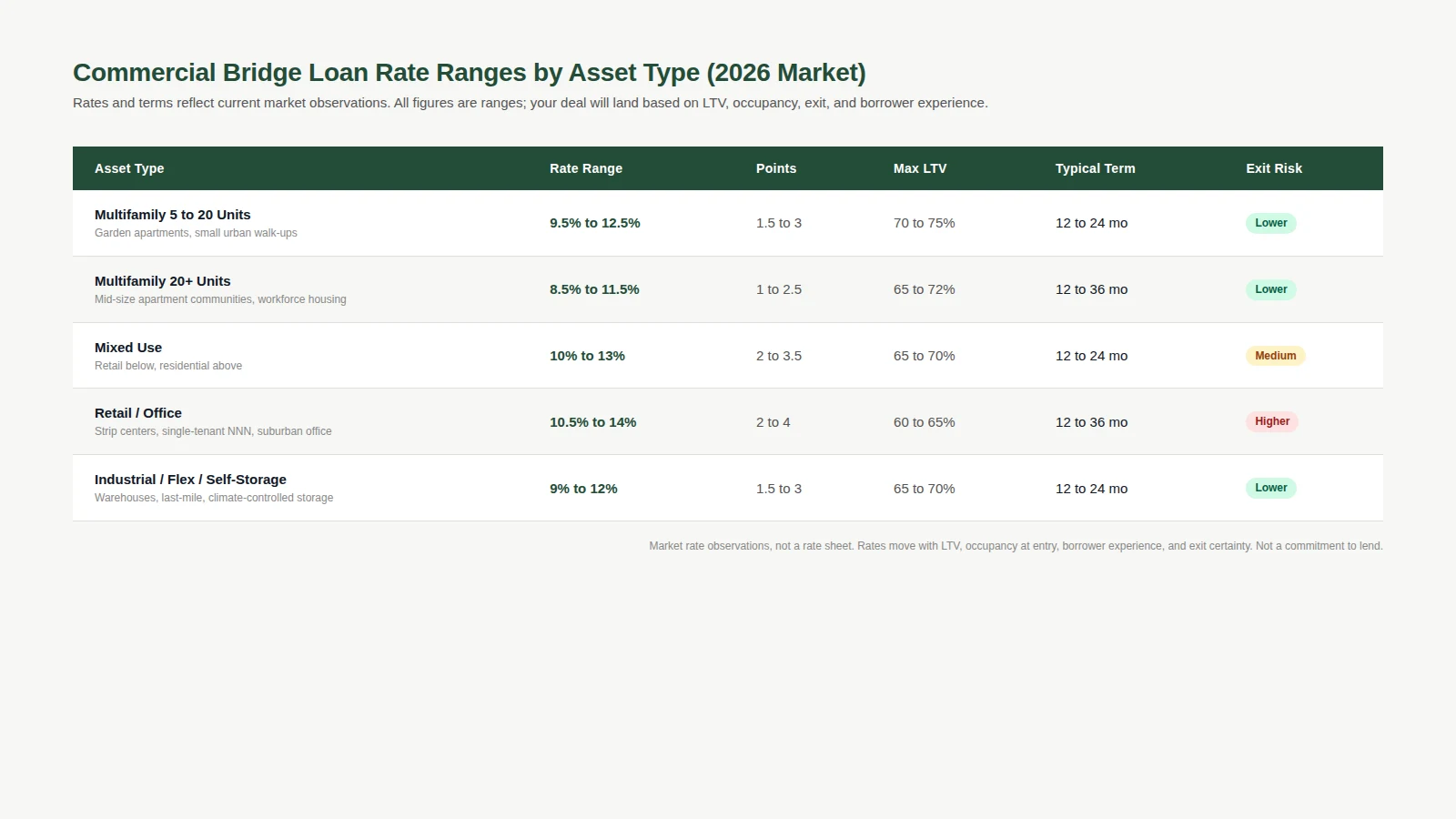
Asset type. Multifamily is the preferred commercial asset for bridge lenders because it has the deepest permanent financing market. Agency debt (Fannie, Freddie) takes 5-plus unit multifamily, and bank and DSCR programs are available for smaller deals. Retail and office carry more exit risk because fewer permanent lenders compete for those assets, and vacancy in those classes is harder to predict. That exit risk shows up in your rate.
Occupancy at entry. A property at 85 percent heading to 90 percent prices better than one at 40 percent with unproven demand. The more lease-up risk the lender is absorbing, the wider the rate spread above the base.
Exit clarity. A borrower who walks in with a specific, verifiable path from the bridge loan to agency debt prices better than one who plans to sell, eventually. The more concrete and realistic the exit, the less risk the lender carries. Lenders will ask for the exit plan in writing as part of underwriting.
Borrower experience. A developer with five completed commercial repositions prices differently than someone moving up from residential investment for the first time. First commercial deals often require lower LTV or a slightly higher rate to reflect the lender’s additional oversight.
The exit: three paths and what each one actually requires
Every commercial bridge lender underwrites the exit as carefully as the entry. There are three realistic paths from a commercial bridge loan, and each has its own requirements.
Refinance to permanent debt is the most common exit for stabilized multifamily. Agency debt becomes available once the property reaches 90 percent occupancy for 90 days and the NOI supports the permanent loan payment. For non-multifamily assets, the permanent lender is usually a bank or a commercial portfolio program. The timeline on the permanent financing commitment matters: if agency takes 60 days to close after you hit occupancy, budget for that in your bridge period.
Sell is a clean exit when the market is cooperative. The bridge funds the repositioning, you stabilize and list, and you close before the term ends. The risk is that the market moves during your bridge period. A sale exit that depends on a buyer at a lower cap rate than the market currently shows is not a conservative underwriting assumption. Model the sale at today’s pricing, not what you hope it will be at month 18.
Extension is not free. Most commercial bridge loans carry extension options of three to six months each, at a cost of 0.5 to 1.5 percent of the outstanding loan balance per extension period. If you budget 10 months to lease up and it takes 14, you are paying the extension fee plus carrying costs at the bridge rate for an additional quarter. On a $1,500,000 loan at 11 percent, a six-month extension costs $82,500 in interest alone, plus an extension fee of $7,500 to $22,500. That number rarely appears in investors’ pro formas. Use our loan cost calculators to model the extended-timeline scenario before you sign the loan agreement.
Our bridge loan program page details loan parameters across both residential and commercial bridge structures, including the $100,000 to $25,000,000 range and 5-to-10-business-day close timeline.
When a commercial bridge loan is the wrong tool
This loan is right for a transitional commercial asset with a clear stabilization path and a credible exit. Several cases where it is the wrong tool deserve direct treatment.
If you are buying or refinancing an owner-occupied residential property, this product does not apply. Business-purpose commercial bridge loans are not subject to consumer lending statutes, and that is precisely why they close in days rather than months. They are for investors and developers, not for anyone buying the property to live in.
If the asset has a structural vacancy problem, not a temporary one, a bridge loan extends the problem without solving it. A retail strip center in a declining corridor with anchor vacancies and no foot traffic is not a lease-up story. A bridge period does not change the fundamentals that drove tenants out. Be honest about whether the vacancy is cyclical or structural before committing to 18 months of bridge carry.
If you are moving up from single-family investment for the first time, assess whether you have the management team and operating capacity for a commercial repositioning. Bridge lenders will ask about your commercial experience directly. The gap between owning a four-plex and managing a 20-unit lease-up is real, and it affects both approval and the rate you get.
If the property is already stabilized at or near target occupancy, a commercial bridge loan is probably the wrong product. A stabilized 5-plus unit building at 92 percent occupancy on a healthy rent roll qualifies for permanent financing today. Paying bridge rates on a stabilized asset to avoid the permanent loan process costs you money without buying you anything.
If the exit depends on conditions outside your control, be specific about what you are assuming. A sale exit at a 5.5 percent cap rate when the local market currently clears at 6.5 percent is not underwriting, it is optimism. Stress-test the exit at today’s conditions before you take on the bridge rate and the extension fee exposure.
For commercial bridge loans on properties from $100,000 to $25,000,000 in all 50 states, call 917-842-9982 or read our full breakdown of bridge loan rates and total cost on a 12-month loan.
Common questions
What is the minimum property size for a commercial bridge loan?
Most commercial bridge lenders require five units or more for multifamily, and a minimum loan size of $500,000 to $1,000,000 for commercial assets. Smaller deals under $500,000 on commercial property often fall into residential hard money or hybrid programs rather than true commercial bridge. Loan sizes vary by lender: our programs fund from $100,000 to $25,000,000.
Do I need a personal guarantee on a commercial bridge loan?
Yes, in most cases. Even when the borrowing entity is an LLC or partnership, commercial bridge lenders typically require a personal guarantee from the principals. The guarantee does not disappear because the title is in an entity. What the entity structure affects is operational liability, not the lender’s credit exposure. Recourse structure varies by deal size: some larger loans over $5,000,000 are structured with partial or non-recourse guarantees, usually at lower LTV.
How is a commercial bridge loan different from a residential bridge loan?
The underwriting method is different. A residential investment property bridge loan on one to four units looks at property value and sometimes rental income in PITIA terms. A commercial bridge loan looks at net operating income, debt yield, and stabilized value. The exit requirements differ as well: commercial lenders require a specific permanent financing plan or sale target, not just a general intention to refinance. Terms also run longer on commercial deals, up to 36 months versus 12 to 18 months for most residential bridge loans.
What happens if my lease-up takes longer than the bridge term?
Most commercial bridge loans allow one or two extensions, typically three to six months each, at a fee of 0.5 to 1.5 percent of the outstanding balance per extension. You also continue paying interest at the bridge rate during the extension. On a $1,500,000 loan at 11 percent over a six-month extension, that is $82,500 in interest plus a $7,500 to $22,500 extension fee, before you have made any progress toward the permanent loan. Model the extended timeline before you commit to the bridge.
Can I use a commercial bridge loan for a retail or office property?
Yes, but at narrower LTVs and higher rates than multifamily. Retail and office carry more exit risk because fewer permanent lenders compete for those asset types, and cap rate volatility is higher. Expect 60 to 65 percent LTV maximum and rates toward the top of the commercial bridge range. You will also face more scrutiny on your permanent financing exit: the lender will want a credible path to a bank loan or CMBS take-out before committing to the bridge.
How quickly can a commercial bridge loan close?
Faster than conventional commercial loans, but not as fast as a residential hard money deal. A straightforward commercial bridge on a small multifamily can close in 10 to 20 business days. Larger or more complex commercial assets, including mixed-use and retail, often take 20 to 30 business days due to commercial appraisal timelines, environmental review requirements, and title complexity. Have your operating statements, rent roll, and title work ready before you approach the lender.
Ready to fund your next deal?
Approval within 72 hours. Close in 5 to 10 business days.
Get Funding Now