Value-Add Bridge Loan: How Lenders Underwrite a Property That Isn’t Generating Income Yet
A value-add bridge loan funds a property that cannot qualify for permanent financing yet because it is vacant, distressed, or in mid-renovation. Here is how LTC underwriting works, what lenders require from your exit plan, and the five scenarios where this loan is wrong for you.
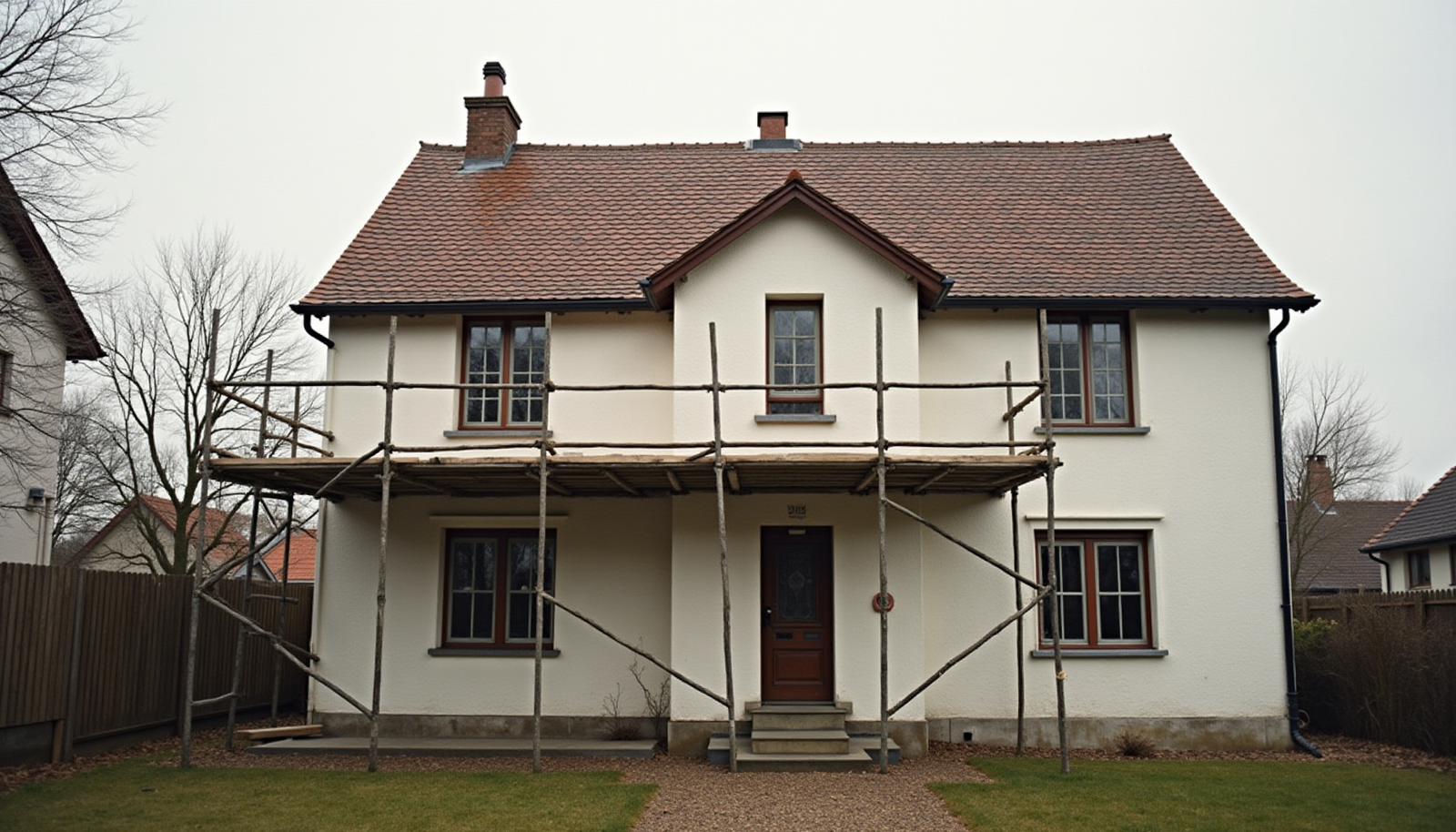
A value-add bridge loan funds a property that cannot qualify for permanent financing yet, typically because it is vacant, distressed, or needs substantial work before a renter or buyer will pay market rate. The lender underwrites on the property’s stabilized value rather than its current condition, and the whole product is structured around your documented plan to exit into a sale or long-term financing within 12 to 24 months. This loan is business purpose only: for investors renovating a rental, repositioning a distressed property, or acquiring a forced-appreciation play. It does not apply to someone buying or refinancing the home they live in, and it cannot be used for a primary residence.
Why DSCR lenders pass on these deals and bridge lenders fund them
A DSCR lender qualifies a loan on the property’s gross rent divided by the loan’s PITIA payment. If there is no rent, there is no DSCR, and the file is dead. That is not a policy choice; it is an arithmetic problem. No income means no coverage ratio.
A bridge lender underwrites on asset value, not current income. The question is: what is this property worth today, and what will it be worth in finished condition? The lender funds a percentage of the total project cost, holds a first lien, and expects you to refinance into a DSCR loan or sell within the loan term. The income question is deferred until the property is stabilized and the bridge is paid off.
This is why value-add residential properties, distressed single-family rentals, and properties with deferred maintenance that blocks a DSCR qualification all end up in the bridge product, not the DSCR product. The loan mechanics are built for the gap between distressed acquisition and stabilized financing. See the full details on our bridge loan program page.
How the LTC math works on a value-add deal
Bridge lenders on residential value-add deals typically lend 65% to 80% of the total project cost, where total project cost is purchase price plus renovation budget. That figure, loan-to-cost (LTC), is different from loan-to-value (LTV) on the as-is property, and the difference matters: a property bought at $280,000 that is worth $225,000 as-is has an LTV problem but no LTC problem if the renovation budget is realistic and the ARV supports the loan.
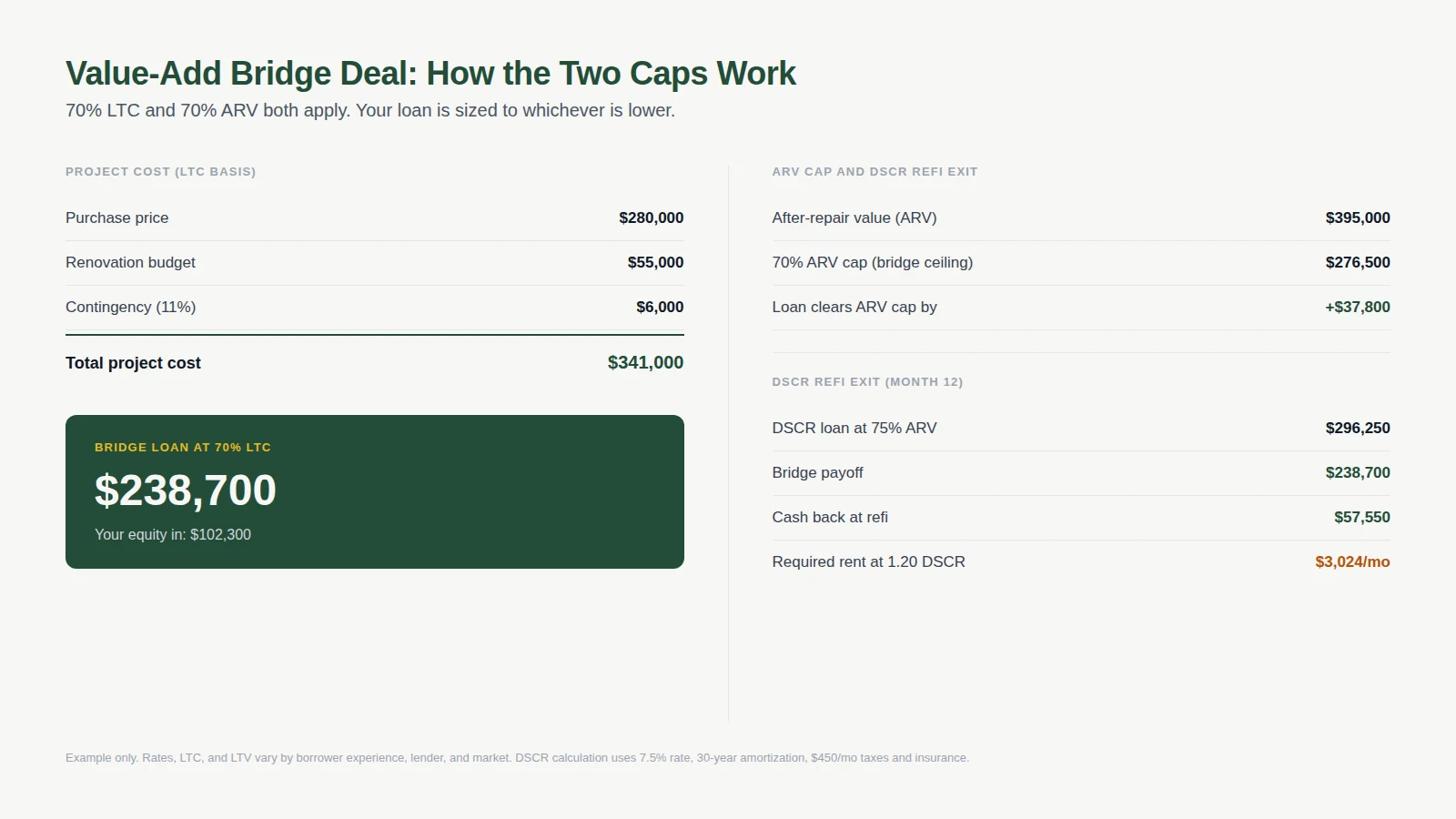
Here is a worked example at 70% LTC:
| Line item | Amount |
|---|---|
| Purchase price | $280,000 |
| Renovation budget | $55,000 |
| Contingency (11%) | $6,000 |
| Total project cost | $341,000 |
| Bridge loan at 70% LTC | $238,700 |
| Your equity in | $102,300 |
Two caps bind simultaneously on every value-add bridge: the LTC cap and an ARV cap. Most lenders set the ARV cap between 65% and 75% of the after-repair value. If the same loan at $238,700 represents 60% of a $395,000 ARV, the lender is comfortable. If the ARV were $310,000, that same loan is 77% of ARV and many lenders would pull back or reduce the loan amount. Your loan is sized to whichever cap produces the lower number.
Use the ARV calculator to test where your project lands before calling a lender. Getting the ARV estimate wrong by $40,000 is one of the most common reasons a deal that makes sense on paper does not fund.
Want terms on a specific deal?Answer seven questions and get a decision in 72 hours.
Get FundingThe experience tier and what it costs you
Value-add bridge lenders price experience into the LTC. A first-time investor with zero completed renovations gets a lower loan-to-cost and a higher rate than someone with five finished projects. The logic is straightforward: the main risk on a value-add bridge is the renovation not finishing on time or on budget. A borrower who has done it before is a materially lower risk than one who has not.
| Completed projects | Typical LTC max | Rate premium vs base |
|---|---|---|
| 0 | 65% | +1.0% to 1.5% |
| 3 to 4 | 70% to 72% | +0.5% |
| 5 to 9 | 75% | Base rate |
| 10 or more | 75% to 80% | At or below base |
Market rates for value-add residential bridge loans in late 2026 ranged from approximately 9% to 11.5%, with the spread driven by borrower experience, LTC, and local market liquidity. Those are market observations, not a rate sheet. What any specific lender quotes depends on the full file, the property, and current market conditions.
The exit plan the lender actually reads
Bridge lenders do not simply trust that you will refinance or sell. They require a credible exit, and the underwriting process includes a check on whether that exit is feasible given the numbers at the time of origination.
For a DSCR refi exit, the lender runs the math forward: take the ARV, multiply by 75% to get the target DSCR loan amount, then calculate the PITIA at today’s DSCR rates and check whether local rents produce a 1.0 or better DSCR on that payment. Using the example above: $395,000 ARV, DSCR loan at 75% LTV equals $296,250. At 7.5% interest on a 30-year amortization with $450 per month in taxes and insurance, PITIA is approximately $2,520. At a 1.20 DSCR floor, you need $3,024 monthly rent. If comparable rents in the market support $3,100, the exit works. If comparable rents are $2,400, the exit does not, and a thorough underwriter will catch it before funding.
The same DSCR math that qualifies the exit also drives the cash-back picture at refi. A $296,250 DSCR loan paying off a $238,700 bridge leaves $57,550 in net proceeds before closing costs. That is the capital recycling that makes value-add bridge lending attractive to investors building a rental portfolio. Test the DSCR exit scenario before signing the bridge term sheet using the DSCR calculator.
How draw disbursements work during renovation
On a value-add bridge with renovation, the construction portion is typically drawn in stages: usually two to four draws based on inspection milestones, not on a fixed calendar. The first draw is often released at or near closing to fund the initial scope. Subsequent draws require an inspection confirming that prior work is complete and materials are on-site or installed.
Interest accrues on the drawn balance only, not the full loan amount. If you have drawn $60,000 of a $238,700 bridge to cover the acquisition and initial demo, you are paying interest on $60,000 until the next draw is released. Once fully drawn, you pay on the full balance until the bridge is retired at the DSCR refi or sale. The difference between interest-on-drawn-balance and interest-on-full-balance is meaningful on a large renovation: a $178,700 undrawn balance at 10% costs $1,489 per month that you are not paying yet.
For a detailed look at how draw mechanics work on a larger construction project, see Construction Loan Draw Schedule: How the Money Actually Moves on a Build. The interest-on-drawn-balance principle is the same; the inspection cadence on a construction loan is more structured.
When this loan is wrong for you
A value-add bridge is the wrong product if any of these apply to your deal:
Your ARV does not support the DSCR exit at current rates. Running the numbers forward assuming rates drop is not an underwriting strategy. If the exit does not work at today’s rates, that is a deal problem, not a lender problem. Build the DSCR scenario at current market rates before you sign the bridge term sheet.
You are depending on appreciation to cover an overpayment. If you are buying a property at $310,000 that comparable sales suggest will be worth $285,000 fully renovated, no bridge lender will cover the gap. LTC underwriting and ARV caps exist precisely to prevent loans that require appreciation to work.
You have no renovation experience and a complex scope. A first-time investor doing a full gut rehab is in a genuinely different risk profile than someone doing kitchen and bath on their fifth property. First-time borrowers on complex scopes typically see lower LTC limits, higher rates, and tighter draw controls. The loan exists, but it is harder to execute successfully.
Your local market is illiquid. A value-add bridge in a rural county where comparable sales are sparse and DSCR lenders do not operate is a loan with no clean exit. When the bridge matures, the DSCR market may not underwrite the property at any price, leaving extension, a second bridge at hard money rates, or a discounted sale in a thin market as the only paths.
Your renovation budget has no contingency. Every experienced lender will ask where the contingency line is. A $55,000 scope with no reserve is a scope that runs to $65,000. If the bridge only funded $55,000 in renovation draws, the last $10,000 of work comes out of your pocket during the loan term or causes a draw shortfall. Plan for 10% to 15% over the base scope as a contingency line, and include it in the project cost you submit to the lender.
For more on how bridge loan costs accumulate when a project runs long, see How a Bridge Loan Works When the Exit Slips. The extension fee math and default rate mechanics described there apply to value-add bridge loans the same way they apply to any bridge position.
To discuss a specific deal, call 917-842-9982 or visit the bridge loan program page.
Common questions
What is the minimum property condition for a value-add bridge loan?
Most bridge lenders will fund properties that are vacant, have deferred maintenance, or are mid-renovation, as long as the structure is sound and the scope is well-documented. Properties with significant structural damage, environmental issues, or active code violations require additional due diligence or a reduced LTC. The key is a credible renovation plan, not a perfect property at the start.
Can you get a value-add bridge loan with no completed renovations?
Yes, but expect a lower LTC, typically 65% rather than 70% to 75%, and a rate that reflects the experience premium. Some lenders require at least one completed project before funding a renovation bridge; others will fund first-timers with a detailed scope, a licensed contractor, and a co-borrower who has experience. The loan is available; the terms are less favorable than for an experienced borrower.
How long does a value-add bridge loan typically run?
Most residential value-add bridge loans are written for 12 months with one to two six-month extension options at a fee of one to two points per extension. The renovation timeline drives the minimum; the DSCR refi seasoning requirement often drives the total. If the DSCR lender requires six months of rental history before closing, your bridge must cover acquisition, renovation, lease-up, and seasoning, which is often 15 to 18 months in total.
What is the difference between a value-add bridge loan and a fix and flip loan?
The structure is similar, but the exit determines the product. A fix and flip loan is sized to a sale exit: the lender underwrites to the ARV, you renovate, you sell, and the loan is paid off. A value-add bridge is sized to a rental exit: the lender underwrites to the stabilized rental value and the DSCR refi capacity. The hold period is longer, the loan costs more over time, and the underwriting includes a stress test on whether the DSCR exit works at current rates.
What happens if the DSCR refi falls through at the end of the bridge?
Three paths: extend the bridge at the extension fee if the lender allows it, refinance with a different bridge or hard money lender to buy time, or sell. The extension option is cheapest if you are close to qualifying for DSCR financing. Carrying a second bridge is costly but preferable to default. Selling into a stable market is usually the cleanest exit when the rental numbers never worked. Default, which triggers the default rate and starts a foreclosure clock, is the outcome to avoid by planning your exit before the bridge closes, not after.
Ready to fund your next deal?
Approval within 72 hours. Close in 5 to 10 business days.
Get Funding Now