1031 Exchange Bridge Loan: How Investors Close on the Replacement Property Without Waiting for Proceeds
A 1031 exchange bridge loan lets you close on a replacement investment property before your sale proceeds arrive, or buy the replacement before you have sold the relinquished property at all. Here is how the timing works, what it costs, and when the loan is wrong for the exchange.

A 1031 exchange bridge loan lets you close on a replacement investment property before your sale proceeds arrive, or buy the replacement before you have sold the relinquished property at all. It is not a special IRS product. It is a standard business-purpose bridge loan that happens to fit an exchange timeline. If you are not exchanging one investment property into another, this is not the loan you need. If you are looking to defer capital gains on a primary residence sale, that is IRC Section 121, and an entirely different analysis.
The exchange itself is a tax strategy. This post covers only the financing mechanics. Work with a qualified intermediary and a tax professional on the IRC requirements. The bridge loan is what a business-purpose lender can help you close.
Why the 45-day and 180-day clock creates a financing problem
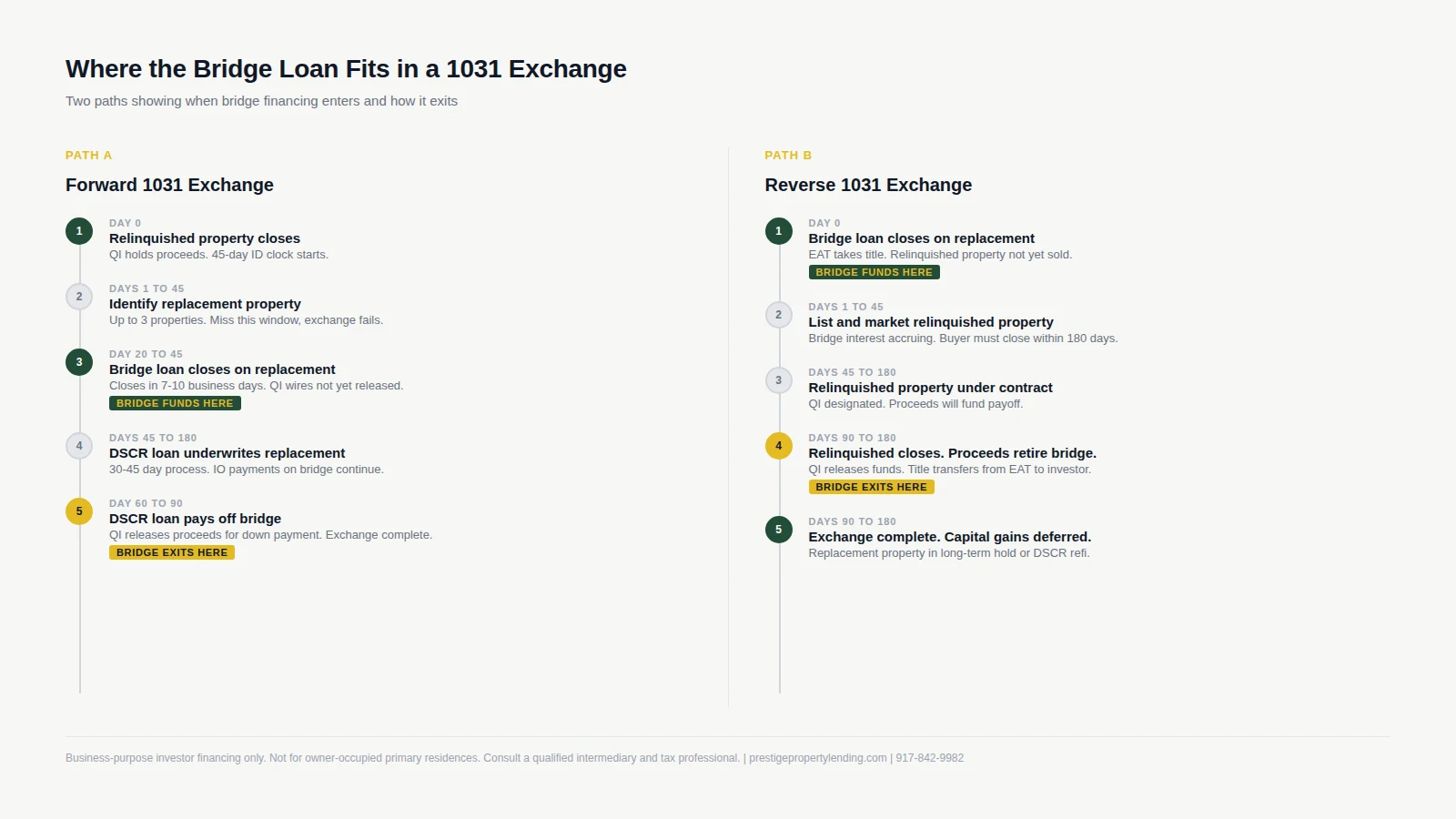
A standard forward 1031 exchange runs on two IRS deadlines once you close the sale of your relinquished property. You have 45 days to identify up to three potential replacement properties. You have 180 days to close on one of them. The proceeds from your sale sit with a qualified intermediary. You cannot touch them until the exchange closes.
That creates a capital problem in two situations. First: a seller accepts your offer on the replacement property before the 180-day window closes, but your exchange proceeds have not been released yet. You need to close in 10 days. The QI holds the funds, the title company needs wire instructions, and your replacement seller will not wait three weeks for the QI to process the transfer.
Second: you find the right replacement property before your relinquished property has sold at all. This is a reverse 1031 exchange. You are buying before you sell. The IRS allows it, but the EAT (exchange accommodation titleholder) needs funds to hold the replacement property while you sell the relinquished one. Without financing, the reverse exchange is not possible for most investors.
In both cases, a bridge loan bridges the gap.
The two scenarios where bridge lending fits a 1031 exchange
Scenario one: forward exchange with a timing gap
You sold your relinquished property for $820,000. The QI holds the proceeds. You identified a fourplex at $650,000 within your 45-day window. The seller wants to close in two weeks. Your QI says the funds can be wired in time, but the replacement property lender needs 30 days to underwrite a DSCR loan.
The bridge loan closes in 7 to 10 business days. It funds the replacement property acquisition. The DSCR lender finishes underwriting over the following weeks, and the DSCR loan pays off the bridge. The QI releases funds to cover the down payment portion the bridge did not fund. The exchange completes within the 180-day window.
The bridge lender does not care about the exchange. They are underwriting the replacement property: its value, its income, and your ability to close. The 1031 timeline is your problem, not theirs, and that is by design. It means you are not dependent on a lender who is unfamiliar with exchange mechanics to understand why you are in a hurry.
Scenario two: reverse 1031 exchange
You found a 12-unit apartment building at a price that works. You have not listed your existing investment property yet. In a reverse 1031 exchange, an EAT takes title to the replacement property while you sell the relinquished property. The EAT needs funds to close on the building.
The bridge loan is secured by the replacement property and funds the EAT’s acquisition. Once your relinquished property sells, the proceeds pay off the bridge. The exchange completes. Your equity comes through without triggering capital gains tax on the sale.
The practical constraint: in a reverse exchange, you need enough liquidity to carry the bridge payments during the sales period. If your relinquished property takes four months to sell, you are carrying four months of bridge interest on the replacement property. That is real cash out of pocket before the exchange closes.
Want terms on a specific deal?Answer seven questions and get a decision in 72 hours.
Get FundingWhat the lender underwrites on the replacement property
The bridge lender is not evaluating your 1031 exchange. They are evaluating the replacement property as collateral for a short-term loan. Standard underwriting applies. For a residential replacement property (1 to 4 units), expect LTV up to 65% to 70% based on the as-is or stabilized appraised value, a clear exit strategy, the property in rentable condition or with a clear rehab path, and a review of your experience as a real estate investor and your available liquidity.
For a commercial or multifamily replacement property (5 or more units), underwriting shifts to the property’s income. Expect NOI-based analysis and a debt yield requirement in addition to LTV constraints. See the commercial bridge loan underwriting guide for how that changes the qualifying numbers at different asset types.
One thing that changes from a standard bridge: the lender knows the proceeds are coming. If you are doing a forward exchange and your QI has $820,000 sitting in escrow, that is a strong argument for your exit. Bring documentation. QI balance statements and exchange agreement copies are legitimate evidence of the exit strategy. Some lenders will adjust pricing or LTV based on documented exchange proceeds. It is information worth volunteering, not something you are required to disclose.
What the bridge actually costs: a worked example
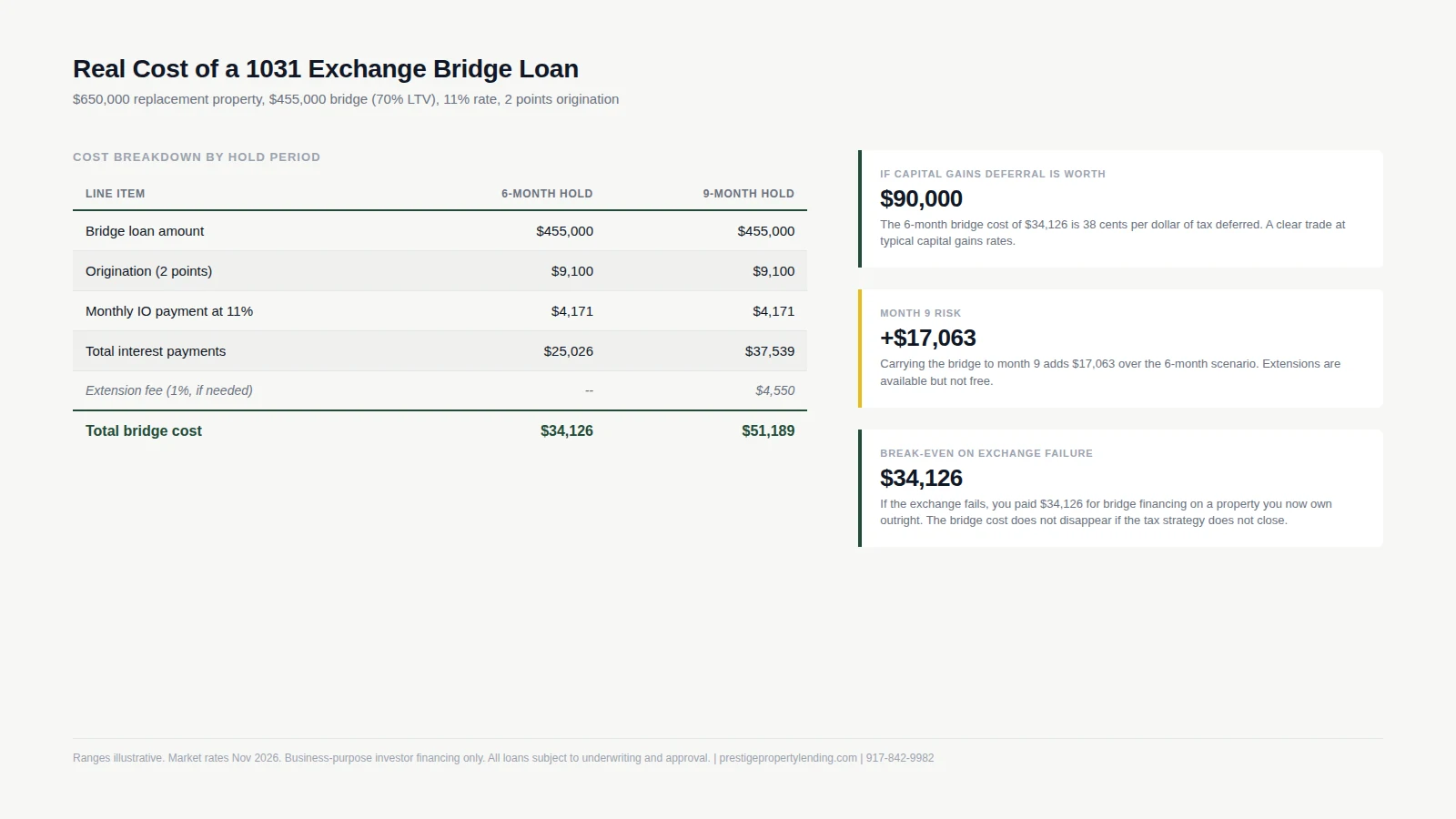
Assume you are acquiring a fourplex at $650,000 as your replacement property. You need to close quickly and bridge to either a DSCR loan or QI proceeds. Using market rate ranges observed in November 2026:
| Item | Amount |
|---|---|
| Bridge loan amount (70% LTV) | $455,000 |
| Rate range (market, Nov 2026) | 10.5% to 11.5% |
| Origination fee (2 points) | $9,100 |
| Monthly IO payment at 11% | $4,171 |
| 6-month total interest | $25,026 |
| Total cost at 6 months | $34,126 |
That $34,126 is what the speed costs you. If your 1031 exchange defers $90,000 in capital gains tax, the bridge cost is 38 cents on every dollar of tax deferred. For most investors, that math is straightforward. Use the loan cost calculator to run your own numbers at different rates and hold periods before committing.
If the exchange takes longer than expected, the math changes. At month 9, the total interest on the same loan reaches $37,539. Add the $9,100 origination fee and an extension fee of 0.5% to 1.0% ($2,275 to $4,550 on $455,000), and the total cost approaches $51,000. Know what your extension terms are before you close the bridge. Lenders typically allow extensions, but those terms are negotiated at origination and you want them in writing before you are six months in and out of options.
When this loan is wrong for you
The bridge loan solves a timing problem. It does not rescue a bad exchange or a property you overpaid for under exchange pressure.
Bridge is the wrong tool when your relinquished property has not sold and you have no strong reason to expect a quick close. The bridge carries real monthly cost. If the sale takes 8 months, you will have spent over $50,000 on a loan you thought would run 6 months. When the replacement property requires substantial rehabilitation before it can support a permanent loan takeout, you have a bridge with no clear exit, and that gets expensive. When you are relying on the exchange to solve a capital problem rather than a tax problem, the bridge buys you time but not solvency, and lenders will see this in underwriting.
Exchange proceeds do not equal down payment, and that confusion causes problems at close. If your relinquished property had a $500,000 net profit and the QI holds those funds, a bridge lender does not automatically grant you $500,000 in bridge credit. They lend against the replacement property’s value. The bridge covers up to 65% to 70% of the replacement property’s value. The gap between that and the purchase price is your out-of-pocket requirement at close, which the QI reimburses after the exchange settles.
This loan is not for investors exchanging a primary residence. Section 1031 applies to investment and business-use property. If you are looking to defer gains on a home sale, the conversation with your tax professional starts at Section 121, not here.
The exit and what goes wrong with it
In a forward exchange, the most common exit is the QI releasing proceeds plus any equity you bring to pay off the bridge, then a DSCR or conventional investment loan takes the long-term position. The bridge loan exit guide covers the full range of exit scenarios, including what happens when the DSCR underwrite comes in lower than expected.
In a reverse exchange, the exit depends entirely on the sale of the relinquished property. If the relinquished property closes in month 3 and the bridge has a 6-month term, you have clean options. If it closes in month 7 and your bridge term ends in month 6, you are negotiating an extension under the pressure of a live loan. Extensions are available but they are not free, and a lender who sees an exchange timeline slipping may be less flexible on price than they were at origination.
What invalidates the exchange and strands the bridge: if the QI becomes insolvent, if the replacement property fails to close within the 180-day window for reasons outside your control, or if the exchange does not qualify under IRS rules (a tax question, not a financing question). In any of these scenarios, you still own the bridge loan. The bridge lender does not care about the exchange outcome. You bought a property, you owe a loan, and the clock on that loan does not stop because the tax strategy fell apart.
Call 917-842-9982 if you are working through a 1031 timeline and want to know what a bridge can cover on the replacement property. The timing pressure is real and we have seen most of the ways it can go wrong.
Common questions
Can you use a bridge loan to fund the down payment on a 1031 replacement property?
The bridge loan is typically secured by the replacement property itself. It covers the acquisition up to 65% to 70% of the property’s value. The portion not covered by the bridge, plus closing costs, is your out-of-pocket requirement at close. The QI proceeds from your exchange can cover this portion once the exchange settles. If you need to bridge the full purchase before QI proceeds release, you will need enough liquidity to cover the down payment at close, which the QI reimburses afterward.
Does the bridge lender need to know about the 1031 exchange?
The bridge lender underwrites the replacement property as collateral. The exchange is your tax strategy and they are not a party to it. That said, disclosing the exchange and providing documentation of the QI-held proceeds is useful, because it strengthens your exit narrative. Some lenders will price more favorably when the exit is well-documented. It is information worth volunteering, not something you are required to provide.
What happens if the 180-day 1031 exchange deadline passes before the bridge is paid off?
The 180-day IRS deadline governs the exchange, not the bridge loan. If the deadline passes without a qualifying exchange close, the exchange fails and the tax deferral is lost. You still owe the bridge loan. This is the scenario that makes exchange planning important before you close the bridge: if the replacement property is in contract and the exchange is structurally sound, the bridge is a tool. If the exchange is on uncertain footing, the bridge adds financing risk to tax risk at the same time.
Can I use a bridge loan for a reverse 1031 exchange on a commercial property?
Yes. The underwriting shifts on a commercial replacement property (5 or more units): the lender will analyze the property’s income using NOI-based metrics rather than a residential PITIA-to-rent ratio. Expect stricter LTV requirements, often 60% to 65%, and a more detailed income analysis. The reverse exchange structure through the EAT adds complexity on the title side. Lenders who have funded reverse exchange transactions are preferable to generalist bridge lenders who would be learning the structure alongside you.
How fast can a bridge loan close for a 1031 exchange timeline?
Five to ten business days is achievable with a complete file: purchase contract, appraisal or desktop valuation, title commitment, and your financial documentation. The 1031 timeline creates real urgency, but urgency does not shortcut the appraisal. If the replacement property is a standard 1 to 4 unit residential, a desktop or drive-by valuation can accelerate the process. Ask directly when you call: what is your process when the exchange is running and we need to close by a specific date. The answer tells you whether the lender has done this before.
Ready to fund your next deal?
Approval within 72 hours. Close in 5 to 10 business days.
Get Funding Now