Debt Yield in Real Estate: What It Is, Why Lenders Use It, and What to Do When Your Deal Fails the Test
Debt yield is net operating income divided by loan amount. When DSCR and LTV both pass but the loan still gets sized down, this is usually why. Here is the math on a real deal and four ways to fix it.

Debt yield is net operating income divided by total loan amount. A 15-unit apartment generating $160,000 of NOI against a $2,000,000 bridge loan has a debt yield of 8.0%. If the lender’s floor is 8.5%, the loan gets sized to $1,882,000 regardless of what LTV and DSCR show on the same deal. This post covers commercial bridge lending on five-or-more-unit multifamily and commercial properties. If you are financing a 1-4 unit rental through a DSCR product, debt yield does not apply to your loan.
Why lenders use debt yield alongside DSCR
DSCR compares income to debt service, which makes it rate-sensitive. At 7.5% interest-only on a $2,000,000 loan, annual debt service is $150,000. At 10%, it rises to $200,000. A property with $160,000 of NOI produces a DSCR of 1.07 at the lower rate and 0.80 at the higher one. The same property, the same income, two very different answers depending on where rates sit when the loan closes.
Debt yield removes that variable entirely. NOI divided by loan amount is 8.0% at $160,000 against $2,000,000, regardless of whether the note rate is 6% or 12%. That stability matters to lenders in a rate environment that can move 300 basis points in eighteen months. A deal that qualifies on DSCR at 7% can go underwater on DSCR at 10%. Debt yield does not move when rates do.
The metric also approximates what the lender would earn on its principal if it had to take title through foreclosure. At 8.0% debt yield, the property throws off 8 cents of NOI for every dollar of debt. At 10.5%, it throws off 10.5 cents. Commercial bridge lenders and CMBS lenders treat this as the floor below which the collateral is not generating enough income to justify the exposure, independent of the borrower’s leverage or rate expectations.
The math on a real deal
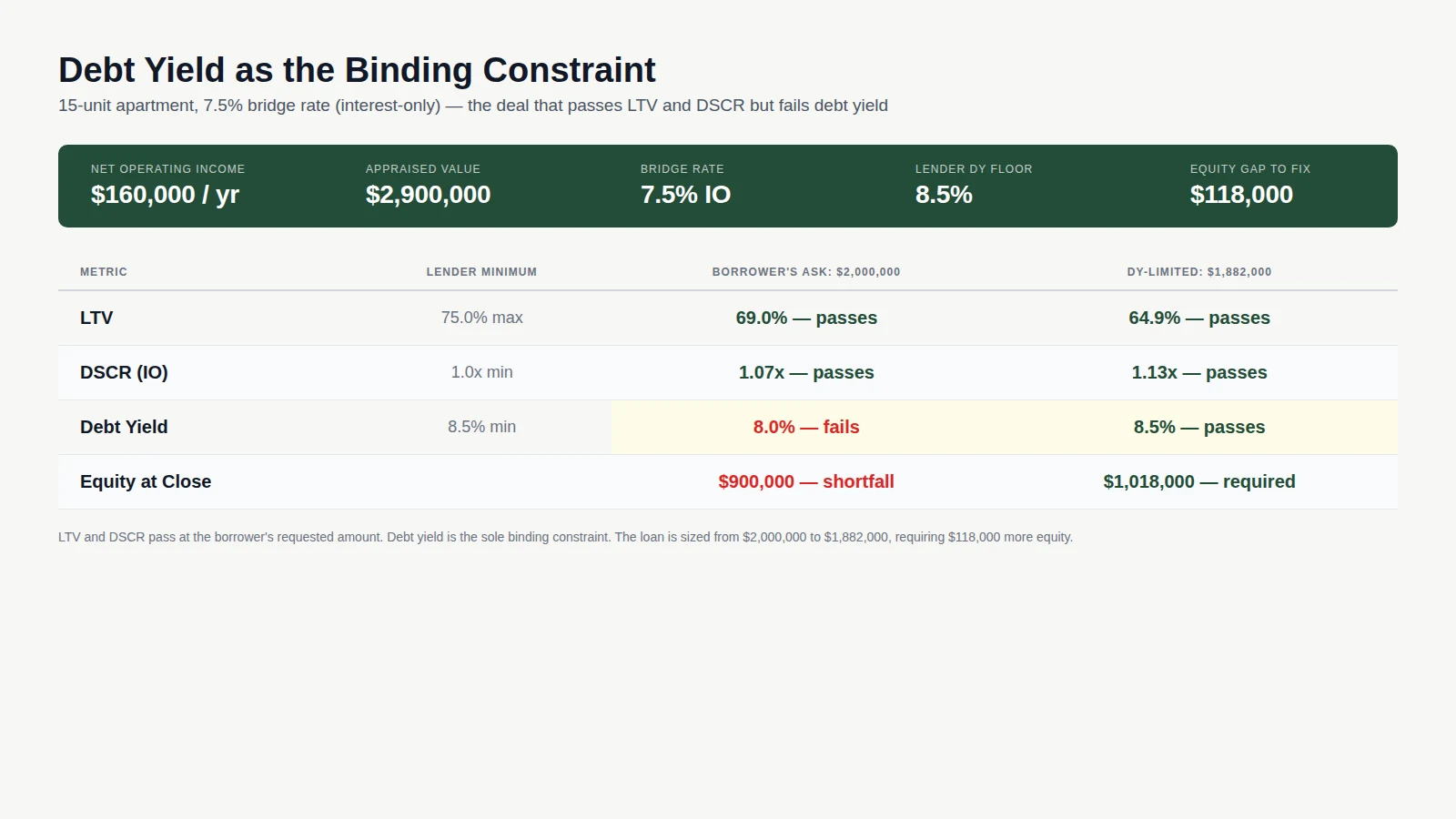
A 15-unit apartment building appraising at $2,900,000, with a net operating income of $160,000, is at a 5.5% cap rate. The borrower is requesting a $2,000,000 bridge loan at 7.5% interest-only to refinance out of a maturing first mortgage. The lender’s minimums are 75% LTV, 1.0x DSCR, and 8.5% debt yield.
LTV: $2,000,000 divided by $2,900,000 is 69.0%. Passes. DSCR: annual IO service on $2,000,000 at 7.5% is $150,000. $160,000 divided by $150,000 is 1.07. Passes. Debt yield: $160,000 divided by $2,000,000 is 8.0%. The lender’s floor is 8.5%. Fails.
The loan gets sized down. Working backward from the 8.5% floor: $160,000 divided by 0.085 is $1,882,353. The lender will commit $1,882,000. The borrower needs $118,000 more equity at close, not because the LTV was wrong or the DSCR was thin, but because debt yield was the binding constraint on a deal that otherwise qualified.
Want terms on a specific deal?Answer seven questions and get a decision in 72 hours.
Get FundingWhen debt yield applies and when it does not
Debt yield is primarily a commercial and bridge lending metric. It applies to multifamily properties of five or more units, mixed-use assets, office, retail, and industrial. CMBS and conduit lenders typically require 8.5% to 10.5% minimums, with stricter floors on retail and hospitality. Bridge lenders vary more widely, from 7.5% on stabilized multifamily to 10%+ on transitional commercial assets where the income is in recovery.
It does not apply to 1-4 unit residential rental loans underwritten through a DSCR rental product. It does not apply to fix and flip loans or hard money loans on residential assets, where LTV and ARV drive proceeds. If your bridge loan is on a single-family property or a small duplex or triplex, the lender is sizing the loan on value, not income. Ask directly which metric they use; on 1-4 unit assets, the answer is almost always LTV.
The five-unit threshold is not arbitrary. At five units, a property is classified as commercial real estate under most underwriting standards. That classification changes the appraisal method (the income approach replaces the sales comparison approach), changes the documentation requirements, and changes which lending guidelines apply. The debt yield floor comes with that shift. Investors moving from small residential rentals to larger multifamily for the first time often hit this metric without expecting it.
What to do when your deal falls short
Four options, ranked by cost and speed.
Bring more equity. This is the most common fix. If the debt yield floor sizes your loan to $1,882,000 and you wanted $2,000,000, you close the $118,000 gap with your own capital. No change to the property, no change to the lender’s requirements. You take a higher equity position and a lower leverage exposure on the deal.
Increase the NOI before closing. Raise rents on vacant units, eliminate below-market leases at renewal, or reduce operating expenses that the appraisal has captured. A $12,000 annual increase in NOI at a lender’s 8.5% floor raises your maximum loan by $141,176. That math is worth knowing before you accept the smaller loan and then improve the asset anyway. Some bridge lenders will credit a stabilization pro forma if the rent increases are documented and the lease-up timeline is credible. Get that in writing before you close, not after.
Find a lender with a lower floor. Debt yield minimums are not universal. A bridge lender competing for your deal may work at 7.5% on stabilized multifamily. That difference between 7.5% and 8.5% on a $160,000 NOI property is the difference between a $2,133,000 max loan and a $1,882,000 max loan, a gap of $251,000 in proceeds. Getting two or three term sheets is the fastest way to find the floor that fits your deal. Call 917-842-9982 or see the bridge loan program page to get a term sheet on a commercial bridge loan structured to your property’s income.
Reconsider the loan amount. If none of the above works, the property may not support the loan size you need at current income levels. That is the honest answer the debt yield floor is giving you. The property’s income needs to grow before the debt can. That is not a reason to abandon the deal, but it is a reason not to close a loan sized for where the asset will be in eighteen months rather than where it is today.

When this loan is wrong for you
Commercial bridge lending on five-plus-unit assets is the wrong product if your property has fewer than five units and you are looking for the highest LTV at the fastest close. The DSCR product handles 1-4 unit rentals and is built for speed. Debt yield is not part of that underwriting, and crossing the five-unit threshold changes your loan structurally, not just in size. Use the DSCR calculator to check whether a DSCR loan is the right fit before approaching a commercial bridge lender.
It is the wrong product if your exit depends entirely on interest rates falling to refinance into agency or CMBS permanent debt. CMBS and Fannie multifamily take months to close and have their own debt yield requirements, often stricter than bridge lenders. If your bridge-to-perm plan works only if the terminal cap rate compresses and rates drop 200 basis points, the bridge buys you time but it does not buy you certainty. Model the exit with rates 150 to 200 basis points higher than you expect. If that model does not close, the deal may be priced above where the market will take it.
It is the wrong product if your projected NOI depends on a lease that has not been signed. A rent roll with vacant units may project a debt yield that qualifies; the actual rent roll on the closing date will not. Lenders underwrite to current income, not projected income, unless you are in a formal stabilization program with a lease-up reserve built into the structure. Getting a term sheet based on projected rents and then closing at a lower proceeds level because the lease did not execute is one of the more avoidable ways a bridge deal goes wrong. Know your current NOI before you approach the lender, not the pro forma one.
Common questions
Is debt yield the same as DSCR?
No. DSCR compares income to debt service, which makes it sensitive to the interest rate. Debt yield compares income to the loan amount and ignores the rate entirely. The same property can have a DSCR above 1.0 and a debt yield below the lender’s floor, depending on where rates sit. The two metrics are related but they constrain the loan size independently of each other.
What is a good debt yield in commercial real estate?
For commercial bridge lenders in the current market, 8.0% to 10%+ is the working range. Multifamily bridge lenders often accept 8.0% to 8.5% on stabilized assets. CMBS and conduit lenders typically require 9.0% to 10.5%, with stricter minimums on retail and hospitality. If you are calculating yours, divide annual NOI by the requested loan amount and compare it to whatever floor the lender quotes in their term sheet.
Does debt yield apply to fix and flip loans?
No. Fix and flip loans are sized on after-repair value and loan-to-cost, not on operating income. Debt yield is an income-based metric. A property under renovation has no stable operating income to calculate against, so the metric does not apply. The same is true of hard money loans on 1-4 unit residential assets. Debt yield is specific to income-producing commercial and multifamily properties of five or more units.
What happens if the debt yield drops below the lender’s floor after closing?
It depends on the loan agreement. Some commercial bridge loans include a debt yield maintenance covenant: if NOI drops and the calculated debt yield falls below a threshold after closing, the lender can require additional reserves or call a default. This is more common on CMBS loans than on bridge loans, but it is worth checking in the term sheet before you close, not after a tenant vacates.
Can you negotiate the debt yield floor with a lender?
Sometimes. The floor is not universal. A bridge lender competing for your deal may work at 7.5% on a stabilized multifamily asset with a credible borrower and strong exit. The number also varies by asset class: industrial and multifamily get more latitude than retail or hospitality. Getting two or three term sheets and comparing the debt yield floors is the fastest way to find out how much room there is on a specific deal.
Ready to fund your next deal?
Approval within 72 hours. Close in 5 to 10 business days.
Get Funding Now