Points, Origination and Junk Fees: Reading a Term Sheet Line by Line
A term sheet is not a commitment to lend. The fees listed on it are real money leaving your account before any draw is made. This post walks every line: origination points, processing fees, third-party costs, extension fees, prepayment penalties, and what is negotiable before you sign.

A term sheet is not a commitment to lend, and the fees listed on it are real money leaving your account before any draw is made. If you borrow $500,000 at 2 origination points, that is $10,000 due at or before close, before you touch the property. This post walks every fee line a real estate investor will see on a business-purpose term sheet: what each one is for, what moves it, and which ones are negotiable. If you are buying or refinancing the home you live in, this does not apply to you. Consumer lending works under different rules, different disclosure requirements, and a different fee structure entirely.
What origination points actually are
One point equals one percent of the loan amount. On a $400,000 bridge loan, two points is $8,000. That is not an interest charge. It goes to the party originating the loan and is collected at close or, on some construction deals, deducted from the first draw.
Points on investor loans serve a different function than on consumer mortgages. A consumer borrower sometimes pays extra points to buy down their interest rate, and the 30-year math can make that worthwhile. On a six-month bridge loan, that math rarely holds. The rate is high because the term is short, and paying an extra half-point to shave 0.25% off the rate saves roughly $200 on a $300,000 loan over six months. It is not worth doing.
What actually moves origination points on investment loans is borrower experience, loan size, and how clean the file is. A first-time investor on a $150,000 fix-and-flip with a thin construction budget will see higher points than a borrower who has closed fifteen flips and is bringing a 70% LTC deal with a presold exit. The difference can be a full point or more. See the hard money loan program page for how that file quality translates into terms on short-term rehab financing.
Processing, admin, and junk fees
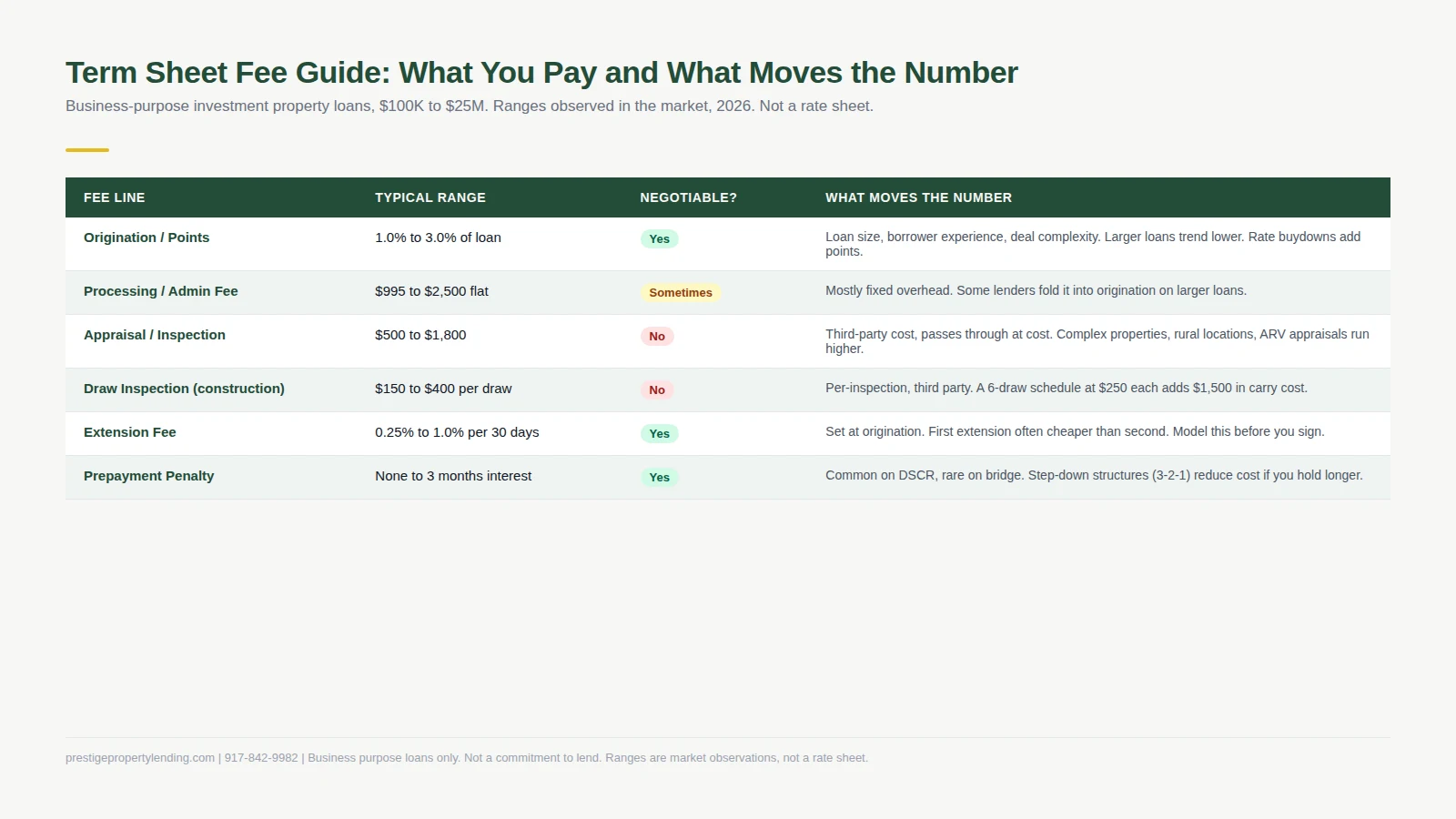
These are flat fees, usually between $995 and $2,500, that cover the work of running the file: ordering the title prelim, pulling a property data report, reviewing the construction budget, coordinating with the appraiser. They appear under different names on different term sheets: processing fee, admin fee, doc prep fee, underwriting fee, commitment fee. When you see multiple flat-fee line items on the same term sheet, add them up and ask what service each one corresponds to. A legitimate fee has a real task behind it. A duplicated name on a different line does not.
The test is simple: if two line items have different names but you cannot get the originator to explain what each one actually does, one of them is a junk fee. On larger loans, some originators roll all of this into the point count and show no flat fees at all. That is not necessarily better or worse. What matters is the total fee load, not the presentation.
Processing and admin fees are mostly not negotiable, because they reflect real overhead. Pushing hard on a $1,500 processing fee signals that you are sweating small numbers. If the deal pencils on the points and the exit, the flat fee is not the variable to fight about. The two levers are origination points and, if the loan has one, the extension fee rate.
Want terms on a specific deal?Answer seven questions and get a decision in 72 hours.
Get FundingThird-party fees: what passes through at cost
Appraisals, title searches, environmental reports, and draw inspections are not lender margin. They are what third parties charge, passed through to you. You can verify the quote, but you cannot negotiate it the same way you would negotiate a point.
For investment properties, the appraisal is often an ARV appraisal, which takes more work than a standard one. A standard single-family appraisal runs $500 to $800. An ARV appraisal on a complex rehabilitation project in a thin comp market can run $1,200 to $1,800. If the term sheet shows a flat appraisal fee and the deal is a hard rehab, ask what type of appraisal is being ordered. The answer affects both the cost and the timeline.
Draw inspections are the third-party cost that catches construction borrowers off guard. On a six-draw schedule, if each inspection runs $250, that is $1,500 in fees before a dollar of the construction budget lands. It is not a large number in isolation, but it belongs in your construction budget, and it is not refundable if the project slips and a draw gets delayed.
Extension fees: the line nobody reads until month 11
An extension is what happens when the loan reaches maturity and the exit is not ready. On a 12-month bridge loan, if you have not sold or refinanced the property by month 12, you owe an extension fee to stay in the loan.
Extension fees are typically priced per 30-day period and range from 0.25% to 1.0% of the loan balance. On a $400,000 loan, a 0.5% monthly extension fee is $2,000 per month. That is on top of the interest still accruing. A two-month extension on that loan adds $4,000 before you close. The structure of the extension matters as much as the rate. Some term sheets offer two extension options at a fixed price. Others step up on the second extension. A few require the property to be under contract before granting any extension at all.
Read this section before you sign, not after the project slips. If the deal has any execution risk on the exit, model what an extension costs at full freight and decide whether you can carry it. Extension fee terms are negotiable before close. Most originators will not remove them entirely, but the per-period rate and the number of available periods can often be adjusted, particularly for borrowers with a track record. The time to ask is before you sign the term sheet, not on day 360.
Prepayment penalties on investment loans
A prepayment penalty is a charge for paying the loan off early. On bridge and hard money loans, prepayment penalties are uncommon because the product is built to be short. On DSCR rental loans, they are standard, because the note is priced assuming a minimum hold period.
The most common structure is a step-down: 3% in year one, 2% in year two, 1% in year three, then zero. On a $350,000 DSCR loan, selling in month eight costs $10,500 in prepayment penalties. That is a real number that belongs in your underwriting, and it gets missed more often than most investors realize until they get to the payoff calculation.

If you are doing a BRRRR and the plan is to refinance out of a DSCR loan once the property seasons, the prepayment window has to clear before that refinance or the penalty eats the cash-out. See the seasoning requirements post for how those two timelines interact and what happens when they do not line up.
Reading the fees together: a worked example
Take a $450,000 bridge loan on a single-family flip. The term sheet shows:
- 2.0 origination points: $9,000
- Processing fee: $1,500
- ARV appraisal: $1,100
- One extension option at 0.5% per 30 days
- No prepayment penalty
At close, you have spent $11,600 in fees before the interest meter starts. If the project runs 14 months instead of 12, you spend another $4,500 in extension fees, bringing the total fee load to $16,100. That is before interest for the full period.
None of that math argues against the loan. A bridge loan closes in days, not weeks, and does not require two years of tax returns. The fee load is the cost of that speed and flexibility. The point is to model it at the start, not at the closing table. The hard money loan calculator runs the full cost of capital including points across different timelines so you can stress-test the all-in number before you commit.
What you can actually negotiate, and when
Most fee negotiation happens before the term sheet is issued, not after. Once you have signed and paid an application deposit, the lender has less incentive to adjust. The time to compare and push is when you are holding two or three term sheets from different sources.
Origination points and extension fee rates are the levers. A borrower with a clean file, a strong exit, and a verifiable track record will get a better number than an investor with a thin resume and a speculative ARV. Bringing a lower LTC, a shorter timeline, or a presold exit all push the cost down. For a full picture of how originators score a file before issuing a term sheet at all, the previous post on what lenders check before issuing a term sheet covers the four factors that determine whether your term sheet comes back clean or with conditions attached.
Third-party fees pass through at cost and are not lender margin. If you believe an appraisal quote is high, you can ask the lender to source a competing quote, but approach it as a request, not a negotiation.
When this does not apply to you
Everything above describes business-purpose investment property financing. If you are borrowing to buy or refinance the home you live in, consumer lending rules apply: fees are disclosed under RESPA and TILA, the structure is different, and the numbers will not match what is here. We fund real estate investors on a business-purpose basis only. Owner-occupied primary residences are not something we can help with.
If you do not have a clear exit before signing: extension fees compound. A 12-month bridge with two 30-day extensions at 1% per period adds $9,000 to a $450,000 loan, on top of continued interest. A deal that only pencils if everything goes to plan is a deal that does not really pencil. Model the worst-case exit timeline before you sign, not after the project hits its first delay.
If you are a first-time investor on a low-margin deal: two to three origination points plus processing plus an ARV appraisal can represent 2.5% to 3.5% of the loan amount in upfront fees alone. On a flip with a projected profit of $30,000, those fees are not small relative to the return. Run the full fee model before you commit, not after.
To discuss terms on an upcoming deal, call 917-842-9982 or see our bridge loan program page for the basics on how these loans are structured.
Common questions
What is the difference between origination points and a processing fee?
Points are a percentage of the loan amount and go to the originating party as compensation for closing the deal. One point on a $500,000 loan is $5,000. A processing fee is a flat charge, typically $995 to $2,500, that covers administrative work: ordering a title prelim, reviewing the appraisal, preparing documents. Both are due at or near close, but they serve different purposes and are negotiated differently. Points move based on the deal and the borrower. The processing fee mostly does not.
Are origination fees negotiable on investment loans?
The origination point count is often negotiable, especially for experienced borrowers with clean files and strong exits. The negotiation happens before you sign the term sheet, not after. Processing and admin fees are mostly fixed overhead and rarely move. Third-party fees like appraisals and draw inspections pass through at cost and are not lender margin. The two variables worth pushing on are origination points and extension fee rates, both of which can improve with borrower track record and deal quality.
What happens if I need to extend my bridge loan?
Extension fees are set in the term sheet and are triggered when the loan reaches maturity without a payoff. A typical extension fee runs 0.25% to 1.0% of the loan balance per 30-day period, on top of whatever interest is accruing. On a $400,000 loan at 0.5% per period, one extension month costs $2,000. Some lenders cap the number of extensions available, and some require the property to be under contract before they will grant one at all. Model the full extension cost before you sign, and treat it as a real scenario rather than an edge case.
Do all investment loans have prepayment penalties?
No. Bridge loans and hard money loans typically do not carry prepayment penalties, because they are designed to be short-term. DSCR rental loans almost always do, in a step-down structure: 3% in year one, 2% in year two, 1% in year three is a common pattern. On a $350,000 loan, selling in year one costs $10,500 before any other closing costs. If your business plan involves refinancing out of a DSCR loan into a conventional one, the prepayment window must clear first or the penalty eats the benefit of the refinance.
Can the fees on a term sheet change before closing?
Third-party fees like appraisals can come in higher than the estimate if the scope changes. Processing and origination fees agreed in the term sheet should not change without your consent. What does change is the payoff amount if the close date slips, because per-diem interest adds up. A deal that was supposed to close in 30 days but closes in 45 has 15 days of additional interest that was not in the original estimate. Ask for the per-diem rate when you review the term sheet, and build a buffer into your close timeline.
Ready to fund your next deal?
Approval within 72 hours. Close in 5 to 10 business days.
Get Funding Now